By
By 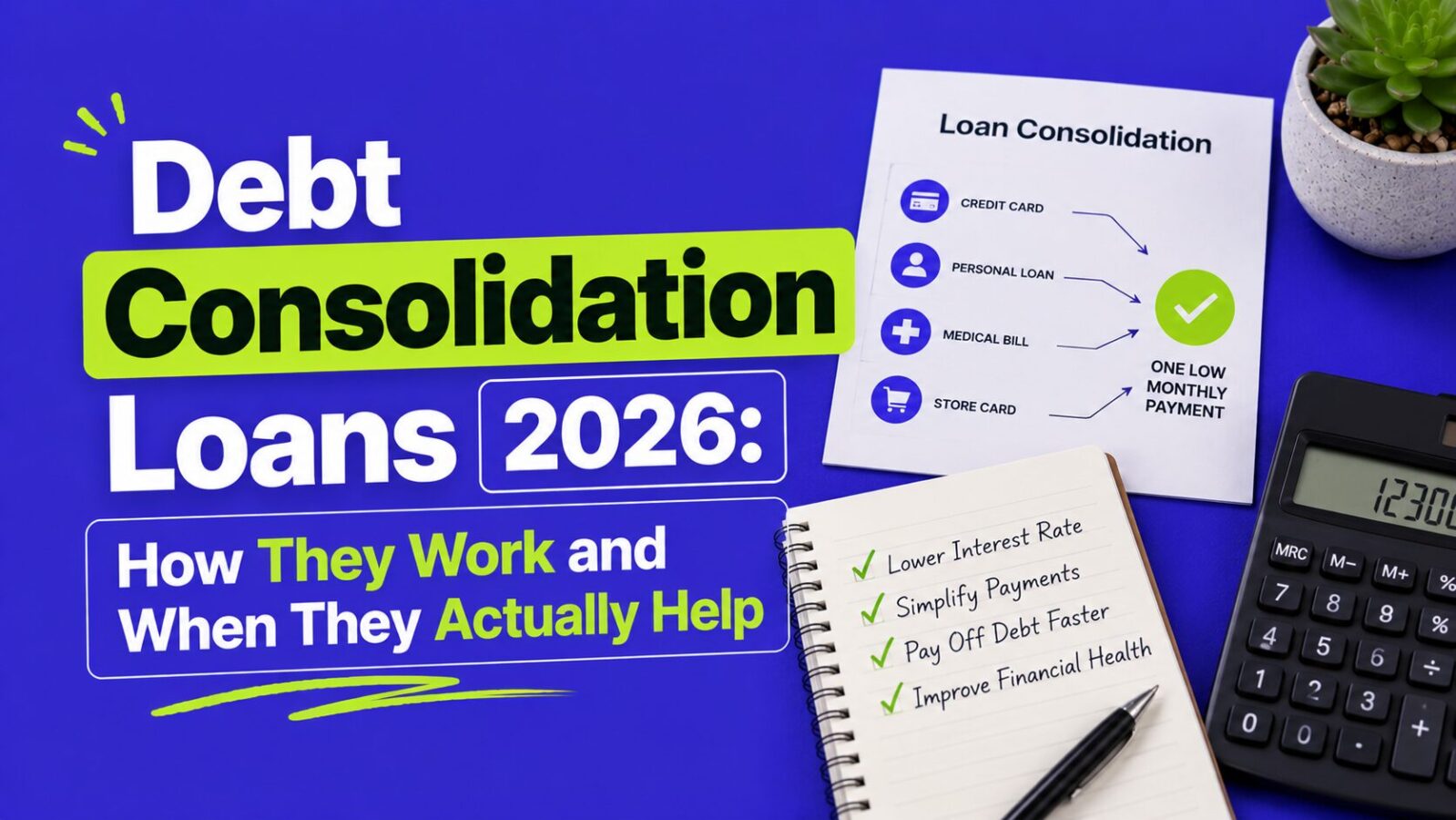
Finance Pulse may earn a commission if you apply through links on this page. This does not affect our recommendations.
A debt consolidation loan combines multiple debts into one fixed monthly payment, ideally at a lower rate. Done right, it moves high-rate credit card debt (averaging about 21.5%) to a personal loan around 8% to 16%, saving thousands and simplifying your finances. Done wrong, it stretches your payoff and costs more, or refills the cards. It only helps if your new rate is meaningfully lower and you stop adding new debt. Here is how to tell the difference.
Key Takeaways
- It replaces several debts with one fixed-rate loan, usually over 2 to 7 years.
- It helps when your new rate is well below your current card rates (ideally under 20%).
- It backfires if you run the cards back up or pick a much longer term.
- Pre-qualify with soft pulls to compare rates without hurting your credit.
How Does Debt Consolidation Work?
You apply for a personal loan from a bank, credit union, or online lender, receive a lump sum, and use it to pay off your existing debts. Then you make one monthly payment at a fixed rate for a set term (usually 2 to 7 years). The value: personal loan rates for good credit (670+) typically run 8% to 16% in 2026, versus the roughly 21.5% average card rate, so moving $15,000 from 21.5% to 12% saves thousands. See our guide on whether consolidation hurts your credit.
What Are Current Consolidation Loan Rates?
| Credit score | Typical APR range | Best for |
|---|---|---|
| 750+ | ~7% to 12% | Excellent savings vs credit cards |
| 700-749 | ~12% to 16% | Good savings if card rates are 20%+ |
| 650-699 | ~16% to 22% | Borderline; compare carefully |
| Below 650 | ~22% to 36% | Usually not worth it |
What Are the Best Consolidation Lenders in 2026?
SoFi (best overall for good credit). Personal loans from $5,000 to $100,000, no origination fees, same-day funding, and unemployment protection that pauses payments if you lose your job. Most approvals need around a 680+ score, and you can check rates with a soft pull at sofi.com.
LightStream by Truist (best rate for excellent credit). Rates start very low for strong credit (720+), loans up to $100,000, no fees, and a Rate Beat program that beats a competitor’s rate by 0.10 points. Best if you have excellent credit and want the lowest rate.
Upgrade (best for fair credit and direct payoff). Loans from about $1,000 to $50,000, available to borrowers with fair credit, with an option to pay your creditors directly for consolidation. A solid middle-ground choice if your score is not yet in prime territory.
Discover Personal Loans (best for existing customers). Loans from $2,500 to $40,000, no origination fees, with a direct-payment-to-creditors option that ensures the funds actually clear your old balances.
Rates and terms change with your credit and the market, so verify current offers before applying.
When Does Consolidation Make Sense?
- The math works: your new rate is at least 3 to 5 points below your weighted average card rate. On $15,000, dropping from 21.5% to 11.5% saves roughly $4,200 over 3 years.
- You have multiple debts to simplify: one payment and one due date cuts the risk of missed payments.
- Your credit qualifies you for a real rate: if you cannot get under about 20%, consolidation rarely helps.
- You will not run up new debt: the critical condition, since refilling the cards leaves you with double the debt.
When Does Consolidation NOT Make Sense?
- Your rate would top 20%, so the loan costs as much as the cards.
- The term is far longer than your payoff plan, lowering the monthly payment but raising total interest; always compare total interest, not just the payment.
- Origination fees offset the savings. Some lenders charge 1% to 8%, so a 5% fee on $15,000 is $750; check that interest savings beat the fee.
- You have not fixed the spending that created the debt, or the cards just refill.
Estimate Your Loan Payoff
Use this calculator to compare payoff time and total interest before you apply:
Loan Payoff Calculator
What Is the Application Process?
- Check your credit score free at Credit Karma or your bank.
- Pre-qualify with several lenders using soft pulls (SoFi, LightStream, and Upgrade all offer this).
- Compare APR, term, total interest, and fees; the lowest APR is not best if the term is long.
- Apply with the best offer, which triggers a hard pull.
- Pay creditors directly if the lender offers it (Discover and Upgrade do), or pay the balances yourself immediately.
- Freeze or put away the paid-off cards so new balances do not build.
Is a Balance Transfer Card Better?
For amounts under $15,000 with a 670+ score, a 0% balance transfer card can beat a consolidation loan. The Citi Double Cash, for example, offers 0% for about 18 months with a 3% fee, so on $10,000 the fee is $300 and you get an interest-free runway to pay it down. The risk is that any balance left when the 0% window ends jumps to a high rate, whereas a consolidation loan keeps one fixed rate for the full term. See our guide on paying off credit card debt fast.
FAQ
What credit score do I need for a debt consolidation loan?
The best rates go to 700+, and most prime lenders want around 670+. Below 650, rates can rival or exceed credit cards, so consolidation often is not worth it.
Does a consolidation loan hurt my credit?
Briefly, from the hard inquiry, but paying off cards lowers your utilization and usually raises your score over a few months, as long as you do not run the cards back up.
Loan or balance transfer card, which is better?
A 0% balance transfer often wins for under $15,000 if you can pay it off within the promo window. A fixed-rate consolidation loan suits larger balances and removes the expiration risk.
Which lenders are best for consolidation in 2026?
SoFi and LightStream for strong credit, Upgrade for fair credit with direct creditor payoff, and Discover for existing customers. Always pre-qualify with soft pulls to compare.
Bottom Line
A debt consolidation loan helps when it cuts your rate by several points and you stop adding new debt, turning 21.5% card balances into one lower fixed payment. Compare total interest, watch origination fees, and consider a 0% balance transfer for smaller balances. To go deeper, see our guides on paying off credit card debt fast, whether consolidation hurts your credit, and your debt-to-income ratio.
Loan rates change with creditworthiness and market conditions, so verify current rates with each lender. This article is for educational and informational purposes only and is not financial advice.