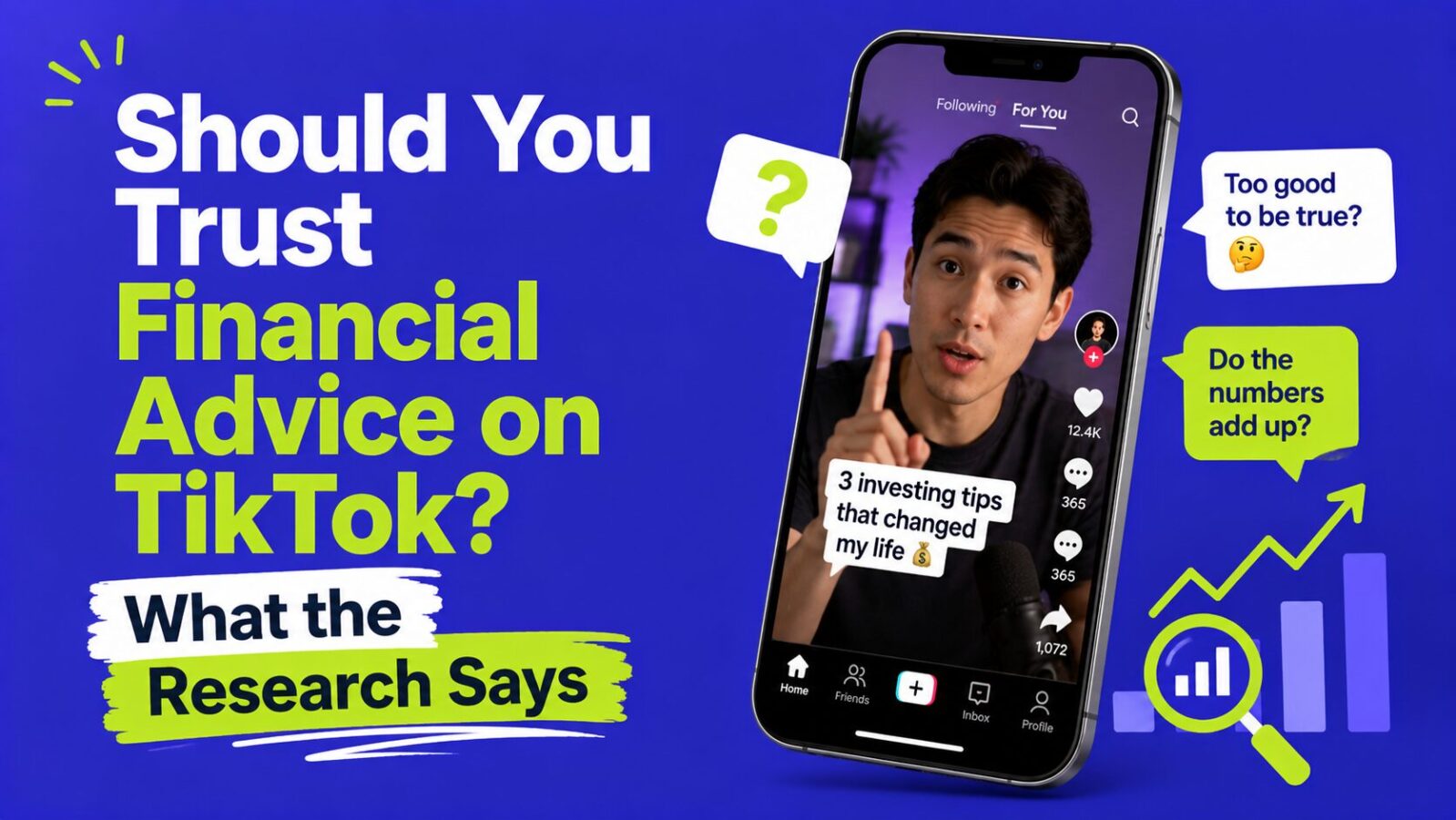
There is a decent chance that someone on TikTok, Instagram, or YouTube taught you something about money that your school never did. Maybe it was how index funds work, why a Roth IRA matters in your 20s, or how to read a pay stub. For millions of Millennials and Gen Z consumers, finfluencers (financial influencers on social media) have become the primary source of financial education.
According to a survey of more than 1,000 Millennials and Gen Z respondents, 79% reported obtaining financial advice from social media. The top five topics they sought out were investing in stocks and bonds (57%), personal budgeting (51%), passive income (49%), reducing debt (40%), and building or improving credit (37%) (Egan, 2023, cited in Lai, 2025).
That reach is remarkable. It is also largely unregulated, frequently undisclosed, and sometimes actively harmful. A 2024 study found that only 20% of finfluencer content containing investment recommendations included any form of disclosure, such as whether the creator received commissions for recommending specific products (Espeute and Preece, 2024, cited in Lai, 2025).
This guide breaks down what the research actually says about social media financial advice, what the real risks are, and how to use finfluencer content as a starting point rather than a finishing line.
“With just a click, a tap, or a swipe, these digital gurus are reshaping how people worldwide navigate the complex world of personal finance, from budgeting and saving to investing and retirement planning.”
Hayes and Ben-Shmuel (2024), cited in Lai (2025)
How Finfluencers Actually Work
A finfluencer is a social media content creator who produces financial content: investment tips, budgeting advice, crypto commentary, real estate strategies, and more, primarily on TikTok, YouTube, Instagram, and Twitter/X. The term blends “finance” and “influencer.”
What makes finfluencers powerful is not credentials. It is relatability and accessibility. Traditional financial advisors are expensive, often intimidating, and speak in jargon that feels designed to exclude. A 24-year-old explaining Roth IRA conversions over a trending audio clip, making it feel simple and relevant to your actual life, is genuinely more engaging than reading a financial planning prospectus. Research shows that finfluencers generate a sense of familiarity and emotional connection with their audiences, and followers often perceive their endorsements as authentic recommendations rather than paid promotions (Hayes and Ben-Shmuel, 2024, cited in Lai, 2025).
The business model of finfluencers runs on attention. Platform algorithms reward content that drives engagement: views, shares, comments, saves. The creators who grow largest audiences are not necessarily the ones with the most accurate advice. They are the ones who generate the most engagement. Bold predictions, confident personalities, and aspirational financial narratives (the “I turned $500 into $50,000” story) tend to outperform careful, nuanced, probabilistic financial guidance.
What Gen Z Is Actually Doing With This Advice
The financial behaviors of Gen Z investors reveal a direct connection to the content they consume online. A joint study by the FINRA Investor Education Foundation and CFA Institute (2023) found that the top three sources of financial information for Gen Z investors were social media (48%), internet searches (47%), and parents or family members (45%).
The investment choices that follow from this information diet are telling. According to the same research, Gen Z investors are more likely to hold cryptocurrencies (55%) and individual stocks (41%), and less likely to invest in mutual funds compared to older generations. From a traditional portfolio construction perspective, this represents a higher-risk profile, and crucially, Gen Z investors are less likely to have substantial savings to offset potential losses if those higher-risk positions turn against them (FINRA Investor Education Foundation and CFA Institute, 2023, cited in Lai, 2025).
A 2025 working paper from Durham University researcher Karen Lai notes that 56% of Gen Zers in the USA already have some investments, with a striking 25% having started investing before age 18, which is a significantly higher proportion than previous generations (Lai, 2025). The democratization of access to investment products through apps like Robinhood has made it easier than ever for young people to begin investing. The question is whether the information guiding those investments is reliable.
The Regulation Gap: Why This Is Riskier Than It Looks
The financial advisory industry is heavily regulated for good reason. Traditional financial advisors must meet qualification and training requirements, comply with “know your customer” procedures, disclose their fees and conflicts of interest, and operate within formal dispute resolution frameworks. When a licensed advisor gives you bad advice, there is a regulated path to seek redress.
None of those protections exist in the finfluencer ecosystem. As the Washington State Department of Financial Institutions (2022) noted: “Such breezy and hyper-emotional endorsements are being made in what is otherwise a very regulated industry with stringent rules about performance claims and disclosure of potential conflicts of interest. Finfluencers are testing the limits of what is considered regulated investment advice and protected free speech” (cited in Lai, 2025).
The disclosure numbers make this concrete. An analysis of finfluencer content posted on YouTube, TikTok, and Instagram found that only 20% of posts containing investment recommendations included any disclosure, meaning no mention of whether the creator had a financial relationship with the products they were endorsing (Espeute and Preece, 2024, cited in Lai, 2025). The other 80% of recommendation content gave viewers no way to assess whether they were watching independent advice or paid promotion.
Some jurisdictions are beginning to address this gap. The UK’s Financial Conduct Authority (FCA) issued guidance on financial promotions on social media in 2024. Brazil has developed advertising guidelines for digital influencers. But social media content travels across borders, and regulation in one country does not protect consumers in another.
The Gamification Problem You Might Not Have Noticed
The finfluencer content problem has a second layer that is less visible but equally consequential: the investment apps that finfluencers often promote are themselves designed to maximize engagement and transaction frequency rather than long-term financial outcomes.
Research on investment app design highlights how features like digital scratch cards, on-screen confetti animations, and push notifications are borrowed directly from gaming culture to encourage more frequent interactions and more trading activity (Lai and Langley, 2024, cited in Lai, 2025). The Robinhood app, for example, gained enormous popularity among younger investors by offering a clean, intuitive interface with features specifically designed to make trading feel exciting. The app proved particularly popular among investors with a median age of 31 and little or no investment experience (Tan, 2021, cited in Lai, 2025).
This creates a compounding risk: a young investor who gets excited about a crypto position after watching a finfluencer video, then uses a gamified app that rewards transaction frequency, is being nudged toward exactly the kind of active trading behavior that decades of investment research show generates worse long-term returns than simply buying and holding a diversified low-cost index fund portfolio. See our guide to building a 3-fund portfolio for what the evidence-based alternative actually looks like.
What Finfluencers Are Actually Good At
This is not a blanket condemnation of social media financial content. There are genuinely useful things that finfluencers do well, and dismissing them entirely misses how they have actually improved financial inclusion and literacy for many people who had no other accessible entry point.
Demystifying Concepts
Many financial concepts that feel intimidating in formal contexts become genuinely understandable when explained by a relatable person in a two-minute video. If a finfluencer’s video about compound interest, the 50/30/20 rule, or what an expense ratio is gives you the mental model you need to take the next step, that is genuinely valuable. The problem is not using social media content to learn concepts. It is using it to make specific investment decisions without verifying the information or the incentives of the person sharing it.
Motivating Action
Financial inertia is one of the most expensive problems in personal finance. People who know they should open a Roth IRA but have not done it yet are losing years of compounding. If a finfluencer’s video provides the push that finally gets someone to open an account and start contributing, the motivation is real and valuable even if the broader information environment is imperfect.
Normalizing Financial Conversation
Talking about money has historically been taboo in many cultures and family contexts. Finfluencers have played a role in normalizing financial conversations among younger generations, making it less socially uncomfortable to discuss debt, income, savings targets, and investment strategies with peers. That cultural shift has genuine positive effects on financial behavior.
How to Use Social Media Financial Content Without Getting Burned
The answer is not to ignore finfluencer content. It is to use it differently than most people currently do.
Use It for Concepts, Not Specific Picks
Social media financial content is most reliable when explaining general concepts: what a Roth IRA is, how credit utilization works, why diversification matters. It is least reliable when making specific recommendations: buy this stock, invest in this crypto, use this specific platform. The gap between those two types of content in terms of reliability is enormous. Treat social media as a glossary and motivational tool, not an investment advisor.
Check for Disclosure
Before acting on any specific product recommendation from a finfluencer, ask: is this person being paid to promote this? Look for hashtags like #ad, #sponsored, or #partner. Check the link in their bio. If they are recommending a specific broker, credit card, or investment platform with no disclosure, assume there may be an undisclosed financial relationship until proven otherwise.
Verify With Primary Sources
Any specific claim about investment returns, tax rules, or account limits can be verified in minutes against authoritative sources: IRS.gov for tax rules, your brokerage’s own documentation for account terms, and SEC.gov for regulatory information. If a finfluencer’s claim does not hold up to thirty seconds of verification, that is a signal about the quality of the broader content.
Be Skeptical of Extraordinary Return Claims
The investment strategies that generate large social media followings tend to be the ones with the most dramatic narratives: turning a small amount into a fortune, achieving financial independence in three years, finding the next ten-bagger stock. These stories exist. They are also rare, highly survivorship-biased (you hear about the wins, not the many more losses), and often not reproducible by someone without the same starting conditions, risk tolerance, or frankly luck. The evidence-based path to long-term wealth is decidedly undramatic: low-cost index funds, consistent contributions, and time. That content does not go viral, which is why you see less of it.
Understand the Algorithm Is Not Your Financial Advisor
Social media algorithms surface content based on what you engage with, not what is accurate or appropriate for your financial situation. If you watch three videos about options trading, you will see more options trading content. The feedback loop can pull you deeper into speculative strategies before you have the foundational knowledge to evaluate whether they are appropriate for you. Being aware of this dynamic is the first step to managing it.
Interactive Tool
Should I Act on This Financial Advice?
Run any piece of social media financial advice through this checklist before taking action. Select all that apply.
The Trustworthy vs. Untrustworthy Signals in Finfluencer Content
| More Trustworthy Signals | Less Trustworthy Signals |
|---|---|
| Explains concepts with downsides included | Only highlights the upside of a strategy |
| Discloses affiliate relationships or sponsorships clearly | Recommends specific products with no disclosure |
| Recommends low-cost, diversified, long-term approaches | Promotes speculative assets, options, or active trading |
| Cites verifiable sources or data | Uses anecdote or personal returns as the primary evidence |
| Acknowledges that advice may not apply to all situations | Claims their strategy works for everyone |
| Creates urgency around learning concepts | Creates urgency around buying a specific asset |
| Has verifiable background or credentials | Authority is based entirely on social media presence |
What to Use Instead (Or Alongside)
The goal is not to replace social media financial content with something boring and inaccessible. It is to build a more reliable information stack that uses social media for what it is good at while verifying important decisions against better sources.
For Learning Concepts
Finfluencer content for concept introductions, then our site for the detailed, no-sales-agenda breakdown. We cover how APR works, how credit card interest is calculated, how to set up automatic savings, and dozens of other foundational topics with no product commissions influencing what we say.
For Investment Decisions
The evidence-based investment literature (Vanguard’s research, the SPIVA reports showing index fund outperformance over active management, the standard financial planning literature) consistently supports the same boring approach: low-cost diversified index funds, consistent contributions, long holding periods. Our guide to investing in your 20s and S&P 500 index fund explainer cover this in practical terms.
For Broker and Product Decisions
Use comparative reviews from sources that disclose their methodology and affiliate relationships transparently. Our reviews section covers brokerages and financial products with explicit disclosure of our editorial standards and affiliate relationships. We rate things independently of what pays us, and we say so clearly.
Frequently Asked Questions
Are finfluencers actually giving good financial advice?
Some do, some do not, and you often cannot tell which from the quality of the content alone. Research shows that 79% of young adults use social media for financial guidance, but only 20% of finfluencer posts with investment recommendations include any disclosure of financial relationships (Espeute and Preece, 2024). The best approach is to use social media content to identify concepts worth learning, then verify specific information against primary sources before acting. The concepts many finfluencers explain are sound. The specific product recommendations are where conflicts of interest are most likely to be hidden.
Why is Gen Z more likely to invest in crypto and individual stocks?
Research by the FINRA Investor Education Foundation and CFA Institute (2023) found Gen Z investors are significantly more likely to hold crypto (55%) and individual stocks (41%) compared to older generations. Researchers attribute this partly to the types of investment content that perform well on social media: dramatic narratives about individual asset price movements generate more engagement than “buy an index fund and wait 30 years.” The algorithm rewards engagement, which selects for exciting rather than sound investment content.
Is TikTok finance content regulated?
In most jurisdictions, no. Traditional financial advisors face qualification requirements, disclosure mandates, and dispute resolution frameworks. Social media financial content creators operate in a largely unregulated space, though some countries are beginning to address this. The UK’s Financial Conduct Authority issued guidance on social media financial promotions in 2024. Brazil has advertising guidelines for digital influencers. But regulation varies significantly across countries, and content travels across borders regardless of which jurisdiction it originated in (Lai, 2025).
How do I know if a finfluencer has a conflict of interest?
Look for disclosure labels like #ad, #sponsored, or #partner. Check if the recommendation includes a referral link or code, and those typically generate commissions when you sign up or purchase. If a creator recommends a specific platform, broker, or product with a link in their bio and no disclosure, treat that as a potential conflict of interest. The absence of disclosure does not prove a conflict exists, but it is a signal to verify independently before acting on the recommendation.
What are the best free resources for learning about personal finance?
The best free resources tend to be from institutions without a financial product to sell. The Consumer Financial Protection Bureau (CFPB) at consumerfinance.gov offers educational content developed independently of product promotion. FINRA’s investor education foundation (finra.org) covers investing basics. For practical, no-paywall guides covering everything from paying off debt to maximizing your 401(k), Finance Pulse covers the full range of personal finance topics with explicit disclosure of our affiliate relationships and editorial standards.
The Bottom Line
Finfluencers have genuinely democratized access to financial information that was previously gated behind expensive advisors or locked in impenetrable jargon. For millions of young people who had no other accessible entry point, a relatable TikTok video about Roth IRAs or compound interest was a genuine service. That matters.
But the structural problem is real. An industry where 80% of product recommendations go undisclosed, where the algorithm rewards engagement over accuracy, and where the investment apps being promoted are designed to maximize transactions rather than long-term returns is an industry with serious potential for harm, particularly for younger investors with less savings to absorb losses (Lai, 2025).
The practical answer is not to stop consuming social media financial content. It is to treat it as a starting point, a way to discover concepts worth learning and questions worth asking, rather than a source of specific actionable investment advice. Run anything specific through the checklist above. Verify claims before acting. Understand that the person talking about a product may be compensated for doing so.
The financial education you need is available for free from sources with more accountability than a TikTok algorithm. Our free calculator library and topic guides cover the foundational material without the undisclosed commissions. The boring approach, explained clearly and applied consistently, still beats the exciting approach almost every time.
Academic References
Lai, K.P.Y. (2025). Finfluencers, gamification and youthful finance. Financial Geography Working Paper #38. Durham University. ISSN 2515-0111.
Espeute, S. and Preece, R. (2024). The finfluencer appeal: Investing in the age of social media. CFA Institute.
FINRA Investor Education Foundation and CFA Institute (2023). Gen Z and investing: Social media, crypto, FOMO, and family. CFA Institute.
Egan, J. (2023). Nearly 80% of young adults get financial advice from this surprising place. Forbes Advisor.
Hayes, A.S. and Ben-Shmuel, A.T. (2024). Under the finfluence: Financial influencers, economic meaning-making and the financialization of digital life. Economy and Society.
Washington State Department of Financial Institutions (2022). Informed investor advisory: Finfluencers.
Tan, G.K.S. (2021). Democratizing finance with Robinhood: Financial infrastructure, interface design and platform capitalism. Environment and Planning A: Economy and Space, 53(8).
Lai, K.P.Y. and Langley, P. (2024). Playful finance: Gamification and intermediation in FinTech economies. Geoforum, Volume 151.