Skip to content

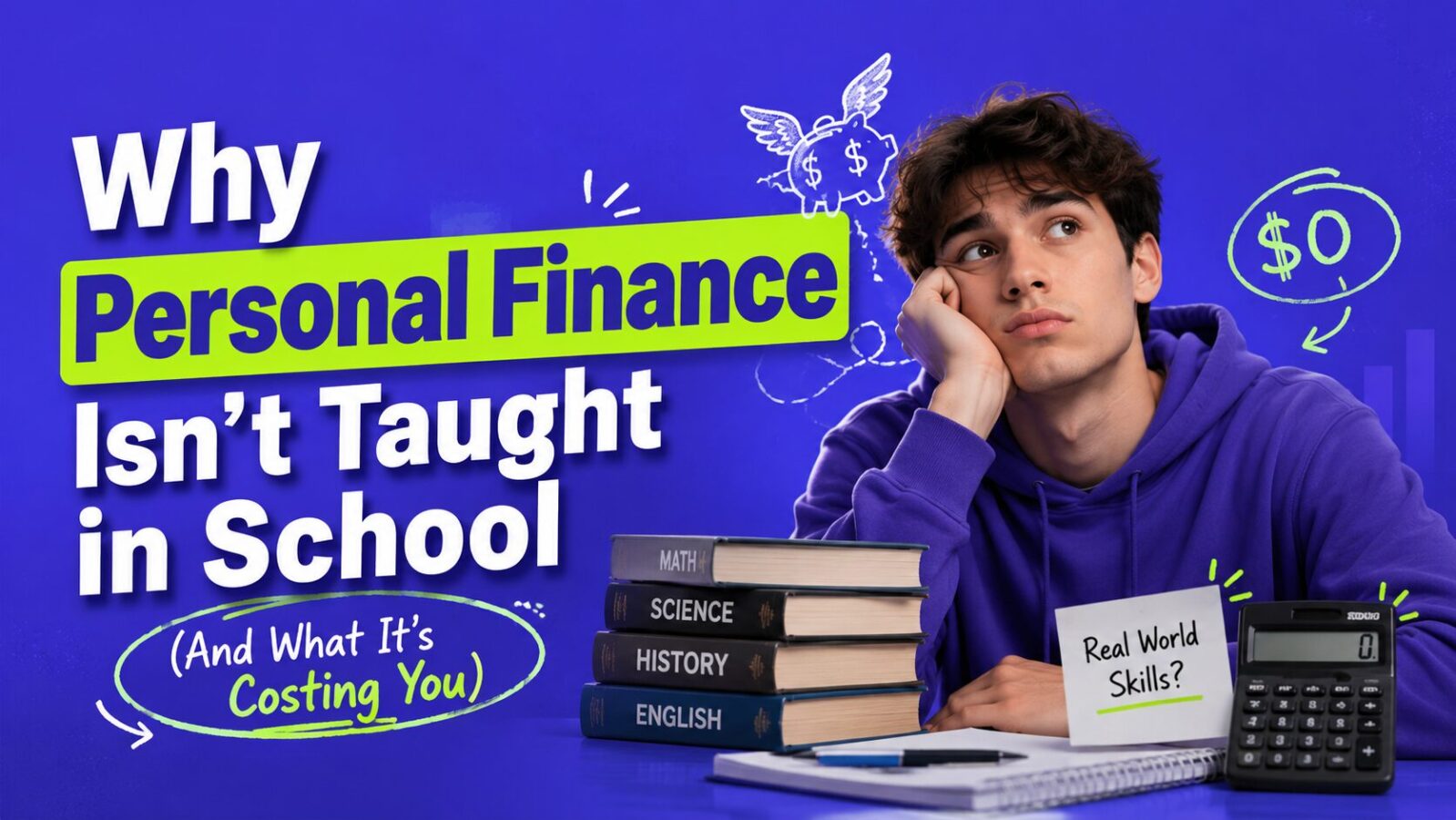
Why Personal Finance Isn’t Taught in School (And What It’s Costing You)

Why Personal Finance Isn't Taught in School (And What It's Costing You)

If you graduated from a US high school without ever learning how compound interest works, what a credit score is, or how a 401(k) functions, you are not alone. You are the majority.

As of 2016, only 17 states required students to take a personal finance course to graduate from high school, according to the Council for Economic Education’s Survey of the States. The other 33 states sent millions of students into adulthood carrying credit cards, student loans, and rent obligations, with no formal instruction in how any of it works.

This is not a minor oversight. Research published in the Journal of Business Administration Online found a positive and significant correlation between high school exposure to economics education and academic performance in a college-level personal finance course, meaning students who got even basic exposure to financial concepts in secondary school demonstrably outperformed those who did not, when tested on personal finance knowledge in college (Logan and Edwards, 2017).

The question is not whether financial education matters. The evidence says it does. The question is why so few people get it, what the lack of it costs you, and what to do about it now.

“The most important task of high school economic education is to raise public literacy in a subject that is of central importance for citizens in many aspects of their lives.”

Walstad, 2001, cited in Logan and Edwards (2017)

The State of Financial Education in America

The number of states including personal finance in their high school education standards grew from 21 to 45 between 1998 and 2016 (Council for Economic Education, 2016). That sounds like progress, and it is, but including something in educational standards and requiring students to take a course in it are very different things. Many states include personal finance as optional content or embed it briefly within an economics or social studies class.

The Logan and Edwards (2017) study, which followed 174 students across five sections of a college personal finance course in Arkansas, found that only 16.7% of college freshmen and sophomores had taken a dedicated personal finance course in high school. By contrast, 67% had taken some economics. The gap reflects a national pattern: economics is treated as a core subject in more states, while personal finance is often treated as supplemental or elective.

What makes this particularly strange is the relative importance of each subject in daily life. Most adults will never calculate a supply and demand curve after high school. Most adults will, however, need to understand credit card interest, evaluate a mortgage, save for retirement, file taxes, and budget for a household. The more practically relevant subject gets the less consistent treatment.

Why the Gap Exists

Curriculum Fights for Space

High school curriculum is a zero-sum competition for hours. Every period added for personal finance is a period taken from somewhere else. Administrators and school boards face pressure to prioritize math, reading, science, and the standardized tests tied to federal funding. Personal finance, which has no equivalent high-stakes standardized test, loses this fight repeatedly.

Teaching Personal Finance Is Genuinely Hard

Research shows that personal finance is delivered through three distinct instructional approaches in schools: business education, family and consumer sciences, and social studies. Each approach produces different emphases and different outcomes (Loibl and Fisher, 2013, cited in Logan and Edwards, 2017). A personal finance unit inside a social studies class covers different topics than a standalone personal finance elective taught by a business education instructor. The heterogeneity makes consistent outcomes difficult to achieve and difficult to measure.

Students Are Not Always Motivated to Learn It

A study by Mandell and Klein (2007, cited in Logan and Edwards, 2017) found significant evidence of apathy among high school students toward personal finance education. Students in their early to mid teens often cannot connect the material to their immediate lives. A 16-year-old learning about compound interest in an abstract way has no mortgage, no retirement account, and no credit card. The concepts feel theoretical rather than urgent.

This is a genuine pedagogical challenge that goes beyond curriculum design. Teaching personal finance effectively requires making the real-world stakes feel present, not distant. That is harder to do in a high school classroom than in a moment of adult financial stress when the stakes are suddenly and viscerally obvious.

There Is No Powerful Lobby for It

Algebra, history, and physical education all have professional associations, teacher training pipelines, textbook industries, and established roles in educational culture. Personal finance has been adding infrastructure: nonprofit organizations like the National Foundation for Financial Education, Jump$tart, and the Council for Economic Education have all developed curriculum materials, but these resources are newer and less embedded in the standard educational system. The institutional inertia favors the established subjects.

What the Research Actually Shows About the Consequences

The consequences of financial illiteracy are not abstract. They show up in behaviors and outcomes that compound over decades.

Early Exposure Affects Long-Term Financial Behavior

Research by Bernheim, Garrett, and Maki (2001, cited in Logan and Edwards, 2017) found that students who received financial education through high school curriculum mandates demonstrated lasting positive effects on both financial knowledge and savings behavior when they reached adulthood. The effects were measurable years after the education occurred. This suggests that what happens in a high school classroom actually changes the trajectory of financial decision-making long into adult life, not just test performance.

College Students With No Prior Exposure Start Behind

The Logan and Edwards (2017) study provides one of the more direct measures of this gap. Using ordinary least squares regression across four exams in a college personal finance course, the researchers found that students who had taken an economics course in high school scored approximately 3.3 points higher on the first exam compared to students who had not. The effect persisted on the fourth exam, where the same group outperformed by approximately 2 points.

These are not enormous score differences, but they are statistically significant and they reflect a real disparity in baseline knowledge between students who had some prior exposure and those who had none. In a college course where the average exam score was 85 points out of 100, a 3-point gap can mean the difference between grade levels. More importantly, it reflects a real-world knowledge gap that does not disappear when the course ends.

Financial Knowledge Improves Financial Behavior

A study by Danes, Huddleston-Casas, and Boyce (1999, cited in Logan and Edwards, 2017) found that early financial education did not just improve test scores. It improved actual financial behaviors including budgeting, and it increased financial confidence among students. The knowledge translated into action, not just academic performance. For a subject where the whole point is behavioral change: actually saving money, actually avoiding unnecessary debt, actually making better investment decisions, and this distinction matters enormously.

Interactive Quiz

Financial Literacy Self-Assessment

Answer 7 questions to see which financial concepts your school did and did not cover. No grades, no judgment, just a gap analysis.

What It Actually Costs You When You Were Not Taught This

The absence of financial education is not a neutral gap. It has specific, measurable costs that play out over your adult life.

Credit Card Debt You Did Not Have to Carry

Most people who carry credit card balances at 22% to 29% APR are not doing so because they are reckless. They are doing so because nobody explained that paying the minimum on a $4,000 balance at 22% APR would take 19 years and cost more in interest than the original purchases. That is not common sense. It requires understanding how compound interest works, which is a teachable concept that many schools simply did not teach.

If you want to see this math in real numbers for your own balance, our guide to how credit card interest is calculated walks through exactly how the daily rate and average daily balance method works. Knowing this changes how you treat credit cards.

Retirement Savings You Did Not Start Early Enough

Compound growth over time is one of the most powerful concepts in personal finance. It is also one of the concepts most dependent on starting early. The difference between investing $5,000 at age 22 versus age 32 is roughly $50,000 in final value at a 7% average return by age 65, not because of additional contributions, but purely because of compounding time.

Most people do not start retirement savings until their late 20s or 30s, often because they were not taught what a 401(k) was, that an employer match exists, or that the Roth IRA is one of the most advantageous financial accounts available to someone in their early 20s. These are not complex concepts once explained, but they require someone to explain them.

Credit Decisions You Made Without Understanding the Consequences

Your credit score affects the interest rate on your mortgage, your car loan, your apartment application, and in some states your insurance premium. A 100-point difference in credit score on a $300,000 30-year mortgage can mean $50,000 to $100,000 more in total interest paid. The rules that govern credit scores: payment history, utilization, length of history. These are not difficult to understand. But they are rarely taught, which is why so many people make credit decisions in their early 20s (missing a payment, maxing out a card, applying for too many accounts) that cost them for years afterward.

Why This Is Not Entirely Your School’s Fault

It would be easy to frame this as a simple failure of the educational system, and there is real accountability to place there. But the research literature points to a more complicated picture.

Logan and Edwards (2017) note that even when personal finance is taught, the outcomes vary dramatically based on the instructional approach (business education versus family and consumer sciences versus social studies), the teacher’s background and preparation, the amount of time devoted to the subject, and whether the course is mandatory or elective. A one-week unit on budgeting embedded in a required social studies class produces different outcomes than a semester-long dedicated personal finance elective taught by a prepared instructor.

Additionally, Mandell and Klein (2007) pointed out that student motivation is a genuine barrier. High school students who lack immediate financial responsibilities have difficulty connecting with financial concepts that feel abstract and distant from their current lives. The most effective financial education tends to happen closer to the moment of relevance: which for many people is not age 16 in a classroom, but age 22 when rent is due and a credit card offer arrives in the mail.

This suggests that the responsibility for financial literacy cannot rest entirely with secondary education. Adults need ongoing access to quality financial information that meets them at the moment they actually need it, not a decade before in a classroom, and not in the fine print of a loan document after they have already signed.

How to Fill the Gaps Yourself

If your school did not teach you personal finance, or taught it poorly, the practical question is what to do now. The good news: every concept that a comprehensive high school personal finance curriculum would have covered can be learned as an adult in a few focused hours of reading. The concepts are not complex. They were designed to be understandable by teenagers. What matters is the sequence and the application.

Start with the Foundational Four

Most personal finance complexity reduces to four foundational concepts. If you understand these four things, you understand the vast majority of what you need to make sound financial decisions:

  1. How compound interest works: both for you (in savings and investments) and against you (in debt). Understanding this single concept changes how you think about credit cards, savings accounts, and retirement contributions. Start with our automatic savings guide which covers compounding in practical terms.
  2. How credit scores are calculated and why they matter. The five factors, how to improve each, and what your score actually costs you (or saves you) on major financial products. Our credit score improvement guide covers all of this.
  3. How tax-advantaged retirement accounts work. The difference between a 401(k) and an IRA, traditional versus Roth, the employer match, and why these accounts are among the most powerful wealth-building tools available. Our guide to maximizing your 401(k) is a practical starting point.
  4. How to build a budget that accounts for saving first. Not a spreadsheet exercise, but a structural approach that puts savings before spending so the decisions happen automatically. The 50/30/20 budget rule is one of the simplest frameworks that works in practice.

Learn in Context, Not in the Abstract

The reason high school personal finance often fails to stick, even when taught, is that the knowledge is learned in the abstract before it has any application. The same information lands differently when you are about to sign a lease, evaluate a credit card offer, or make your first investment. If you are at one of those decision points, use it as a moment to actually learn the relevant concept properly rather than guessing or going with defaults.

Use Calculators and Real Numbers

One of the most effective ways to internalize financial concepts is to run your actual numbers through a calculator. Knowing that compound interest is powerful is abstract. Seeing that $300 per month invested at 7% for 30 years grows to $340,000 makes it concrete. Finance Pulse’s free calculator library lets you run your real numbers on compound interest, retirement savings, credit card payoff, emergency funds, and more.

What Better Financial Education Would Look Like

For those interested in the policy dimension, the research suggests what effective financial education actually requires, and it is more than just adding personal finance to a curriculum checklist.

Logan and Edwards (2017) note that teacher preparation and standardized curriculum are key differentiating factors between effective and ineffective financial education programs. A teacher trained specifically to deliver personal finance content, using a structured curriculum with clear learning outcomes, produces meaningfully better results than a general education teacher assigned a personal finance unit with minimal preparation.

Mandatory courses, rather than electives, expose a larger portion of the student population to the material, though mandatory instruction without motivated learners produces its own challenges. The research by Tennyson and Nguyen (2001, cited in Logan and Edwards, 2017) found a positive and significant correlation between mandatory coursework and student knowledge of personal finance, suggesting that the mandated-course model, despite its limitations, produces real knowledge gains at the population level.

The ideal model that emerges from the research involves mandatory dedicated courses (not embedded units), teacher-specific training in personal finance content, standardized curriculum with clear assessment, and ideally exposure that continues or reinforces in the years immediately before students face real financial decisions, specifically the gap year or early college years when consequences begin to materialize.

Frequently Asked Questions

Why isn’t personal finance taught in most schools?

The primary reasons are curriculum competition (limited instructional time allocated to subjects with standardized tests), inconsistency in how personal finance is classified and delivered, insufficient teacher training in financial content, and the challenge of motivating students to engage with financial concepts before those concepts have immediate real-world relevance. As of 2016, only 17 states required a personal finance course for graduation, though the number of states including financial education in their standards has grown significantly since the late 1990s (Council for Economic Education, 2016).

Does taking a personal finance class in high school actually help?

Research suggests yes, particularly for economics exposure. A study published in the Journal of Business Administration Online found that students who had taken an economics course in high school scored significantly higher on exams in a college-level personal finance course compared to students who had not (Logan and Edwards, 2017). However, the effect depends heavily on the quality and format of the instruction. Dedicated personal finance courses taught by trained instructors using structured curricula produce the most consistent outcomes (Harter and Harter, 2009, cited in Logan and Edwards, 2017).

How can I learn personal finance as an adult?

The most practical approach is to learn concepts at the moment they become relevant to a real decision you are facing. When you get your first credit card, learn how interest is calculated. When you start a new job with a 401(k), learn how it works before you set your contribution percentage. When you are ready to move, understand how your credit score affects apartment applications and eventually mortgage rates. Supplemented by free resources like Finance Pulse’s calculators and guides, this sequential, context-driven approach is often more effective than trying to learn everything at once.

What personal finance topics should everyone know?

The most practically impactful topics, in rough order of daily relevance, are: how credit cards and credit scores work, how compound interest affects both savings and debt, how retirement accounts (401k and IRA) function and why they matter, how to build a sustainable budget, how taxes work and what deductions apply to your situation, and how to invest in low-cost index funds for long-term goals. Our free calculators and topic-specific guides cover each of these in practical terms.

The Bottom Line

The absence of personal finance education in most American schools is a genuine public policy failure with real consequences for the financial wellbeing of millions of adults. Research consistently shows that early exposure to economics and personal finance education improves financial knowledge and, importantly, financial behavior, not just in the short term but years later in adulthood (Bernheim, Garrett, and Maki, 2001, cited in Logan and Edwards, 2017).

But if your school did not teach you, the gap is not permanent. Every concept that was missing from your education is learnable now, usually in a few hours of focused reading, and the return on that investment compounds for the rest of your financial life. The quiz above shows you where your specific gaps are. The guides linked from each gap show you exactly how to fill them.

You did not get the financial education you deserved in school. That is the system’s failure. What you do about it now is yours to decide.


Academic References
Logan, J., and Edwards, S. (2017). High school exposure to economics and personal finance: does it matter? Journal of Business Administration Online, Spring 2017. Southern Arkansas University.
Council for Economic Education. (2016). Survey of the states: Economic and personal finance education in our nation’s schools. New York, NY.
Additional studies cited as referenced in Logan and Edwards (2017), including Bernheim, Garrett, and Maki (2001); Danes, Huddleston-Casas, and Boyce (1999); Loibl and Fisher (2013); Mandell and Klein (2007); Tennyson and Nguyen (2001); Walstad (2001).

Written by

We founded Finance Pulse to cut through the noise in personal finance content. We research brokerages, credit cards, and money tools so you don't have to. Every review is independent, every recommendation is one we'd give a friend.

Leave a Reply

Your email address will not be published. Required fields are marked *