By
By 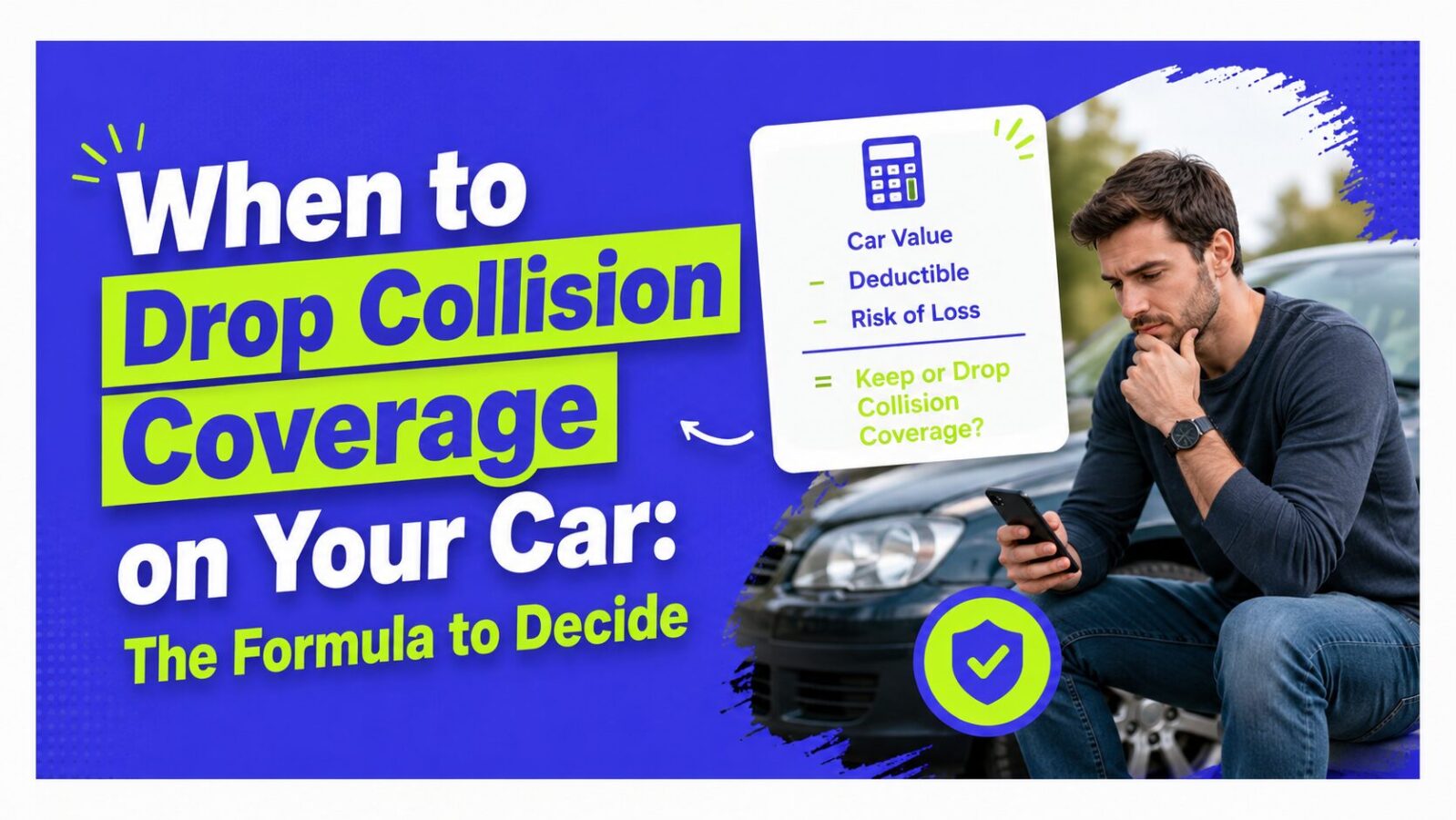
Collision coverage pays to repair or replace your car after an accident, regardless of fault. Your lender requires it if you have a loan or lease, but it is optional once you own the car outright. At some point, keeping it on an old, low-value car costs more than it is worth. Here is a simple formula to decide when to drop it.
Key Takeaways
- The 10% rule: if your annual collision premium exceeds 10% of your car’s value, consider dropping it.
- Your real benefit is the car’s value minus your deductible, not the full value.
- Keep comprehensive even when you drop collision, since it is cheap and covers unpredictable events.
- Only drop it if you could replace the car, so check your emergency fund first.
The Break-Even Formula
Collision makes financial sense when the annual premium is small relative to what it could actually pay out. The simplest version is the 10% rule used by many advisors: if your annual collision premium is more than 10% of your car’s current value, the coverage may not be worth it.
For example, if your car is worth $4,000 and collision costs $600 a year, that is 15% of the value, so dropping it may make sense. If your car is worth $12,000 and collision costs $600, that is only 5%, so keeping it makes sense.
Factor in Your Deductible
Your real benefit is the car’s value minus your deductible, not the full value. With a $1,000 deductible on a $4,000 car, insurance pays at most $3,000 even in a total loss. Paying $600 a year for a maximum benefit of $3,000 is marginal value. So the number that matters is the car’s market value minus your deductible, and you keep coverage only when that comfortably exceeds the annual premium.
Step by Step
- Find your car’s current value (private-party) at a site like KBB.com or Edmunds.
- Find your annual collision premium on your insurance declarations page.
- Subtract your deductible from the car’s value.
- Divide the annual premium by that result.
- If it is above 10%, seriously consider dropping collision.
Other Factors to Weigh
- Could you replace the car? If it is worth $4,000 but you have no savings to replace it, dropping coverage creates real risk even if the math says drop. Have an emergency fund that could cover a replacement first.
- Do you need it for work? If the car is essential for your income, going weeks without it after a total loss weighs against dropping, even on an older car.
- Comprehensive is different. It covers theft, vandalism, weather, and animal collisions, and is usually much cheaper (often $100 to $300 a year). Many advisors suggest keeping comprehensive even when you drop collision, since the events are unpredictable and the cost is low.
How Much Dropping Saves
Collision typically costs $300 to $800 a year depending on the car and your profile, while comprehensive runs about $100 to $300. Dropping collision while keeping comprehensive often saves a few hundred dollars a year. Over a few years on a low-value car, that can add up to more than the coverage would ever pay out after the deductible. Figures vary, so check your own declarations page.
FAQ
When should I drop collision coverage?
When your annual collision premium exceeds about 10% of your car’s value, and you have savings to replace the car if it is totaled.
Should I drop comprehensive too?
Usually not. Comprehensive is much cheaper and covers unpredictable events like theft and weather, so many people keep it even after dropping collision.
How do I find my car’s value?
Check the private-party value at KBB.com or Edmunds, then subtract your deductible to see your real potential payout.
What if I still owe on the car?
You cannot drop collision while you have a loan or lease, since your lender requires it until the car is paid off.
Bottom Line
Drop collision when its premium is high relative to your car’s value (roughly above 10%) and you could replace the car yourself, but keep the cheaper comprehensive coverage. Run the simple formula on your own numbers, make sure your emergency fund could cover a replacement, and redirect the savings. A smart move is to put what you save toward an emergency fund earmarked for a future car, so you are self-insuring rather than just going without protection. For the full picture, see our guides on how much car insurance you need, cheap car insurance, and why car insurance is so expensive.
This article is for educational and informational purposes only and is not insurance advice. The right choice depends on your car’s value, your savings, and your risk tolerance, and figures are general estimates. Consult a licensed insurance professional for your situation.