 By
By 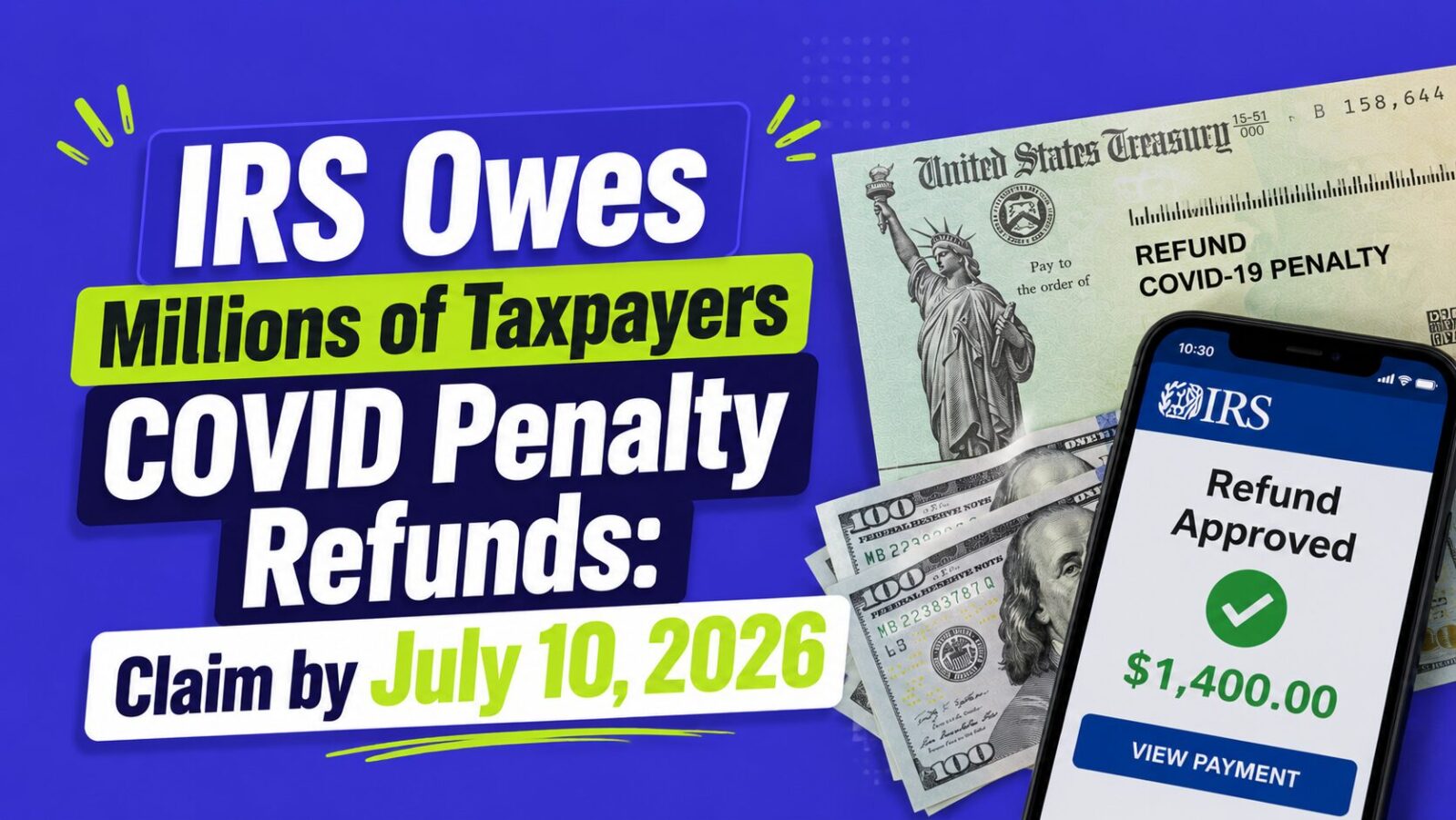
Tens of millions of Americans may be owed refunds for IRS penalties and interest they paid during the COVID-19 pandemic, but the deadline to claim most of them is July 10, 2026. The refunds are not automatic; you must file a claim (Form 843), and because the government is expected to appeal, you should file it as a protective claim to preserve your rights. Here is who qualifies, how much you might recover, and exactly how to file before the deadline.
Key Takeaways
- The deadline is July 10, 2026, and refunds are not automatic, so you must file.
- You may qualify if you paid IRS late penalties or interest on returns due January 20, 2020 to July 10, 2023.
- File Form 843 as a protective claim, citing the Kwong case, since the ruling is being appealed.
- The risk of filing is minimal; the risk of waiting is losing the refund when the deadline passes.
What Happened?
In November 2025, the U.S. Court of Federal Claims ruled in Kwong v. United States (179 Fed. Cl. 382) that the IRS should not have assessed certain penalties and interest for late filings and payments during the COVID-19 federal disaster period. The court interpreted IRC Section 7508A(d), the disaster-postponement statute, to have mandatorily and automatically extended every tax deadline falling within the declared disaster window, meaning returns and payments in that period were never technically “late,” so the penalties were invalid.
The National Taxpayer Advocate, Erin Collins, highlighted this as a major refund opportunity in an April 2026 blog post and urged taxpayers to act before the deadline, noting the issue is widespread and not limited to a narrow group. In fiscal year 2022 alone, the IRS levied tens of millions of penalties worth billions of dollars.
Who Qualifies?
You may qualify if you paid any of the following on a return originally due between January 20, 2020 and July 10, 2023:
- Failure-to-file penalty (5% of unpaid taxes per month, up to 25%).
- Failure-to-pay penalty (0.5% of the unpaid balance per month, up to 25%).
- Estimated-tax penalties for underpaying quarterly taxes.
- Interest charged on those penalties.
This covers individuals, the self-employed, businesses, partnerships, S corporations, and trusts. You do not qualify if you never paid penalties in this period, or if you already received a refund under the narrower 2022 IRS program (Notice 2022-36), which automatically refunded penalties to about 1.6 million taxpayers for 2019 and 2020 returns only.
How Much Could You Get Back?
It depends on what you were penalized. Tax professionals estimate a typical individual penalized for a late payment on a $5,000 liability during the pandemic could recover more than $1,000 in penalties and interest combined. Small business owners and the self-employed who struggled with quarterly payments during 2020 to 2023 may have paid the most and could see the largest refunds, and partnerships and S corporations should review penalties on informational returns too. There is no guarantee, since the ruling is not yet final and is expected to be appealed, but the National Taxpayer Advocate’s public endorsement is a strong signal the theory is solid enough to act on. See our guide on lowering your tax bill.
How Do You File a Claim Before July 10?
Pull your IRS account transcripts. Log in at irs.gov and download your Account Transcript for each tax year from 2020 through 2023, looking for penalty and interest assessments (common transaction codes include 170 for the estimated-tax penalty, 196 for interest, and 276 for the failure-to-pay penalty).
Add up what you were charged across all penalty and interest items from January 20, 2020 through July 10, 2023.
File Form 843 (Claim for Refund and Request for Abatement) for each tax period and type of tax separately. On the form, enter the year and type of tax and the amount claimed, write something like “Protective Refund Claim Pursuant to Kwong” across the top, cite Kwong v. United States and IRC Section 7508A as the legal basis in the explanation, and attach copies of the IRS notices showing the penalties.
Mail by certified mail before July 10, 2026. The National Taxpayer Advocate recommends certified mail for proof of the filing date. Send it to the IRS center for your state listed in the Form 843 instructions. Electronic filing of Form 843 is not yet available.
Why File a Protective Claim?
Because the government is expected to appeal Kwong, a final ruling may come after the normal refund-claim deadline has passed. A protective claim, filed by July 10, 2026, preserves your right to the refund while the appeal plays out, so you do not lose your window if the courts ultimately side with taxpayers. This is exactly why the National Taxpayer Advocate is urging people to file now rather than wait for a final decision.
What Happens After You File?
IRS processing for Form 843 typically takes several months, and the agency may approve, deny, or partially approve your claim, with denial giving you the right to appeal. Because the legal question is still in the courts, some claims may be held pending a final ruling. The risk of filing is minimal: if denied, you are no worse off than today. The risk of not filing is potentially losing hundreds or thousands of dollars when the deadline passes. For complex cases (multiple entities, large amounts, or many years), a CPA or enrolled agent familiar with Kwong can file on your behalf.
FAQ
Is the IRS COVID penalty refund automatic?
No. You must file Form 843 by July 10, 2026 to claim it. Only the narrower 2022 program (Notice 2022-36) was automatic, and it covered different penalties for 2019 and 2020 only.
Who qualifies for the Kwong COVID penalty refund?
Anyone who paid IRS late-filing, late-payment, or estimated-tax penalties or related interest on a return due between January 20, 2020 and July 10, 2023, including individuals, the self-employed, and businesses.
How do I file the claim?
File Form 843 by certified mail before July 10, 2026, one per tax period and type of tax, marked as a protective claim citing Kwong v. United States and IRC Section 7508A, with copies of your penalty notices attached.
Is the refund guaranteed?
No. The Kwong ruling is not final and is expected to be appealed. Filing a protective claim preserves your right to a refund if taxpayers ultimately prevail, with little downside if the claim is denied.
Bottom Line
If you paid IRS late penalties or interest on a return due between January 20, 2020 and July 10, 2023, you may be owed a refund under the Kwong ruling, but you must file Form 843 as a protective claim by July 10, 2026. The downside of filing is minimal and the upside can be hundreds or thousands of dollars, so pull your transcripts and file before the deadline. To go deeper, see our guides on lowering your tax bill, estimated taxes, the student loan forgiveness tax bomb, and the OBBBA tax changes.
This article is for educational and informational purposes only and does not constitute tax or legal advice. The Kwong ruling is not yet a final appellate judgment, so consult a tax professional before filing, and confirm current details at irs.gov and taxpayeradvocate.irs.gov.