 By
By 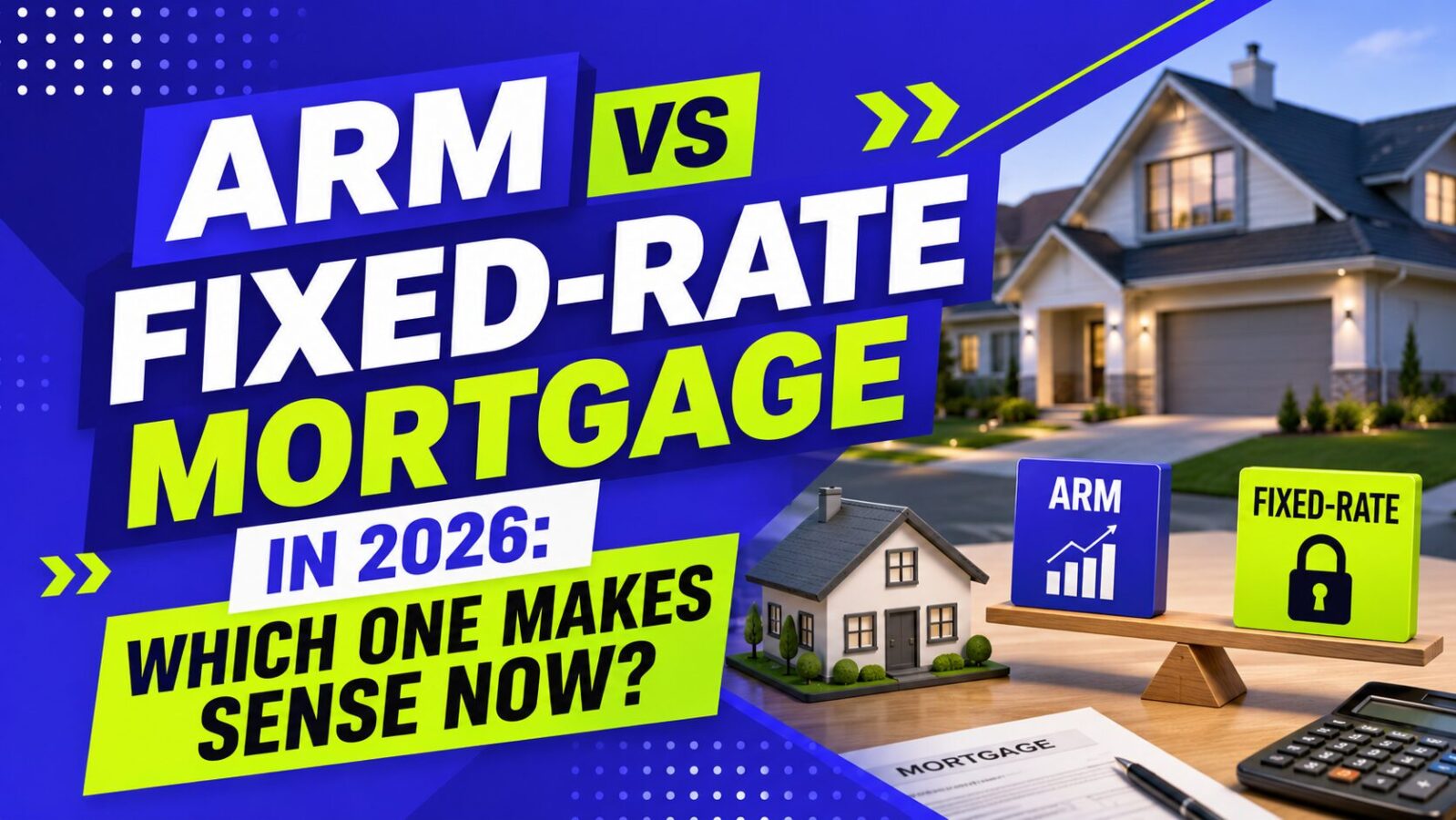
An adjustable-rate mortgage can still save you money, but do not assume an ARM automatically starts with a much lower rate than a 30-year fixed mortgage.
That traditional discount is not consistent in 2026.
In early August, one national rate survey showed a 5/1 ARM several tenths of a percentage point below a 30-year fixed loan, while another showed the five-year ARM slightly higher.
So the decision is not simply ARM equals cheaper. The real question is:
How much are you actually saving during the fixed period, and is that savings large enough to justify the risk of future rate changes?
Part of our complete first-time home buyer guide for 2026.
Key takeaways
- An ARM has an initial fixed-rate period followed by a period when the rate can change.
- Current ARM pricing does not guarantee a large discount versus a 30-year fixed mortgage.
- Many newer conforming ARMs adjust every six months after the initial period, so a 5/6 ARM is different from a 5/1 ARM.
- ARM contracts include caps limiting how much the rate can change at the first adjustment, later adjustments, and over the life of the loan.
- An ARM is easier to justify when the initial savings are meaningful and you have a realistic reason to expect you will not keep the loan into the adjustable period.
- A fixed mortgage is usually easier to live with when long-term payment certainty matters more than a modest initial discount.
How does an adjustable-rate mortgage work?
An ARM usually starts with a rate that is fixed for several years.
After that period ends, the rate can change based on an index plus a lender-set margin, subject to the limits written into your loan.
The numbers in the ARM name tell you when that happens.
For example:
5/1 ARM: fixed for five years, then adjusts once per year.
5/6 ARM: fixed for five years, then can adjust every six months.
7/6 ARM: fixed for seven years, then can adjust every six months.
10/6 ARM: fixed for ten years, then can adjust every six months.
That second number matters. Do not assume every five-year ARM adjusts annually.
The CFPB’s ARM guide recommends checking the exact adjustment schedule, index, margin, and caps before choosing one.
What determines your rate after the fixed period?
After the introductory period, the lender generally calculates a new rate using:
Index + margin = fully indexed rate
The index changes with market conditions.
The margin is set in the mortgage agreement and normally stays the same.
Many conforming ARMs sold to Fannie Mae use the 30-day Average SOFR as their index. Other ARM products can use different indexes, so check your own Loan Estimate rather than assuming yours uses SOFR. (Fannie Mae)
For example, if your applicable index were 4% and your margin were 2.75%, the fully indexed rate would be 6.75% before applying any contractual caps or floors.
The index can fall too, so an ARM does not only move upward. But your contract may limit how far the rate can rise or fall.
What are ARM rate caps?
Rate caps put boundaries around future changes.
There are three numbers to understand.
Initial adjustment cap
This limits how much the rate can change at the first adjustment after the fixed period ends.
Subsequent adjustment cap
This limits each later change.
Lifetime cap
This limits how far the rate can move over the entire life of the mortgage.
The CFPB notes that first-adjustment caps commonly allow changes of two or five percentage points, later caps commonly allow one or two points, and lifetime caps are commonly around five points. Your loan can be different. (CFPB)
For example, Fannie Mae’s standard SOFR ARMs include:
| ARM | First adjustment | Later adjustments | Lifetime increase |
|---|---|---|---|
| 5/6 SOFR ARM | 2% | 1% | Up to 5% |
| 7/6 SOFR ARM | 5% | 1% | Up to 5% |
| 10/6 SOFR ARM | 5% | 1% | Up to 5% |
Those are examples of conforming ARM structures, not rules for every mortgage. (Fannie Mae)
Your Loan Estimate shows the minimum and maximum rates and how often your specific loan can adjust.
Are ARM rates actually lower in 2026?
Sometimes. Not always.
Freddie Mac reported the average 30-year fixed mortgage at 6.67% on August 13, 2026. (Freddie Mac)
ARM averages are harder to summarize because the rate depends on the ARM structure and data source.
For example, on August 7, Bankrate showed:
- 5/1 ARM: 6.36%
- 30-year fixed: 6.75%
That was a discount of about 0.39 percentage points. (Bankrate)
But another national snapshot using Zillow data on August 2 showed:
- 5-year ARM: 6.72%
- 30-year fixed: 6.67%
In that snapshot, the ARM was actually slightly higher. (NerdWallet)
That is why I would not build a 2026 mortgage decision around a national ARM average.
Get actual quotes for the same:
- loan amount;
- down payment;
- credit profile;
- property;
- points;
- and closing date.
Then compare the ARM and fixed option side by side.
When does an ARM make sense?
The initial savings are actually meaningful
Start with dollars, not the product name.
If the fixed mortgage is 6.70% and the ARM is 6.65%, the difference may be too small to justify giving up long-term rate certainty.
If the ARM is meaningfully cheaper, the decision becomes more interesting.
Compare both the monthly payment and the cost over the entire period you realistically expect to keep the loan.
You expect to sell before adjustments begin
Suppose you are choosing a five-year ARM for a home you expect to own for three or four years.
If you sell as planned, the adjustable period may never matter.
That can be a reasonable use of an ARM.
But treat selling as a plan, not a guarantee.
A job change, weak housing market, family decision, or other event could leave you in the home longer than expected.
You should still understand what happens if the plan changes.
You can afford the loan even if you keep it longer
This is the part I care about most.
An ARM should not only work if everything goes perfectly.
Ask yourself:
If I still own this house when the fixed period ends, could I handle a higher payment?
If the answer is no, the initial savings may not justify the risk.
What about taking an ARM and refinancing later?
You can refinance an ARM before it adjusts.
But “I’ll just refinance” should not be the entire strategy.
Refinancing depends on conditions you do not completely control:
- future mortgage rates;
- your income;
- your credit;
- your home’s value;
- lender requirements;
- and refinancing costs.
Rates could fall and make refinancing attractive.
They could also stay high, while your income changes or your home loses value.
If refinancing is part of your plan, our mortgage refinance guide explains how to calculate whether the savings justify the closing costs.
When does a fixed-rate mortgage make more sense?
You expect to own the home for a long time
The longer you expect to keep the mortgage, the more valuable long-term rate certainty becomes.
With a fixed-rate mortgage, the interest rate and principal-and-interest payment do not change because market rates rise.
Taxes and homeowners insurance can still change, so your total housing payment is not necessarily fixed forever.
But the mortgage rate itself is.
The ARM discount is tiny
Taking future rate risk for a very small initial discount is difficult to justify.
This is especially relevant in 2026 because the ARM advantage can vary widely from lender to lender.
If two comparable quotes are almost the same, I would usually favor the fixed loan unless there is a specific reason the ARM fits your plans better.
Your budget has little room for a higher payment
A buyer already stretching to afford the current payment has less ability to absorb an ARM adjustment later.
The CFPB specifically recommends asking whether you could afford the mortgage if the rate and payment reached the maximum allowed by the contract. (CFPB)
If a higher future payment would seriously strain your budget, payment certainty has real value.
How should you stress-test an ARM?
Do not estimate the worst case using a generic online ARM rule.
Use your actual Loan Estimate.
Look for:
- initial interest rate;
- first adjustment date;
- adjustment frequency;
- index;
- margin;
- first adjustment cap;
- subsequent caps;
- maximum interest rate.
The Loan Estimate’s Adjustable Interest Rate table is designed to show these terms.
Then ask the lender to show you the maximum possible payment under that specific mortgage.
The CFPB explicitly recommends doing this before choosing an ARM. (CFPB)
That calculation is better than taking today’s $350,000 balance and simply applying the lifetime maximum rate, because when the ARM eventually reaches an adjustment date, your remaining principal and remaining loan term will have changed.
Compare ARM quotes using more than the starting rate
A lower headline rate can come with higher points or fees.
When comparing an ARM with a fixed loan, look at:
- starting interest rate;
- APR;
- lender credits or points;
- closing costs;
- monthly principal and interest;
- how long the starting rate lasts;
- index and margin;
- adjustment caps;
- maximum rate;
- and how long you realistically expect to keep the loan.
Two mortgages both advertised as “5-year ARMs” can have very different economics.
The starting rate alone does not tell you which one is cheaper.
What about jumbo ARMs?
ARMs can be particularly worth comparing for jumbo borrowers because jumbo mortgage pricing does not always move in lockstep with conforming mortgage pricing.
But do not assume a jumbo ARM automatically has a better discount.
Get both fixed and ARM quotes from the same lenders and compare the full cost.
The same rule applies: take adjustment risk only when you are receiving something worthwhile in return.
FAQ
Is a 5-year ARM a good idea in 2026?
It can be, but only after comparing real offers. Current 2026 data does not show a guaranteed large ARM discount. An ARM becomes more attractive when its initial rate is meaningfully lower and you have a realistic short holding period.
What is the difference between a 5/1 and 5/6 ARM?
Both keep the initial rate fixed for about five years. After that, a 5/1 adjusts once per year, while a 5/6 can adjust every six months.
Can an ARM rate go down?
Yes. Depending on the index and your loan’s terms, an adjustable rate can decrease as well as increase. Floors and caps can limit how far it moves. (CFPB)
Can I refinance before my ARM adjusts?
Yes, if you qualify for a new mortgage. But refinancing is not guaranteed, and closing costs can reduce or eliminate the savings.
Is a fixed mortgage better for first-time buyers?
Not automatically. But if you expect to stay in the home for a long time, have a tight budget, or receive only a small ARM discount, the predictable fixed payment is usually easier to justify.
Bottom line
An ARM should give you a clear benefit for taking on future rate risk.
In 2026, that benefit is not guaranteed. Some ARM quotes are meaningfully cheaper than fixed mortgages, while others are barely cheaper or even more expensive.
Compare actual Loan Estimates. If the ARM saves enough money during the period you realistically expect to keep the loan and you could survive a higher payment if your plans change, it can make sense.
If the savings are small, the 30-year fixed is usually the cleaner choice.