 By
By 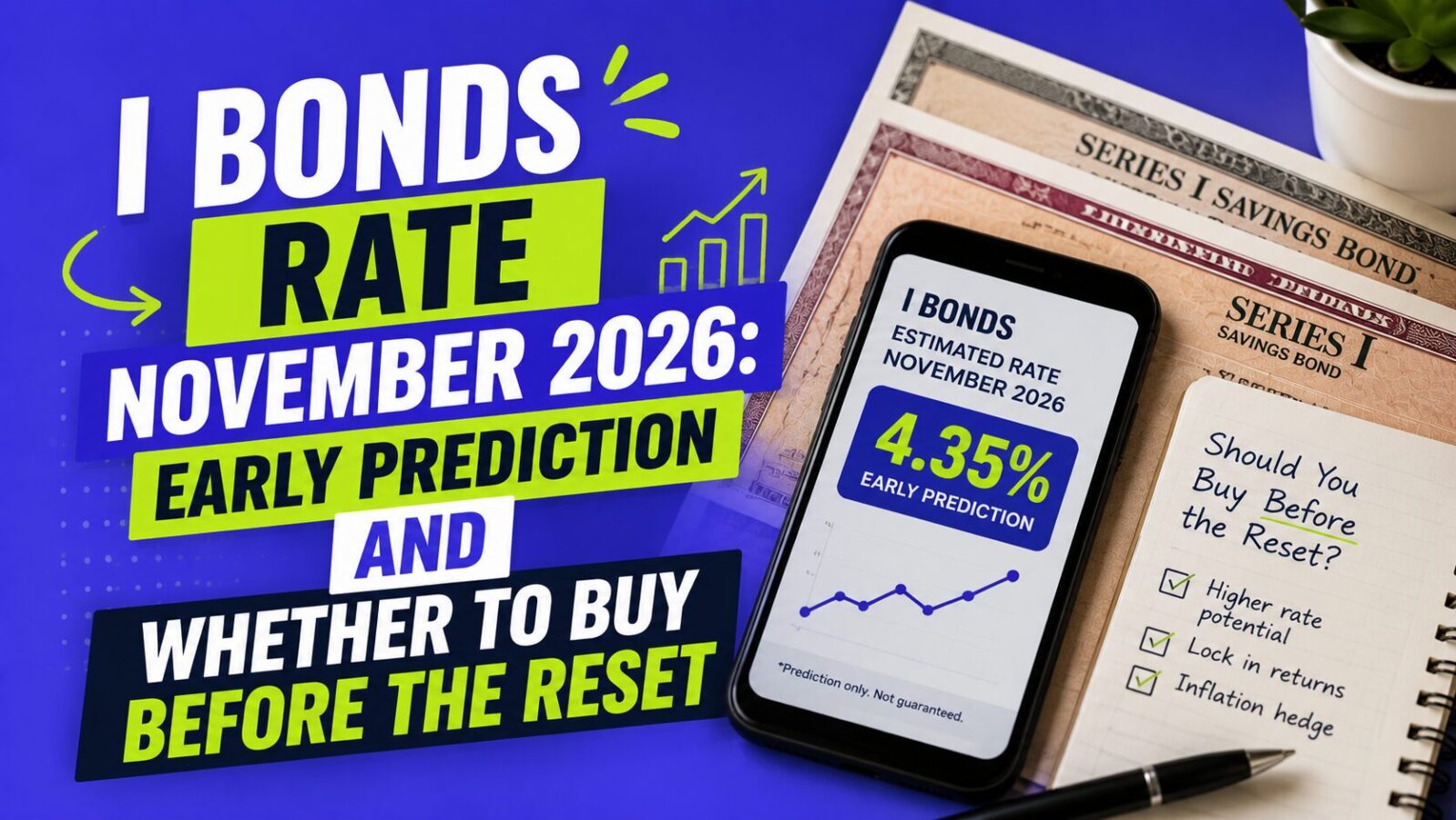
The next I Bond rate resets November 1, 2026, with the new composite rate announced October 30 to 31. The current composite rate is 4.26% (a 0.90% fixed rate plus a 3.34% annualized variable rate) for bonds bought May through October 2026. Based on inflation data so far, the November variable rate looks likely to land in a similar range. Whether to buy before or after the reset comes down to the fixed rate and your read on inflation. Here is the framework.
Key Takeaways
- The current composite rate is 4.26%, with a 0.90% fixed rate you keep for the life of the bond.
- November’s rate depends on March-to-September 2026 inflation, announced October 30 to 31.
- Buy before October 31 to lock the 0.90% fixed rate if you fear the Treasury lowers it.
- Buy late in the month either way, since I Bonds earn a full month of interest regardless.
How Is the Next I Bond Rate Calculated?
The current I Bond composite rate is 4.26% annually, in effect for bonds bought May 1 through October 31, 2026. It combines a 0.90% fixed rate and a 3.34% annualized variable rate based on CPI-U changes from September 2025 to March 2026. The November 2026 rate will be based on CPI-U changes from March 2026 to September 2026, with the September data released in mid-October, just before the Treasury’s announcement. We already have partial data through mid-2026 that hints at the direction.
What Does the Early Data Suggest?
CPI-U has been running above 3.5% year-over-year through mid-2026, pushed by energy prices and tariff effects. If inflation stays around 3.5% to 4.0% through September:
- The semi-annual CPI-U change (March to September 2026) could be roughly 1.5% to 2.0%.
- That implies an annualized variable rate of about 3.0% to 4.0%.
- Combined with the fixed rate, a total composite rate in the rough range of 3.9% to 4.9%.
The fixed rate decision is separate and harder to predict. The Treasury could hold it at 0.90%, raise it if real yields climb, or cut it if the Fed eases significantly before November. At 0.90%, the fixed rate sits below its recent peak (1.30% in November 2023, 1.20% in November 2024) but well above the 0% offered through most of 2020 to 2022. Whatever fixed rate you buy at, you keep it for the life of the bond.
Should You Buy Before or After November 1?
Buy before October 31 if: you want to lock in the 0.90% fixed rate in case the Treasury lowers it, you think inflation will cool (making November’s variable rate lower than 3.34%), or you simply want certainty on your first six months at 4.26%.
Wait until after November 1 if: you expect inflation to stay elevated or rise (making November’s variable rate higher), you think the Treasury might raise the fixed rate, or you have no urgency and prefer more data.
What Is the Timing Trick Worth Knowing?
I Bonds earn a full month of interest no matter when in the month you buy. A bond purchased October 31 earns October interest as if you held it all month, so buying early or late in October locks the same 4.26% for your first six months. The advantage of buying late is that your cash keeps earning elsewhere for nearly the whole month while the bond still gets a full month of interest, at no cost. The same applies after the reset: buying in late November captures the new rate and a full month of interest.
What Should Existing I Bond Holders Do?
If you bought during the 9.62% peak in 2022, those bonds are still earning meaningful rates, though your personal composite rate depends on your purchase month and locked-in fixed rate. Check TreasuryDirect to see your current rate and when your next six-month reset falls.
If your bonds are past the five-year mark (no early-redemption penalty), weigh whether they still beat alternatives. A 0%-fixed-rate bond currently earns only the variable portion, about 3.34%, versus roughly 4.25% on a 12-month CD. The I Bond wins on tax treatment (state-tax exempt), but the CD wins on yield and liquidity here. A bond with a positive fixed rate (0.50% or higher) is a closer call. See our guide on the current I Bond rate.
FAQ
What is the current I Bond rate?
4.26% composite for bonds bought May through October 2026, made up of a 0.90% fixed rate and a 3.34% annualized variable rate. The fixed portion stays with the bond for life.
When does the I Bond rate change?
Every May 1 and November 1. The next reset is November 1, 2026, with the new rate announced October 30 to 31 based on March-to-September 2026 inflation.
Should I buy I Bonds before or after the November reset?
Buy before October 31 to lock the 0.90% fixed rate and the known 4.26% first-six-months rate. Wait if you expect higher inflation or a higher fixed rate in November. Either way, buy late in the month.
Are I Bonds still worth it in 2026?
They can be, especially for tax-advantaged, low-risk savings, but compare them to CDs and high-yield savings. A positive fixed rate and state-tax exemption are the main draws; CDs may win on yield and liquidity.
Bottom Line
The current I Bond pays 4.26% with a 0.90% fixed rate, and the November reset hinges on summer inflation plus the Treasury’s fixed-rate call. Buy before October 31 to lock today’s fixed rate, wait if you expect higher inflation, and always buy late in the month to capture a full month of interest. To go deeper, see our guides on the current I Bond rate, the best high-yield savings accounts, and stablecoin yield vs HYSA.
This article is for educational and informational purposes only and is not financial advice. Rate predictions are estimates based on current inflation data and may not reflect actual November 2026 rates. Confirm current rates at treasurydirect.gov.