By
By 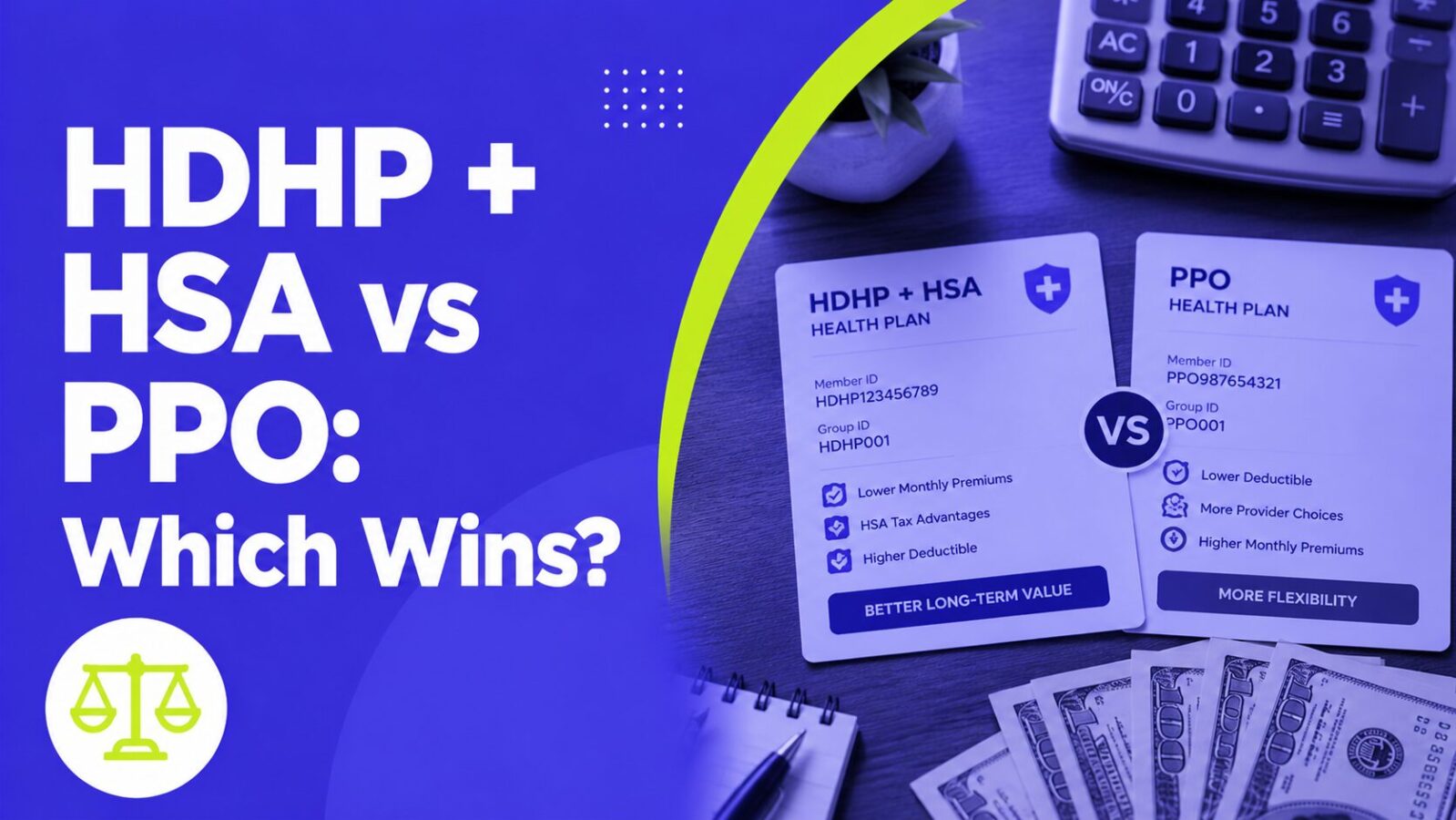
Disclosure: some links on this page are affiliate links. We may earn a commission at no cost to you if you open an account through them. Our editorial content is not influenced by compensation. See our full disclosure.
For a healthy person who rarely uses care, an HDHP paired with a funded HSA almost always beats a traditional PPO on total annual cost. For someone with regular prescriptions, ongoing specialist visits, or a chronic condition, the PPO often wins despite the higher premium. The decision comes down to one number: how much care will you actually use next year? Here is how to figure that out and run the real math.
Key Takeaways
- The HDHP + HSA wins when you are healthy, low-utilization, and can fund the HSA — the premium savings plus tax benefit usually beat the PPO.
- The PPO wins when you regularly hit or exceed the HDHP deductible, making the higher premium cheaper than the deductible exposure.
- The HSA’s triple tax advantage (pre-tax contribution, tax-free growth, tax-free withdrawals for medical costs) is real and worth quantifying before dismissing the HDHP.
- For 2026: HSA contribution limit is $4,300 (self-only) / $8,550 (family) — verify at irs.gov before contributing.
- If you cannot cover the HDHP deductible from savings without hardship, the HDHP carries real financial risk regardless of the math.
What Qualifies as an HDHP in 2026?
The IRS defines an HDHP by minimum deductible and maximum out-of-pocket limits. For 2026 (verify at irs.gov before enrolling):
A plan must meet those minimums to qualify as an HDHP and unlock HSA eligibility. Many HDHPs have much higher deductibles than the minimums. Read your plan’s Summary of Benefits to find the actual deductible, not just the IRS floor.
What Is the HSA and Why Does the Triple Tax Benefit Matter?
A health savings account (HSA) is a tax-advantaged account available only to people enrolled in an HSA-eligible HDHP. It has three tax advantages that stack on top of each other, which is rare in the US tax code:
- Contributions are pre-tax. If you contribute through payroll, the money never hits your taxable income. If you contribute directly, you deduct it on your federal return. At a 22% marginal rate, a $4,300 contribution saves you $946 in federal taxes alone.
- Growth is tax-free. Most HSA providers let you invest your balance in index funds once you clear a small threshold. That growth is never taxed.
- Withdrawals for qualified medical expenses are tax-free. Use the money for any IRS-qualified medical, dental, or vision expense and you owe nothing on withdrawal.
After age 65, HSA funds can be withdrawn for any purpose (not just medical) and are taxed like traditional IRA withdrawals — making a fully-funded HSA effectively a second IRA with the bonus of tax-free medical withdrawals. The 2026 contribution limits: $4,300 self-only, $8,550 family, plus $1,000 catch-up for age 55+. Verify the current figures at irs.gov before contributing, as limits adjust for inflation annually.
For a full breakdown of how HSAs compare with FSAs on limits, eligibility, and rollover rules, see the HSA vs FSA 2026 guide.
The Cost Comparison: Three Real Scenarios
The only way to know which plan wins for you is to run the math with your actual expected usage. Here are three scenarios using representative 2026 plan figures. Your numbers will differ; use these as a template.
Assumptions for this comparison:
HDHP: $200/month premium, $3,000 deductible, 20% coinsurance after deductible, $6,500 out-of-pocket max.
PPO: $420/month premium, $800 deductible, 20% coinsurance after deductible, $6,500 out-of-pocket max.
HSA contribution: $3,000/year (you keep any unspent amount).
*HDHP moderate OOP: $3,000 deductible + 20% of remaining $1,000 = $3,200. **PPO moderate OOP: $800 deductible + 20% of remaining $3,200 = $1,440. Both plans share the same $6,500 out-of-pocket max in this example. Actual plan figures vary; use your plan’s SBC to run your own numbers.
In this comparison, the HDHP wins in all three scenarios because the premium difference ($220/month, or $2,640/year) is large enough to offset the higher deductible exposure. That will not always be true. If the premium gap between the HDHP and PPO offered to you is smaller, the breakeven point shifts.
When the HDHP + HSA Wins
- You are healthy and use little care. Low utilization means you rarely approach the deductible, so the premium savings come out ahead.
- You can fund the HSA. An unfunded HSA is just an HDHP with a high deductible. The tax savings from contributing to the HSA are part of what makes the math work.
- You have enough savings to cover the deductible. If an unexpected $3,000 bill would go on a credit card, the HDHP is a financial risk, not a savings strategy.
- You want to build long-term tax-advantaged savings. Unused HSA funds roll over and can be invested. Over a decade of low-utilization years, a funded HSA can accumulate meaningfully.
- You are self-employed. Self-employed people who deduct their health insurance premiums can also deduct HSA contributions, creating a powerful combined tax benefit.
When the PPO Wins
- You have ongoing prescriptions or regular specialist visits. If you know you will spend $3,000 or more out-of-pocket every year, a lower-deductible plan often costs less total even at a higher premium.
- You are managing a chronic condition. Predictable, recurring costs make a lower-deductible plan more economical, and the administrative burden of tracking HSA-eligible expenses adds friction you do not need.
- You cannot absorb the HDHP deductible from savings. The math does not matter if a $3,000 bill in January would derail your finances. Financial security has a value the spreadsheet does not capture.
- You need a specific out-of-network provider. If your plan of care requires a doctor outside any HDHP network in your area, the PPO’s out-of-network coverage may be necessary regardless of cost.
- You are expecting significant planned care. Pregnancy, elective surgery, or a known procedure coming up? Model the total cost under each plan before enrolling. A year you know will be high-cost tips the balance toward the lower deductible.
The Decision Checklist
Answer yes or no to each question:
- Was my total out-of-pocket medical spend (not counting premiums) under $2,000 last year? Yes = HDHP leans better.
- Can I pay the full HDHP deductible from savings without going into debt? No = reconsider the HDHP.
- Do I take regular prescriptions or see specialists more than twice a year? Yes = PPO leans better.
- Is the premium difference between the HDHP and PPO at least $100/month? Yes = HDHP savings are material.
- Am I willing to fund the HSA and track qualified medical expenses? No = some of the HDHP advantage disappears.
If most of your answers point toward the HDHP, try it for a year and fund the HSA from day one. If most point toward the PPO, the premium is buying you predictability that is worth real money for your situation.
Frequently Asked Questions
Is an HDHP worth it?
For healthy, low-utilization people who fund the HSA, usually yes. The premium savings plus the HSA tax benefit typically outperform a higher-premium plan. For people with regular medical needs, the math often favors the lower-deductible plan.
What is the HSA contribution limit for 2026?
$4,300 for self-only HDHP coverage and $8,550 for family coverage, with a $1,000 catch-up for age 55 and older. Verify current limits at irs.gov before contributing.
Can I use my HSA to pay the HDHP deductible?
Yes. HSA funds can be used for any IRS-qualified medical expense, including deductible payments, copays, coinsurance, prescriptions, dental, and vision. This is exactly what the account is designed for.
What happens to my HSA if I switch to a PPO next year?
You keep your HSA and can spend the existing balance on qualified medical expenses. You just cannot make new contributions while enrolled in a non-HDHP plan. The money does not disappear.
Can I have both an HSA and an FSA?
Not a standard healthcare FSA at the same time. You can pair an HDHP and HSA with a limited-purpose FSA (LPFSA), which covers dental and vision only. The HSA vs FSA guide covers the combinations in detail.
Bottom line: the HDHP + HSA wins in most scenarios for healthy people, primarily because the premium savings plus the HSA tax benefit outweigh the higher deductible. The PPO wins when you reliably use enough care to make the lower deductible worth the higher monthly cost. Run the math with your actual numbers, make sure you can cover the deductible from savings, and see the Open Enrollment 2026 Complete Guide for the full enrollment picture.
This article is for educational and informational purposes only and does not constitute financial, tax, or insurance advice. HSA contribution limits, HDHP thresholds, and plan terms change annually and vary by plan and state. Verify current IRS limits at irs.gov and review your plan’s Summary of Benefits and Coverage before enrolling. Consult a tax professional or licensed insurance advisor for guidance on your specific situation.