 By
By 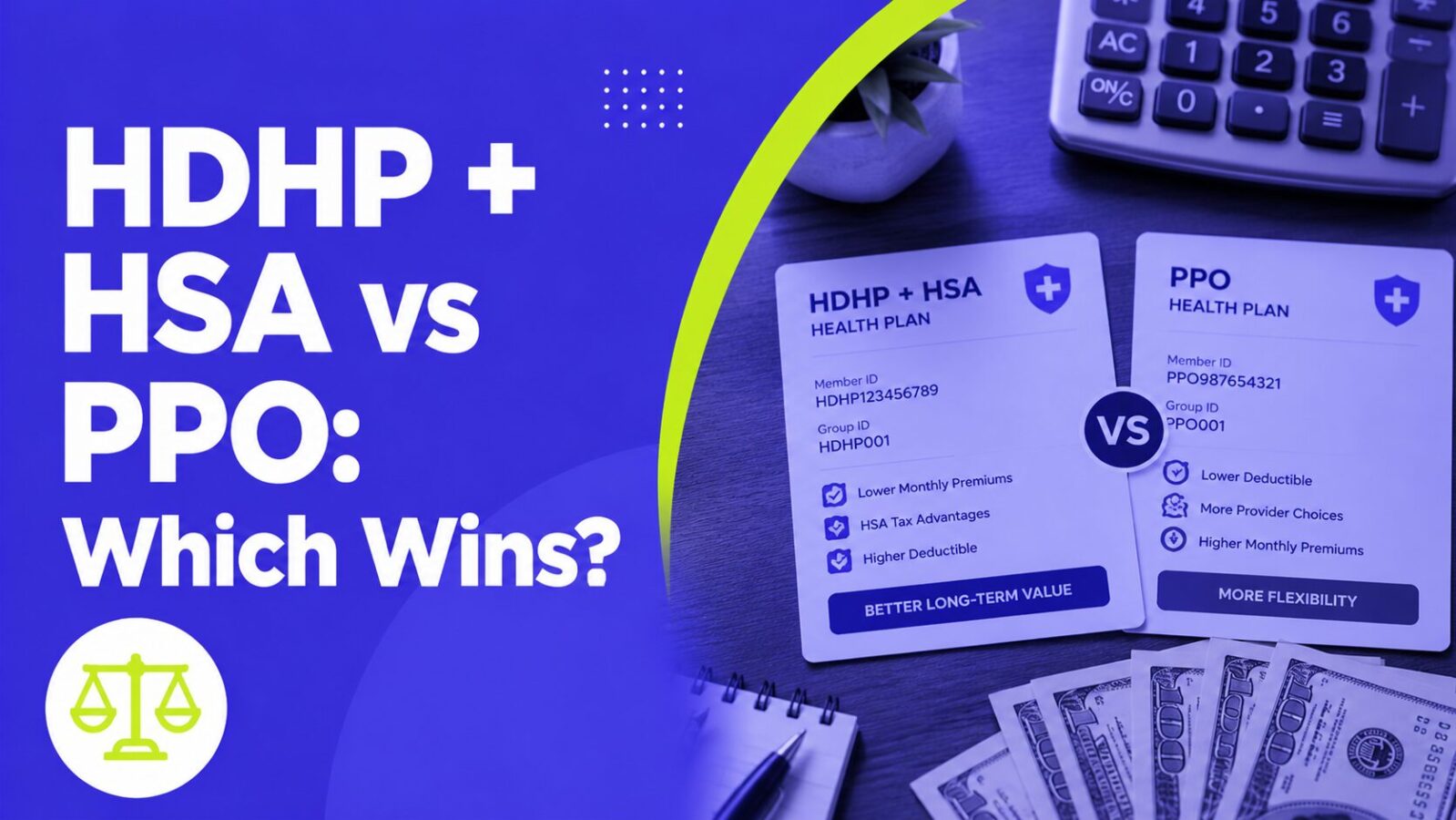
An HDHP with an HSA can be the better deal when its lower premiums, employer HSA contributions, and tax advantages outweigh the extra medical costs you would pay under the higher deductible. A lower-deductible PPO can be better when the premium difference is small, you expect substantial care, or its prescription and specialist benefits are meaningfully better.
There is no reliable rule that says healthy people should always choose the HDHP or people with chronic conditions should always choose the PPO.
The better way to decide is to compare annual premiums + expected out-of-pocket costs – employer HSA contributions, then look separately at the HSA tax benefit, provider network, prescriptions, and how much financial risk you can comfortably absorb.
Key takeaways
- 2026 HSA limits are $4,400 for self-only coverage and $8,750 for family coverage, not $4,300 and $8,550.
- For 2026, a traditional HSA-qualified HDHP generally must have at least a $1,700 self-only or $3,400 family deductible, with out-of-pocket expenses capped at $8,500 and $17,000 respectively under the federal HDHP rules.
- Do not compare deductibles alone. Annual premiums, employer HSA funding, coinsurance, copays, prescription coverage, and out-of-pocket maximums can change the winner.
- Money you contribute to an HSA is still your money, so do not treat an HSA contribution itself as a health-plan expense.
- HSA contributions can receive favorable federal tax treatment, earnings can grow tax-free, and qualified medical withdrawals can be tax-free.
- If an unexpected deductible-sized bill would force you into high-interest debt, the lower premium on an HDHP may not compensate for the cash-flow risk.
- Starting in 2026, HSA eligibility expanded. Certain Bronze and Catastrophic plans are treated as HSA-compatible even if they do not meet the traditional HDHP deductible and out-of-pocket tests.
First, HDHP and PPO are not exact opposites
This is worth clearing up before comparing costs.
HDHP, or high-deductible health plan, describes a health plan with particular deductible and cost-sharing characteristics. HSA eligibility is tied to federal rules around qualifying coverage.
PPO, or preferred provider organization, describes how a plan’s provider network works. PPO members generally pay less in-network but can use out-of-network providers at additional cost.
So it is possible for a health plan to be both:
an HSA-eligible HDHP and a PPO
When employers offer choices labeled something like “HDHP + HSA” and “Traditional PPO,” what you are usually comparing is a higher-deductible option against a lower-deductible PPO option.
That is the comparison this guide focuses on.
What qualifies as an HSA-eligible HDHP in 2026?
For calendar year 2026, the IRS generally defines an HDHP using these limits:
| Coverage | Minimum annual deductible | Maximum annual out-of-pocket expenses |
|---|---|---|
| Self-only | $1,700 | $8,500 |
| Family | $3,400 | $17,000 |
The out-of-pocket figures include items such as deductibles, copayments, and other covered cost sharing, but not premiums.
These are federal qualification limits, not necessarily the deductible or out-of-pocket maximum your employer’s plan will use.
For example, an HSA-eligible plan could have a $3,000 self-only deductible even though the IRS minimum is only $1,700.
Always use your plan’s Summary of Benefits and Coverage, or SBC, to find its actual deductible, copays, coinsurance, prescription rules, and out-of-pocket maximum. The Department of Labor describes the SBC as a standardized document designed to help consumers compare those costs.
One important 2026 change
The old rule is no longer the whole story.
Beginning January 1, 2026, certain Bronze and Catastrophic plans are treated as HSA-compatible under the new federal law even when they would not satisfy the traditional HDHP deductible or out-of-pocket rules.
That matters mainly for people buying individual coverage. If you are comparing two employer plans, use the employer’s materials to confirm whether the option is specifically HSA-eligible rather than trying to determine eligibility from the deductible alone.
What is the HSA contribution limit for 2026?
The 2026 HSA contribution limits are:
| Coverage | 2026 HSA contribution limit |
|---|---|
| Self-only | $4,400 |
| Family | $8,750 |
| Age 55+ catch-up | Additional $1,000 |
Employer contributions count toward the applicable annual contribution limit.
That means if you have self-only coverage and your employer contributes $1,000 to your HSA, you generally do not get another $4,400 of regular contribution room on top. The employer contribution uses part of the $4,400 limit.
For a full comparison with flexible spending accounts, see our HSA vs FSA 2026 guide.
Why the HSA tax benefit matters
HSAs have unusually favorable federal tax treatment.
The IRS says employer contributions, including qualifying salary-reduction contributions through a cafeteria plan, may be excluded from gross income. Contributions you make outside your employer generally may qualify for an above-the-line federal income tax deduction when you are eligible.
Money left in the account stays there, and earnings within the HSA can be tax-free. Withdrawals can also be tax-free when used for qualified medical expenses incurred after the HSA is established.
That is the basis for the phrase “triple tax advantage.”
But there are two mistakes to avoid when comparing plans.
First, your HSA contribution is not a cost in the same way a premium is. If you move $3,000 from your checking account into your HSA, you still own the $3,000.
Second, the exact tax benefit depends on how you contribute and your tax situation. It is not accurate to assume every $3,000 contribution automatically saves exactly 22%.
If you contribute directly and qualify for the deduction, a $3,000 deduction could reduce federal income tax by approximately $660 for someone whose affected income would otherwise be taxed at 22%.
Payroll contributions made through a qualifying cafeteria plan can receive different employment-tax treatment as well. Your actual benefit can therefore be higher or lower depending on circumstances.
What happens to an HSA after age 65?
The HSA does not expire.
You can continue taking tax-free distributions for qualified medical expenses. If you withdraw money for something that is not a qualified medical expense after reaching age 65, the distribution is generally taxable income, but the additional 20% HSA penalty no longer applies.
That makes an HSA unusually flexible later in life.
Before age 65, a nonqualified withdrawal is generally subject to ordinary income tax plus an additional 20% tax, unless another exception applies.
The right way to compare HDHP vs PPO costs
Do not start with the deductible.
Start with this:
Expected annual plan cost = annual premiums + expected medical cost sharing – employer HSA/HRA contributions
Then separately consider:
HSA tax benefit + network differences + prescription coverage + cash-flow risk
There is also a useful worst-case calculation:
Worst-case in-network cost = annual premiums + in-network out-of-pocket maximum – employer account contribution
That tells you approximately what a very expensive covered in-network medical year could cost.
Remember that premiums generally do not count toward the out-of-pocket maximum. Out-of-network services, balance billing, or excluded services can also fall outside the number shown as the plan’s out-of-pocket limit.
HDHP vs PPO: Three example scenarios
Here is a simplified example.
Assume your employer offers these two plans:
| Plan feature | HDHP + HSA | Lower-deductible PPO |
|---|---|---|
| Employee premium | $300/month | $380/month |
| Annual premium | $3,600 | $4,560 |
| Deductible | $3,000 | $800 |
| Coinsurance after deductible | 20% | 20% |
| In-network out-of-pocket max | $6,500 | $4,500 |
| Employer HSA contribution | $750 | $0 |
For simplicity, the examples below assume the medical spending shown consists of covered in-network allowed charges subject to the deductible and coinsurance, with no special copays. Real plans often price office visits, prescriptions, labs, and other services differently.
Scenario 1: Low-use year
Suppose you incur $500 of cost sharing.
HDHP:
$3,600 premium + $500 medical cost – $750 employer HSA contribution = $3,350
PPO:
$4,560 premium + $500 medical cost = $5,060
In this simplified year, the HDHP is ahead by about $1,710 before counting any personal HSA tax benefit.
This is the kind of situation where a lower-premium HDHP can be very attractive.
Scenario 2: Moderate-use year
Now assume there are $4,000 of covered allowed charges.
Under the HDHP:
$3,000 deductible + 20% of the remaining $1,000 = $3,200 out of pocket
Total economic cost after the employer HSA contribution:
$3,600 + $3,200 – $750 = $6,050
Under the PPO:
$800 deductible + 20% of the remaining $3,200 = $1,440 out of pocket
Total:
$4,560 + $1,440 = $6,000
Now the PPO is ahead by only $50 before considering the employee’s potential HSA tax benefit.
That is effectively a toss-up on cost alone. Network, prescriptions, and risk tolerance could decide it.
Scenario 3: Very high-use year
Assume enough covered in-network care to reach both plans’ out-of-pocket maximums.
HDHP:
$3,600 premium + $6,500 OOP max – $750 employer HSA contribution = $9,350
PPO:
$4,560 premium + $4,500 OOP max = $9,060
The PPO is ahead by about $290 before considering personal HSA tax benefits.
That is very different from saying “high medical use automatically means PPO.” In this example, the two plans remain fairly close because the HDHP saves $960 per year in premiums and comes with $750 of employer HSA funding.
Your employer’s numbers could produce a completely different result.
Do not forget employer HSA contributions
This may be the most overlooked number in the whole comparison.
Suppose Plan A costs $1,200 less per year in premiums and your employer contributes another $1,000 to the HSA.
The HDHP effectively starts with a $2,200 economic advantage before you compare medical cost sharing.
That can be enough for the HDHP to remain cheaper even in a relatively expensive medical year.
Conversely, if the employer contributes nothing and the PPO costs only $30 more per month, the lower deductible could become valuable much sooner.
When comparing plans, treat employer HSA money as part of the compensation package rather than ignoring it.
When an HDHP + HSA tends to make sense
An HDHP becomes more attractive when the premium savings are substantial, your employer puts money into the HSA, and your expected medical spending is low enough that you are unlikely to give all of those savings back through higher cost sharing.
It can also appeal to someone who wants to accumulate HSA assets for future qualified medical expenses.
Unused HSA balances remain in the account from year to year and are portable if you change employers.
But the plan should still work without relying on investment returns.
If you would need to put a $3,000 deductible on a 25% APR credit card, the lower annual premium may not justify the financial stress.
When a lower-deductible PPO tends to make sense
A lower-deductible PPO becomes more attractive when its premium is only modestly higher and you expect enough care that the lower deductible, copays, or prescription structure will save more than the premium difference.
That may happen when you expect:
- Frequent specialist visits
- Expensive recurring prescriptions
- Regular therapy or other ongoing treatment
- Pregnancy or planned surgery
- Repeated imaging, testing, or outpatient procedures
But none of those automatically makes the PPO cheaper.
A person with substantial medical needs can still come out ahead on an HDHP if the employer heavily subsidizes its premiums or makes a large HSA contribution.
Run the numbers instead of deciding from health status alone.
Prescription coverage can completely change the answer
Prescription benefits deserve their own comparison.
One plan may require you to pay the negotiated cost of prescriptions until the deductible is met, while another may use flat copays or a separate prescription structure.
For someone taking a high-cost medication every month, those details can matter more than a few hundred dollars of annual premium difference.
Open each SBC and formulary and check:
your exact drug + its tier + deductible treatment + copay or coinsurance + annual out-of-pocket maximum
Do not assume “PPO” automatically means better drug coverage.
Compare the networks too
A PPO generally lets members use out-of-network providers at greater cost.
But network rules vary from one plan to another, and an HDHP can itself use a PPO network.
Before choosing either option, check whether your:
- Primary doctor
- Specialists
- Preferred hospital
- Therapist
- Pharmacy
- Planned surgeon or facility
are in-network.
This is especially important because the federal HDHP out-of-pocket ceiling does not necessarily protect you from all out-of-network expenses. IRS guidance notes that the HDHP limit is applied differently to out-of-network services when a plan uses a provider network.
Preventive care does not necessarily wait for the deductible
Another reason not to estimate an HDHP by simply assuming “I pay everything until $3,000.”
Federal HSA rules allow an HDHP to provide qualifying preventive care before the deductible is met. IRS guidance lists examples including routine evaluations, immunizations, screenings, and certain preventive services.
Some preventive care for specified chronic conditions can also receive special treatment under HSA rules.
Your SBC will show what your particular plan covers before the deductible.
What if you cannot afford the HDHP deductible?
Then that deserves real weight in the decision.
Suppose the HDHP is expected to save $700 over a normal year, but a medical event in January could leave you responsible for several thousand dollars immediately.
If you do not have enough liquid savings to absorb that bill, choosing the HDHP creates a cash-flow risk that is not captured by the expected-value calculation.
A useful check is:
Could I pay the plan’s deductible tomorrow without using high-interest debt?
If the answer is no, the lower-deductible plan may be worth paying more for even when its expected annual cost is somewhat higher.
Insurance is partly about reducing financial volatility, not just maximizing the average expected return.
Can you have an HSA and FSA at the same time?
Usually not with a general-purpose health FSA.
IRS guidance says someone covered by an HDHP and a health FSA that reimburses ordinary qualified medical expenses generally cannot make HSA contributions.
But some arrangements can work with an HSA, including a limited-purpose FSA that covers permitted categories such as dental and vision expenses, or certain post-deductible arrangements.
See our HSA vs FSA 2026 guide for the combinations.
What happens to your HSA if you switch to a PPO?
The HSA remains yours.
You do not lose the account or the existing balance when you change health plans or employers.
You can continue using existing HSA money tax-free for eligible qualified medical expenses.
What changes is your ability to make new contributions.
If the new coverage makes you ineligible to contribute to an HSA, you generally stop accumulating new HSA contribution eligibility for those months, subject to the IRS contribution and eligibility rules.
What about self-employed people?
Self-employed taxpayers should not assume the HSA uniquely favors them.
Eligible individuals can generally receive the federal HSA deduction whether they are employees or self-employed, subject to the HSA rules.
A self-employed person may separately qualify for the self-employed health insurance deduction under its own rules.
Those are different tax provisions, and the exact result depends on business income, coverage, entity structure, and other factors. Avoid double-counting the same expense when estimating the tax benefit.
The five numbers I would compare first
If you have two plans open in front of you, ignore the marketing names for a minute and write down:
1. Your annual premium
Multiply your paycheck contribution by the number of pay periods.
2. Employer HSA or HRA contribution
This can materially change the real price of an HDHP.
3. Deductible
Check both individual and family rules if you cover dependents.
4. Out-of-pocket maximum
Use the in-network number and understand what does not count toward it.
5. Cost of care you already know you will use
Price regular prescriptions, specialist visits, therapy, planned procedures, and other predictable services under each plan.
Those five numbers usually tell you more than the labels “HDHP” and “PPO.”
A simple decision rule
Rather than saying “healthy = HDHP” and “chronic condition = PPO,” use this approach:
Choose the HDHP when its premium savings + employer HSA money + expected HSA tax benefit are larger than the extra medical costs and financial risk you expect to take on.
Choose the lower-deductible PPO when its lower cost sharing, prescription design, network advantages, and greater predictability are worth more than its extra premiums.
If the difference comes out to only a few hundred dollars, I would give more weight to network quality, prescription coverage, and how comfortable you are paying a large bill early in the year.
FAQ
Is an HDHP better than a PPO?
Neither is automatically better. HDHP describes deductible and HSA-related plan characteristics, while PPO describes a provider-network structure. A plan can even be both. Compare total annual cost, employer contributions, network, prescriptions, and financial risk.
What is the HSA contribution limit for 2026?
The 2026 limit is $4,400 for self-only coverage and $8,750 for family coverage. Eligible individuals age 55 or older can generally make an additional $1,000 catch-up contribution.
What is the minimum HDHP deductible for 2026?
Under the general federal HDHP rules, the minimum annual deductible is $1,700 for self-only coverage and $3,400 for family coverage. The corresponding out-of-pocket ceilings are $8,500 and $17,000.
Certain Bronze and Catastrophic plans receive special HSA treatment beginning in 2026 and do not necessarily have to satisfy those general thresholds.
Can I use an HSA to pay my deductible?
Yes. HSA distributions can generally be tax-free when used for qualified medical expenses incurred after the HSA was established, and those expenses can include eligible amounts you pay toward your deductible.
Does my employer’s HSA contribution count toward my limit?
Yes. Employer HSA contributions generally use part of your annual contribution limit.
What happens to my HSA if I choose a PPO next year?
You keep the HSA and its balance. If the new plan does not leave you HSA-eligible, you generally cannot continue making new HSA contributions for periods when you are ineligible, but you can still use existing funds for qualified medical expenses.
Can a PPO be HSA-eligible?
Yes. PPO describes the provider-network arrangement, while HSA eligibility depends on separate federal coverage rules. A high-deductible plan can use a PPO network.
Bottom line
Do not choose an HDHP simply because you are healthy, and do not choose a PPO simply because you expect medical care.
For 2026, start by comparing annual premiums, expected cost sharing, the out-of-pocket maximum, and any employer HSA contribution. Then account for the HSA’s federal tax advantages and check the parts a spreadsheet can miss, especially prescriptions, provider networks, and whether you could comfortably handle the deductible early in the year.
The 2026 numbers also matter: the HSA contribution limits are $4,400 self-only and $8,750 family, while the traditional HDHP thresholds are a minimum deductible of $1,700/$3,400 and maximum out-of-pocket expenses of $8,500/$17,000.
If one plan is clearly cheaper after running those numbers, the choice is straightforward. If they are close, the plan with better access to your doctors, better prescription coverage, and a level of cost risk you can comfortably absorb is often the more useful choice.
See the Open Enrollment 2026 Complete Guide for the rest of the enrollment checklist.
This article is for general educational purposes and is not individualized financial, tax, medical, or insurance advice. Plan costs, networks, formularies, and benefits vary. Review each plan’s Summary of Benefits and Coverage and confirm current HSA rules with the IRS before enrolling or contributing.
Disclosure: Some links on this page are affiliate links. We may earn a commission at no cost to you if you open an account through them. Our editorial content is not influenced by compensation. See our full disclosure.