By
By 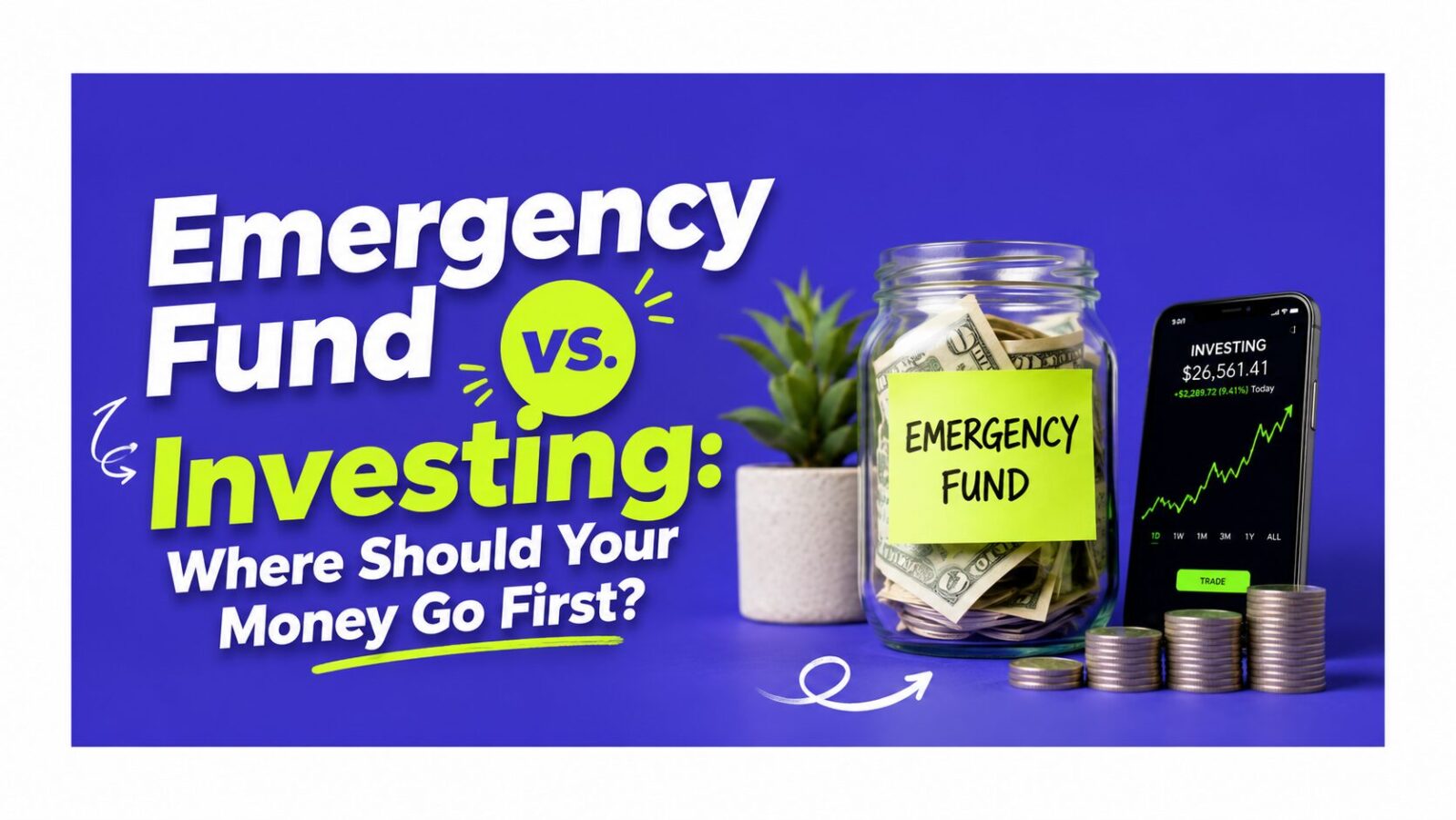
You have some extra cash each month and are finally ready to do something smart with it. But now you are stuck on the classic personal finance dilemma: should you build an emergency fund first, or start investing so you do not miss out on market gains?
- Build a starter emergency fund ($1,000 to $2,000) first, then capture any 401k match.
- After the match, finish a 3 to 6 month emergency fund before investing heavily.
- High-interest debt (20%+ APR) usually comes first, ahead of both saving and investing.
- It is not strictly either/or; once the basics are covered you can split contributions.
The emergency fund vs. investing debate is one of the most common questions in personal finance. The good news is there is a clear answer, and it is more nuanced than “just pick one.”
The case for each side
The argument for investing first. The S&P 500 has historically returned about 10% annually on a nominal basis, or roughly 7% after inflation, based on long-term data from NYU Stern School of Business. Every year you delay investing, you lose the most powerful wealth-building tool available: compound interest. A dollar invested at 25 is worth far more than a dollar invested at 35.
The argument for saving first. The stock market can drop 20 to 30% in a single year. If an emergency hits during a downturn, you might be forced to sell investments at a loss. Without savings, unexpected expenses go on credit cards at 20%+ APR, which wipes out any investment returns. People with no cushion are the ones who panic-sell at the bottom.
Why the emergency fund (usually) comes first
If you invest every spare dollar and then your car breaks down, your options are: sell investments (potentially at a loss, plus triggering taxes), take on high-interest debt, or scramble to borrow from friends and family. None of those are great.
An emergency fund is not just about money. It is about mental bandwidth. When you know you can handle a $1,000 surprise expense without going into debt, you sleep better, make better decisions, and are more likely to stay the course with your investments during market downturns.
That said, there is one important exception covered below.
The right priority order for your money
Where Should My Extra Money Go?
Answer 3 questions to get a personalized recommendation.
Here is the standard order that most financial experts recommend:
Step 1: Get your employer match. If your employer offers a 401(k) match, contribute enough to get the full match before anything else. This is free money — an instant 50 to 100% return. Skipping this is leaving money on the table.
Step 2: Build a starter emergency fund. Save $1,000 to $2,000 as a mini emergency fund. This prevents you from spiraling into more debt when small surprises pop up.
Step 3: Pay off high-interest debt. Credit cards or anything above 7 to 8% APR should be your next priority. Paying off a credit card charging 22% APR is the equivalent of earning a guaranteed 22% return. No investment can promise that.
Step 4: Build your full emergency fund. Now it is time to build a proper cushion (see below).
Step 5: Invest aggressively. With your safety net in place and high-interest debt eliminated, max out your Roth IRA, increase 401(k) contributions, and open a taxable brokerage account if you still have room.
See what investing consistently looks like over time:
Compound Interest Calculator
How much emergency fund is enough?
The standard advice is 3 to 6 months of essential expenses. But the right number depends on your situation.
3 months is enough if: you have a stable job, a two-income household, no dependents, and work in a high-demand field where finding a new job would not take long.
6 months or more is better if: you are a freelancer or have irregular income, are the sole earner for your household, work in a volatile industry, or have dependents or significant fixed expenses.
Important: Calculate this based on essential expenses, not your full income. Your emergency fund needs to cover rent, utilities, food, insurance, and minimum debt payments. It does not need to cover dining out, subscriptions, or vacations.
Calculate your target emergency fund amount:
Emergency Fund Calculator
Where to keep your emergency fund
Do: High-Yield Savings Account (HYSA). In 2026, the best HYSAs pay 4%+ APY. Your money stays liquid (accessible within 1 to 2 business days), FDIC insured up to $250,000, and earns a reasonable return while it sits there.
Do not: The stock market. Stocks can lose 30% in weeks. If you need that money during a downturn, you are forced to sell at the worst possible time. Your emergency fund is not an investment. It is insurance.
Do not: A regular checking account. A checking account earning 0.01% APY means inflation eats your savings every year.
Do not: CDs or bonds (for the full amount). CDs lock your money up for a set term, and early withdrawal penalties defeat the purpose of emergency savings. Keep the bulk in a HYSA.
The employer match exception
If your employer offers a 401(k) match, contribute enough to get the full match even before you have a complete emergency fund.
Why? Because the employer match is a guaranteed return. If your company matches 100% on the first 3%, that is an immediate doubling of your money. No emergency fund savings rate comes close.
The practical approach: contribute enough for the full employer match from day one, then funnel extra cash into your emergency fund until it is fully funded, then ramp up investing. You can do two things at once. You just cannot do everything at once.
Common mistakes to avoid
Waiting to invest until the emergency fund is “perfect.” If you have 3 months of expenses saved and a stable job, it is okay to start investing while slowly building to 6 months. Perfection is the enemy of progress.
Investing the emergency fund to “make it grow faster.” Every few months, someone asks if they should put their emergency fund in index funds. The answer is no. An emergency fund that drops 25% during a market crash is not an emergency fund. It is a liability.
Skipping the employer match to save faster. Always get the employer match. Always. Even if your savings account is at zero.
Not having the fund in a separate account. If your emergency fund sits in the same checking account you use for daily spending, you will spend it. Open a dedicated HYSA at a separate bank.
Forgetting to replenish after an emergency. Used your emergency fund for an actual emergency? Pause extra investing contributions temporarily and rebuild it first.
Frequently Asked Questions
Build a small starter emergency fund ($1,000 to $2,000), capture your 401k match, then finish a 3 to 6 month emergency fund before investing more aggressively.
A common target is 3 months of essential expenses if your income is stable, 6 months if it is variable. You can start investing once the starter fund and match are in place.
In a high-yield savings account earning around around 4% APY, kept separate from your checking and investments so it stays liquid and untouched.
The bottom line
The emergency fund vs. investing question is not either/or. It is about sequencing. Get your employer match, build a safety net, eliminate high-interest debt, then invest aggressively. That is the order that protects you from worst-case scenarios while still letting your money grow.
You do not need to have it all figured out today. You just need to start moving in the right direction.
Take the next step based on where you are right now:
- No emergency fund yet? Open a high-yield savings account today and set up an automatic transfer. Even $25/week builds momentum. Read our emergency fund guide to get there faster.
- Emergency fund in place? Open a Roth IRA and invest your first contribution this week. The 2026 limit is $7,500 and every month you wait costs compound growth.
- Not sure how much to save or invest? Use the calculators above to see your numbers.