 By
By 
The Repayment Assistance Plan, or RAP, is a new federal income-driven repayment plan available since July 1, 2026.
Instead of basing your bill mainly on how much student loan debt you owe, RAP uses your adjusted gross income, or AGI, and the number of dependents you claim on your federal tax return.
Base payments range from 1% to 10% of AGI, depending on income. RAP also reduces the monthly payment by $50 for each dependent, although the required payment generally cannot fall below $10 per month.
The plan also includes an unpaid-interest subsidy and a principal-matching benefit designed to help borrowers make progress instead of watching their balance grow even while making the required payment.
Remaining eligible debt can be forgiven after 360 qualifying monthly payments, or 30 years.
Key takeaways
- RAP became available July 1, 2026.
- Base payments range from 1% to 10% of AGI, depending on your income.
- If AGI is $10,000 or less, the base payment is $120 per year.
- Your monthly payment is reduced by $50 for each dependent claimed on your federal tax return.
- Your required payment generally cannot fall below $10 per month.
- If your full, on-time payment does not cover the month’s interest, the remaining eligible interest is subsidized.
- RAP also includes a principal-matching benefit of up to $50, but it is not an automatic $50 payment for every borrower every month.
- Remaining eligible debt can be forgiven after 30 years of qualifying payments.
- RAP payments can count toward Public Service Loan Forgiveness when you meet the other PSLF requirements.
- Parent PLUS Loans and consolidation loans that include Parent PLUS debt are not eligible for RAP.
What is the Repayment Assistance Plan?
RAP is one of the biggest changes to federal student loan repayment in 2026.
It is an income-driven repayment plan, which means your required payment is based mainly on income rather than your loan balance.
The calculation starts with your AGI.
Your annual base payment is determined by an income bracket, divided by 12, and then reduced by $50 for each dependent you claim.
RAP also tries to solve a problem borrowers have faced under some repayment plans: making the required payment every month while the loan balance keeps growing because the payment is not enough to cover interest.
It does that through two separate benefits:
- an unpaid-interest subsidy
- a principal-matching benefit
Those benefits affect your loan balance.
They are separate from the formula used to determine your required monthly payment.
Which loans are eligible for RAP?
RAP is available for many Direct Loans.
Eligible loans generally include:
- Direct Subsidized Loans
- Direct Unsubsidized Loans
- Direct PLUS Loans made to graduate or professional students
- Direct Consolidation Loans that do not include Parent PLUS debt
Parent PLUS Loans do not qualify
Parent PLUS Loans are not eligible for RAP.
A Direct Consolidation Loan that paid off a Parent PLUS Loan is also generally excluded.
That includes loans created through Parent PLUS double consolidation.
This is important because the rules for Parent PLUS borrowers are different from the rules for ordinary undergraduate and graduate federal loans.
Does everyone have to use RAP now?
No.
The answer depends partly on when your federal loans were disbursed.
If all of your eligible loans were disbursed on or after July 1, 2026, RAP is the only income-driven repayment plan available for those loans.
Borrowers whose eligible loans were all disbursed before July 1, 2026 may still be able to use older plans such as IBR, PAYE, or ICR, depending on the loan type and other eligibility rules.
If you have a mix of loans from before and after July 1, 2026, plan eligibility can be more complicated. Different loans may not have exactly the same repayment options.
Do not assume one rule applies to your entire account without checking your actual loans.
Federal Student Aid’s income-driven repayment FAQ has the current eligibility table.
How is a RAP payment calculated?
RAP starts with your adjusted gross income.
The basic calculation is:
Monthly RAP payment = annual base payment ÷ 12 − $50 per dependent
The final required payment generally cannot be less than:
$10 per month
For most borrowers, the annual base payment is calculated as a percentage of total AGI.
RAP income brackets
| Adjusted gross income | Annual RAP base payment |
|---|---|
| $10,000 or less | $120 |
| More than $10,000 to $20,000 | 1% of AGI |
| More than $20,000 to $30,000 | 2% of AGI |
| More than $30,000 to $40,000 | 3% of AGI |
| More than $40,000 to $50,000 | 4% of AGI |
| More than $50,000 to $60,000 | 5% of AGI |
| More than $60,000 to $70,000 | 6% of AGI |
| More than $70,000 to $80,000 | 7% of AGI |
| More than $80,000 to $90,000 | 8% of AGI |
| More than $90,000 to $100,000 | 9% of AGI |
| More than $100,000 | 10% of AGI |
These percentages calculate the annual base payment, not the monthly payment.
The annual amount is divided by 12 before the dependent reduction is applied.
RAP payment example: $55,000 AGI
Suppose your AGI is:
$55,000
That falls in the 5% bracket.
Your annual base payment would be:
$55,000 × 5% = $2,750
Then divide by 12:
$2,750 ÷ 12 = about $229.17 per month
With no dependents, your estimated required RAP payment would therefore be about:
$229 per month
Notice that your loan balance does not appear in that basic calculation.
Two borrowers with very different loan balances can therefore have similar RAP payments if their income and dependent situations are the same.
How does the $50 dependent reduction work?
After RAP calculates the monthly base payment, it subtracts:
$50 for each dependent claimed on your federal tax return
Suppose your AGI is $60,000 and you claim two dependents.
At $60,000, the RAP base percentage is 5%.
$60,000 × 5% = $3,000 per year
Divide by 12:
$3,000 ÷ 12 = $250 per month
Two dependents reduce that payment by $100:
$250 − $100 = $150 per month
Your estimated RAP payment would therefore be:
$150 per month
If the dependent reduction would push the payment below $10, the $10 monthly minimum generally applies.
RAP Payment Estimator
How does marriage affect RAP payments?
Marriage can change the calculation.
If you are married and file a joint federal tax return, RAP generally uses your combined income.
If your spouse also has federal student loans, the calculation can be adjusted based on your shares of the combined federal student loan debt.
If you are married and file separately, RAP generally uses your individual income and the dependents you claim on your own return.
That does not mean married filing separately is automatically better.
Changing filing status can affect:
- your federal income tax,
- tax credits,
- deductions,
- and other financial benefits.
Compare the student loan savings with the tax consequences before changing how you file solely to lower a RAP payment.
How does RAP’s interest subsidy work?
This is one of RAP’s most useful features.
Suppose your required monthly RAP payment is less than the interest that accrues during the month.
If you make the required payment in full and on time, the remaining eligible unpaid interest for that month is subsidized.
For example, imagine:
- $300 of interest accrues
- your required RAP payment is $150
Your payment does not cover all $300 of interest.
Under RAP’s interest benefit, the remaining eligible unpaid interest can be covered rather than being left to increase what you owe.
That means your balance generally should not grow simply because the RAP formula gave you a payment too small to cover the month’s interest, as long as you satisfy the plan’s requirements.
This does not mean RAP loans stop charging interest.
Interest still accrues. RAP addresses eligible interest that remains unpaid after you make the required payment.
What is the RAP principal-matching benefit?
The principal benefit is separate from the $50 dependent reduction.
The dependent reduction lowers the payment you owe.
The principal match helps reduce your loan balance.
If your full, on-time monthly payment reduces your total principal by less than $50, the Department of Education can make an additional principal reduction under RAP’s matching formula.
The goal is to make sure a qualifying payment produces at least some progress on principal.
But this is not the same as saying:
“Every RAP borrower gets $50 from the government each month.”
That would be inaccurate.
The matching amount depends on how much you paid and how much of your payment actually reduced principal.
It can be up to $50, subject to the plan’s rules.
Be careful when paying ahead on RAP
Paying extra on student loans is usually straightforward, but RAP has an extra wrinkle.
The interest subsidy and principal-matching benefits depend on making a qualifying payment for that month.
If you make a large payment that puts your account into a paid-ahead status, you may not receive the RAP subsidy and matching benefits for future months in which no actual payment is made.
That does not mean you should never pay extra.
It means you should understand how your servicer will apply the payment before using a large lump sum to pay several future bills at once.
Does RAP forgive student loans after 30 years?
RAP provides forgiveness of remaining eligible debt after:
360 qualifying monthly payments
That equals:
30 years
Thirty years is the maximum repayment period under RAP.
It does not mean every borrower will stay in repayment for 30 years.
If you repay the balance earlier, you are done earlier.
And if you qualify for another forgiveness program such as PSLF, you may reach forgiveness much sooner.
Tax law can also change dramatically over a 30-year period, so I would not choose RAP today based on an assumption about how forgiveness might be taxed decades from now.
Does RAP count toward PSLF?
Yes.
Full, on-time RAP payments can count toward Public Service Loan Forgiveness when the borrower also meets the other PSLF requirements.
PSLF generally requires the equivalent of:
120 qualifying monthly payments
while working for an eligible public-service employer and satisfying the program’s other requirements.
That means a borrower who successfully reaches PSLF would not normally need to wait for RAP’s 30-year forgiveness point.
See our PSLF in 2026 guide for the current rules.
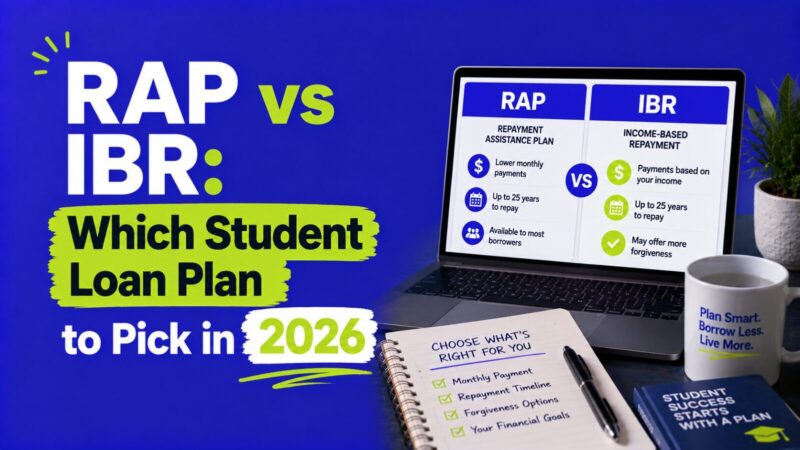
RAP vs IBR: which is better?
RAP is not automatically better than IBR for every borrower who can still choose between them.
The formulas are very different.
RAP uses a percentage of AGI, ranging from 1% to 10%, and then applies the dependent reduction.
IBR generally uses 10% or 15% of discretionary income, depending on when you became a borrower.
Discretionary income is not the same thing as total AGI because IBR subtracts a poverty-guideline allowance before calculating the payment.
That means IBR can sometimes produce a lower payment, particularly for borrowers with low incomes.
RAP may be more attractive for borrowers who benefit from:
- the $50-per-dependent reduction,
- the unpaid-interest subsidy,
- the principal-matching benefit,
- or its particular payment formula.
Do not choose based only on which plan sounds newer.
Compare:
- monthly payment,
- total projected repayment,
- repayment period,
- interest treatment,
- forgiveness timeline,
- and PSLF eligibility if relevant.
See our full RAP vs IBR comparison before switching.
What if you do not want an income-driven plan?
RAP is not the only type of repayment structure.
For borrowers affected by the new 2026 system, the Tiered Standard Repayment Plan is another major option.
Unlike RAP, Tiered Standard payments are not based on your income.
That can work better for some borrowers, but it has very different rules and should not be treated as a substitute for RAP without comparing the long-term cost.
If PSLF is your goal, the distinction is especially important because RAP can count toward PSLF while Tiered Standard does not.
See our Tiered Standard Repayment Plan guide for details.
How do you apply for RAP?
RAP is available through the federal student loan repayment system.
Start at StudentAid.gov and review the repayment options available for your actual loans.
You can use the federal repayment tools to compare estimated payments before choosing a plan.
You may also be able to authorize the Department of Education to access federal tax information directly from the IRS.
That can make income verification and future recertification easier.
RAP borrowers generally need to keep income and family-size information current so their payment can be recalculated when required.
Before changing plans, check:
- your loan types,
- disbursement dates,
- current repayment plan,
- estimated RAP payment,
- estimated payment under any other plan you still qualify for,
- PSLF status if applicable,
- and your servicer’s instructions.
What happened to SAVE?
SAVE is no longer an active repayment option.
A federal court order ended the SAVE Plan on March 10, 2026.
RAP and the Tiered Standard Plan became available on July 1, 2026.
Borrowers affected by SAVE should not assume they automatically moved into RAP or that every borrower has the same deadline.
Check your StudentAid.gov account and any notice sent by your loan servicer.
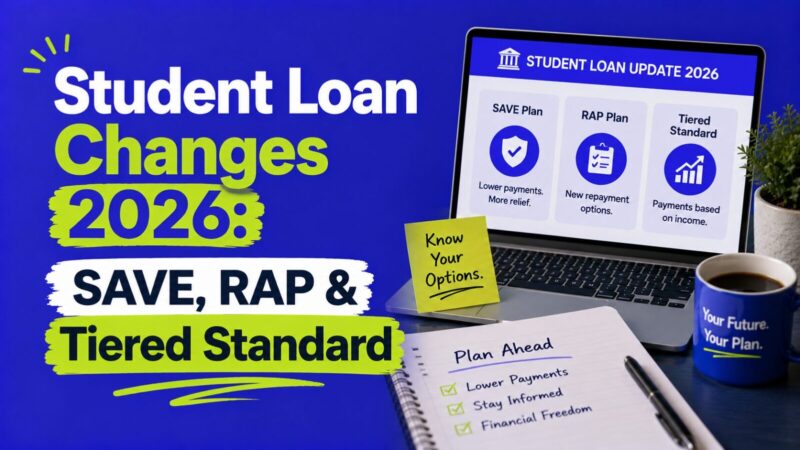
For the bigger picture, see our federal student loan changes in 2026.
Frequently asked questions
Is RAP available now?
Yes. RAP became available on July 1, 2026.
Eligible borrowers can compare repayment options and apply through the federal student loan system.
What is the minimum RAP payment?
The minimum required payment is generally:
$10 per month
That includes cases where the normal income calculation or dependent reduction would otherwise produce a lower payment.
Can a RAP payment be $0?
Generally, no.
RAP has a $10 monthly minimum.
That is different from some older income-driven plans that could produce a $0 required payment for borrowers with very low income.
Does my loan balance determine my RAP payment?
Not directly in the basic payment formula.
RAP primarily uses your AGI and dependents.
Loan balances can still matter in certain situations, including calculations involving married borrowers when both spouses have federal student loans.
Does RAP stop interest from accruing?
No.
Interest can still accrue.
But if your full, on-time RAP payment does not cover all eligible interest for the month, the remaining unpaid interest can be subsidized under the plan’s rules.
Does every RAP borrower get $50 toward principal?
No.
The principal benefit is up to $50 and depends on how much your qualifying payment reduces principal.
It is not a guaranteed flat $50 government payment every month.
Can Parent PLUS borrowers use RAP?
No.
Parent PLUS Loans are not eligible for RAP.
Direct Consolidation Loans containing Parent PLUS debt are also generally excluded.
Is RAP the only income-driven plan in 2026?
Not for every borrower.
Borrowers with older loans may still qualify for IBR, PAYE, or ICR, depending on the loan and borrower rules.
If all of your loans were disbursed on or after July 1, 2026, RAP is the only income-driven repayment option for those loans.
Mixed loan histories can be more complicated, so check your actual eligibility on StudentAid.gov.
How long does RAP last?
RAP’s repayment period is up to:
30 years, or 360 qualifying monthly payments
Any remaining eligible balance can then be forgiven under the plan’s rules.
Does RAP qualify for PSLF?
Yes.
Full, on-time RAP payments can count toward PSLF when you meet the other PSLF requirements.
Bottom line
RAP bases your federal student loan payment mainly on your AGI and the dependents you claim, with payment rates ranging from 1% to 10%, a $50-per-dependent reduction, and a $10 monthly minimum.
But the payment formula is only part of the story.
RAP also offers:
- an unpaid-interest subsidy,
- a principal-matching benefit,
- potential forgiveness after 30 years,
- and qualifying payment credit toward PSLF.
That does not make RAP automatically better than every older repayment plan.
If you still qualify for IBR or another plan, compare the actual numbers before switching.
And pay close attention to your loan types and disbursement dates. The repayment options available to someone with only older loans can be different from those available to someone whose loans were first disbursed after July 1, 2026.
For the broader repayment overhaul, see our student loan changes in 2026.
This article is for general educational purposes only and is not individualized financial, legal, or tax advice. Federal student loan rules, court orders, repayment options, and individual eligibility can change. Confirm your loan types, disbursement dates, repayment-plan eligibility, payment estimate, and current requirements through StudentAid.gov or your federal loan servicer before changing repayment plans.