By
By 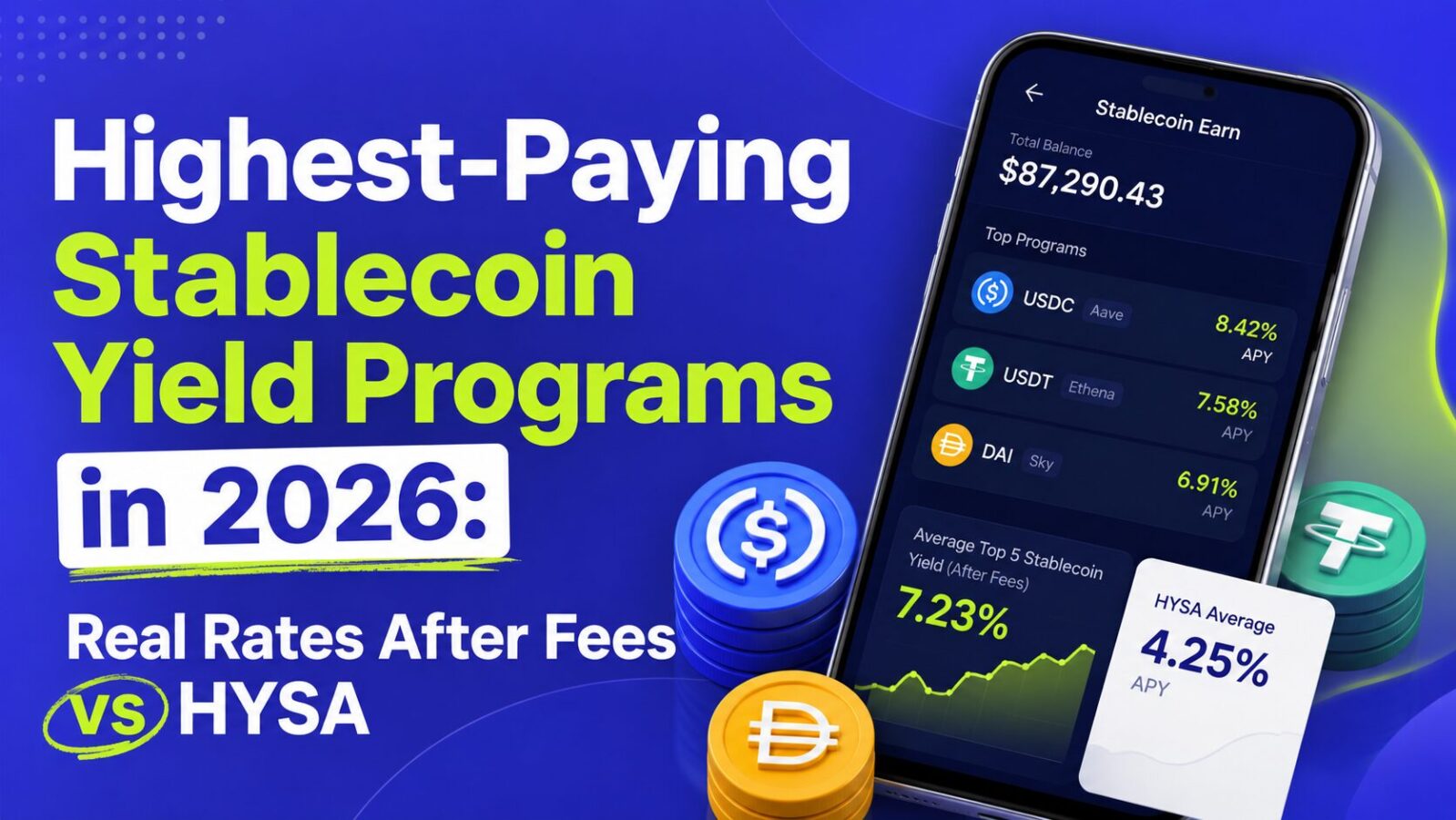
Stablecoin yield programs are advertising roughly 3% to 4.25% APY as of mid-2026, while top high-yield savings accounts pay about 4.2% to 4.5%. That comparison matters before you move money into crypto to chase yield. A few stablecoin programs edge out the best HYSAs on headline rate, but many do not, especially after subscription fees. And unlike a savings account, none of them are FDIC-insured. Here is the honest comparison and how to work out your real net yield after fees.
Important risk notice: Stablecoin yield programs are not FDIC-insured, and your principal is at risk, including the risk that a stablecoin loses its peg or a platform fails. Pending federal legislation could also restrict some of these programs (more below). Only consider money you could afford to lose entirely. This article is informational and is not investment advice.
Key Takeaways
- Top HYSAs and CDs currently pay as much as or more than most stablecoin programs, with FDIC insurance and no fees.
- Only a couple of stablecoin programs beat the best HYSAs on headline rate, and the edge is small.
- Subscription fees can wipe out the advantage unless your deposit is large.
- None of these programs are FDIC-insured, so your principal is genuinely at risk.
- Pending legislation (the CLARITY Act) could restrict passive stablecoin yield, adding regulatory uncertainty.
Stablecoin Yield vs HYSA and CDs (Mid-2026)
Rates below are approximate and reported figures vary by source, region, and date. Stablecoin rates in particular change constantly, so treat these as a snapshot and verify on the platform before depositing.
| Product | Approx. headline APY | Monthly fee | FDIC insured | Regulatory risk |
|---|---|---|---|---|
| Kraken USDC rewards | ~4.25% (subscriber tier) | ~$4.99 (Kraken+) | No | Higher |
| Gemini asset rewards | ~4.0% | $0 | No | Higher |
| Crypto.com Earn | ~3.7% | Subscription tiers apply | No | Higher |
| Coinbase USDC rewards | ~3.5% to 4% | Varies by tier | No | Higher |
| Best HYSA (SoFi, Ally, Marcus) | ~4.2% to 4.5% | $0 | Yes (to $250K) | None |
| Best CDs (6 to 12 month) | ~4.5% to 4.8% | $0 | Yes (to $250K) | None |
The takeaway most yield articles skip: as of mid-2026, the best HYSAs and CDs are paying as much as or more than most stablecoin programs, with FDIC insurance and no subscription fees. The few stablecoin programs that beat the top HYSAs on headline rate do so by a small margin, and the real question is whether that thin edge justifies the extra risk and any fees. See our current HYSA rates guide for the safe side of this comparison.
Your Real Net Yield After Fees
Subscription-based programs only make sense above a break-even deposit, the point where the extra yield covers the fee. The math is simple:
- Annual fee = monthly fee times 12.
- Extra yield over a free HYSA = your deposit times (stablecoin APY minus HYSA APY).
- Break-even deposit = annual fee divided by (stablecoin APY minus HYSA APY).
Here is why this matters. Suppose a program pays 4.25% with a $4.99 monthly fee, and a free HYSA pays 4.30%. The stablecoin rate is actually lower than the HYSA, so you would earn less and pay a fee on top, a guaranteed loss versus the savings account. Now suppose the stablecoin pays 4.25% and the HYSA pays 4.00%, a 0.25 point edge. The annual fee is about $60, so your break-even deposit is $60 divided by 0.0025, which is roughly $24,000. You would need about $24,000 parked there just to cover the fee, and only above that do you earn anything extra, all while taking crypto and platform risk a savings account does not have.
The practical lesson: paid stablecoin programs rarely beat a free HYSA unless your balance is large and the rate gap is real. Always run the break-even before subscribing.
The Risks a Higher Rate Does Not Show
- No FDIC insurance. If the platform fails or freezes withdrawals, there is no government backstop for your balance.
- Peg risk. A stablecoin is only as stable as its reserves and management. Pegs have broken before.
- Platform and counterparty risk. Your yield often depends on how the platform lends or deploys your funds, which you may not fully see.
- Regulatory risk. Pending law could change or end some programs, covered next.
What the CLARITY Act Could Change
Regulation is moving. On May 14, 2026, the Senate Banking Committee advanced the Digital Asset Market Clarity (CLARITY) Act by a 15 to 9 vote, sending it toward reconciliation with a related Senate Agriculture Committee bill before any full Senate vote. On stablecoin yield specifically, lawmakers reached a compromise: the text bars paying interest or yield on idle stablecoin balances in a way that is economically equivalent to a bank deposit, while still permitting certain activity-based rewards.
In plain terms, the passive “park it and earn interest” style of program faces the most legal risk, while activity-based rewards may survive in some form. Nothing is final until the full Senate and House act and the president signs, but if you are weighing a passive yield program, factor in that the rules could shift.
Who This Makes Sense For (and Who It Does Not)
For most people building an emergency fund or short-term savings, a top HYSA or CD is the better fit: comparable or higher rates, FDIC insurance, no fees, and no crypto risk. A stablecoin program may only make sense for someone who already understands crypto, accepts the risk of total loss, has a large enough balance to clear any fee, and is using a no-fee or activity-based program that clearly out-yields a savings account. Even then, it should be money you can afford to lose. If you are early in your journey, our guide on how to start investing with $1,000 and the 50/30/20 budget rule are better starting points.
FAQ
Are stablecoin yields safe?
No, not in the way a savings account is. They are not FDIC-insured, your principal is at risk, and yields depend on the platform and the stablecoin keeping its peg. Treat any balance as money you could lose.
Do stablecoins pay more than a high-yield savings account?
Sometimes, but as of mid-2026 the gap is small and often negative after fees. Top HYSAs and CDs frequently match or beat stablecoin programs while carrying FDIC insurance.
How do subscription fees affect my real yield?
A monthly fee creates a break-even deposit below which you earn less than a free HYSA. Divide the annual fee by the rate advantage over a HYSA to find that break-even amount before subscribing.
Could the CLARITY Act end stablecoin yield?
It could restrict it. The version advanced in May 2026 bans deposit-equivalent passive yield on idle balances but allows some activity-based rewards. The final rules are not set, so regulatory risk remains.
Bottom Line
As of mid-2026, a top HYSA or CD usually beats chasing stablecoin yield once you account for fees, FDIC insurance, and risk. A stablecoin program only makes sense for crypto-comfortable savers with a large balance and a clear rate edge, using money they can afford to lose. Run the break-even math, weigh the lack of insurance and the pending regulation, and remember that a slightly higher rate is not worth your principal.
This article is for educational and informational purposes only and is not investment, financial, or legal advice. Crypto assets are volatile, are not FDIC-insured, and can lose value, including your entire principal. Rates, fees, and regulations change frequently. Do your own research and consider a qualified advisor before investing.