By
By 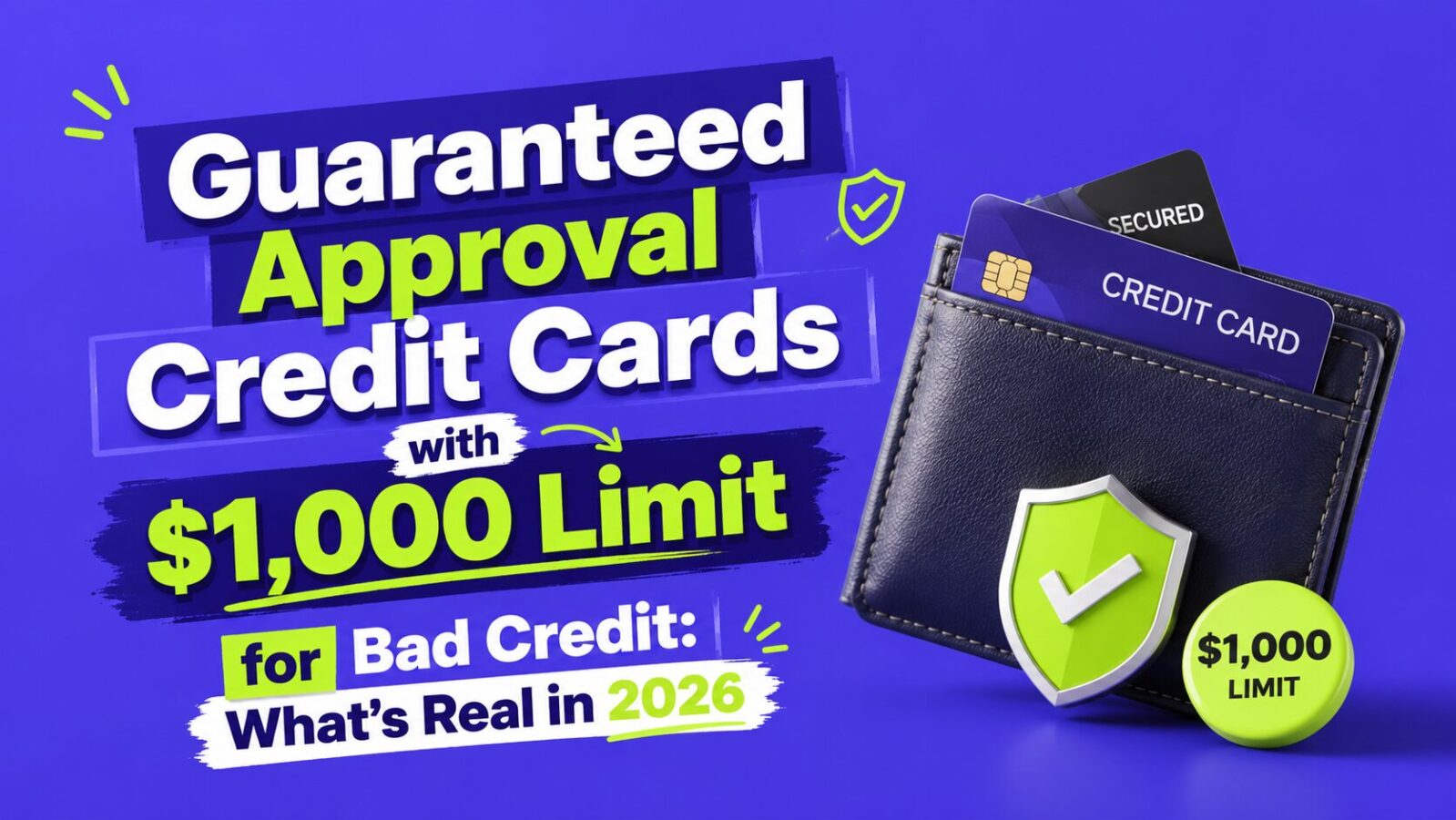
Finance Pulse may earn a commission if you apply through links on this page. This does not affect our recommendations.
Here is the honest answer: truly guaranteed approval does not exist, because federal law requires every legitimate issuer to evaluate applicants. But several cards are built for bad or no credit, have very high approval rates, and some need no deposit. To actually reach a $1,000 limit, a secured card (deposit $1,000, get a $1,000 limit) is the fastest route, while unsecured bad-credit cards usually start at $300 to $500 and grow over time. Here is what is really available in 2026 and how to use it.
Key Takeaways
- “Guaranteed approval” is a myth; legitimate cards always evaluate you, but high-approval options exist.
- Want a $1,000 limit now? A secured card lets you set it directly with your deposit.
- Discover it Secured is the best overall for rebuilding: no fee, real rewards, deposit returned on graduation.
- Avoid cards stacked with fees ($75+ annual, program, and monthly maintenance fees on top of each other).
What Does “Guaranteed Approval” Actually Mean?
No legitimate card can legally guarantee approval. In marketing, “guaranteed approval” usually means one of two things: the card has a very high approval rate for poor-credit applicants (sometimes above 90% for anyone 18+ with a bank account), or it is really a secured or prepaid card where “approval” depends on funding a deposit. Cards that call themselves “guaranteed” and pile on heavy upfront fees (large annual fees plus program fees plus monthly maintenance fees) are preying on people who feel they have no options. They exist, and you should avoid them.
What Are the Best High-Approval Cards Without a Deposit?
Credit One Bank Platinum Visa. Credit One targets the subprime market and is one of the more likely cards to approve applicants in roughly the 550 to 620 range. It is unsecured (no deposit), reports to all three bureaus, and offers 1% cash back, with a starting limit around $300 to $500 reviewed every 6 months. The drawbacks are a $75 first-year annual fee (around $99 after) and a high APR near 29%, so carry no balance. You can pre-qualify with a soft pull, which makes it a reasonable stepping stone.
Indigo Mastercard. Built for applicants with prior bankruptcies or bad credit, with soft-pull pre-qualification that shows your terms before you commit. The annual fee ranges from $0 to $99 depending on your profile, there is no deposit, and the starting limit is around $300.
Milestone Mastercard. Similar structure: pre-qualify to see your terms, an annual fee that varies by profile, no deposit, and about a $300 starting limit. It is issued by Concora Credit (formerly Genesis FS Card Services) and reports to all three bureaus.
What Are the Best Secured Cards for a Higher Limit?
If your goal is a $1,000 limit, secured cards give you direct control: deposit $1,000 and that becomes your limit, versus the $300 to $500 most unsecured bad-credit cards start at.
Discover it Secured (best overall). Deposit $200 to $2,500 to set your limit. After about 7 months, Discover starts reviewing your account to graduate you to unsecured and return your deposit. Meanwhile you earn 2% back at gas stations and restaurants (on up to $1,000 in combined quarterly spending) and 1% elsewhere, with no annual fee and a cashback match at the end of year one. The rewards are real, the fee is zero, and the deposit comes back, making it the clear first choice if you can fund it.
Capital One Platinum Secured. Some applicants get a $200 limit for a deposit as low as $49 to $200, lower than most competitors, with no annual fee. Capital One reviews for limit increases in as little as 6 months without an additional deposit.
OpenSky Secured Visa. OpenSky runs no credit check at all, basing approval solely on your ability to fund the deposit ($200 minimum), which makes it the closest thing to true guaranteed approval for anyone with a bank account. The annual fee is $35 and there is no automatic upgrade path, but it reports to all three bureaus.
How Do You Actually Reach a $1,000 Limit?
For an unsecured card starting at $300 to $500, reaching $1,000 typically takes 12 to 18 months of on-time payments. The path:
- Get approved for an entry-level card (secured or unsecured).
- Use it for small, regular purchases, like one recurring bill or gas fill-up a month.
- Pay the full balance every month without exception.
- Around 6 months, request a limit increase; many issuers do it with a soft pull if you ask.
- Around 12 to 18 months, your improved score may qualify you for a better card with a $1,000+ starting limit.
There is no shortcut to a $1,000 unsecured limit with bad credit on day one. Anyone promising that with no deposit and no income check is either a scam or a fee-loaded product. See our guide on building credit from scratch.
What Should You Do Right Now?
- Check your credit score free at Credit Karma or your bank’s app.
- If your score is around 580+, pre-qualify for Credit One or Indigo with a soft pull.
- If it is below 580 or you had a recent bankruptcy, start with Discover it Secured or OpenSky Secured.
- Use the card for one small recurring purchase a month and pay in full.
- Revisit your options in about 12 months, when your score should qualify you for better products.
If you are rebuilding after bankruptcy, see our guide on your credit score after bankruptcy.
FAQ
Are there really guaranteed approval credit cards?
No legitimate card guarantees approval, since federal law requires issuers to evaluate you. The closest options are high-approval subprime cards and secured cards like OpenSky, which approve based on your deposit rather than a credit check.
Can I get a $1,000 limit with bad credit?
Yes, fastest through a secured card, where a $1,000 deposit sets a $1,000 limit. Unsecured bad-credit cards usually start at $300 to $500 and grow to $1,000 over 12 to 18 months of on-time payments.
What is the best card for bad credit with no deposit?
Credit One, Indigo, and Milestone are common high-approval unsecured options, all with soft-pull pre-qualification. Watch the annual fees and high APRs, and never carry a balance.
Which secured card is best for rebuilding credit?
The Discover it Secured, thanks to no annual fee, real cash back, a cashback match in year one, and a review to graduate you to unsecured (returning your deposit) after about 7 months.
Bottom Line
Guaranteed approval is a myth, but high-approval cards and secured cards make rebuilding realistic, and a secured card is the fastest way to a true $1,000 limit. Skip fee-loaded “guaranteed” products, start with the Discover it Secured or a soft-pull unsecured card, pay in full every month, and you can qualify for far better cards within a year. To go deeper, see our guides on building credit from scratch, your credit score after bankruptcy, and what is a good credit score.
Card terms, fees, and approval criteria change frequently, and APRs shown are approximate as of 2026. Pre-qualify before applying to avoid hard inquiries. This article is for educational and informational purposes only and is not financial advice.