By
By 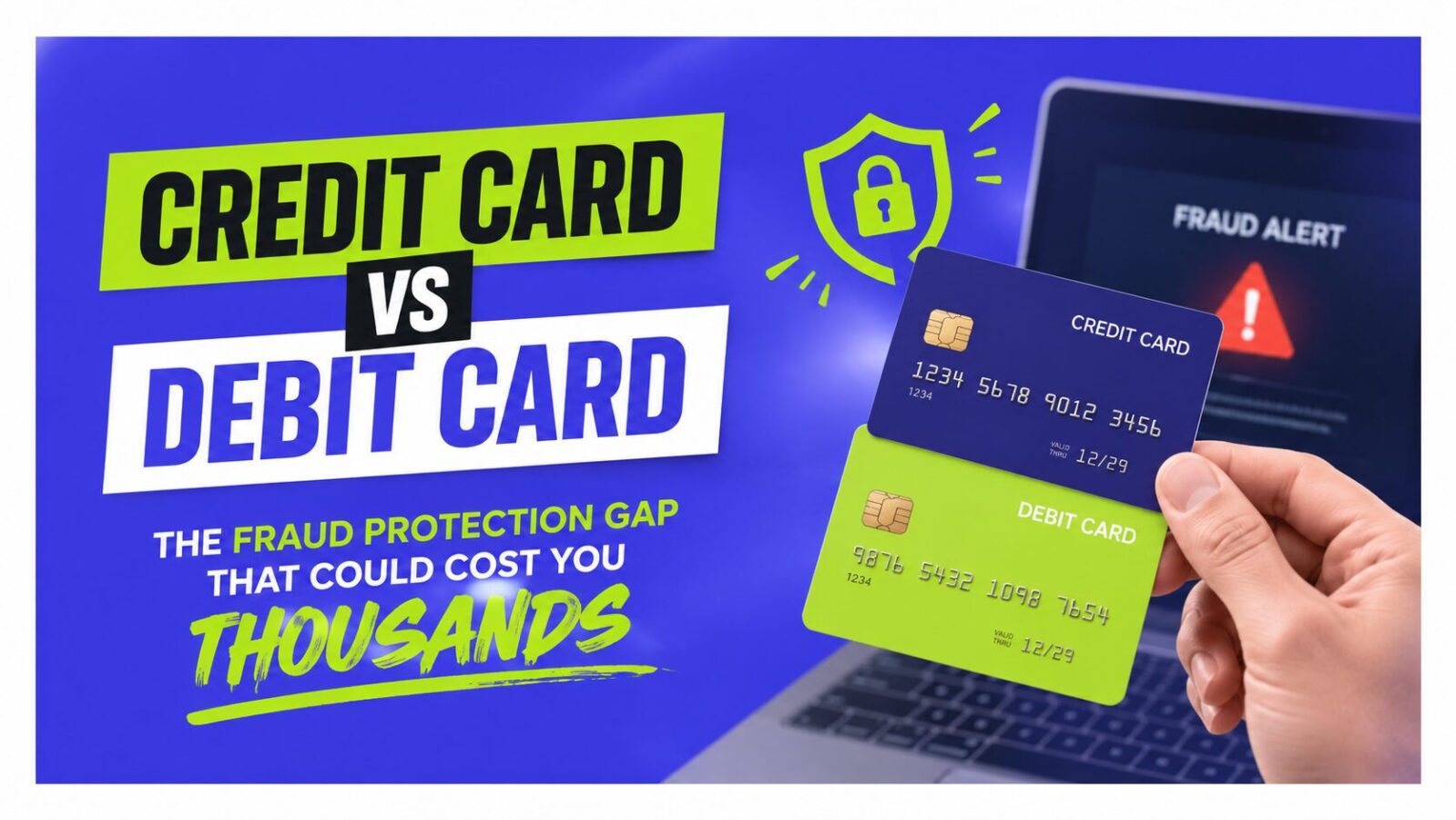
The key difference between a credit card and a debit card is whose money is at risk during fraud. With a credit card, a fraudulent charge is the issuer’s money until the dispute is resolved, and federal law caps your liability at $50 (usually $0). With a debit card, the money leaves your checking account immediately, and if you report late you can be liable for the full amount. They look identical, but the fraud protection gap is enormous. Here is the concrete difference and why it matters every time you choose which card to use.
Key Takeaways
- Credit cards risk the issuer’s money; debit cards drain your actual bank account.
- Credit card liability is capped at $50 (usually $0) no matter when you report.
- Debit liability rises with delay: $50 in 2 days, $500 in 60 days, then potentially unlimited.
- Use a credit card for almost everything and pay it in full to get protection plus rewards.
What Is the Core Legal Difference?
Credit cards are governed by the Fair Credit Billing Act (FCBA); debit cards by the Electronic Fund Transfer Act (EFTA). These laws set very different liability limits and reporting windows:
| Situation | Credit card (FCBA) | Debit card (EFTA) |
|---|---|---|
| Report within 2 business days | $0 to $50 max | $50 max |
| Report within 60 days | $0 to $50 max | $500 max |
| Report after 60 days | $0 to $50 max | Potentially unlimited |
| Zero-liability policy | Yes, across Visa, MC, Amex, Discover | Varies by bank |
| Money gone during dispute | No, it is the issuer’s money | Yes, it leaves your account immediately |
Whose Money Is Actually at Risk?
This is the difference that matters most. A fraudulent credit card charge is the issuer’s money on the line until resolved, so your bank account is untouched and the issuer has every incentive to investigate. A fraudulent debit charge takes your money out of your account immediately, and even if you get it back, you may be without those funds for days or weeks. If rent or a mortgage payment was due in that window, an insufficient-funds problem stacks on top of the fraud.
Put simply: a $2,000 fraudulent charge on a credit card leaves your checking account untouched, while the same $2,000 debit charge means $2,000 vanishes from your account the day the fraud happens.
What Do Real Fraud Scenarios Look Like?
A data breach exposes your card. A retailer you used months ago is breached, and fraudsters run $800 over a weekend. On a credit card, you call Monday, get provisional credit in a few days, a new card arrives midweek, and you lose nothing. On a debit card, even reporting promptly caps your liability at $50, but the $800 already left your checking account Friday, so a Monday autopay could bounce, triggering an NSF fee and possibly a late mark.
You miss the 60-day window. You travel for two months and spot a $1,500 fraudulent charge after 65 days. On a credit card, you are still fully protected, with $50 maximum liability regardless of timing. On a debit card, you are outside the 60-day window, so the bank may hold you responsible for the full $1,500 with limited recourse.
Do Debit Card Zero-Liability Policies Close the Gap?
Most banks advertise zero-liability policies for debit fraud, but these are voluntary policies, not legal requirements, so they can be modified or revoked and usually require you to report “promptly,” which banks define on their own terms. In practice they work reasonably well for straightforward fraud reported quickly, but they are at the bank’s discretion rather than federal law, making the protection weaker and less consistent than what credit cards get by statute.
Where Should You Use Each Card?
Use a credit card for:
- All online purchases, where breach risk is highest.
- Gas stations, where skimming is most common.
- Travel and hotels, with their large charges and deposits.
- Restaurants, where the card leaves your sight.
- Any unfamiliar or small merchant, and all subscriptions.
Debit is lower-risk for:
- ATM withdrawals at your own bank (chip and PIN).
- Cash back at a point-of-sale terminal.
- Situations where you deliberately do not want to use credit.
For extra online protection, see our guide on virtual credit card numbers.
How Do You Build the Right Habit?
The simplest rule: use a no-annual-fee credit card for everyday purchases, pay the full balance every month, and keep your debit card for ATM withdrawals. That gives you full fraud protection on every dollar, earns cash back, and builds your credit, all at zero cost if you pay in full.
People who “only use debit to avoid debt” are solving the right problem (not carrying a balance) with the wrong tool. The fix for credit card debt is paying in full monthly, not using a card that exposes your actual bank account to fraud. See our guides on the best free credit monitoring and credit freeze vs fraud alert.
FAQ
Is a credit card safer than a debit card?
Yes, for fraud. Credit card liability is capped at $50 (usually $0) regardless of when you report, and the issuer’s money is at risk during the dispute. Debit fraud drains your account and your liability grows the longer you wait.
What is my liability for debit card fraud?
Up to $50 if you report within 2 business days, up to $500 within 60 days, and potentially unlimited after 60 days under the EFTA. Bank zero-liability policies may reduce this but are not guaranteed by law.
Should I use my debit card for online shopping?
Generally no. Online purchases carry the highest breach risk, and a credit card keeps your bank account out of the line of fire. Use a credit card or a virtual card number instead.
Does using a credit card build credit while a debit card does not?
Correct. Credit card activity reports to the bureaus and builds your credit history; debit cards do not report or build credit at all.
Bottom Line
With a credit card, fraud risks the issuer’s money and your liability is capped at $50 no matter when you report; with a debit card, the money leaves your account instantly and late reporting can cost you everything. Use a no-fee credit card for almost everything, pay it in full each month, and reserve debit for ATM withdrawals. To go deeper, see our guides on virtual credit card numbers, the best free credit monitoring, and credit freeze vs fraud alert.
This article is for educational and informational purposes only and does not constitute legal or financial advice. Liability rules and bank policies vary, so confirm current protections with your card issuer or bank.