By
By 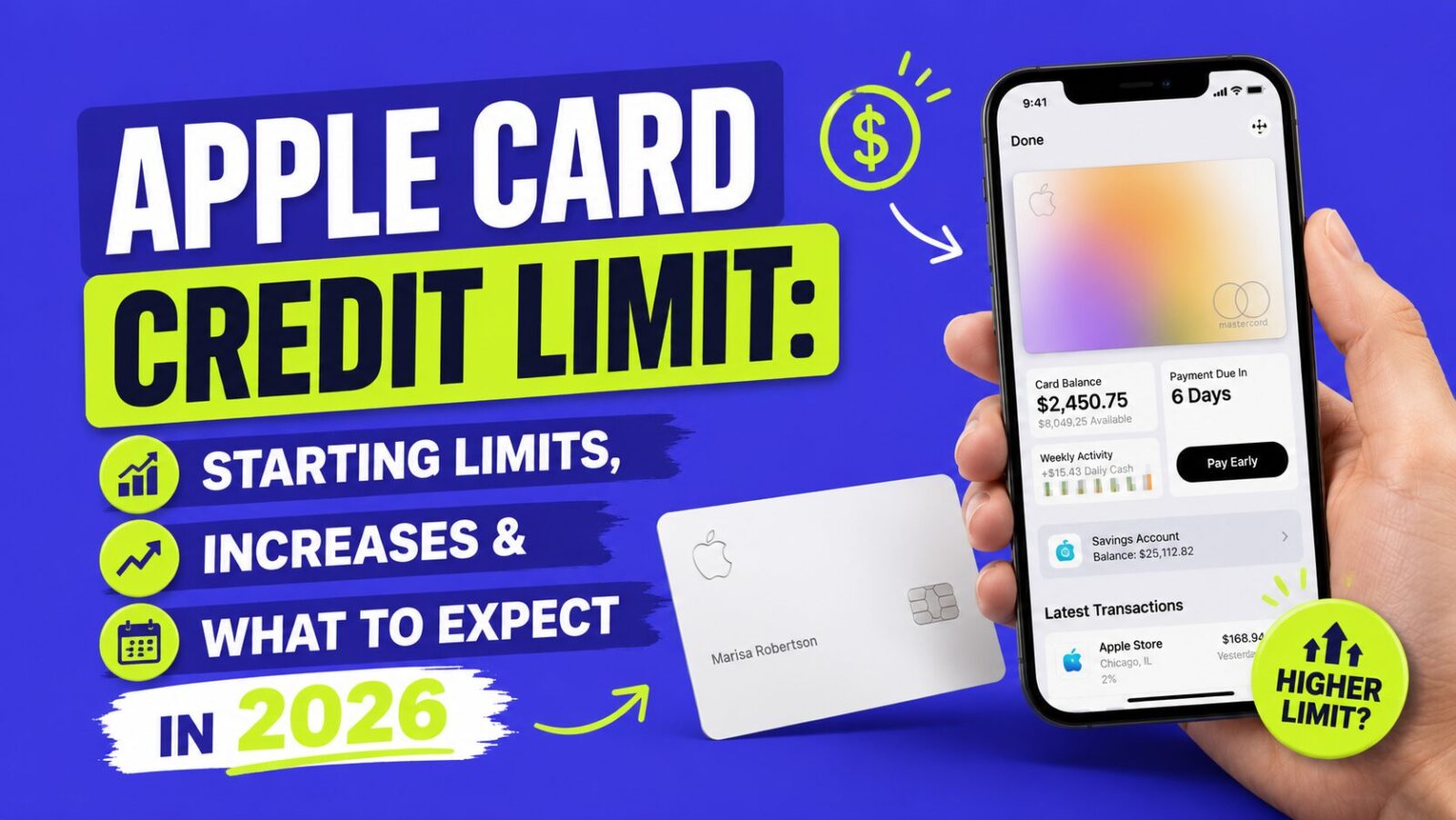
Apple Card does not advertise a minimum or maximum credit limit, but user-reported data consistently shows starting limits in the $2,500 range for average applicants, and as high as $20,000 or more for those with strong credit and income. What Goldman Sachs sets at approval is not your ceiling. Here is everything you need to know about how the Apple Card credit limit works, what drives it, and how to get it raised.
What Credit Limit Will You Get on Apple Card?
Apple and Goldman Sachs do not publish a stated minimum or maximum credit limit for the Apple Card. Based on aggregated user reports and third-party analysis, typical starting limits fall in the following ranges:
- Fair credit (FICO 580–669): Approval is possible but less common; starting limits tend to be on the lower end, often $500 to $1,500
- Good credit (FICO 670–739): Starting limits most commonly reported in the $2,500 to $5,000 range
- Very good credit (FICO 740–799): Starting limits frequently in the $5,000 to $10,000 range
- Excellent credit (FICO 800+) with high income: User-reported limits as high as $20,000, with some reports going higher
These ranges are approximate and based on publicly shared cardholder data, not disclosed issuer policy. Two applicants with identical credit scores can receive different limits because Goldman Sachs also weighs income, existing debt obligations, and credit utilization on other accounts, all of which it evaluates in combination rather than in isolation.
How Goldman Sachs Determines Your Apple Card Credit Limit
Apple’s own financial health page confirms that Goldman Sachs uses the same factors for setting your initial credit limit as it does for evaluating your application, with additional emphasis on your ability to repay.
Credit score. Goldman Sachs pulls from TransUnion as its primary bureau for Apple Card decisions. The application process starts with a soft pull that does not affect your score. A hard pull only happens if you choose to accept your offer. Most approvals come at FICO scores of 670 or above, with better credit consistently producing higher starting limits.
Income. Goldman Sachs specifically assesses disposable income, meaning income remaining after existing monthly debt obligations. A high gross income with significant existing debt servicing costs may produce a lower limit than a moderate income with little debt. Reporting total annual income accurately on your application, including all qualifying sources, is important here.
Existing debt load. Goldman Sachs calculates minimum payment obligations on all existing debt and uses that to model how much additional credit you can realistically service. High credit card balances, large student loans, or a recent auto loan all reduce the limit Goldman Sachs is willing to extend.
Credit utilization on existing accounts. Even if your score is high, carrying balances close to your existing credit limits signals financial strain and typically results in a more conservative starting limit.
Payment history. Goldman Sachs also draws from available utility payment history (telecom, gas, electricity) where applicable, in addition to traditional credit bureau data. This is part of Apple’s stated goal of assessing creditworthiness beyond the FICO score alone, which is relevant for applicants with thin credit files but consistent bill-payment histories.
How to View Your Apple Card Credit Limit
You can check your current credit limit, available credit, and APR directly in the Wallet app at any time:
- Open the Wallet app and tap your Apple Card
- Tap the More button (the circle with three dots)
- Tap Account Details
- Scroll down to Credit Details
Alternatively, through iOS Settings: go to Settings, scroll to Wallet & Apple Pay, tap Apple Card, then tap the Info tab. Your credit limit, available credit, and APR are all displayed there.
How to Request an Apple Card Credit Limit Increase
The entire process for requesting a credit limit increase on the Apple Card happens through the Wallet app via a text-style message to a Goldman Sachs representative. There is no web portal or phone-based self-service form. The steps:
- Open the Wallet app and tap your Apple Card
- Tap the More button
- Tap Account Details
- Tap the Message button at the top of the screen
- Type a message requesting a credit limit increase and tap Send
A Goldman Sachs representative will respond, potentially asking about changes in your income or other relevant factors. Many cardholders report near-instant decisions, though Goldman Sachs notes that some requests may take up to 30 days to review.
Alternatively, you can call Goldman Sachs customer service through the Wallet app to make the request by phone.
Does Requesting a Credit Limit Increase Affect Your Credit Score?
In most cases, no. Apple’s support documentation confirms that requesting a credit limit increase does not impact your credit score. Goldman Sachs uses a soft pull of your credit report for the vast majority of increase requests, which is invisible to other lenders and does not affect scoring models.
A hard pull is possible in some situations, particularly if you push back on a counteroffer and request a manual review, or if Goldman Sachs determines additional underwriting is needed. Goldman Sachs cannot perform a hard pull without your explicit permission and must notify you before doing so. If a representative indicates a hard pull will be required, you can decline and wait until a better time.
User reports in Apple community forums suggest Goldman Sachs uses TransUnion for Apple Card credit decisions, including limit increase requests. If you have a credit freeze on your TransUnion file, unfreezing it before submitting your request may be advisable, though Goldman Sachs may be able to access it as an existing creditor even with a freeze in place.
When to Request an Increase
Goldman Sachs reviews Apple Card accounts regularly and may grant automatic increases without any action on your part. However, automatic increases are not guaranteed and the timing is unpredictable. The most reliable path to a higher limit is a direct request, and the best timing considerations are:
Wait at least 6 months after opening the account. Apple’s support documentation explicitly recommends this. An account with less than 6 months of history does not give Goldman Sachs enough data to evaluate your payment pattern, making approval for an increase unlikely regardless of your credit profile.
Make on-time payments consistently. Every on-time payment strengthens your case. Goldman Sachs looks at payment history on your Apple Card specifically, not just your overall credit report, when evaluating limit increase requests.
Keep utilization low. Using a small percentage of your available limit and paying it off monthly signals that you manage credit responsibly and do not need to borrow close to your ceiling.
Update your income if it has grown. Higher income directly supports a higher limit. If your salary has increased since you opened the account, mentioning the updated figure in your request message is worthwhile. Goldman Sachs uses disposable income as a key factor in limit decisions.
Do not request more than once every 6 months. Multiple requests in quick succession are unlikely to succeed and may signal financial instability. Spacing requests out by at least 6 months is generally recommended.
Why a Higher Limit Matters Beyond Spending Power
The most practical reason to pursue a credit limit increase is not to spend more money. It is to lower your credit utilization ratio, which is one of the most influential factors in your credit score.
Credit utilization is calculated as your current balance divided by your total available credit. If your Apple Card has a $2,500 limit and you regularly carry a $600 balance, your utilization on that card is 24%. Raise the limit to $5,000 with the same spending pattern and utilization drops to 12%. Credit scoring models reward lower utilization, and reducing it can meaningfully improve your score within one to two billing cycles.
This dynamic is particularly relevant for Apple Card users who use the card heavily because they want Daily Cash back on Apple Pay purchases. High utilization on a heavily-used card can drag down a credit score even if you pay the full balance every month, because credit bureaus often capture the statement balance before it is paid.
A Note on the Apple Card’s Issuer Transition
On January 7, 2026, Goldman Sachs and JPMorgan Chase jointly announced that Chase will take over as the issuer of the Apple Card. The transition is expected to take approximately 24 months to complete, meaning Goldman Sachs will continue operating the Apple Card program and making all credit decisions through roughly early 2028.
For current cardholders, nothing changes during the transition period. Existing cards continue working normally, rewards structure remains the same, and credit limit decisions are still made by Goldman Sachs until the formal handover is complete. Chase will issue new physical cards to existing cardholders and establish a new Apple Savings account structure as part of the migration, but no action is required from cardholders in the near term.
Once Chase takes over, credit limit policies may evolve. Chase has its own underwriting standards and existing cardholders may find that limit increase requests are evaluated differently under Chase’s framework. Apple has set up a transition information page at learn.applecard.apple/transition for updates as the process advances.
What to Do If Your Request Is Denied
If Goldman Sachs declines your credit limit increase request, you will receive an email explaining the specific reasons. Common denial reasons include a credit score that has declined since account opening, high credit utilization on your Apple Card or other accounts, insufficient income relative to existing debt obligations, or an account history that is too short.
The denial notice gives you a specific roadmap. Address the cited factors before making another request, and wait at least 6 months before trying again. If the reason is utilization, paying down your balance is the fastest lever. If the reason is credit score, reviewing your full credit report for any errors or negative items worth disputing is a practical next step.
There is no limit on how many times you can request an increase over time, though frequency matters. One well-timed request with strong supporting factors is more likely to succeed than multiple quick requests after a denial.
Credit limit ranges are based on aggregated user-reported data and third-party analysis; Apple and Goldman Sachs do not publish minimum or maximum credit limits for the Apple Card. Apple Card is issued by Goldman Sachs Bank USA. As of January 2026, JPMorgan Chase has agreed to take over as Apple Card issuer; the transition is expected to take approximately 24 months. All credit decisions during the transition period remain with Goldman Sachs. This article is for informational purposes only. Finance Pulse may earn affiliate compensation if you apply through links on this page.