By
By 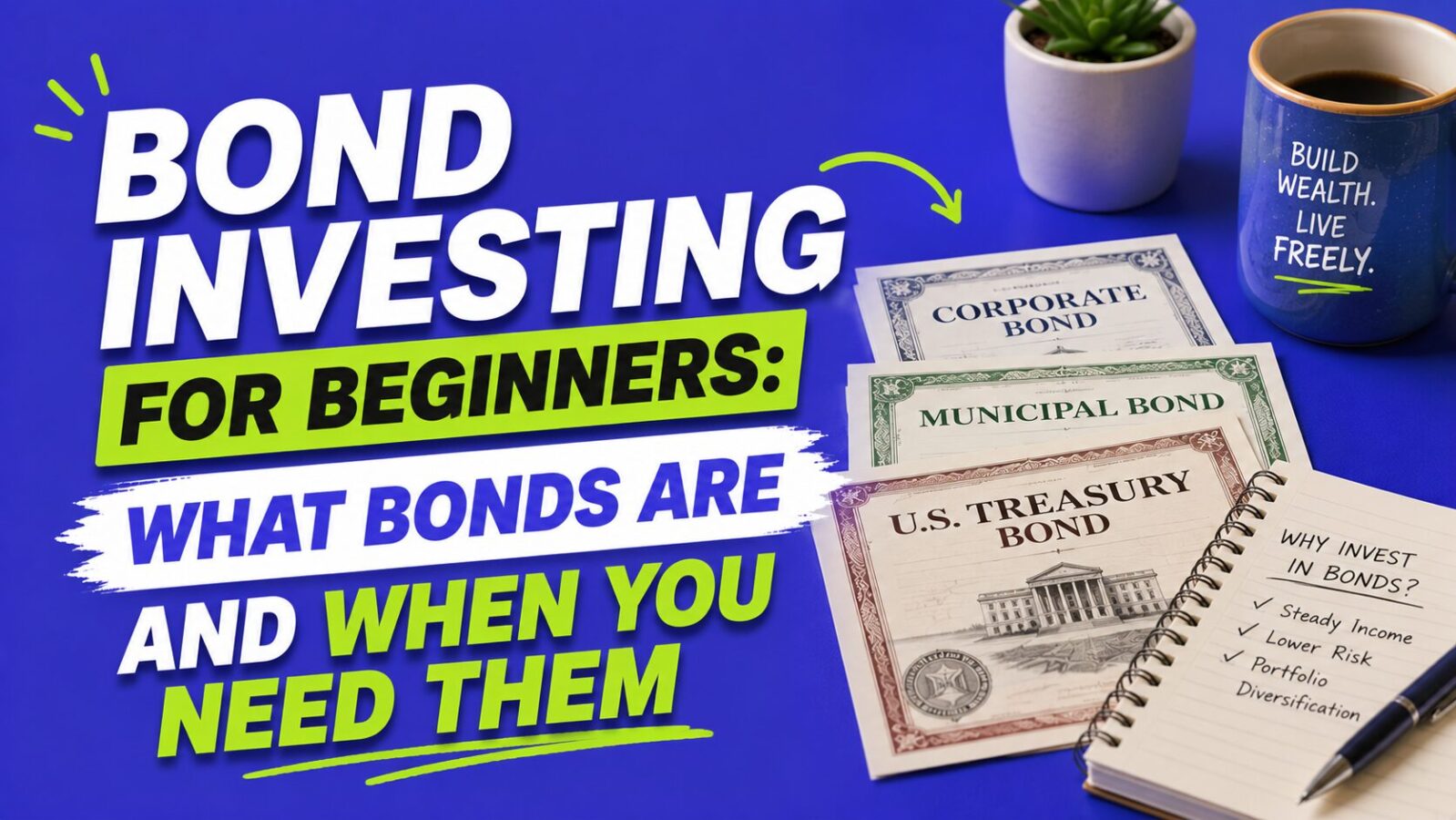
Bonds are the boring part of your portfolio that keeps you from panicking when stocks crash. Here is how bonds work, when you need them, and the best bond funds for beginners.
In our investing guides, we recommend allocations like “90% stocks, 10% bonds” or “60% stocks, 30% international, 10% bonds.” We mention BND in our 3-fund portfolio. We reference bonds in our target-date fund explanation.
But we have never explained what bonds actually are, why they matter, and when you should care about them. If you are in your 20s with a 100% stock portfolio, bonds feel irrelevant. They earn less. They are boring. Why bother?
The answer: bonds are the part of your portfolio that prevents you from selling everything at the worst possible moment. When stocks dropped 34% in March 2020, portfolios with 20 to 30% bonds dropped only 20 to 25%. That smaller drop is the difference between “this is uncomfortable” and “I am selling everything.” And selling at the bottom is the most expensive mistake an investor can make.
- A bond is a loan you make to a government or company. They pay you regular interest and return your principal at maturity.
- Bonds reduce portfolio volatility. In the 2008 crash, a 60/40 portfolio lost roughly half as much as a 100% stock portfolio.
- For most beginners, BND or AGG (broad US bond ETFs at 0.03%) is all you need.
- If you are in your 20s, 0 to 10% bonds is fine. Gradually increase as you approach retirement.
- Hold bonds in tax-advantaged accounts (Roth IRA, 401k) since bond interest is taxed as ordinary income.
What Is a Bond?
A bond is a loan you make to a government or corporation. They borrow your money and promise to pay you back with interest on a specific date.
When you buy a US Treasury bond, you are lending money to the US government. When you buy a corporate bond from Apple, you are lending money to Apple. In both cases, the borrower pays you regular interest (called the coupon) and returns your principal (the original loan amount) when the bond matures.
Example: You buy a $1,000 US Treasury bond with a 4% coupon and a 10-year maturity. For 10 years, the government pays you $40 per year in interest. At the end of 10 years, you get your $1,000 back. Total received: $1,400 ($400 interest + $1,000 principal).
That is it. Bonds are loans with predictable payments. Compared to stocks — which have no guaranteed returns and can lose 50% in a bad year — bonds are the boring, predictable anchor of your portfolio.
Types of Bonds
US Treasury Bonds (Government Bonds)
Issued by the US Department of the Treasury. Backed by the full faith and credit of the US government. Essentially zero default risk.
- Treasury Bills (T-Bills): 4 weeks to 1 year maturity. Sold at a discount, redeemed at face value.
- Treasury Notes (T-Notes): 2 to 10 year maturity. Pay semiannual coupons.
- Treasury Bonds (T-Bonds): 20 to 30 year maturity. Pay semiannual coupons.
- TIPS: Adjust principal with inflation. Protects against inflation eroding your purchasing power.
- I Bonds: Sold through TreasuryDirect.gov. Earn a fixed rate plus inflation adjustment. $10,000 annual limit per person. Cannot be redeemed for 12 months.
Treasury interest is exempt from state and local income taxes. This makes Treasuries especially attractive in high-tax states like California or New York.
Corporate Bonds
Issued by companies to fund operations or expansion. Higher yield than Treasuries because companies carry more default risk than the US government.
- Investment-grade: Rated BBB or higher. Low default risk. Examples: Apple, Microsoft, Johnson and Johnson bonds.
- High-yield (junk bonds): Rated BB or lower. Higher default risk, higher yield (7 to 10%+). Not recommended for beginners.
Municipal Bonds
Issued by state and local governments to fund infrastructure. Interest is typically exempt from federal income taxes and often from state taxes if you live in the issuing state. Best for high-income investors in high-tax states.
Bond Funds (How Most People Invest in Bonds)
Instead of buying individual bonds, most investors buy bond ETFs or mutual funds that hold thousands of bonds. Benefits: instant diversification, easy to buy and sell, no need to manage individual bond maturities. For most people, a single bond ETF like BND is all they need.
The Best Bond Funds for Beginners
| Fund | Type | Expense Ratio | Yield | Best For |
|---|---|---|---|---|
| Vanguard Total Bond Market ETF (BND) | Broad US bonds | 0.03% | ~4.0 to 4.5% | Core bond allocation |
| iShares Core US Aggregate (AGG) | Broad US bonds | 0.03% | ~4.0 to 4.5% | Same as BND |
| Vanguard Short-Term Bond ETF (BSV) | Short-term bonds | 0.04% | ~4.0% | Lower interest rate risk |
| Vanguard Total International Bond (BNDX) | International bonds | 0.07% | ~3.5% | Global diversification |
| iShares TIPS Bond ETF (TIP) | Inflation-protected | 0.19% | ~3.5% | Inflation hedge |
| Vanguard Short-Term Treasury ETF (VGSH) | Short US Treasuries | 0.04% | ~4.0% | Ultra-safe, cash alternative |
For most beginners: BND or AGG. These are broadly diversified US bond funds holding government and corporate bonds across all maturities. One fund, total bond market exposure. BND and AGG are nearly identical — choose whichever is available in your account.
If you use a target-date fund, your bond allocation is already handled automatically. You do not need to buy BND separately.
When Do You Need Bonds?
You are building a 3-fund portfolio. Our recommended 3-fund portfolio: 60% VTI (US stocks), 30% VXUS (international stocks), 10% BND (bonds). The 10% bond allocation reduces volatility and provides rebalancing opportunities when stocks crash.
You are within 10 to 15 years of retirement. As you approach retirement, increasing your bond allocation protects against a major stock crash right before you need the money. A target-date fund does this automatically, shifting from roughly 10% bonds at age 25 to 40 to 50% bonds at age 60.
You need money in 2 to 5 years. For medium-term goals such as a house down payment, short-term bond funds or TIPS provide better returns than a savings account with much less risk than stocks.
You have a low risk tolerance. If a 30% stock market drop would cause you to sell everything, a higher bond allocation (30 to 40%) keeps losses in a range you can tolerate. A portfolio you stick with through crashes beats a theoretically optimal portfolio you abandon when it drops.
You are in your 20s and 100% stocks. Honestly? You may not need bonds yet. With a 30 to 40-year time horizon, the higher expected return of stocks outweighs the volatility reduction of bonds. If you can truly stomach a 40% decline without selling, 100% stocks is fine in your 20s. If that drop would rattle you, add 10 to 20% bonds for smoother returns.
Not sure how much to allocate? Use this calculator:
Bond Allocation Calculator
Set your age and risk tolerance to get a personalized stock/bond split.
How Bonds Reduce Risk: The Math
The best way to understand bonds is to see how different stock/bond allocations performed during real market crashes. Use the comparison below to explore each scenario:
Portfolio Drawdown Comparison
How did different allocations perform during each major downturn?
Long-term average annual returns (1926 to 2025):
- 100% stocks: ~10%
- 80/20 stocks/bonds: ~9.3%
- 60/40 stocks/bonds: ~8.5%
- 40/60 stocks/bonds: ~7.5%
You give up roughly 0.7% annual return for each 20% shift from stocks to bonds. Over 30 years on a $500/month investment, the difference between 100% stocks and 80/20 is roughly $120,000. Significant — but the 80/20 investor probably stayed invested through the crashes, which is the harder part.
Bond Risks You Should Know
Interest rate risk. When interest rates rise, existing bond prices fall. If you hold a bond fund like BND and rates increase by 1%, the fund drops roughly 5 to 6%. This is what happened in 2022. If you hold individual bonds to maturity, this does not matter — you still get your principal back. In a bond fund, you can experience temporary losses.
Inflation risk. If your bond yields 4% and inflation is 5%, you are losing purchasing power in real terms. This is why TIPS and I bonds exist: they adjust for inflation. Standard bonds do not.
Credit risk. Corporate bonds carry the risk the company defaults. Investment-grade bonds have very low default rates (under 0.5%). Treasury bonds have essentially zero credit risk.
Reinvestment risk. When interest rates fall, the coupon payments you receive are reinvested at lower rates, reducing total return over time.
For most beginners investing through BND, interest rate risk is the primary concern. The solution: hold for the long term. Bond fund returns recover from rate increases as the fund continuously buys new higher-yielding bonds to replace maturing lower-yielding ones.
Where to Hold Bonds in Your Portfolio
Tax-advantaged accounts are best. Bond interest is taxed as ordinary income (your marginal rate, up to 37%). In a Roth IRA, bond interest grows tax-free. In a 401(k) or Traditional IRA, it grows tax-deferred.
If you hold bonds in a taxable brokerage account, consider Treasury bonds or municipal bonds for their tax advantages. Treasury interest is state-tax-exempt. Municipal bond interest is often federal-tax-exempt.
This is the “asset location” concept: stocks in taxable accounts (lower tax on qualified dividends and long-term gains), bonds in tax-advantaged accounts (sheltering the higher-taxed interest income).
Bonds vs High-Yield Savings Accounts
With high-yield savings accounts paying 4 to 5% APY, you might wonder: why bother with bonds at all?
For short-term savings (under 2 years): A HYSA is better. FDIC-insured, no price fluctuation, no interest rate risk. Use it for your emergency fund and short-term goals.
For portfolio diversification: Bond funds serve a different purpose. They are part of your investment portfolio, providing a counterweight to stocks during downturns. When stocks crash, bonds typically hold steady or rise, giving you the ability to rebalance (sell bonds, buy cheap stocks). A HYSA does not serve this function.
For long-term returns: Bonds have historically returned 4 to 6% annually. HYSA rates fluctuate with Fed policy. When rates eventually fall, HYSA yields drop — but bond fund values increase as existing higher-coupon bonds become more valuable. Bonds provide more predictable long-term returns inside a portfolio.
Frequently Asked Questions
Are bonds safe?
US Treasury bonds are considered the safest investment in the world. Investment-grade corporate bonds are very safe. Bond funds can lose value temporarily when interest rates rise, but the underlying bonds still pay coupons and return principal at maturity. “Safe” depends on your time frame and what you mean by safe.
How much of my portfolio should be in bonds?
A common rule: your age minus 20 equals your bond percentage (30 years old = 10% bonds). This is a guideline, not a rule. At 25, 0 to 10% is fine. At 50, 25 to 35% is common. At 65, 40 to 50% is typical. Use the calculator above for a personalized starting point. If you use a target-date fund, this is handled automatically.
Can I lose money in a bond fund?
Yes, temporarily. When interest rates rise, bond fund prices fall. BND lost roughly 13% in 2022. However, the fund’s yield increased as new bonds were added at higher rates. If you hold through the downturn, the fund recovers over 2 to 4 years as bonds mature and are replaced with higher-yielding ones.
What is the difference between BND and AGG?
Very little. Both track the Bloomberg US Aggregate Bond Index. Both hold 10,000+ bonds. Both charge 0.03%. Performance is nearly identical. Choose whichever is available in your brokerage account.
Should I buy individual bonds or bond funds?
Bond funds for most people. Individual bonds require large minimums ($1,000+ per bond), research into creditworthiness, and active management of a bond ladder. Bond ETFs give you diversified exposure for the price of one share with zero management effort.
Are I bonds a good investment?
I bonds are excellent for inflation protection and short-to-medium term savings (1 to 5 years). They cannot lose value, adjust for inflation, and are tax-deferred until redemption. The $10,000 annual purchase limit and 12-month lockup are the main drawbacks. They complement but do not replace a bond fund in your investment portfolio.
Why did bonds fail to protect my portfolio in 2022?
2022 was historically unusual: the Federal Reserve raised interest rates at the fastest pace in decades, causing both stock and bond prices to fall simultaneously. This almost never happens. In the 2001 dot-com crash, 2008 financial crisis, and 2020 COVID crash, bonds held steady or rose while stocks fell sharply. One anomalous year does not change the long-term role bonds play in a diversified portfolio.
Do bond funds pay dividends?
Bond funds distribute interest income as monthly dividends (unlike stock ETFs which pay quarterly). BND currently yields approximately 4.0 to 4.5% annually, paid monthly. This income is taxed as ordinary income — one more reason to hold bond funds inside a Roth IRA or 401(k) rather than a taxable brokerage account.
The Bottom Line
Bonds are not exciting. They will never double in a year. Nobody posts their bond returns on social media. But they serve a critical function: keeping your portfolio stable enough that you do not panic-sell during a stock market crash.
If you are in your 20s, 0 to 10% bonds is fine. If you are in your 30s, 10 to 20% is reasonable. As you approach retirement, gradually increase to 30 to 50%. Or just use a target-date fund and let it handle the allocation automatically.
The best bond fund for most people is BND (Vanguard Total Bond Market ETF) at 0.03%. Buy it in your Roth IRA or 401(k), set your allocation, and rebalance once a year. That is the entire bond strategy.
Build a balanced portfolio today
Where to go next:
- Want the full allocation strategy? Read our 3-fund portfolio guide to see how stocks, international, and bonds fit together.
- Want it handled automatically? Read our target-date fund guide — one fund does the whole allocation for you.
- Where to open an account? Read our Fidelity review for the easiest place to buy BND, VTI, and VXUS together.