Financial stress affects your sleep, relationships, and health. Here is how money anxiety works, why avoidance makes it worse, and practical strategies to break the cycle.
According to the American Psychological Association (APA), money has been the top source of stress for Americans for over a decade. A 2023 APA survey found that 72% of adults reported feeling stressed about money at least some of the time, with 26% feeling stressed about money most or all of the time.
Financial stress is not just unpleasant. It is harmful. Research published in Social Science & Medicine shows that financial stress is linked to depression, anxiety, insomnia, relationship conflict, and even physical health conditions like hypertension and weakened immune function.
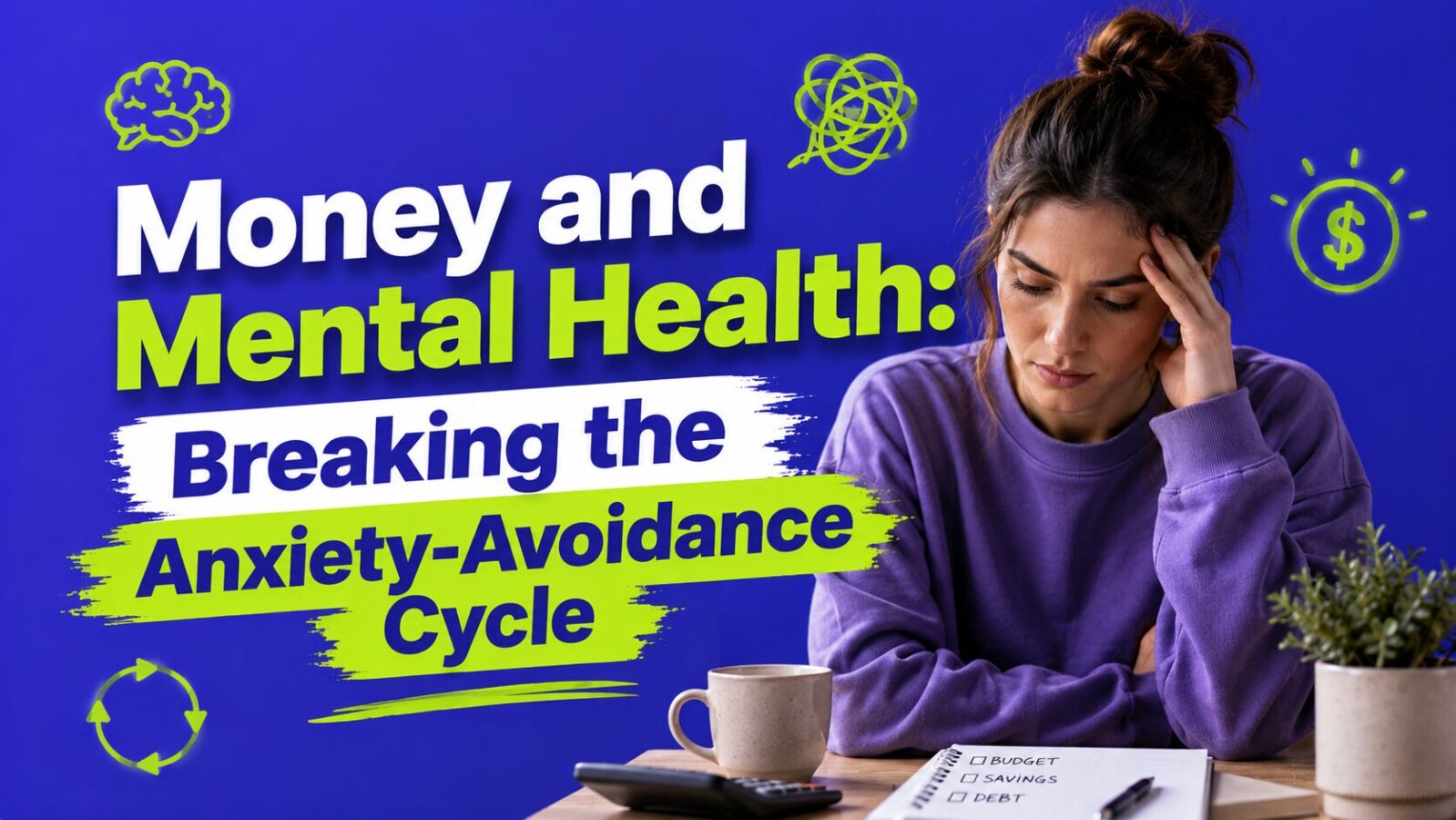
The cruelest part: financial anxiety often leads to financial avoidance (not checking balances, ignoring bills, avoiding conversations), which makes the financial situation worse, which increases anxiety. It is a cycle, and breaking it requires understanding how it works.
The anxiety-avoidance cycle
Here is how it typically plays out:
Step 1: Financial trigger. A bill arrives. Your credit card statement closes. Tax season approaches. You remember that you have not checked your bank account in weeks.
Step 2: Anxiety response. Your chest tightens. Your mind races with worst-case scenarios. You feel shame, guilt, or overwhelm. The emotional response is disproportionate to the actual situation because the uncertainty amplifies the fear.
Step 3: Avoidance. To relieve the anxiety, you do not look. You leave the bill unopened. You do not check the balance. You change the subject when your partner brings up money. The avoidance provides immediate emotional relief.
Step 4: Consequences compound. The bill accrues a late fee. The credit card balance grows with interest. The financial situation deteriorates because no action was taken.
Step 5: Greater anxiety. The next time a trigger occurs, the anxiety is worse because the situation is worse. The cycle repeats, each loop making the financial and emotional reality harder to face.
This is not a character flaw. It is a well-documented psychological pattern. Research from the University of Nottingham on financial wellbeing shows that financial avoidance is a coping mechanism for distress, not laziness or irresponsibility.
Why money triggers such strong emotions
Money is never just about money. It is tangled with:
Survival instincts. Our brains are wired to perceive financial threats as survival threats. A low bank balance triggers the same stress hormones (cortisol, adrenaline) as a physical danger. This is why money problems feel so viscerally distressing, your brain is responding as if your life is at risk.
Childhood experiences. The way money was handled in your household growing up shapes your financial emotions as an adult. If money was a source of conflict, scarcity, or secrecy in your childhood, financial situations can unconsciously trigger those old emotional patterns.
Identity and self-worth. In a culture that equates financial success with personal value, financial struggle can feel like personal failure. Debt feels like a moral failing. Not earning “enough” feels like not being “enough.” These beliefs are culturally constructed but emotionally real.
Social comparison. Seeing peers who appear to be doing better financially (nicer apartment, newer car, frequent vacations) triggers inadequacy. Social media amplifies this by presenting curated highlights without showing the debt, stress, or family support behind them.
Breaking the cycle: practical strategies
Strategy 1: The 5-minute financial check-in
The hardest part of financial avoidance is the first look. Make it small.
Set a timer for 5 minutes. Open your bank account. Look at the number. Close it. That is it. You do not have to fix anything, plan anything, or feel anything specific. Just look.
The act of looking breaks the avoidance pattern. The anxiety spike is temporary (usually peaks in 30 to 60 seconds and then subsides). What you find is almost always less catastrophic than what your anxiety imagined.
Do this daily for a week. By day 4 or 5, the anxiety associated with checking your balance drops significantly. You are retraining your brain to associate financial awareness with safety rather than threat.
Strategy 2: Automate to reduce decisions
Every financial decision is a potential anxiety trigger. Reduce the number of decisions by automating:
- Autopay minimum payments on all bills (prevents late fees and the anxiety of missed payments)
- Automatic transfers to savings on payday
- Automatic 401(k) contributions
- Automatic Roth IRA contributions
- Automatic sinking fund transfers
When savings, investing, and bill payments happen automatically, you remove the decision points that trigger avoidance. The financial system runs whether you feel anxious or not.
Strategy 3: Separate the emotion from the math
When financial anxiety hits, your brain floods with emotional narratives: “I will never get out of debt,” “I am terrible with money,” “Everyone else has it figured out.”
Counter this by returning to the math. Math is neutral. It has no opinion about you.
- “I owe $8,000 in credit card debt” is math. “I am a failure” is narrative.
- “My savings rate is 10%” is math. “That is not enough” is judgment.
- “I spent $400 on dining out” is data. “I have no self-control” is a story.
When you separate data from emotion, you can work with the numbers without the shame spiral. $8,000 in debt at 24% APR, paid off with a balance transfer and $400/month payments, is gone in 21 months. That is a solvable math problem, not a permanent character deficiency.
Strategy 4: Start with one thing
Financial overwhelm often comes from trying to fix everything at once: debt, savings, investing, budget, credit score, retirement. That is paralyzing.
Pick one thing. Just one.
- If you have no savings: build a $1,000 emergency fund
- If you have high-interest debt: apply for a balance transfer card
- If you are not investing at all: open a Roth IRA with $50
- If you do not know where your money goes: track spending for one week
Completing one small financial action creates momentum and reduces the helplessness that fuels anxiety. The second action is easier than the first. The third is easier than the second.
Strategy 5: Talk about it
Financial shame thrives in silence. Talking about money with a trusted friend, partner, family member, or therapist reduces the emotional weight.
According to the Financial Health Network, people who discuss their finances with others report lower financial stress and make better financial decisions. Saying “I have $15,000 in student loans and it stresses me out” out loud is uncomfortable but immediately defuses some of the anxiety.
If your financial anxiety is severe (disrupting sleep, relationships, or daily functioning), a therapist who specializes in financial therapy can help. The Financial Therapy Association has a directory of licensed professionals who address the emotional and psychological aspects of money.
Strategy 6: Celebrate progress, not perfection
Financial anxiety often involves perfectionism: “I should be saving 20% already,” “I should have started investing at 22,” “I should not have this much debt.”
Replace “should” with “progress.” You are saving 5%? That is more than 0%. You paid $200 toward debt this month? That is $200 less debt. You checked your bank account for the first time in a month? That is a win.
Progress, no matter how small, reverses the anxiety-avoidance cycle because it builds evidence that you are capable of improving your financial situation. Each small win weakens the “I am bad with money” narrative and replaces it with “I am figuring this out.”
When to seek professional help
Financial anxiety crosses into a clinical concern when it:
- Causes persistent sleep disruption (insomnia, waking with racing thoughts about money)
- Leads to physical symptoms (chest tightness, nausea, headaches) when thinking about finances
- Prevents you from opening mail, checking accounts, or filing taxes for months
- Causes significant relationship conflict about money
- Leads to harmful coping behaviors (emotional spending, substance use, complete financial avoidance)
A licensed therapist experienced with financial anxiety can help you identify underlying patterns, develop coping strategies, and create a path forward. Financial therapy combines traditional therapy with practical financial planning.
Frequently asked questions
Is financial anxiety the same as being bad with money? No. Financial anxiety is an emotional response, not a skill deficit. Many financially anxious people actually know what they should do but feel paralyzed by anxiety. The problem is emotional, not informational.
How do I stop emotional spending? Emotional spending is a coping mechanism for stress, boredom, or sadness. Identify the emotion before the purchase: “Am I buying this because I need it, or because I feel [stressed/bored/sad]?” Use a 24-hour rule: wait 24 hours before non-essential purchases over $50. Find alternative coping mechanisms (walk, exercise, call a friend, journal).
My partner and I fight about money constantly. Is that normal? Money is the #1 source of conflict in relationships. It is common but not inevitable. Our guide on talking about money with your partner covers how to have productive financial conversations. If the conflict is persistent, couples therapy with a financial therapy component can help.
I am embarrassed about my financial situation. How do I get past that? Remember that 56% of Americans cannot cover a $1,000 emergency. 30% of six-figure earners live paycheck to paycheck. Financial struggle is more common than financial media suggests. Embarrassment decreases as action increases. Take one small step today.
The bottom line
Financial anxiety is real, common, and treatable. The anxiety-avoidance cycle makes financial problems worse by preventing the actions that would fix them. Breaking the cycle starts with small, manageable steps: a 5-minute check-in, one automated payment, one conversation with someone you trust.
Your financial situation is a set of numbers, and numbers can change. They change slowly, then quickly, as small habits compound over time. The same way compound interest grows your investments, consistent small financial actions grow your confidence, reduce your anxiety, and transform your relationship with money.
You do not need to have it all figured out. You need to take the next step. Just one. The rest follows.
Take your first step toward financial confidence