 By
By 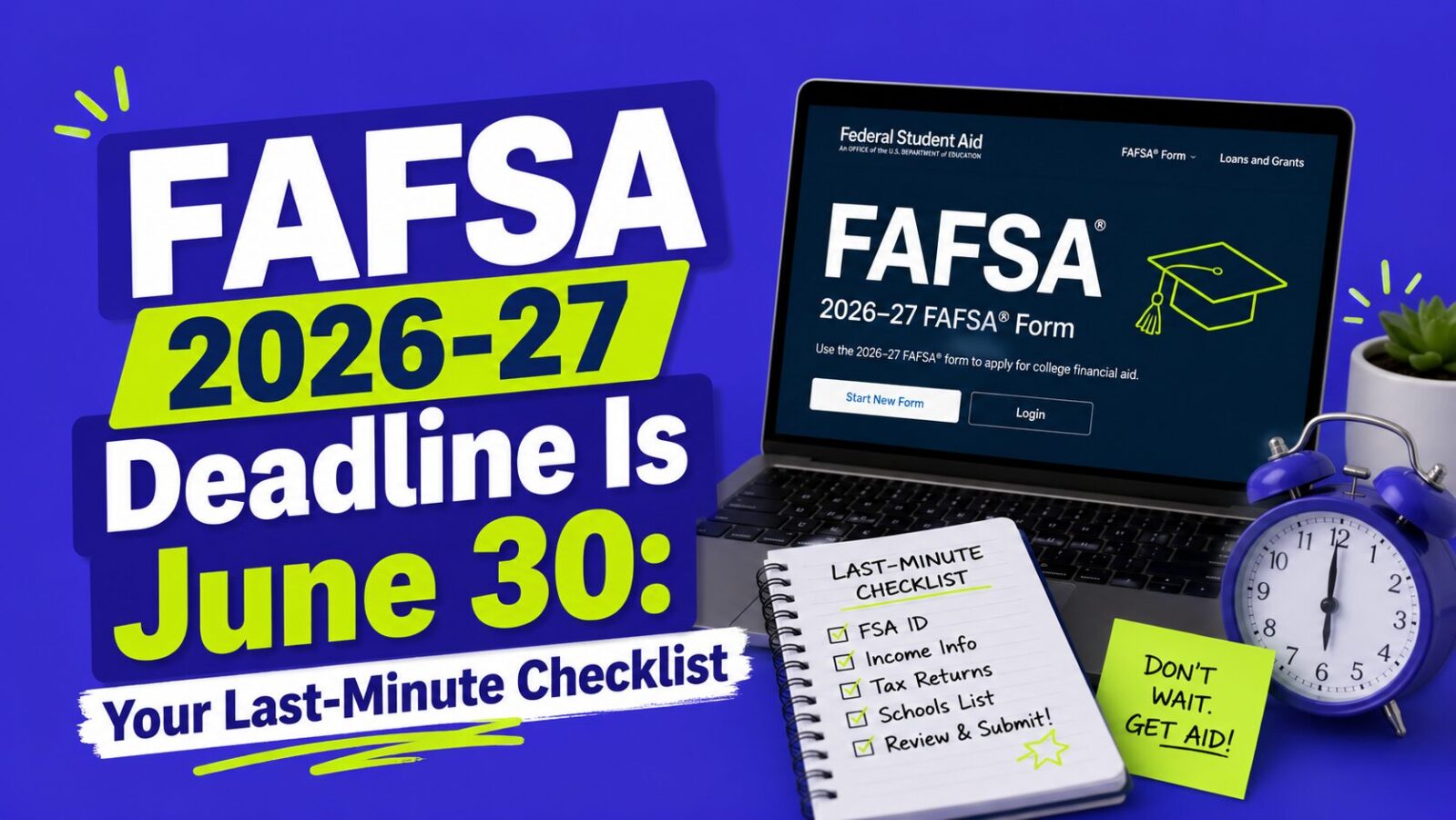
The federal deadline to submit the FAFSA for the 2025-2026 school year is June 30, 2026, so if you still need to file for the current year, you have only days left. The 2026-2027 FAFSA is already open at studentaid.gov with a federal deadline of June 30, 2027, though most state and school deadlines fall much earlier. The federal date is a floor, not the deadline that matters most. Here is what you need and the mistakes to avoid.
Key Takeaways
- The 2025-26 federal deadline is June 30, 2026; the 2026-27 deadline is June 30, 2027.
- State and school deadlines come first, and missing them forfeits grant money.
- Tax data imports automatically through the IRS Direct Data Exchange once you consent.
- File even if late; you still need it for federal loans and work-study.
Which FAFSA Deadline Applies to You?
| School year | Federal deadline | Tax year used |
|---|---|---|
| 2025-2026 (current) | June 30, 2026 | 2023 return |
| 2026-2027 (upcoming) | June 30, 2027 | 2024 return |
The federal deadline is the last possible date, but it is rarely the one that matters. Most states and colleges set earlier deadlines for grants and institutional aid, and missing a state deadline forfeits grant money that does not roll over. Check your state’s deadline at studentaid.gov.
What Do You Need to Complete the FAFSA?
Gather these before you start so it takes 30 minutes or less.
For the student: Social Security number; an FSA ID (create one at studentaid.gov); the relevant federal tax return (2023 for 2025-26, 2024 for 2026-27, imported automatically via the IRS Direct Data Exchange); records of untaxed income; and current bank and non-retirement investment balances.
For parents (if the student is a dependent): the parent’s Social Security number and FSA ID (new in recent cycles, parents can be invited by email rather than each creating one separately); the parent’s tax return for the relevant year; current bank and investment balances; and, if parents are divorced, information from the parent who provided the most financial support over the past 12 months.
How Does the Tax Data Import Work?
The FAFSA now uses the IRS Direct Data Exchange (which replaced the old IRS Data Retrieval Tool) to pull your tax information directly into the form once each contributor gives consent. It is faster, more accurate, and reduces the chance of a verification hold. If your relevant-year taxes are not yet filed, you can still complete the FAFSA with estimates and correct them after filing, so do not delay the FAFSA just because your taxes are not done.
How Does the OBBBA Affect 2026-27 Aid?
The One Big Beautiful Bill Act changed federal student lending, effective July 1, 2026. Parent PLUS is now capped at $20,000 per year per student and $65,000 aggregate per student, where there were previously no caps. Grad PLUS loans are eliminated for new borrowers, with new graduate and professional borrowing limits instead. The law also tied some Pell Grant eligibility to program outcomes, so a few programs with poor earnings data may see reduced eligibility for new students. Check current limits at studentaid.gov before planning your package. See our guides on the student loan changes and maximizing financial aid.
What Mistakes Should You Avoid?
- Not listing all schools. Add up to 20; each sees only its own entry, and adding one does not obligate you to attend.
- Leaving fields blank. Enter “0” rather than blank for items that do not apply, since blanks can trigger verification.
- Using the wrong parent for divorced families. Use the parent who provided more support in the past 12 months, not necessarily who you live with or who claims you.
- Reporting business ownership wrong. A business with more than 100 employees is reportable; small businesses and family farms with fewer are generally excluded.
- Missing the school’s priority deadline. Many fall in February or March, so filing in June likely misses priority consideration, but file anyway for federal loans and work-study.
What Happens After You Submit?
You will receive a summary of what you reported and your Student Aid Index (SAI), which replaced the old Expected Family Contribution. Schools use the SAI to build your aid package. If you are selected for verification, respond quickly, since delays hold up disbursement. And if your finances changed significantly since the tax year used (job loss, medical costs, divorce), contact the school’s financial aid office to request a professional judgment review, since schools can adjust based on current circumstances.
FAQ
When is the FAFSA deadline?
June 30, 2026 for the 2025-26 year and June 30, 2027 for 2026-27. But state and school deadlines come earlier and matter more, since missing them forfeits grant money.
What tax year does the FAFSA use?
The prior-prior year: the 2025-26 FAFSA uses 2023 taxes and the 2026-27 FAFSA uses 2024 taxes, imported automatically through the IRS Direct Data Exchange.
Should I still file the FAFSA if I missed the priority deadline?
Yes. You still qualify for federal loans and work-study, and some aid may remain. Filing late is far better than not filing at all.
How did the OBBBA change student aid?
It capped Parent PLUS at $20,000 per year per student ($65,000 aggregate), eliminated Grad PLUS for new borrowers, and tied some Pell eligibility to program outcomes, all effective July 1, 2026.
Bottom Line
File the FAFSA before June 30, 2026 for the current year (or by June 30, 2027 for 2026-27), but treat your state and school deadlines as the real targets since they distribute grant money first. Gather your FSA IDs and tax data, let the Direct Data Exchange import your return, and file even if you are late. To go deeper, see our guides on maximizing financial aid, the forgiveness tax bomb, and student loan changes.
This article is for educational and informational purposes only and is not financial advice. FAFSA rules and deadlines change, so verify current information at studentaid.gov before filing.