By
By 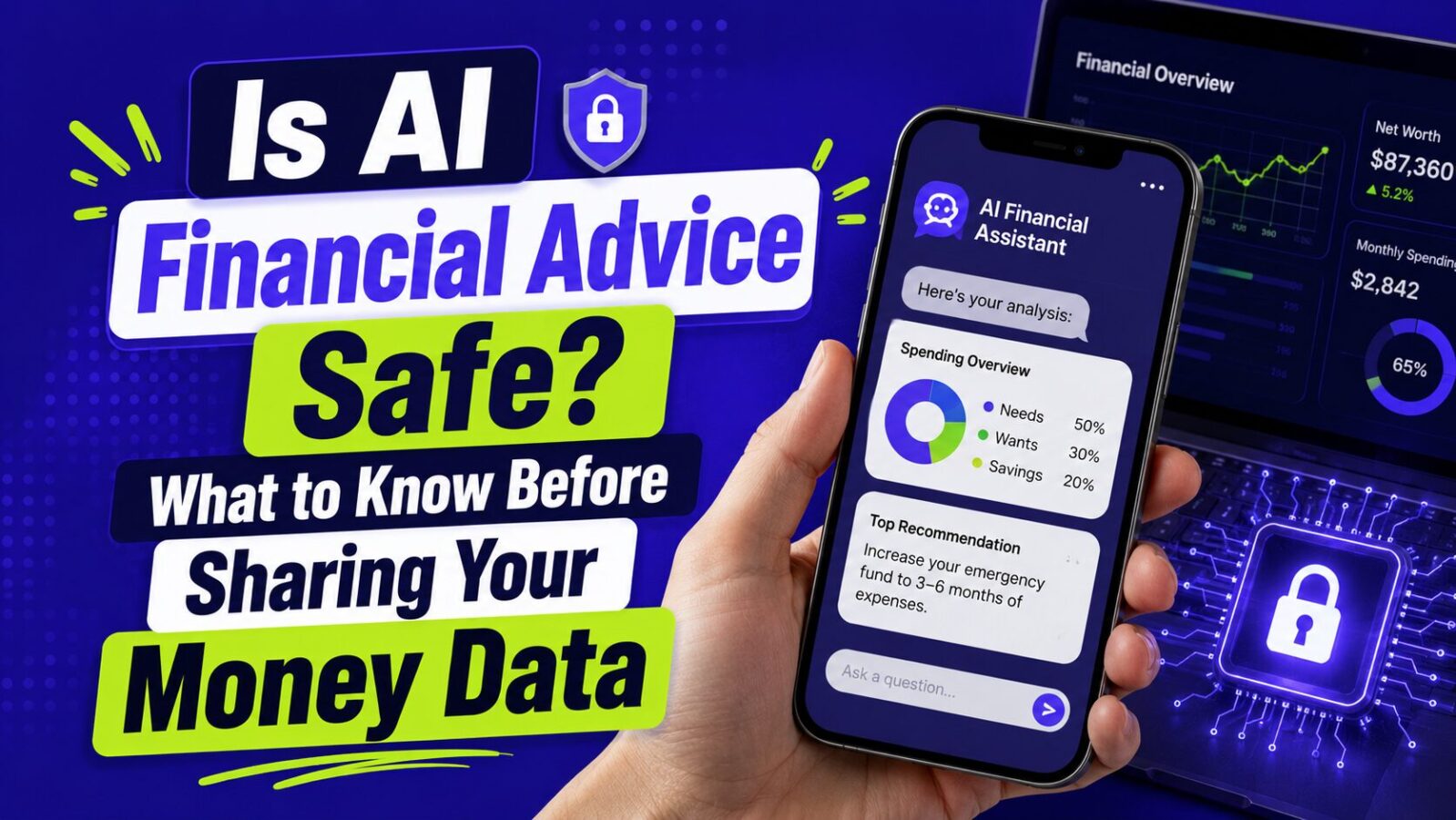
AI financial tools are useful and getting more capable, but safety depends entirely on what you share. The short rule: never upload documents containing your Social Security number (tax returns, W-2s) to a consumer AI tool, but describing your situation in general terms or connecting accounts read-only through Plaid carries much lower risk. After Mel Robbins urged followers to upload financial documents to Microsoft Copilot, and OpenAI launched a Plaid-based finance feature in ChatGPT, millions are now trying these tools. Here is what is actually safe and what is not.
Key Takeaways
- Never upload SSN documents (tax returns, W-2s) to consumer AI tools.
- Describing your situation in text or connecting accounts read-only via Plaid is far lower risk.
- AI is great for education and modeling, not for personalized, fiduciary investment advice.
- Read the data retention policy and disconnect accounts when you are not using them.
What Did Mel Robbins Say, and Why the Concern?
Robbins encouraged her audience to upload financial documents, like tax returns and bank statements, into Microsoft Copilot for personalized analysis, then walked some of it back after backlash. The technique works in that an AI with your full picture gives more relevant advice, but the concern is data governance: what happens to those documents, who can access them, how long they are kept, and whether the data feeds model training. Microsoft’s consumer terms note that data submitted through consumer accounts may be used to improve its products, while business accounts have stronger protections, and for sensitive documents that distinction matters.
How Is ChatGPT’s Finance Feature Different?
OpenAI launched a personal finance feature for ChatGPT Pro users in May 2026. Instead of uploading documents, users connect accounts through Plaid, the same infrastructure used by Monarch Money and thousands of apps, across 12,000+ institutions. Plaid connections are read-only: the AI can see balances, transactions, and portfolio values but cannot move money, trade, or transfer. OpenAI has said synced data is deleted within 30 days of disconnecting, and saved “financial memories” can be reviewed and deleted in settings. That is meaningfully different from uploading a tax-return PDF: one is a read-only connection with defined retention, the other is an unstructured document with murkier governance. See our Monarch Money review for how dedicated apps handle the same Plaid data.
What Is the Actual Risk Breakdown?
| Action | Risk | Main concern |
|---|---|---|
| General money questions (no data) | None | Advice may be generic |
| Describing your situation in text | Low | Stored in chat history |
| Connecting a bank account via Plaid | Low to medium | Read-only, but data exists outside your control |
| Uploading tax returns to consumer AI | Medium to high | SSN and full financial picture exposed |
| Uploading bank statements | Medium | Account numbers and transaction history |
What Are AI Financial Tools Actually Good At?
Education with no personal data. Questions like “how does a Roth conversion ladder work?” or “explain dollar-cost averaging” carry no privacy risk and AI handles them well.
Scenario modeling with anonymized numbers. “If I earn $80,000, have $15,000 saved, and want to retire at 55, what savings rate do I need?” lets AI help plan without exposing your SSN or institution names.
Document analysis in protected settings. If you want AI to read your tax return, use a business or enterprise subscription with explicit data-protection terms, or a local model that does not send data out. Standard consumer AI is not the right place for SSN-containing documents.
What Advice Can AI Not Legally Give?
All major AI companies state their tools do not provide personalized financial advice and are not registered investment advisors, with disclaimers that responses are informational only. That matters because personalized investment advice (“buy this stock,” “allocate your portfolio this way”) legally requires a registered advisor with fiduciary responsibility, which AI does not have. AI helps with education, scenario modeling, calculations, and preparing questions for a human advisor; it does not replace a fiduciary making personalized recommendations and accepting legal responsibility for them.
What Are the Practical Rules?
- Never upload documents with your SSN (tax returns, W-2s, Social Security statements) to consumer AI.
- Read the data retention policy before connecting any account: how long is data kept, can you delete it, what happens if the company is acquired.
- Use describing language (“I earn $X and have $Y saved”) instead of uploading source documents.
- Log out and disconnect accounts when not actively using AI finance features.
- Treat AI output as a starting point, not a final answer, for any significant decision.
For account-security basics, see our guide on monitoring and protecting your financial data.
FAQ
Is it safe to give AI my financial information?
It depends what you share. General questions and anonymized scenarios are safe; connecting accounts read-only via Plaid is low to medium risk; uploading SSN-containing documents to consumer AI is the riskiest and should be avoided.
Should I upload my tax return to ChatGPT or Copilot?
No, not to a consumer AI tool. Tax returns contain your SSN and full financial picture. If you need document analysis, use an enterprise subscription with data protections or a local model.
Can AI give real financial advice?
It can educate, model scenarios, and run numbers, but it is not a registered investment advisor and cannot give personalized, fiduciary advice. Use it to prepare for, not replace, a human advisor.
Is connecting my bank to ChatGPT via Plaid safe?
It is read-only, so the AI cannot move money, and OpenAI says synced data is deleted within 30 days of disconnecting. The main caveat is that your data exists outside your control while connected, so disconnect when not in use.
Bottom Line
AI financial tools are genuinely useful for learning and planning, but the safe approach is to share context without handing over identity documents: describe your situation or connect accounts read-only, and never upload SSN-containing files to consumer AI. Know the difference between a Plaid connection and a tax-return PDF, and treat AI as a thinking aid, not a fiduciary. To go deeper, see our guides on the Monarch Money review, protecting your financial data, and choosing a human advisor.
This article is for educational and informational purposes only and is not financial advice. AI tools and their privacy terms change quickly, so review each provider’s current policies before sharing any data.