 By
By 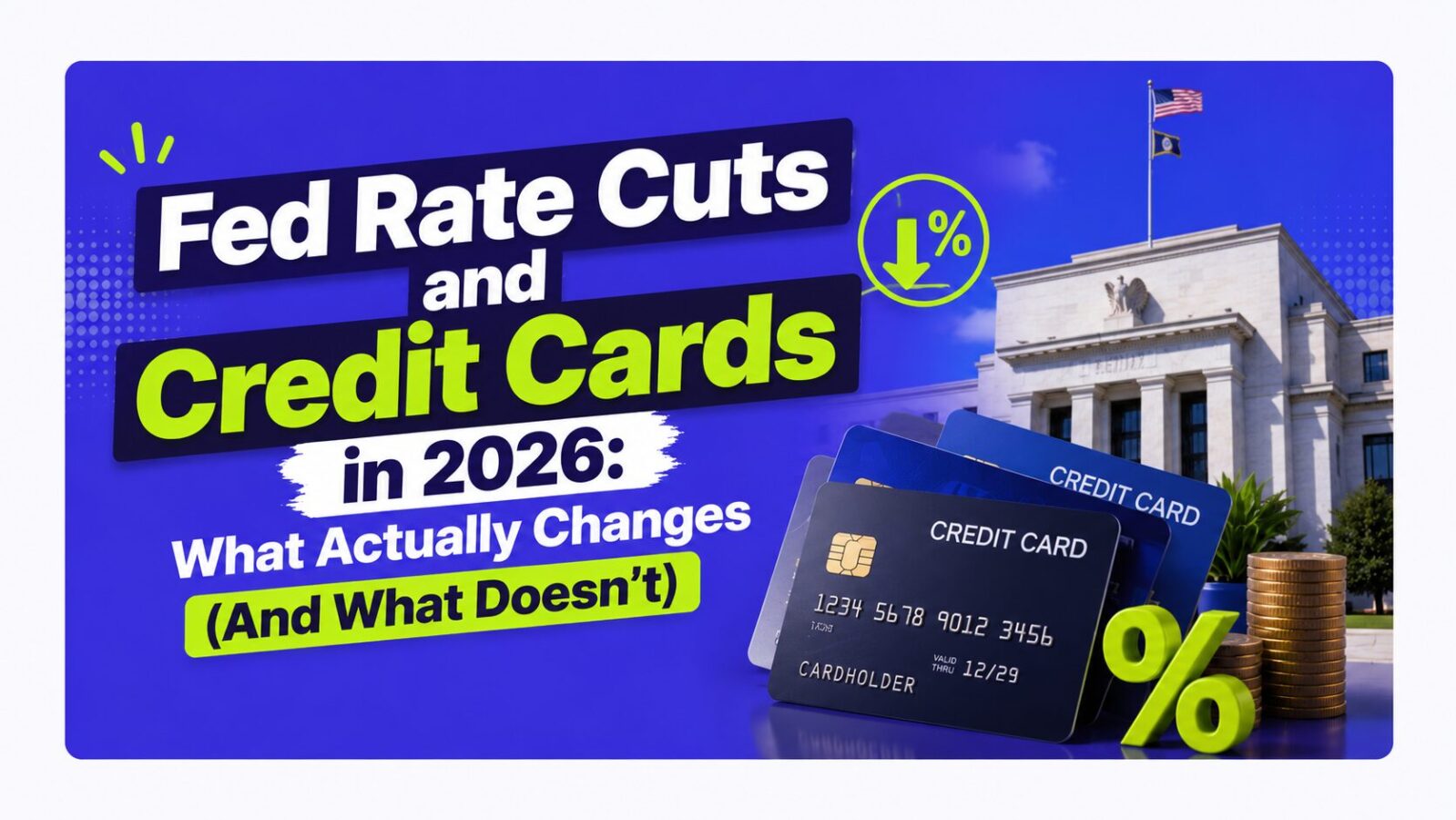
Yes, Fed rate cuts can lower the APR on many variable-rate credit cards. But if you are carrying a balance, the savings from a typical 0.25-point cut are usually small compared with what you can save by paying down the balance or moving it to a materially lower rate.
The Federal Reserve cut its target rate three times in 2025, by 0.25 percentage point each time, for a total reduction of 0.75 percentage point. The target range has remained at 3.50% to 3.75% throughout 2026, including after the Fed’s July 29 meeting.
Meanwhile, the Fed’s latest credit data show an average APR of 22.15% for credit card accounts that were actually assessed interest in Q2 2026.
FinancePulse view: If you carry credit card debt, do not build your payoff plan around the next Fed meeting. Rate cuts can help at the margin, but reducing the balance or securing a much lower APR can have a far larger effect.
How much does a Fed rate cut save on credit card debt?
Suppose your credit card APR falls by the full amount of a Fed cut.
On a balance that stayed at $5,000:
| APR reduction | Approximate annual difference |
|---|---|
| 0.25 percentage point | $12.50 |
| 0.50 percentage point | $25.00 |
| 0.75 percentage point | $37.50 |
| 1.00 percentage point | $50.00 |
So the Fed’s three 0.25-point cuts in 2025 would represent roughly $37.50 per year on a constant $5,000 balance if your card APR fell by the full 0.75 percentage point.
On $10,000, the equivalent difference would be about $75.
These examples are intentionally simplified. Many issuers calculate interest daily based on account balances, so your actual cost changes as you make payments, new purchases, or other transactions. CFPB notes that paying some or all of a balance sooner generally reduces the interest you pay because many cards accrue interest daily.
The point is the scale.
A quarter-point rate reduction sounds important in monetary-policy news.
On an expensive credit card balance, it may barely move the monthly interest bill.
What is the average credit card APR in 2026?
Federal Reserve data for Q2 2026 report:
| Fed credit card measure | Average APR |
|---|---|
| All credit card accounts | 20.94% |
| Accounts assessed interest | 22.15% |
The second figure is particularly relevant to people carrying balances because the Fed defines it using finance charges on accounts where interest was actually assessed.
That distinction matters.
If you pay your statement balance in full and retain a grace period, a card’s 20% or 25% purchase APR may never actually cost you anything.
If you carry debt from month to month, the APR becomes one of the most important numbers on the account.
How does the Fed affect your credit card APR?
The Fed does not set your credit card APR directly.
Many credit cards have variable APRs that move with an outside interest-rate index. CFPB gives the prime rate as a common example and says the cardholder agreement should explain how the variable APR can change.
A simplified example might be:
Prime rate + issuer margin = card APR
The Federal Reserve’s bank prime loan rate was 6.75% at the end of July 2026.
Imagine a hypothetical card priced at:
Prime + 15 percentage points
At a 6.75% prime rate, that would produce a 21.75% APR.
If the relevant index dropped by 0.25 percentage point and the card’s formula passed that change through, the APR could fall to 21.50%.
That is how Fed policy can eventually reach your credit card account.
Why doesn’t every card rate fall exactly with the Fed?
Because credit cards do not all have the same pricing formula.
Different accounts can have different:
- Variable-rate indexes
- Issuer margins
- Credit-risk pricing
- Promotional rates
- Fixed or variable APR structures
- APRs for purchases, balance transfers, and cash advances
CFPB notes that a variable APR moves with its underlying index, while a fixed APR does not automatically fluctuate with an index.
So it is too broad to say:
“The Fed cuts 0.25%, therefore every credit card immediately gets 0.25% cheaper.”
Check your own card agreement.
The terms governing your account matter more than the national average.
Are credit card rates still high after the 2025 cuts?
Yes.
The Fed’s Q2 2026 data put the average APR on accounts assessed interest at 22.15%. For comparison, the same series averaged 22.32% during 2025 and 22.89% during 2024.
So interest costs for people carrying balances remain high even after the Fed reduced its target range by 0.75 percentage point in late 2025.
This is why waiting for another small rate cut is rarely the strongest lever available to a borrower.
What is the Fed doing now?
At its July 29, 2026 meeting, the Federal Open Market Committee kept the federal funds target range at 3.50% to 3.75%. The decision passed 9 to 3, with three members preferring a 0.25-point increase instead.
That tells you something useful, but not what the Fed will definitely do next.
Fed policy changes with inflation, employment, economic activity, financial conditions, and other developments.
For someone carrying credit card debt, predicting the next rate decision is unnecessary.
Even if the Fed eventually cuts 0.25 percentage point and your full APR follows, the approximate annual difference on $5,000 is only $12.50 before accounting for changing balances.
Paying down principal usually matters much more
Suppose you owe $5,000 at 22%.
If you reduce the balance by $1,000, you eliminate roughly $220 of annualized interest exposure on that $1,000, assuming the balance otherwise stayed outstanding.
Compare that with a 0.25-point APR reduction on the full $5,000 balance:
About $12.50 per year
That is why principal reduction is such a powerful lever.
CFPB explains that many credit card issuers calculate interest daily. The sooner you reduce the balance, the less interest can accrue on that amount.
You do not need a Fed forecast to take advantage of that.
Can a 0% balance transfer save more?
Potentially, by a lot, if you qualify and can repay the balance before the promotional rate expires.
Imagine transferring $5,000 from a card charging more than 20% to an offer with a temporary 0% balance-transfer APR.
The interest reduction can be much larger than a quarter-point Fed cut.
But balance transfers have important costs and rules.
CFPB confirms that issuers can charge a balance transfer fee even when the promotional APR is 0%.
You also need to know:
- The transfer fee
- How long the promotional APR lasts
- The APR after the promotion
- Whether you can realistically repay the balance in time
- How new purchases are treated
Do the math before transferring rather than assuming “0%” means free.
Be careful using a balance-transfer card for new purchases
One of the easiest mistakes is moving debt to a promotional card and then continuing to use that same card for everyday spending.
CFPB warns that when you carry a promotional balance transfer, new purchases may begin accruing interest immediately unless you pay the entire account balance, including the transferred balance, by the due date.
That can make an otherwise good balance-transfer strategy much less effective.
FinancePulse view: If you use a card specifically to eliminate transferred debt, treating it as a payoff tool rather than a new spending line is usually the cleaner approach.
Can you ask your issuer for a lower APR?
Yes, you can ask. There is simply no guarantee the issuer will agree.
If your rate is high or you are struggling with payments, contact the issuer directly before paying a company that promises to negotiate your debt.
You can ask whether the issuer offers:
- A lower APR
- A hardship program
- A temporary payment arrangement
- Fee relief
- Another repayment option
The outcome depends on the creditor and your circumstances.
Do not assume there is a standard two-point or three-point reduction available to everyone.
What if you pay your credit card in full every month?
Then Fed cuts may have little or no direct effect on the interest you pay.
Most credit cards provide a grace period on purchases, although they are not legally required to do so.
CFPB says that when a card has a grace period and you are not carrying a balance, paying the balance in full by the due date can allow you to avoid interest on purchases.
So a consumer who consistently pays in full might earn rewards from a card with a 22% APR while paying $0 in purchase interest.
A consumer revolving the same card balance experiences something very different.
Should you wait for the Fed to cut before paying off your card?
No, not if you already have money available for a responsible debt payment.
Interest can accrue daily, so delaying a payment while waiting for a possible future rate reduction can cost more than the cut eventually saves.
The next Fed decision is uncertain.
Your payment is not.
If you can reduce a high-interest balance without draining money needed for essential expenses or leaving yourself unable to handle basic emergencies, paying earlier generally reduces the amount exposed to interest.
What actually makes the biggest difference?
For someone carrying credit card debt, I would rank the levers this way:
1. Stop the balance from growing
If possible, avoid putting new discretionary purchases onto a balance you are trying to eliminate.
2. Reduce principal
Every dollar removed from the revolving balance is a dollar that no longer generates future card interest.
3. Lower the APR materially
A good balance-transfer offer or another genuinely cheaper form of debt may produce a much larger reduction than a quarter-point Fed move.
Compare fees, promotional periods, and the full repayment timeline carefully.
4. Ask the issuer about relief
A creditor may have options you will never discover unless you contact it.
5. Treat future Fed cuts as a bonus
If your variable APR eventually falls, good.
Let the lower rate accelerate a payoff plan you are already following.
Do not make the rate cut the plan itself.
Frequently asked questions
Do Fed rate cuts lower credit card interest rates?
They can.
If your card has a variable APR tied to an index such as prime, changes in that index can change your APR according to the formula in your card agreement.
What is the average credit card interest rate in 2026?
The Federal Reserve reported an average APR of 20.94% for all accounts and 22.15% for accounts assessed interest in Q2 2026.
What is the prime rate in 2026?
The Fed’s bank prime loan rate was 6.75% at the end of July 2026.
Prime and the federal funds target range are not the same rate.
How much would a 0.25% rate cut save on $5,000?
If your card APR declined by the full 0.25 percentage point and the balance stayed at $5,000, the rough annual difference would be $12.50.
Actual savings depend on your balances, payments, interest calculation, and account terms.
Did the Fed cut rates in 2026?
As of August 18, no.
The Fed has maintained the 3.50% to 3.75% target range established after its December 2025 cut, including at the July 29, 2026 meeting.
Is a 0% balance transfer better than waiting for a Fed cut?
It can be much more powerful if you qualify, the fee is reasonable, and you can repay the balance before the promotional period ends.
A balance transfer can still charge a fee even when the promotional APR is 0%.
What is the best way to lower credit card interest?
Reduce the balance and, if appropriate, move remaining debt to a substantially lower APR.
Those changes usually affect your interest bill much more than a small Fed rate move.
The bottom line
Fed rate cuts do lower some variable credit card APRs, but they are not a credit card debt solution.
The Fed cut its target rate by 0.75 percentage point across three moves in 2025, then kept rates unchanged through its July 29, 2026 meeting.
If your card APR fell by the entire 0.75 percentage point, the rough annual difference on a constant $5,000 balance would be only $37.50.
At the same time, the Fed’s Q2 data show that credit card accounts actually assessed interest averaged 22.15% APR.
So if you are carrying debt, focus first on what can change the math substantially:
Stop adding to the balance → pay down principal → compare lower-rate options carefully → ask the issuer about relief
If the Fed eventually cuts again and your APR follows, take the savings.
Just do not wait for the Fed to do a job that your debt-payoff plan needs to start doing now.