By
By 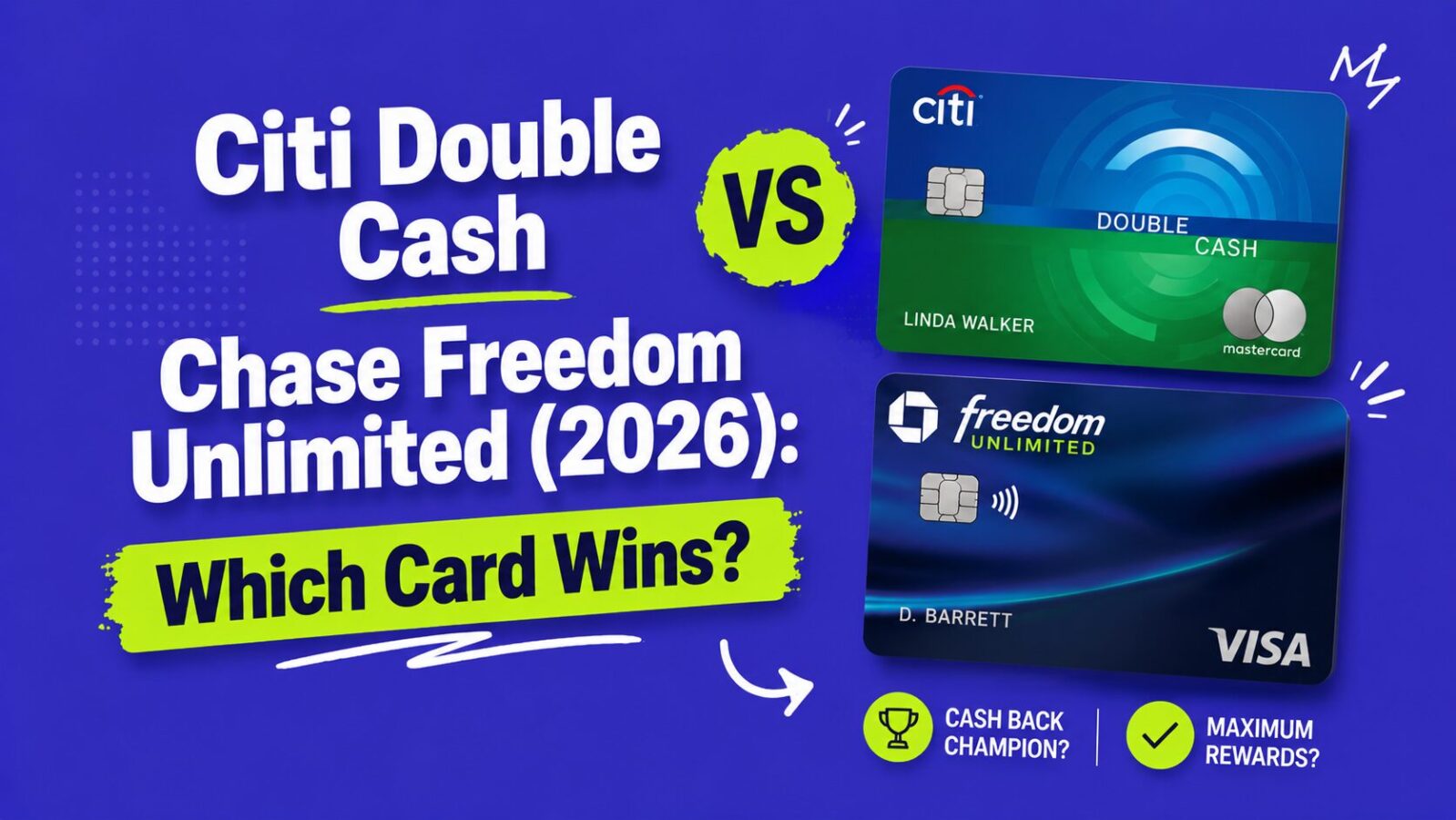
Two of the most recommended no-annual-fee cash back cards in 2026 are the Citi Double Cash and the Chase Freedom Unlimited. On paper they look similar: both cost $0 per year, both offer straightforward cash back, both come with intro APR offers. In practice they suit very different spending patterns, and picking the wrong one means leaving real money on the table every year.
Here is a complete side-by-side breakdown of both cards to help you figure out which one actually earns more for the way you spend.
Card Snapshot: The Key Differences at a Glance
| Citi Double Cash | Chase Freedom Unlimited | |
|---|---|---|
| Annual Fee | $0 | $0 |
| Base Rewards Rate | 2% on everything | 1.5% on everything |
| Bonus Categories | 5% on Citi Travel portal; none on everyday spend | 3% dining + drugstores; 5% Chase Travel; 2% Lyft |
| Welcome Bonus | $200 after $1,500 spend in 6 months | $200 after $500 spend in 3 months |
| Intro APR on Purchases | None | 0% for 15 months |
| Intro APR on Balance Transfers | 0% for 18 months | 0% for 15 months |
| Ongoing APR | 17.49%–27.49% variable | 18.24%–27.74% variable |
| Foreign Transaction Fee | 3% | 3% |
| Rewards Currency | Citi ThankYou Points | Chase Ultimate Rewards |
| Travel Perks | Minimal | Trip cancellation/interruption insurance; purchase protection; extended warranty |
Rewards: Who Earns More at What Spending Level
The headline comparison is 2% flat (Citi) versus 1.5% flat plus bonus categories (Chase). The math depends entirely on how much you spend in Chase’s bonus categories.
Chase Freedom Unlimited earns 3% cash back at restaurants and drugstores, and 5% on travel booked through Chase Travel. If you spend meaningfully in those categories, Freedom Unlimited can easily outperform Citi Double Cash on your overall portfolio.
Here is the math at a concrete spending example. Say you spend $2,000 per month: $400 on dining, $100 at drugstores, and $1,500 on everything else.
Citi Double Cash: $2,000 at 2% = $40/month = $480/year.
Chase Freedom Unlimited: $400 dining at 3% = $12 + $100 drugstore at 3% = $3 + $1,500 at 1.5% = $22.50. Total = $37.50/month = $450/year.
In this example, Citi Double Cash wins by $30/year despite the lower base rate, because the non-bonus spending at $1,500/month is large enough to offset the category advantages.
Now change the split: same $2,000/month but $800 on dining, $100 at drugstores, $1,100 on everything else.
Citi Double Cash: $2,000 at 2% = $40/month = $480/year.
Chase Freedom Unlimited: $800 at 3% = $24 + $100 at 3% = $3 + $1,100 at 1.5% = $16.50. Total = $43.50/month = $522/year.
Chase wins by $42/year once dining becomes a large enough share of spending. The break-even point in this two-category comparison is roughly when dining plus drugstore spending combined exceeds about $1,000/month, though the exact number shifts with your spending mix.
The practical takeaway: if your biggest monthly spend is on a mix of everyday purchases with no particular concentration in dining, Chase Freedom Unlimited’s bonus categories may not be enough to overcome Citi Double Cash’s higher base rate.
Welcome Bonus: Chase Wins by a Wide Margin
Both cards offer a $200 welcome bonus, but the spending requirements are very different.
Citi Double Cash requires $1,500 in purchases within the first 6 months. Chase Freedom Unlimited requires only $500 in purchases within the first 3 months. Most cardholders will hit $500 in the first month of use. Hitting $1,500 over 6 months requires averaging $250/month in card spending, which is achievable but meaningfully more demanding.
For someone opening a new card, Chase Freedom Unlimited is the easier bonus to earn with no change in spending behavior. That $200 represents a guaranteed 40% return on the required $500 spend before you ever use the card for anything else.
Intro APR: Different Use Cases
The two cards have meaningfully different intro APR offers that suit different needs.
Citi Double Cash offers 0% APR for 18 months on balance transfers only (not purchases). This is one of the longer balance transfer windows available on a no-annual-fee card, making it a strong option if your primary goal is moving existing high-interest debt from another card and paying it down interest-free. The intro balance transfer fee is 3% within the first 4 months, then 5% after that.
Chase Freedom Unlimited offers 0% APR for 15 months on both purchases and balance transfers. The 15-month window is 3 months shorter, but the coverage of purchases is a significant advantage if you are planning a large upcoming expense. A home appliance, laptop, or medical bill charged to the card can be paid off over 15 months with zero interest while still earning 1.5% cash back on the purchase.
If you need balance transfer flexibility: Citi Double Cash, by 3 months.
If you need purchase financing flexibility: Chase Freedom Unlimited is the only option, since Citi Double Cash has no intro APR on purchases.
Does Citi Double Cash Have Foreign Transaction Fees?
Yes. Citi Double Cash charges a 3% foreign transaction fee on purchases made outside the United States. This applies to any charge processed in a foreign currency, which includes online purchases from international merchants even when you are physically in the US.
Chase Freedom Unlimited also charges a 3% foreign transaction fee.
Neither card is a good choice for international travel or frequent cross-border spending. Both cards will add 3 cents to every dollar spent abroad, which offsets the rewards entirely and then some. If international use is a priority, a no-foreign-transaction-fee card like the Chase Sapphire Preferred, Capital One Venture, or similar travel card is a better fit regardless of the cash back comparison.
Perks and Benefits: Chase Has More
Citi Double Cash is a lean card. Its value is almost entirely in the rewards rate. Cardholders get access to Citi ThankYou point transfers to airline and hotel partners, but the transfer ratios for Double Cash alone are not the best, requiring a premium Citi card like the Strata Premier or Prestige to unlock 1:1 transfer rates.
Chase Freedom Unlimited carries more built-in benefits. Trip cancellation and interruption insurance covers up to $1,500 per person and $6,000 per trip for prepaid, non-refundable travel expenses. Purchase protection covers new purchases for 120 days against damage or theft, up to $500 per claim. Extended warranty adds an extra year to eligible US manufacturer warranties of 3 years or less. These are protections you generally only find on premium cards, and Freedom Unlimited provides them at $0 annual fee.
If you are part of the Chase ecosystem and carry a Chase Sapphire Preferred or Reserve, Freedom Unlimited becomes significantly more valuable. Points earned on Freedom Unlimited can be transferred to Sapphire cards and then moved to Chase’s airline and hotel partners at 1:1 ratios, unlocking substantially higher redemption values than the standard 1 cent per point cash back rate. This Chase Trifecta strategy makes Freedom Unlimited a cornerstone card for points maximizers.
Which Card Is Better for You
Choose Citi Double Cash if:
- Your spending is spread evenly across categories with no strong concentration in dining or drugstores
- You need a long balance transfer window (18 months beats Freedom Unlimited’s 15)
- You want the simplest possible rewards structure with nothing to track
- You are not interested in the Chase ecosystem or travel point transfers
Choose Chase Freedom Unlimited if:
- You spend significantly on dining, takeout, or delivery ($400+ per month)
- You want 0% APR on purchases for a planned large expense
- You value purchase protection and trip insurance on a no-fee card
- You already have or plan to get a Chase Sapphire card (the point transfer synergy is substantial)
- You want the easiest welcome bonus to earn ($500 in 3 months is a very low bar)
Can You Have Both?
Yes, and it is one of the more commonly recommended two-card setups in the no-annual-fee category. Citi Double Cash handles all non-bonus purchases at 2%, while Chase Freedom Unlimited covers dining and drugstores at 3% and travel through Chase at 5%. The combination squeezes more value out of everyday spending than either card alone, at zero combined annual fee.
The main consideration is credit inquiry management. Applying for both within a short window will generate two hard pulls on your credit report. If you are planning any major borrowing (mortgage, auto loan) in the next 6 to 12 months, timing new card applications carefully is worth considering.
Card terms are accurate as of May 2026 based on issuer websites and verified third-party sources. APR ranges, welcome bonuses, and intro offers are subject to change. Always verify current terms directly with Citi and Chase before applying. Finance Pulse is not a financial advisor. This comparison is for informational purposes only and does not constitute a recommendation to apply for any specific credit product. Finance Pulse may earn affiliate compensation if you apply through links on this page.