By
By 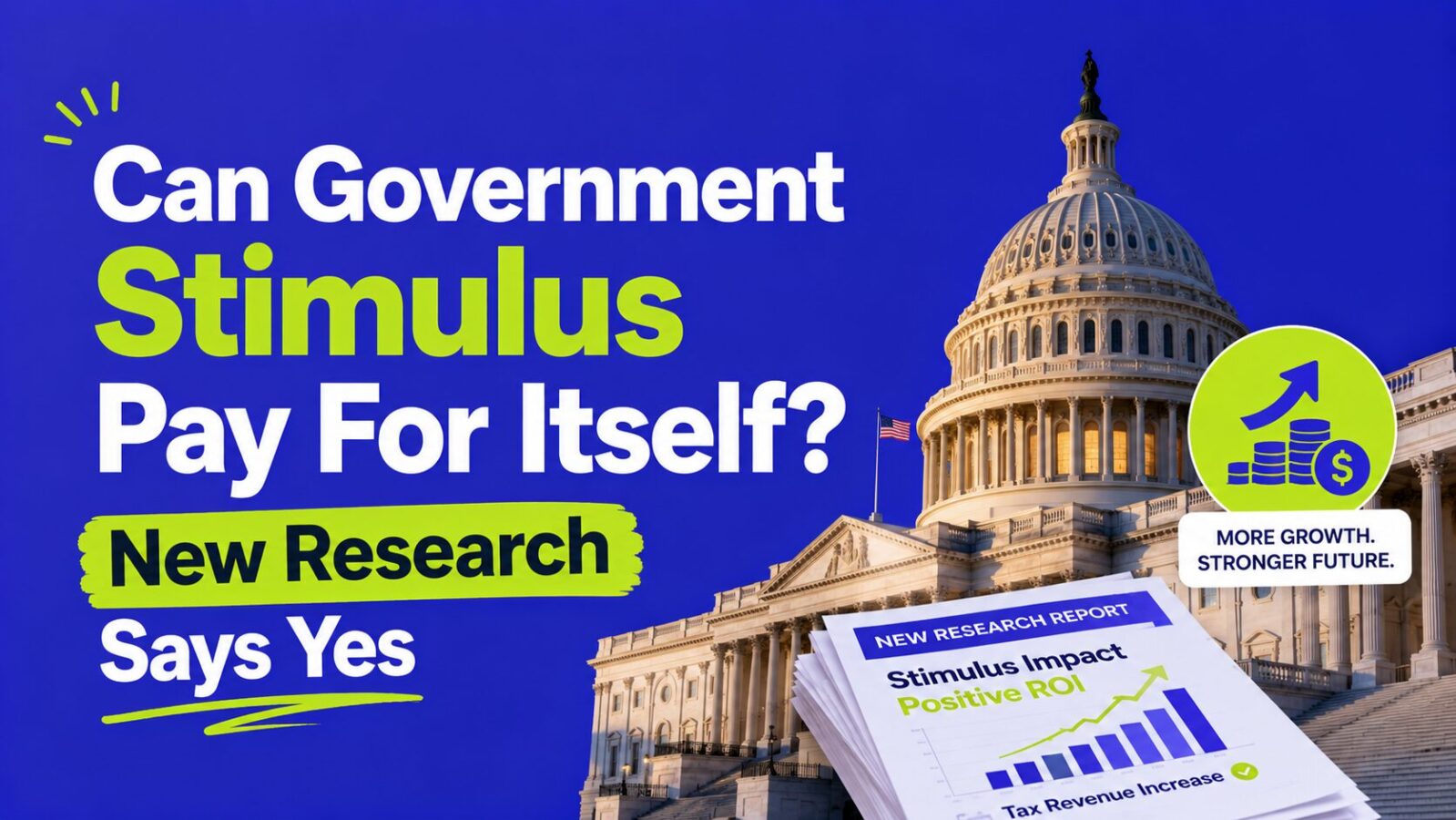
Every big deficit comes with the same warning: someone has to pay for it later through higher taxes. But a 2023 working paper from economists at MIT, Northwestern, and UC Berkeley argues that under realistic conditions, deficits can largely finance themselves with no future tax hike. When prices adjust slowly and real households spend a meaningful share of any windfall, stimulus triggers a boom that raises tax revenue and erodes the real value of debt. The longer the government waits to tighten, the more self-financing it gets. Here is how that works.
Key Takeaways
- Deficits can largely finance themselves under realistic conditions, without future tax hikes.
- Two channels do the work: a bigger tax base from growth, and inflation eroding real debt.
- The tax-base channel dominates, doing about 80% to 95% of the self-financing.
- The longer the government delays tightening, the more of the deficit pays for itself.
What Is the Old Assumption?
Standard economics carries “Ricardian equivalence”: if the government sends you a $1,400 check today but plans to raise taxes to repay it later, a perfectly rational person just saves the $1,400 for the future tax bill, so the stimulus does nothing. In that framing, every deficit dollar is simply a future tax dollar. The paper, “Can Deficits Finance Themselves?” by Angeletos, Lian, and Wolf, agrees this holds for an idealized, infinitely lived, perfectly rational consumer, but asks what happens when people behave like actual humans.
What Two Conditions Change Everything?
The research identifies two real-economy features that break the old assumption. Nominal rigidity: prices and wages do not adjust instantly, so when money enters the economy, real output rises before prices catch up, the classic Keynesian mechanism (demand up, hiring up, spending multiplies). Realistic household behavior: people have finite planning horizons, many cannot borrow freely, and they spend a meaningful share of extra income (the paper calibrates a quarterly marginal propensity to consume, or MPC, of about 22 cents per dollar). When both hold, a deficit triggers a genuine boom that generates tax revenue and erodes debt.
What Are the Two Self-Financing Channels?
The tax base expands automatically. When the economy grows, incomes rise, and so do tax revenues with no change in rates. In the calibrated model (a 30% effective tax rate and survey-based MPC), this channel does most of the work, recouping a large fraction of the deficit even when prices respond slowly.
Inflation erodes real debt. When stimulus generates inflation, the real value of outstanding government debt falls, so a government owing $1 trillion nominally owes less in real terms after a burst of inflation. But with the flat Phillips curve most modern estimates suggest, the tax-base channel does about 80% to 95% of the self-financing, and inflation contributes meaningfully only when prices are far more flexible (as in the post-COVID period).
What Is the Most Important Variable?
The headline result: the longer the government delays any fiscal adjustment, the more of the deficit finances itself. Push the eventual tax hike further out, and the Keynesian boom has more time to play out, generating more revenue. Delay it far enough and full self-financing becomes possible, with debt-to-GDP returning to its starting level on its own. The mechanism: when the future tax hike is far away, households barely factor it into spending, so their effective MPC approaches 1 and the full multiplier plays out, raising enough revenue to stabilize debt before any tightening is even needed. At empirically realistic delays, the self-financing share can reach 95% or higher.
What Does a Simple Example Look Like?
The paper includes a clean illustration. Hand out $1,000 in stimulus, with a 22% MPC and 30% tax rate: the $1,000 generates roughly $260 of extra GDP through the multiplier, 30% of which (about $78) flows back as tax revenue, for roughly 7.8% self-financing in the single-period case. But as the effective MPC rises toward 1 over longer horizons (which realistic behavior produces), the multiplier grows and the self-financing share climbs toward 100%. The key empirical fact is that real people spend a meaningful share of windfalls quickly (“front-loading”) and barely respond to distant future taxes (“discounting”), which is what lets the boom generate revenue before any adjustment is necessary.
What Could Stop It From Working?
- Aggressive monetary tightening. If the Fed hikes sharply in response, households delay spending and the amplification weakens, so a hawkish enough central bank can prevent full self-financing (relevant to the post-2022 hiking cycle).
- Open economies. The model is closed; in a small open economy, part of the demand leaks abroad through imports, so the mechanism fits large, relatively closed economies like the U.S. best.
- Saving instead of spending. If households save deficit transfers entirely, Ricardian equivalence holds and neither channel activates, though evidence says that is not how most households behave.
What Does This Mean for Understanding Debt?
This does not argue deficits are free or the national debt is irrelevant; it argues the fiscal arithmetic is more forgiving than “every dollar borrowed is a future tax dollar.” A few takeaways: COVID-era stimulus was not purely debt-shifting, since much of the activity recycled back as tax revenue automatically; the “stimulus just causes inflation” claim is nuanced, since the tax-base channel, not inflation, does most of the work; and rushing to cut deficits can be counterproductive, since premature tightening aborts the boom that would have done the self-financing. See our guide on the Fed and your money.
FAQ
Can government deficits really pay for themselves?
Largely, under realistic conditions, per the 2023 Angeletos, Lian, and Wolf paper. Stimulus triggers a boom that raises tax revenue and erodes real debt, and at empirically calibrated parameters the self-financing share can exceed 90%.
Does this mean stimulus is free?
No. It means the cost is lower than the simple “every dollar borrowed is a future tax dollar” view. Aggressive Fed tightening, open-economy leakage, and extreme delays all limit how much self-financing happens.
Did COVID stimulus checks add to future tax burdens?
Less than commonly assumed. A significant share of the activity they generated recycled back to the government as income, payroll, and sales tax revenue automatically, without any policy change.
Does stimulus mainly cause inflation?
Not according to this research. With a flat Phillips curve, inflation contributes only a small share of the self-financing; the larger tax base from growth does most of the work.
Bottom Line
New research makes a rigorous case that deficits can finance most of themselves when prices adjust slowly, households spend real income, and the government does not tighten too fast, with self-financing shares that can top 90%. It does not erase fiscal limits, but it shows the “borrow now, tax later” story misses a big part of the picture. To go deeper, see our guides on the Fed and your money, the latest inflation data, and recent tax changes.
This article summarizes an academic working paper for general educational purposes and does not constitute financial or policy advice.