By
By 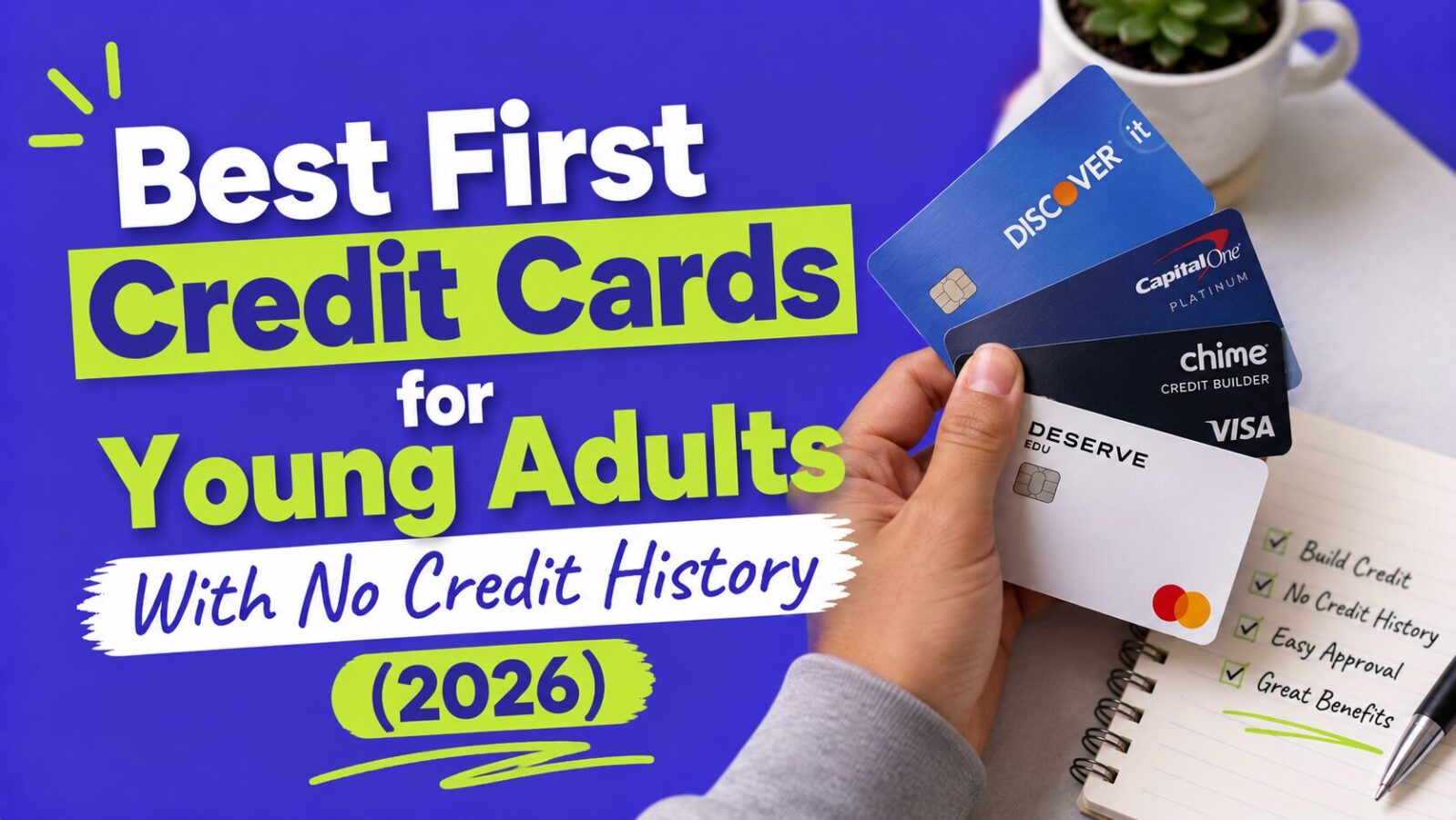
Getting your first credit card with no credit history feels like a catch-22: you need credit to get credit. But the right starter cards are specifically designed for people in exactly your situation — zero credit history, no track record, and a desire to build something from scratch.
The good news: in 2026, there are genuinely excellent first credit cards available with no annual fee, real cash back rewards, and a clear path to upgrading to a better card within 12 to 18 months. You do not need a parent to co-sign, a huge income, or a spotless history. You just need the right card and a few simple habits.
This guide covers the best first credit cards for young adults with no credit history, explains exactly how to use your first card to build credit fast, and helps you figure out whether a secured card or a student card is the right starting point for you.
Quick Answer
Best first credit cards for no credit history in 2026:
- Best overall starter card: Discover it Secured — cash back + automatic upgrade review after 7 months
- Best for college students: Discover it Student Cash Back — no SSN required for some applicants, first-year cash back match
- Best for students who want simple rewards: Capital One SavorOne Student — 3% on dining, entertainment, groceries, and streaming
- Best secured with low deposit: Capital One Platinum Secured — $49 deposit option for qualified applicants
- Best with no credit check at all: OpenSky Secured Visa — approved based on deposit, not credit score
Fastest path to good credit: Pay your full balance every month, keep utilization under 10%, and never miss a payment. Most people see a 700+ score within 12 to 18 months of responsible use.
Do You Need a Secured Card or a Student Card?
Before picking a specific card, you need to answer one question: are you a college student or not? This determines which category of first card you should focus on.
Student Credit Cards
Student credit cards are unsecured cards (no deposit required) specifically designed for full-time college students with little or no credit history. Issuers approve students more easily because they understand the life stage — you are young, income is limited, and credit history is nonexistent. Most student cards require proof of college enrollment.
Pros: No security deposit needed, often include real cash back rewards, can graduate to a better card automatically.
Cons: Require proof of student status, income verification still required (financial aid counts), credit limits tend to be low ($300 to $1,000).
Secured Credit Cards
Secured cards require a refundable security deposit that typically becomes your credit limit. If you deposit $200, your credit limit is $200. The deposit protects the issuer, which is why approval rates are high even with no credit history. The deposit is returned when you close the account or graduate to an unsecured card.
Pros: Available to almost anyone regardless of student status, some issuers do not check credit at all, good path to unsecured cards after 6 to 12 months.
Cons: Requires upfront cash for the deposit, some charge annual fees, credit limit equals your deposit.
The Simple Rule
If you are currently enrolled in college: start with a student card, no deposit needed. If you are not a student or cannot qualify for a student card: start with a secured card. Either path works — the credit you build is identical.
The Best First Credit Cards in 2026
Discover it Secured Credit Card
Best overall first card for people with no credit history
Type
Secured
Min. Deposit
$200
Annual Fee
$0
Rewards
2% gas + restaurants, 1% everything
The Discover it Secured is the gold standard for first-time credit card holders. It is one of the very few secured cards that actually earns cash back — 2% at gas stations and restaurants (up to $1,000 in combined purchases per quarter) and 1% on everything else. And Discover matches all cash back earned in your first year, making the effective rate 4% and 2% in year one.
The upgrade path is automatic and early. Starting at seven months, Discover reviews your account automatically and may upgrade you to the unsecured Discover it Card, returning your deposit in full. You do not need to call or apply — Discover does the review for you.
What makes it special for beginners:
- No annual fee — your $200 deposit earns interest in a linked savings account while it is held
- Free FICO score on every monthly statement so you can track your progress
- No penalty APR if you miss a payment (your first late payment fee is also waived)
- Discover does not require a prior credit history to approve you — they look at income and ability to make minimum payments
Best strategy: Use it for gas and restaurants to maximize the 2% category. Pay the full balance every month. After 7 months, check your Discover app — your upgrade invitation may already be waiting.
Discover it Student Cash Back
Best for college students who want to earn rewards while building credit
Type
Unsecured (Student)
Deposit Required
None
Annual Fee
$0
Rewards
5% rotating categories, 1% all else
The Discover it Student Cash Back is the student version of Discover’s flagship rewards card, and it is remarkably generous for a first card with no credit history. You get 5% cash back in rotating quarterly categories (typically groceries, Amazon, restaurants, and gas stations in different quarters) plus 1% on everything else. And like all Discover cards, the first-year cash back match applies — every dollar you earn gets doubled.
Real example: If you spend $200 per month on groceries during the quarter when groceries are the 5% category, you earn $10 in cash back. Over the year, using the rotating categories thoughtfully, a college student spending $600 to $800 per month could realistically earn $100 to $150 in cash back — then get it all matched to $200 to $300 at year end.
Who qualifies: Full-time or part-time college students. Financial aid counts as income. Discover accepts ITIN numbers, which means some international students may qualify without a Social Security Number.
What to know:
- The 5% categories rotate quarterly and require activation in the Discover app — set a reminder
- The 5% rate is capped at $1,500 in purchases per quarter ($75 max per quarter at 5%)
- You get a $20 cash back reward each school year your GPA is 3.0 or higher (up to 5 years)
- Free FICO score on every statement
Capital One SavorOne Student Cash Rewards
Best for students who spend heavily on dining, entertainment, and groceries
Type
Unsecured (Student)
Deposit Required
None
Annual Fee
$0
Rewards
3% dining, entertainment, groceries, streaming
The Capital One SavorOne Student card earns 3% cash back on dining, entertainment, popular streaming services, and groceries — the four categories that define most college student spending. No rotating categories to activate, no quarterly cap to track. Just consistent 3% on the things you actually buy.
Real example: A typical college student spending $300/month on groceries and dining earns $9/month at 3% — $108 per year on those categories alone. Add $30/month in streaming subscriptions and you pick up another $10.80 per year. That is roughly $120 annually in cash back from a card with no annual fee and no credit history requirement.
Who should get this card: Students who eat out regularly, pay for streaming services (Netflix, Spotify, Hulu), and grocery shop for themselves. The flat 3% on multiple categories beats rotating-category cards for students who do not want to think about quarterly activation.
What to know:
- Also earns 5% on hotels and rental cars booked through Capital One Travel
- No foreign transaction fees — useful for study abroad or travel
- Capital One reports to all three major credit bureaus, which helps you build a complete credit profile
- After graduation and some credit history, Capital One may upgrade you to the full SavorOne card automatically
Capital One Platinum Secured Credit Card
Best for non-students who want a low deposit option to get started
Type
Secured
Min. Deposit
$49, $99, or $200
Annual Fee
$0
Rewards
None
The Capital One Platinum Secured stands out from other secured cards because of its flexible deposit structure. Based on your creditworthiness, Capital One may approve you with a deposit as low as $49 or $99 — both of which give you a $200 credit limit. This means you can get a $200 credit line with as little as $49 upfront, which is one of the lowest barriers to entry in the secured card market.
No rewards on this card, which is the main downside. But if cash is tight and the $200 deposit required by Discover is a stretch, the Capital One Platinum Secured’s $49 entry point makes getting started possible regardless of your savings situation.
The upgrade path: Capital One automatically reviews your account after six months of responsible use and may upgrade you to the unsecured Capital One Platinum card, returning your deposit. Some cardholders have been upgraded in as little as 6 months.
What to know:
- No annual fee, no foreign transaction fees
- Minimum deposit varies by applicant — $49 and $99 options are not guaranteed
- Credit limit starts at $200 regardless of deposit amount
- Reports to all three credit bureaus monthly
OpenSky Secured Visa Credit Card
Best for people who cannot qualify elsewhere or have had past credit problems
Type
Secured
Min. Deposit
$200
Annual Fee
$35
Credit Check
None required
The OpenSky Secured Visa is the one card on this list that requires no credit check whatsoever. Your approval is based entirely on your ability to pay the $200 security deposit. If you can fund the deposit, you get the card — period.
This makes OpenSky the right choice if you have been rejected by other cards, have past negative marks on your credit (collections, late payments), or simply have no Social Security Number and limited documentation. OpenSky’s approval process is one of the most accessible in the market.
The trade-off: OpenSky charges a $35 annual fee, which the other cards on this list do not. Over 12 months, that is $35 that goes to the issuer rather than reducing your debt. For most people, starting with Discover it Secured or Capital One Platinum Secured is better. But if those options have turned you down, OpenSky is a legitimate fallback that builds real credit.
What to know:
- No credit check means no hard inquiry on your report when you apply
- Reports to all three credit bureaus monthly
- No rewards
- Upgrade path is manual — you would need to apply for a new card separately after building credit
Quick Comparison
| Card | Type | Deposit | Annual Fee | Rewards | Best For |
|---|---|---|---|---|---|
| Discover it Secured | Secured | $200 | $0 | 2% gas/restaurants, 1% other | Best overall starter |
| Discover it Student Cash Back | Student | None | $0 | 5% rotating, 1% other | College students, max rewards |
| Capital One SavorOne Student | Student | None | $0 | 3% dining, entertainment, groceries, streaming | Students who eat out and stream |
| Capital One Platinum Secured | Secured | $49–$200 | $0 | None | Low deposit, non-students |
| OpenSky Secured Visa | Secured | $200 | $35 | None | No credit check needed |
Interactive Quiz
Which First Card Is Right for You?
Answer 3 quick questions and get your perfect starter card.
1. Are you currently enrolled in college or university?
How to Use Your First Credit Card to Build Credit Fast
The card is just a tool. What actually builds your credit score is how you use it. Here are the habits that move the needle fastest.
Rule 1: Pay Your Full Balance Every Month
This is the single most important rule. Paying in full means you never pay interest, you always have a clean slate for the next month, and you demonstrate responsible use to the credit bureaus. If you cannot pay the full balance, pay as much as possible — and figure out why spending exceeded what you could cover. Our guide on the 50/30/20 budget rule is a great framework for making sure your spending stays within bounds.
Rule 2: Keep Your Utilization Below 10%
Credit utilization is how much of your available credit limit you are using. If your credit limit is $500 and your balance is $400, your utilization is 80% — which seriously hurts your credit score. Most credit experts recommend staying below 30%, but under 10% is where score gains accelerate.
Real example: If your first card has a $300 limit, keep your monthly balance under $30 before your statement closes. That might mean using the card for one small purchase per month, or making a mid-month payment to bring the balance down before the statement date.
Rule 3: Never Miss a Payment — Ever
Payment history is the single biggest factor in your credit score (roughly 35% of your FICO score). One missed payment can drop your score by 60 to 110 points and stays on your credit report for seven years. Set up autopay for at least the minimum payment as a safety net, even if you plan to pay in full manually. Think of autopay as insurance against forgetting.
Rule 4: Use the Card Every Month
A dormant card that you never use does not help you build credit. You need active, on-time payment history. The solution: use your card for one or two small purchases per month — gas, coffee, a recurring subscription — and pay the balance in full. This creates consistent positive history without any risk of overspending.
Rule 5: Do Not Apply for Multiple Cards at Once
Each credit card application creates a hard inquiry on your credit report, which temporarily lowers your score by 5 to 10 points. When you are just starting out with no credit history, multiple inquiries in a short period can limit your approval odds for future cards. Pick one card, use it well for 12 to 18 months, then consider adding a second card to your wallet.
Interactive Tool
Credit Score Progress Estimator
Tell us about your habits and see a realistic timeline for building your credit score from scratch. These are estimates based on typical patterns — your results may vary.
How will you manage your card each month?
What will your typical credit utilization be?