By
By 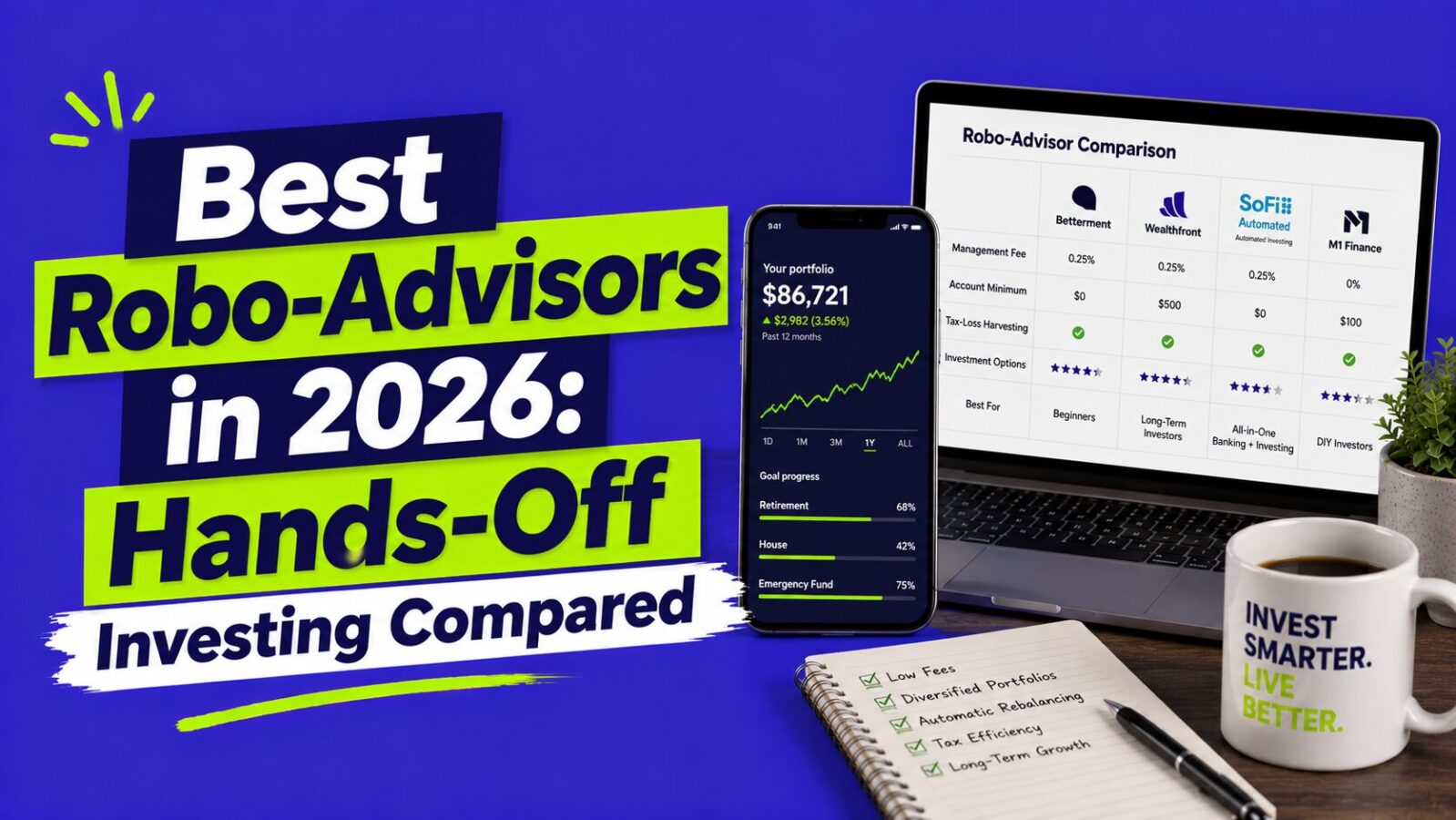
Robo-advisors build and manage your investment portfolio for a small fee. Here is how they compare to DIY investing, which ones are best, and whether you actually need one.
Not everyone wants to pick index funds, set allocations, and rebalance annually. Some people just want to deposit money and have something handle the rest. That is exactly what a robo-advisor does.
A robo-advisor is an automated investment service that builds, manages, and rebalances a diversified portfolio based on your age, risk tolerance, and goals. You answer a questionnaire, deposit money, and the algorithm handles everything: asset allocation, rebalancing, tax-loss harvesting, and dividend reinvestment.
The fee is typically 0.25% of your assets per year ($25 per year on $10,000; $250 per year on $100,000). That is cheaper than a human financial advisor (1%+) but more expensive than managing a 3-fund portfolio yourself (roughly 0.04 to 0.08%). Is the convenience worth the cost? Here is the honest answer.
- Robo-advisors charge roughly 0.25% per year to build and manage a diversified portfolio automatically.
- Fidelity Go is free under $25,000. Schwab Intelligent Portfolios charges $0 with a $5,000 minimum.
- Tax-loss harvesting in taxable accounts can offset the 0.25% fee — making a robo-advisor cost-neutral or even free for the right investor.
- In retirement accounts (IRA, 401k), a target-date fund does the same job at one-third the cost. Robo-advisors add the most value in taxable accounts.
- If the alternative is not investing at all, a robo-advisor wins easily. The best portfolio is the one you actually fund.
How Robo-Advisors Work
- Sign up and answer questions. Your age, income, goals (retirement, house, general investing), risk tolerance, and investment timeline.
- The algorithm assigns a portfolio. Based on your answers, you get an allocation across stocks, bonds, international, and sometimes alternatives (REITs, commodities).
- You deposit money. One-time or recurring. Most robo-advisors support automatic weekly or monthly deposits.
- The robo-advisor manages everything. Buys ETFs, rebalances when allocations drift, harvests tax losses in taxable accounts, reinvests dividends.
- You check in occasionally. Quarterly or annually, review performance and adjust goals if your life circumstances change.
The underlying investments are almost always low-cost ETFs — the same Vanguard, Schwab, and iShares funds you could buy yourself. The robo-advisor’s value is in the automation and behavioral guardrails: it does not let you panic-sell during a crash.
The Best Robo-Advisors in 2026
1. Betterment — Best Overall
Betterment is the largest independent robo-advisor with the most polished experience. It offers taxable accounts, Traditional and Roth IRAs, SEP IRAs, trust accounts, and joint accounts.
- Management fee: 0.25%/year (Digital). 0.40%/year (Premium, $100,000 minimum) adds unlimited certified financial planner access.
- Minimum investment: $0
- Key features: Tax-loss harvesting, automatic rebalancing, socially responsible investing (SRI) portfolios, goal-based planning, tax-coordinated investing across account types.
- Portfolio: Vanguard, iShares, and Goldman Sachs ETFs. Typical allocation for a 30-year-old: ~90% stocks (US and international), ~10% bonds.
Our take: Betterment is the most polished robo-advisor with the best goal-setting tools and no minimum. The 0.25% fee is the industry standard. Tax-loss harvesting in taxable accounts can offset the fee entirely.
2. Wealthfront — Best for Tax Optimization
Wealthfront matches Betterment on most features and edges it on tax efficiency at higher balances.
- Management fee: 0.25%/year
- Minimum investment: $500
- Key features: Tax-loss harvesting including direct indexing at $100,000+ (harvests losses on individual stocks for greater savings), automatic rebalancing, financial planning tools (Path), high-yield cash account at 4%+ APY.
- Portfolio: Vanguard and iShares ETFs. Similar construction to Betterment.
Our take: Wealthfront edges Betterment on tax optimization, especially with direct indexing for accounts over $100,000. The $500 minimum is a minor barrier. The cash account is convenient for your emergency fund.
3. Schwab Intelligent Portfolios — Best No-Fee Option
Schwab Intelligent Portfolios charges zero management fee. The catch: it holds 6 to 10% of your portfolio in cash earning a low interest rate, creating a small drag on returns.
- Management fee: $0
- Minimum investment: $5,000
- Key features: No advisory fee, automatic rebalancing, tax-loss harvesting, broader asset class exposure (includes REITs, commodities, gold).
Our take: If you have $5,000+ and want robo-advisor convenience with no ongoing fee, Schwab is hard to beat. The cash drag costs roughly 0.10 to 0.20% in opportunity cost, making the effective cost comparable to Betterment’s 0.25% — but you pay nothing directly.
4. Vanguard Digital Advisor — Best for Vanguard Users
Vanguard Digital Advisor provides automated management using Vanguard’s legendary low-cost index funds. Approximately 0.20% all-in (including fund expenses) — the cheapest full-service robo-advisor on a net basis.
- Management fee: ~0.20%/year all-in
- Minimum investment: $3,000
- Key features: Vanguard index funds, automatic rebalancing, retirement income planning, integration with existing Vanguard accounts. No tax-loss harvesting.
Our take: If you already have a Vanguard account, this is the natural fit. No tax-loss harvesting matters less in retirement accounts where most Vanguard investors hold their money.
5. Fidelity Go — Best for Small Balances
Fidelity Go charges $0 for balances under $25,000. The underlying Fidelity Flex funds also charge 0% expense ratios, making your total investment cost literally $0.
- Management fee: $0 (under $25K) or 0.35%/year (over $25K, includes financial coach access)
- Minimum investment: $10
- Key features: Zero-expense-ratio Fidelity Flex funds, $10 minimum, integration with Fidelity platform, human coaching at higher balances.
Our take: For anyone starting with less than $25,000 at Fidelity, the total cost is $0. Genuinely hard to beat for beginners.
Quick Comparison
| Robo-Advisor | Fee | Minimum | Tax-Loss Harvesting | Best For |
|---|---|---|---|---|
| Betterment | 0.25% | $0 | Yes | Best overall |
| Wealthfront | 0.25% | $500 | Yes (+ direct indexing) | Tax optimization |
| Schwab Intelligent | $0 | $5,000 | Yes | No-fee investing |
| Vanguard Digital | ~0.20% | $3,000 | No | Vanguard investors |
| Fidelity Go | $0 (under $25K) | $10 | No | Small balances |
Not sure which one fits your situation? Use this quick picker:
Which Robo-Advisor Is Right for Me?
Answer 2 questions to get your best match.
Step 1: What is your starting balance?
Robo-Advisor vs DIY Investing: The Honest Comparison
What You Get with a Robo-Advisor
- Automatic portfolio construction (no decision paralysis)
- Automatic rebalancing (no annual homework)
- Tax-loss harvesting in taxable accounts (saves 0.10 to 0.50%/year in taxes)
- Behavioral guardrails (harder to panic-sell when you are not making individual trades)
- Financial planning tools and goal tracking
What You Give Up
- Control. You cannot customize your exact allocation beyond the robo’s preset options.
- Money. 0.25% feels small but compounds over decades. See exactly how much below.
- Learning. Managing your own portfolio teaches you investing. A robo-advisor abstracts everything away, which is convenient but means you never fully understand what is happening with your money.
Here is the actual dollar impact of advisory fees over time:
Robo-Advisor Fee Calculator
See what advisory fees actually cost you over time (assumes 10% gross annual return).
When the Robo-Advisor Is Worth It
You will not invest otherwise. If the alternative is money sitting in a checking account, the robo-advisor wins easily. 0.25% on invested money beats 0% return on uninvested money.
You know you will panic-sell. If a 30% market drop would send you to the sell button, the robo-advisor’s abstraction layer helps. You see a portfolio balance, not individual stock positions plunging.
You have a taxable account over $50,000. Tax-loss harvesting can save more than the 0.25% fee in taxable accounts, making the robo-advisor potentially net-positive.
You simply do not want to manage it. Not everyone finds investing interesting. If you would rather spend your time on other things and the 0.25% fee is worth the convenience, that is a completely legitimate choice.
When DIY Is Better
Your money is mostly in retirement accounts. Tax-loss harvesting does not apply to 401(k)s or IRAs. In retirement accounts, a target-date fund at 0.08% does everything a robo-advisor does at one-third the cost.
You want to optimize. DIY allows asset location (bonds in tax-advantaged, stocks in taxable), specific fund selection, and custom allocations a robo-advisor will not match.
You want the lowest possible fees. A 3-fund portfolio (VTI + VXUS + BND) costs roughly 0.04% blended. Over 30 years on a large portfolio, the fee savings are significant. The calculator above shows exactly how much.
The Hybrid Approach
Many investors use both: a robo-advisor for their taxable brokerage account (where tax-loss harvesting adds value) and DIY index funds in their Roth IRA and 401(k) (where the fee is pure cost with no tax benefit).
This gives you automated tax optimization where it matters and the lowest possible fees where it does not.
Frequently Asked Questions
Are robo-advisors safe?
Yes. Betterment, Wealthfront, Schwab, Vanguard, and Fidelity are all regulated by the SEC and members of SIPC, which protects brokerage accounts up to $500,000 if the firm fails. Your investments are held in your name, not the robo-advisor’s name.
Can I lose money with a robo-advisor?
Yes. Robo-advisors invest in stocks and bonds, which can lose value. A robo-advisor does not prevent market losses — it manages your portfolio to match your risk tolerance and time horizon, but market risk is inherent in investing.
Do robo-advisors beat the market?
No. Robo-advisors invest in index funds that match the market. They are not trying to beat the market. They aim to deliver market returns minus a small fee, with proper diversification and tax efficiency.
Can I withdraw my money anytime?
Yes. Taxable accounts have no withdrawal restrictions. Retirement accounts (IRA, 401k) follow standard early withdrawal rules regardless of whether a robo-advisor manages them.
Should I use a robo-advisor or a human financial advisor?
A human financial advisor charges 1%+ of assets (or flat fees of $2,000 to $5,000 per year) and provides personalized advice on taxes, estate planning, insurance, and more complex financial situations. For straightforward situations, a robo-advisor at 0.25% is sufficient. For complex situations — business ownership, stock options, estate planning, multiple income streams — a human advisor may be worth the higher cost.
I already use a target-date fund. Do I need a robo-advisor?
Probably not. A target-date fund in your retirement account does essentially the same thing as a robo-advisor (diversified, age-appropriate, automatically rebalancing) at a lower cost (0.08 to 0.12%). A robo-advisor adds value primarily in taxable accounts through tax-loss harvesting.
What is tax-loss harvesting and why does it matter?
Tax-loss harvesting is when the robo-advisor automatically sells investments that have declined in value to realize a capital loss, then immediately buys a similar fund to maintain your portfolio allocation. That realized loss can offset capital gains elsewhere in your portfolio — or up to $3,000 of ordinary income per year. For taxable accounts, this can save 0.10 to 0.50% per year, potentially offsetting the 0.25% advisory fee entirely.
Is Betterment or Wealthfront better?
For most people, they are effectively equal. Both charge 0.25%, both offer tax-loss harvesting, and both use similar low-cost ETF portfolios. Betterment wins on having no minimum investment and slightly better goal-planning tools. Wealthfront wins on tax optimization at higher balances (direct indexing at $100,000+) and the integrated cash account. If your balance is under $100,000, pick either one — the difference is negligible.
The Bottom Line
Robo-advisors are the perfect middle ground between doing nothing and managing your own portfolio. For 0.25% per year (or free, in the case of Schwab and Fidelity Go), you get a professionally constructed, automatically rebalanced, tax-optimized portfolio that you never have to think about.
If you have been meaning to start investing but keep putting it off because choosing funds feels overwhelming, a robo-advisor removes every barrier. Sign up, answer the questions, set up automatic deposits, and you are investing.
For everyone else: a target-date fund in your retirement accounts and a simple 3-fund portfolio in your taxable account costs less and gives you more control. Both paths lead to the same destination: a diversified, long-term portfolio building wealth while you live your life.
Where to go next:
- Want to DIY instead? Read our 3-fund portfolio guide for the simplest hands-on strategy.
- Want full automation? Read our target-date fund guide — one fund, zero decisions.
- Comparing specific robo-advisors? Read our Betterment review for a full deep-dive on the top pick.