By
By 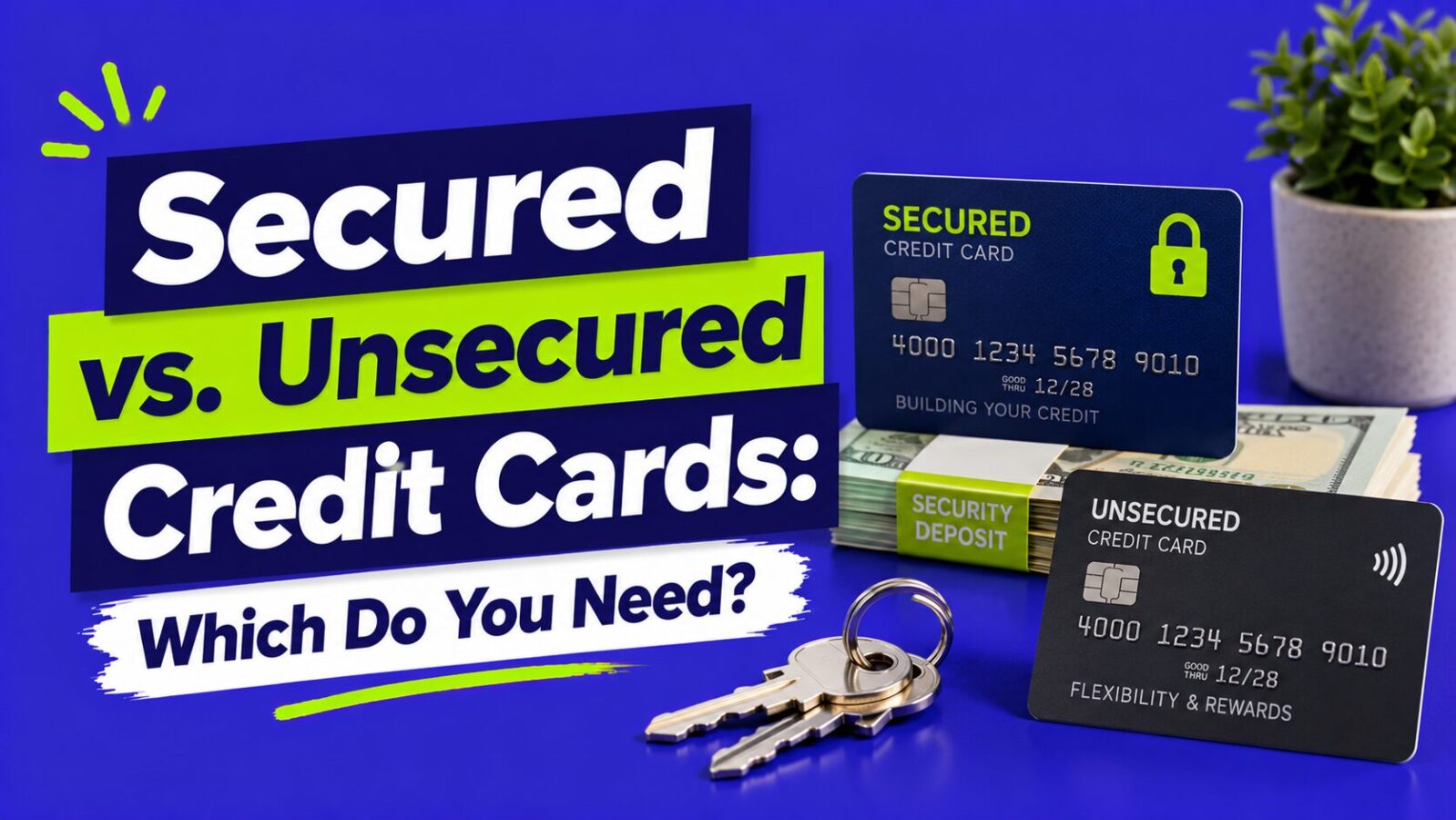
No credit history or damaged credit? A secured card is your fastest path in. Here is how the two types differ, which one you need right now, and how to graduate to a full rewards card in 12 to 18 months.
If you are building credit from scratch or rebuilding after a financial setback, you have probably encountered two categories of credit cards: secured and unsecured. The difference is simple, but choosing the right one determines how quickly you build or rebuild your credit score.
- Secured cards and unsecured cards build credit identically. The credit bureaus do not distinguish between them. On-time payments, low utilization, and account age contribute to your FICO score the same way regardless of card type. The deposit is the only structural difference.
- The deposit on a secured card is fully refundable. It sits as collateral while your account is open and is returned when you close the account or when the issuer graduates you to an unsecured card — minus any unpaid balance. Think of it as a refundable investment, not a fee.
- The Discover it Secured is the clear best-in-class secured card: $0 annual fee, 2% cash back at restaurants and gas stations, 1% everywhere else, and an automatic first-year Cashback Match that doubles all rewards. No other secured card offers comparable rewards.
- Most people can go from no credit to a 700+ credit score in 12 to 18 months using a secured card responsibly: use it for one or two small monthly charges, pay the full balance every month, keep utilization under 10%, and do not close the account after graduating.
- Never carry a balance on a secured card. Interest rates are typically 25%+. A secured card is a credit-building tool, not a borrowing tool. Every month of on-time full payment builds your score; every month of interest charges destroys the financial value of having the card.
Which type of card do you need right now?
Secured or Unsecured?
Answer 3 questions for a specific card recommendation.
Question 1 of 3: What is your credit history?
Side-by-side comparison
| Feature | Secured card | Unsecured card |
|---|---|---|
| Deposit required | Yes (fully refundable) | No |
| Credit limit | Usually equals deposit ($200 to $2,500) | Based on creditworthiness ($500 to $50,000+) |
| Approval odds | Very high (deposit removes bank risk) | Depends on credit score and history |
| Builds credit | Yes — identical to unsecured | Yes |
| Rewards | Usually minimal (Discover it Secured is the exception) | Cash back, points, miles |
| Annual fee | $0 to $49 (look for $0) | $0 to $695 |
| Best for | No credit, bad credit, thin file | Established credit (670+ score) |
The best secured cards in 2026
1. Discover it Secured — best overall
Deposit: $200 minimum. Annual fee: $0. Rewards: 2% cash back at gas stations and restaurants (up to $1,000 combined per quarter), 1% everywhere else — plus a first-year Cashback Match that doubles all rewards earned.
The only secured card with meaningful rewards. The Cashback Match makes year 1 competitive with many unsecured cards. Discover automatically reviews your account after 7 to 8 months for graduation to unsecured status, with deposit returned. Reports to all three bureaus.
2. Capital One Platinum Secured — most accessible
Deposit: As low as $49 for a $200 credit limit. Annual fee: $0. Rewards: None.
The lowest possible entry deposit — some applicants qualify for a $200 limit with only a $49 deposit. Capital One reviews accounts regularly for automatic credit line increases and graduation to unsecured status. Best for people with very limited savings who need to start somewhere.
3. Bank of America Customized Cash Secured — best rewards (non-Discover)
Deposit: $200 to $5,000. Annual fee: $0. Rewards: 3% in a category of your choice, 2% at grocery stores and wholesale clubs, 1% everywhere else.
Unusually strong rewards for a secured card. The $5,000 maximum deposit gives you a higher credit limit, which helps keep your utilization ratio low. Good for existing Bank of America customers or people with higher savings who want to maximize rewards during the credit-building phase.
How to build credit with a secured card: the 5-step plan
- Open the card with the minimum deposit. $200 to $300 is sufficient. A larger credit line is not needed to build credit — consistent on-time payments matter far more than the limit.
- Use it for one or two small recurring charges. One streaming subscription ($15) or one small gas fill-up per month. Never exceed 30% of your credit limit. On a $300 limit, keep charges under $90. Under 10% ($30) is even better for your score.
- Pay the FULL statement balance every month via autopay. This ensures on-time payments (35% of your FICO score) and zero interest charges. The interest rate on most secured cards is 25%+ — never carry a balance.
- Wait 7 to 12 months. Credit building takes time. Most secured card issuers review accounts after 6 to 8 months for graduation to unsecured status with deposit returned.
- Apply for an unsecured card after graduation. After 6 to 12 months with a score in the 650 to 700+ range, apply for a no-annual-fee unsecured card. Keep the graduated secured card open — closing it reduces your total credit limit and average account age.
Realistic timeline: No credit to a 700+ score: 12 to 18 months. Poor credit to a 700+ score: 18 to 24 months. Results vary based on starting conditions and consistency.
Common mistakes to avoid
Carrying a balance. Interest rates on secured cards are typically 25%+. A secured card is a credit-building tool, not a borrowing tool. Pay in full every month without exception.
Maxing out the credit limit. Using 90% of a $300 limit ($270) creates 90% utilization — a major score penalty. Keep spending under 30%, ideally under 10%.
Applying for multiple cards at once. Each application is a hard inquiry that temporarily lowers your score. Apply for one secured card, build credit for 6 to 12 months, then apply for an unsecured card.
Closing the card after graduating. When you get an unsecured card, keep the graduated secured card open (assuming no annual fee). Closing it reduces your total available credit and average account age — both factors in your credit score.
Paying an annual fee on a secured card. The best secured cards charge $0. Never pay an annual fee on a secured card. Any card charging $35 to $99 annually can be replaced with a Discover it Secured or Capital One Platinum Secured at $0.
Frequently Asked Questions
Does a secured card build credit as well as an unsecured card?
Yes — identically. The credit bureaus (Equifax, Experian, TransUnion) do not distinguish between secured and unsecured cards in their reporting or scoring models. A payment marked “on time” from a Discover it Secured carries exactly the same weight as one from a Chase Sapphire Preferred. Your credit score does not know (or care) that you put down a deposit. What matters is: making on-time payments every month, keeping utilization low, and letting your account age over time. These three factors work the same way regardless of card type.
How long does it take to build credit with a secured card?
Starting from zero credit history: you will typically have a scoreable FICO record after 3 to 6 months of activity. Reaching a 700+ score from zero: 12 to 18 months with consistent on-time payments and low utilization. Reaching 700+ from damaged credit (prior late payments, collections): 18 to 24 months, with the timeline depending heavily on how old the negative marks are and whether any can be removed through disputes or goodwill deletions. The single fastest accelerator: keeping utilization under 10% of your limit every month.
Can I get my deposit back?
Yes — the deposit is fully refundable. You receive it back in one of two ways: (1) graduation, where the issuer automatically converts your account to an unsecured card and returns the deposit (Discover does this after about 7 months, Capital One does it automatically after several months of responsible use), or (2) account closure, where you close the card and the deposit is refunded minus any unpaid balance. Do not close a graduated secured card — keep it open for the credit history and available credit it contributes. Only close a still-secured card if you need the deposit back and have another established credit account to maintain your history.
Is a secured card the same as a prepaid debit card?
No — these are completely different products. A prepaid card is a debit card you load with money and spend down. There is no credit involved, no monthly statement, no payment due date, and no reporting to credit bureaus. Prepaid cards do not build credit in any way. A secured credit card is a real credit card where you make purchases on credit, receive a monthly statement, and make payments. The deposit serves as collateral for the issuer — it does not get spent; it sits as security. Only secured cards (and all other credit products that report to bureaus) build your credit history.
Which secured card is best — Discover it Secured or Capital One Platinum Secured?
Discover it Secured for most people. It earns 2% at restaurants and gas stations, 1% everywhere else, plus a first-year Cashback Match that doubles all rewards — making it genuinely competitive with many unsecured cash back cards in year 1. It has no annual fee and reports to all three bureaus. Capital One Platinum Secured is better if the minimum deposit is an obstacle: some applicants qualify for a $200 credit limit with only a $49 deposit, making it the most accessible secured card for people with very limited savings. Capital One Platinum earns no rewards but otherwise builds credit just as effectively.
Can I upgrade from a secured card to an unsecured card?
Most major issuers do this automatically. Discover reviews secured accounts after 7 to 8 months and upgrades qualifying cardholders to unsecured status with the deposit returned. Capital One reviews accounts and upgrades automatically after several months of responsible use. Bank of America also has an automatic graduation process. You can also call your issuer and request an upgrade review — this is especially worth doing if your score has improved significantly but you have not received an automatic upgrade after 10 to 12 months. When you graduate, your account number, credit limit, and full payment history remain — the card simply becomes unsecured and your deposit is refunded.
Should I get a secured card or a student credit card?
If you are currently enrolled in college: apply for the student card first. Discover it Student Cash Back and Capital One Savor Student both approve no-history applicants without requiring a deposit. Student cards offer identical credit-building benefits to secured cards, often with the same or better rewards, and do not require tying up $200 to $300. If you are not a student: secured card is the right path. The student card eligibility requirement (current enrollment) is strictly enforced. Once you graduate from college, your student card can typically remain open or be converted to the standard version — it does not close automatically.
What credit score can I expect after 12 months with a secured card?
Starting from zero (no prior credit history): most people reach 650 to 700 FICO after 12 months of on-time payments and low utilization (under 10%). Some reach 720+ within 12 months, especially if they also have a credit-builder loan or authorized user status on an established account. The variables that matter most: (1) utilization — keeping it under 10% throughout produces the highest scores, (2) payment history — even one 30-day late payment can drop the score 50 to 80 points and delay reaching 700 by 6 to 12 months, and (3) number of accounts — two positive accounts (secured card + credit-builder loan) typically produce a faster score climb than one account alone.
The bottom line
A secured credit card is the most reliable path to building credit from nothing or rebuilding damaged credit. Deposit $200 to $300, use the card for a small monthly charge, pay in full every month, and wait. In 12 to 18 months, you will have a score strong enough for the rewards cards and financial products that require good credit.
Use the quiz above to find the right card for your situation. If you are eligible for a secured card, the Discover it Secured is almost always the right choice. Six months of patience now opens the full world of cash back rewards and travel points for the rest of your financial life.
Related reading:
- Want a month-by-month roadmap to 700+? Read our credit score improvement guide — specific actions for each score range with realistic timelines.
- Ready to pick your first unsecured card after graduating? Read our best no-annual-fee cards guide — top options ranked by spending profile and credit history.
- Want to understand your credit report before applying? Read our credit report guide — what each section means and how to spot errors that could be holding your score back.