By
By 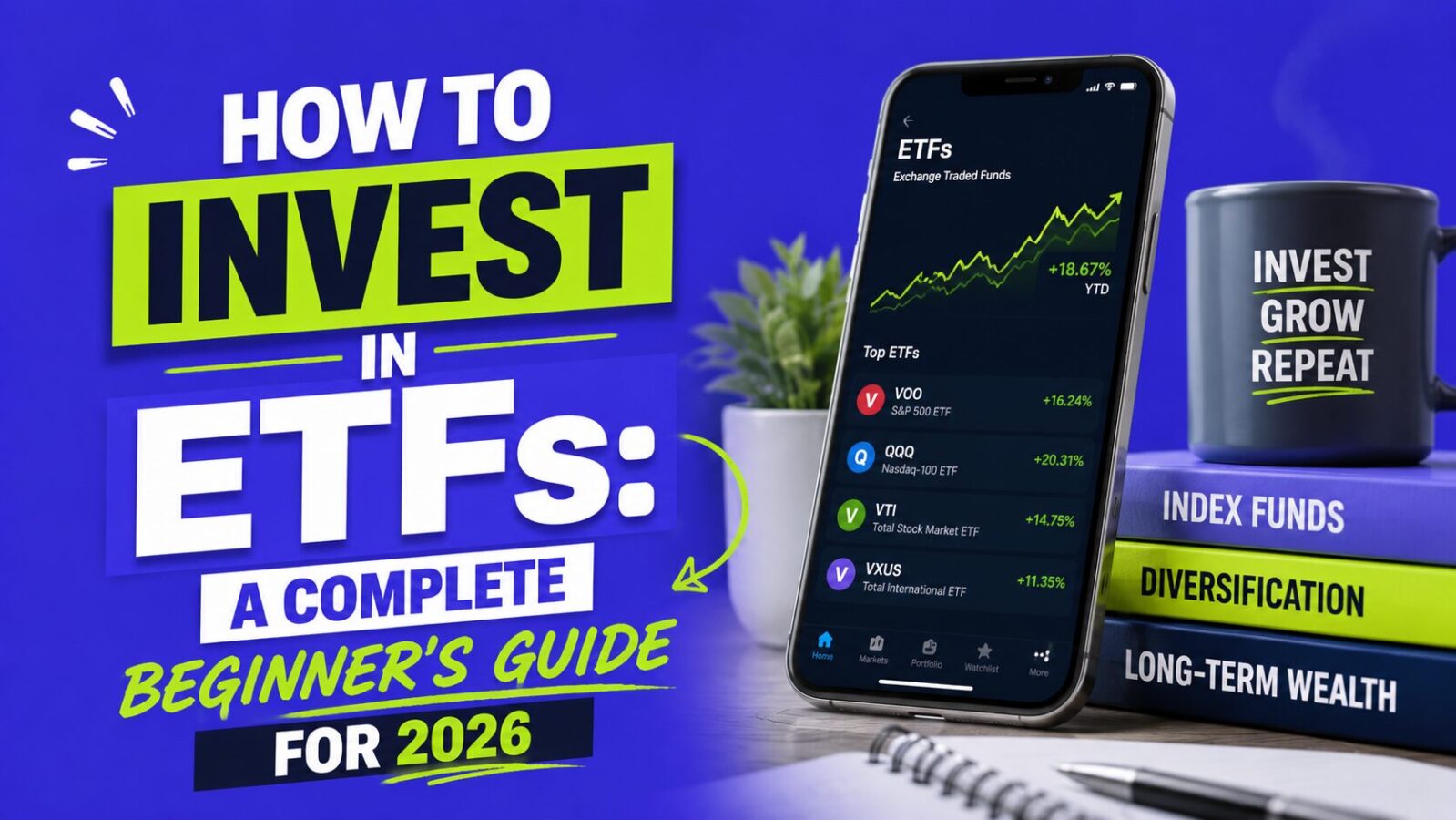
Exchange-traded funds have quietly become the default investment vehicle for an entire generation of investors, and for good reason. They are cheap, flexible, tax-efficient, and dead simple to buy. If you have been staring at your brokerage account wondering where to start, ETFs are probably the answer.
This guide walks you through everything you need to know about how to invest in ETFs — from understanding what they actually are to building a diversified portfolio that works on autopilot. No finance degree required.
- An ETF is a basket of investments that trades on a stock exchange like a single stock. One purchase of VTI gives you ownership in 3,600+ US companies.
- Expense ratios are the most important factor when choosing an ETF. The difference between 0.03% and 1.00% costs tens of thousands of dollars over 30 years.
- ETFs are more tax-efficient than mutual funds in taxable accounts due to the in-kind creation/redemption mechanism — they rarely distribute capital gains.
- Most beginners need only 1 to 3 ETFs. VTI (US total market), VXUS (international), and BND (bonds) cover the entire investable world.
- You can buy ETFs with as little as $1 using fractional shares at Fidelity, Schwab, and most major brokerages.
What Exactly Is an ETF?
An exchange-traded fund (ETF) is a basket of investments — stocks, bonds, commodities, or a mix — bundled into a single fund that trades on a stock exchange just like an individual stock. When you buy one share of an ETF, you instantly own a tiny slice of every asset inside that fund.
Think of it like ordering a sampler platter instead of a single dish. One share of a total stock market ETF gives you exposure to over 3,600 companies in a single transaction.
ETFs were introduced in 1993 but really took off in the 2010s as investors and the data realized that most actively managed funds fail to beat the market over time. Today, trillions of dollars sit in ETFs, and they have become the default investment vehicle for index investors worldwide.
ETFs vs Mutual Funds vs Individual Stocks
| Feature | ETFs | Mutual Funds | Individual Stocks |
|---|---|---|---|
| Trading | Throughout the day | Once daily at closing NAV | Throughout the day |
| Minimum investment | $1 (fractional shares) | Often $1,000 to $3,000 | $1 (fractional shares) |
| Expense ratios | 0.03% to 0.20% typical | 0.10% to 1.00%+ | None |
| Tax efficiency | High | Lower | Depends on your trading |
| Diversification | Built-in | Built-in | You build it yourself |
| Auto-investing | Improving (fractional) | Easy with dollar amounts | Manual |
The biggest practical differences: ETFs trade like stocks during market hours, they have lower expense ratios than most mutual funds, and their structure makes them more tax-efficient in taxable accounts. Mutual funds still have one advantage: many brokerages let you invest exact dollar amounts automatically (no partial share complexity). As fractional ETF share support improves, this gap is closing fast.
Individual stocks give you total control but zero diversification unless you buy dozens or hundreds of them. For most people, ETFs are the better starting point. For a deeper dive, see our index funds vs ETFs guide.
Types of ETFs You Should Know
Index ETFs track a specific market index (S&P 500, US total market, Russell 2000). They are the core of passive investing — an S&P 500 ETF gives you 500 of the largest US companies for as little as 0.03% per year. See our full S&P 500 index funds guide for detailed coverage.
Bond ETFs hold portfolios of government, corporate, or municipal bonds. They provide income and stability to balance stock volatility. Common options: BND (total bond market), AGG (US aggregate), VGSH (short-term Treasury).
International ETFs invest in companies outside the US — either developed markets (Europe, Japan, Australia) or emerging markets (China, India, Brazil). VXUS covers both in one fund. See our international stocks guide for allocation recommendations.
Sector ETFs focus on specific industries (technology, healthcare, energy). Use them as satellite positions only — they sacrifice the diversification that makes ETFs valuable in the first place.
Thematic ETFs target specific trends (AI, clean energy, cannabis). They tend to have higher expense ratios, lower diversification, and often launch after the trend has already been priced in. Most beginners should skip these entirely.
Dividend ETFs focus on companies paying regular dividends. Good for income-focused investors, but note that dividend investing is not free money — the stock price adjusts downward when dividends are paid.
How to Buy ETFs: Step by Step
Step 1: Open a brokerage account. Fidelity, Charles Schwab, and Vanguard are the top options for buy-and-hold index ETF investing. All offer commission-free ETF trading and fractional shares. The account opening process takes about 15 minutes. Choose a Roth IRA first if you have earned income and are eligible — the tax-free growth is one of the best deals in personal finance.
Step 2: Fund your account. Transfer money from your bank. Set up recurring transfers if you plan to invest regularly — automation removes the temptation to time the market.
Step 3: Research and select your ETFs. For a simple starter portfolio you need one to three ETFs. Key criteria:
- Expense ratio — lower is always better. Target under 0.10% for core holdings.
- Assets under management — larger funds have tighter bid-ask spreads. Look for at least $1 billion.
- Tracking error — how closely the ETF follows its benchmark. Lower is better.
Step 4: Place your order. Use a limit order set near the current market price for most purchases — it gives you price control and avoids paying slightly more during volatile moments. Avoid buying in the first or last 15 minutes of the trading day when spreads tend to be wider.
Step 5: Monitor and rebalance. Check your allocation once or twice a year, not daily. Rebalance by selling what has grown past its target and buying what has lagged. In retirement accounts, this has no tax consequences.
Understanding Expense Ratios
The expense ratio is the annual fee a fund charges, expressed as a percentage of your investment. An expense ratio of 0.03% means you pay $3 per year per $10,000 invested. An expense ratio of 1.00% means you pay $100.
This compounds ruthlessly over time. Enter your numbers to see the real cost:
Expense Ratio Impact Calculator
Compare the actual dollar cost of different ETF expense ratios over time (assumes 8% gross annual return).
The lesson: for your core portfolio, pick the cheapest index ETF available that tracks your target index. Spending more than 0.10% on a core holding needs a clear justification that rarely exists.
Why ETFs Are Tax-Efficient
ETFs have a structural advantage over mutual funds in taxable accounts. When mutual fund investors sell shares, the manager often has to sell underlying holdings to raise cash, generating capital gains distributed to all remaining shareholders — even if you did not sell anything. You get a tax bill for gains you never personally realized.
ETFs avoid this through in-kind creation and redemption. Large institutional traders exchange baskets of the underlying stocks for ETF shares without triggering taxable events inside the fund. The result: ETFs rarely distribute capital gains.
This tax efficiency matters most in taxable brokerage accounts. In a Roth IRA or 401(k), both ETFs and mutual funds grow tax-free, so the structural advantage disappears.
Building an ETF Portfolio
The One-Fund Portfolio
Buy a total world stock market ETF (VT from Vanguard covers the entire global market in one fund) or a target-date ETF. Not lazy — efficient. One fund, total global diversification.
The Three-Fund Portfolio
The classic approach using three ETFs to cover the entire investable universe:
- US total stock market ETF (50 to 60% of portfolio) — VTI, ITOT, or SPTM
- International total stock market ETF (20 to 30%) — VXUS, IXUS
- US total bond market ETF (10 to 30%) — BND, AGG
The exact percentages depend on your age and risk tolerance. See our full 3-fund portfolio guide for specific allocations.
The Core-Satellite Portfolio
Core of broad index ETFs (80 to 90%) plus small satellite positions in specific areas you want to emphasize (sector ETF, small-cap value, etc.). This gives diversification at the core with room for conviction at the edges.
Not sure which ETF to buy first for your specific situation? Use this quick picker:
Which ETF Should I Start With?
Answer 2 questions to get a specific first ETF recommendation.
Step 1: What type of account?
Common ETF Mistakes to Avoid
Overcomplicating your portfolio. You do not need 15 ETFs. Three to five covers most investors well. Every additional fund adds rebalancing complexity and the temptation to tinker. Start simple.
Chasing past performance. The ETF that returned 40% last year is not guaranteed to repeat. Top-performing categories rotate. Buy based on your long-term plan, not last quarter’s leaderboard.
Ignoring expense ratios on specialty ETFs. Thematic and actively managed ETFs often charge 0.50 to 0.75%+. The expense ratio calculator above shows exactly what that premium costs over decades. Stick with broad, low-cost index ETFs for your core holdings.
Trading too frequently. ETFs trade like stocks, which makes it tempting to buy and sell on impulse. Every trade is a potential taxable event in a brokerage account, and frequent trading almost always underperforms buy-and-hold. Set your allocation and leave it alone.
Buying at the wrong time of day. ETF prices tend to be more volatile right at market open (9:30 AM ET) and near market close (4:00 PM ET). Mid-day offers tighter spreads. Use limit orders rather than market orders for larger purchases.
Neglecting international diversification. US stocks have dominated the past 15 years, but that has not always been the case. Allocating 20 to 40% of your stock ETF holdings internationally reduces concentration risk without sacrificing expected long-term returns.
A Quick-Start ETF Portfolio for Beginners
If you have read this far and just want someone to tell you what to buy, here is a straightforward portfolio for a long-term investor in their 20s or 30s:
| ETF Type | Allocation | Example Tickers | Expense Ratio |
|---|---|---|---|
| US Total Stock Market | 60% | VTI, ITOT, FSKAX | 0.03% to 0.015% |
| International Stock Market | 25% | VXUS, IXUS, FTIHX | 0.07% to 0.06% |
| US Total Bond Market | 15% | BND, AGG, FXNAX | 0.03% to 0.025% |
This gives you exposure to thousands of stocks and bonds across the globe for an average blended expense ratio under 0.05%. Adjust the bond percentage upward as you approach your goal date or as your risk tolerance decreases. See our complete 3-fund portfolio guide for detailed setup instructions at each brokerage.
Frequently Asked Questions
What is the difference between an ETF and a mutual fund?
The main practical differences: ETFs trade throughout the day like stocks (mutual funds price once at market close), ETFs typically have lower expense ratios, and ETFs are more tax-efficient in taxable accounts due to their in-kind creation/redemption mechanism. Mutual funds have one edge: easy automatic investing in exact dollar amounts. For most long-term buy-and-hold investors, these differences are minor — the expense ratio matters far more than the ETF vs mutual fund distinction.
Can I lose all my money in an ETF?
In a broad index ETF like VTI or VOO, effectively no. That would require every publicly traded US company to become worthless simultaneously — an essentially impossible scenario. In a narrow sector or thematic ETF focused on a single industry, a significant portion could be lost if that sector collapses. The broader and more diversified the ETF, the lower the risk of catastrophic loss. Temporary losses of 20 to 50% during market downturns are entirely possible and historically always recovered.
How many ETFs should I own?
Most investors need 1 to 3 ETFs. One total world fund (VT) covers everything. Three funds (VTI + VXUS + BND) give you more control over allocation. Beyond five ETFs, you are usually adding complexity without meaningfully improving diversification — the US total stock market fund already includes small-caps, mid-caps, REITs, and value stocks. More funds often just mean more rebalancing work.
What is a good expense ratio for an ETF?
For broad index ETFs (your core holdings): under 0.10%, with the best at 0.03%. For sector ETFs or specialty funds you use as satellite positions: under 0.25% is reasonable. Anything above 0.50% on a core holding needs a very specific justification — actively managed ETFs at 0.50 to 0.75% almost never justify their premium over the long term based on actual performance data.
Do ETFs pay dividends?
Yes. Most stock ETFs distribute dividends quarterly. VTI’s current dividend yield is approximately 1.3 to 1.5% per year. Bond ETFs distribute monthly interest income. In a Roth IRA or 401(k), these distributions reinvest tax-free. In a taxable account, they are taxable as either qualified dividends (lower rate) or ordinary income (higher rate, applies to bond interest). You can usually set dividends to automatically reinvest through your brokerage’s DRIP (Dividend Reinvestment Plan).
Can I buy ETFs in a Roth IRA?
Yes, and you should. A Roth IRA is one of the best accounts for ETF investing — all dividends, capital gains, and growth inside the account accumulate tax-free, and qualified withdrawals in retirement are tax-free. Buy VTI and VXUS in your Roth IRA and let them compound for decades with zero annual tax drag. The 2026 contribution limit is $7,000 per year ($8,000 if you are 50+).
What is the best ETF for a complete beginner?
VTI (Vanguard Total Stock Market ETF) is the most common first recommendation: 3,600+ US companies, 0.03% expense ratio, highly tax-efficient, available at any brokerage. If you are at Fidelity, FSKAX (mutual fund version) at 0.015% is slightly cheaper and works better for automated dollar-amount investing. For complete global coverage in one fund, VT (Vanguard Total World Stock ETF) adds international exposure automatically. Use the picker above for a personalized recommendation based on your account type and goal.
Are ETFs safer than individual stocks?
Yes, in the sense that diversification reduces risk. A broad index ETF owns hundreds or thousands of companies — one company going bankrupt barely affects the fund. An individual stock can go to zero. However, broad ETFs can still lose 30 to 50% during market downturns. “Safer” means less volatile and less exposure to single-company risk, not immune from market losses. For most investors without specialized knowledge of specific companies, ETFs deliver better risk-adjusted returns than individual stock picking over long time horizons.
The Bottom Line
Investing in ETFs is one of the most straightforward paths to building wealth over time. Pick a low-cost, diversified set of ETFs, invest consistently, rebalance once a year, and let compound growth do the heavy lifting. You do not need to pick individual stocks, time the market, or pay a financial advisor 1% of your portfolio.
The expense ratio calculator above shows in real dollar terms why the 0.03% index ETF wins. The picker above shows exactly which fund to buy first. The rest is just consistency over time.
Open a brokerage account and buy your first ETF today
Next steps:
- Ready to build a full portfolio? Read our 3-fund portfolio guide for the complete setup with exact fund choices at each brokerage.
- Want to understand what VTI and VOO actually hold? Read our S&P 500 index funds guide for a deep dive on the core US stock ETFs.
- Want it all done automatically? Read our robo-advisor comparison — some manage an ETF portfolio for you at low or zero cost.