By
By 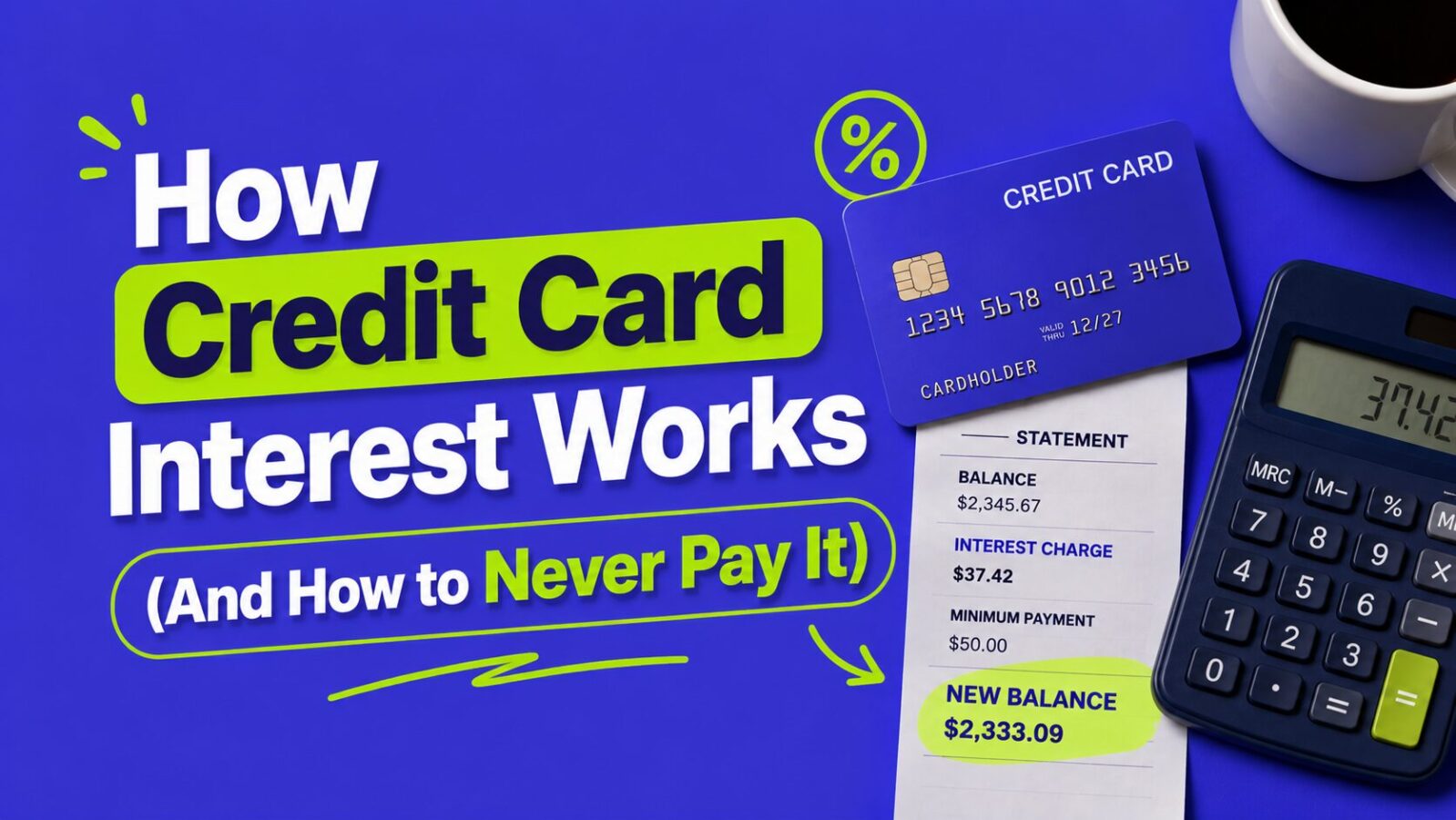
Credit card interest is how banks make billions. Here is exactly how APR, daily interest, and the grace period work, plus the one rule that guarantees you never pay a cent in interest.
Credit card companies are not running a charity. They offer you cash back, travel rewards, and purchase protections because they make money when you carry a balance and pay interest. According to the Consumer Financial Protection Bureau (CFPB), Americans paid over $130 billion in credit card interest in 2024 alone.
The good news: if you understand how credit card interest actually works, you can use credit cards for all their benefits and pay exactly $0 in interest. Forever. Here is the complete breakdown.
- Credit card interest compounds daily. A 24% APR means 0.0658% per day — on a $5,000 balance that is $3.29 in interest every single day, or roughly $99/month.
- The grace period (21 to 55 days between your purchase and payment due date) is interest-free — but only if you pay your full statement balance each month. Carry any balance and you lose the grace period on new purchases immediately.
- The one rule to never pay interest: pay your full statement balance by the due date, every month. Not the minimum — the full balance. Set up autopay and it happens automatically.
- Cash advances have no grace period — interest starts the moment you withdraw the cash, plus a 3 to 5% upfront fee. Never use a credit card at an ATM.
- “Deferred interest” (common at furniture and electronics stores) is not the same as 0% APR. Miss the payoff deadline and you owe all the interest that would have accrued from day one — retroactively.
What is APR?
APR stands for Annual Percentage Rate. It is the yearly interest rate your credit card charges on balances you carry past the due date. The average credit card APR in 2026 is roughly 24%, according to the Federal Reserve.
But here is what most people miss: you are not charged 24% once per year. Credit card interest compounds daily. Your APR is divided by 365 to get your Daily Periodic Rate (DPR), and that rate is applied to your balance every single day.
The math:
- APR: 24%
- Daily Periodic Rate: 24% / 365 = 0.0658% per day
- On a $5,000 balance: $5,000 x 0.000658 = $3.29 per day in interest
- Over 30 days: roughly $98.70 in interest for a single month
That $98.70 gets added to your balance. Next month, you pay interest on the interest. This is how credit card debt spirals: compound interest working against you instead of compound interest working for you.
What is your balance costing you right now?
Daily Interest Calculator
See exactly what a carried balance costs you — daily, monthly, and annually — and what that money could be doing instead.
The grace period: your interest-free window
The grace period is the time between the end of your billing cycle (statement closing date) and your payment due date. By law (CARD Act of 2009), it must be at least 21 days.
The critical rule: If you pay your full statement balance by the due date, you pay zero interest on your purchases. The grace period gives you free use of the bank’s money for 21 to 55 days depending on when in the billing cycle you made the purchase.
Buy something on day 1 of your billing cycle? You get roughly 50+ days before interest would start. Buy something on the last day? You get the minimum 21 days.
When the grace period disappears: If you do not pay your full statement balance, you lose the grace period on new purchases. This means interest starts accruing on new charges immediately, from the date of purchase. You do not get the grace period back until you pay your balance in full for two consecutive billing cycles (varies by issuer).
This is the trap. Once you carry a balance, everything you buy starts accumulating interest from day one. The cost of carrying even a small balance extends to every future purchase until the slate is clean.
How interest is calculated: the Average Daily Balance method
Most credit cards use the Average Daily Balance method. Here is how it works:
Step 1: The card issuer tracks your balance every single day of the billing cycle.
Step 2: At the end of the cycle, it adds up every daily balance and divides by the number of days. That is the Average Daily Balance.
Step 3: It multiplies the Average Daily Balance by the Daily Periodic Rate and by the number of days in the cycle.
Example:
- Billing cycle: 30 days, starting balance: $2,000
- Day 10: You charge $500 (balance becomes $2,500)
- Day 20: You make a $1,000 payment (balance becomes $1,500)
- Average Daily Balance: ($2,000 x 10 + $2,500 x 10 + $1,500 x 10) / 30 = $2,000
- Interest charge: $2,000 x 0.000658 x 30 = $39.48
This is why making a payment early in the billing cycle reduces your interest. If you had made that $1,000 payment on day 5 instead of day 20, your average daily balance would drop to $1,583, saving roughly $8 in interest for that month. Small timing difference, real money saved.
Purchase APR vs cash advance APR vs penalty APR
| APR type | Typical rate | Grace period? | What triggers it |
|---|---|---|---|
| Purchase APR | 18 to 28% | Yes (21+ days) | Regular purchases when you carry a balance |
| Cash advance APR | 25 to 29% | No — starts immediately | ATM withdrawals, convenience checks. Plus 3 to 5% upfront fee. |
| Balance transfer APR | 0% intro, then 18 to 24% | Varies | Balances moved from another card |
| Penalty APR | Up to 29.99% | N/A | Late payments (60+ days). May apply to entire balance indefinitely. |
Cash advance rule: Never use your credit card for cash advances. A $500 cash advance at 27% APR with a 5% fee costs $25 immediately plus $0.37/day in interest from day one. If you need emergency cash, a personal loan or hardship withdrawal is far cheaper.
The minimum payment trap
Your credit card statement shows a minimum payment — usually 1 to 3% of the balance or $25 to $35, whichever is greater. Here is why minimum payments are a trap:
$5,000 balance at 24% APR, minimum payment of 2% ($100 initial):
- Time to pay off: approximately 30 years
- Total interest paid: approximately $8,800
- Total amount paid: approximately $13,800 for a $5,000 balance
You would pay nearly three times the original balance. The CARD Act requires your statement to show a “Minimum Payment Warning” comparing minimum payments vs a fixed payment that clears the balance in 3 years. Read that section. The numbers are sobering — and the calculator in our credit card statement guide shows your specific numbers.
How introductory 0% APR works
Many credit cards offer 0% introductory APR on purchases, balance transfers, or both for 12 to 21 months. During this period, no interest accrues on the qualifying balance. Key things to know:
The promo has an end date. When the 0% period expires, the standard APR (18 to 28%) applies to any remaining balance immediately.
Balance transfer fees still apply. Most cards charge 3 to 5% of the transferred amount upfront. A $10,000 balance transfer with a 3% fee costs $300 — still far cheaper than 24% APR, but not free.
New purchases may not be at 0%. Some cards only offer 0% on balance transfers, not new purchases. Read the terms carefully.
Deferred interest is completely different from 0% APR. Store cards at furniture or electronics retailers often offer “no interest if paid in full within 12 months.” This is deferred interest, not true 0% APR. If you do not pay the full balance by the deadline, you owe all the interest that would have accrued from the original purchase date — retroactively. On a $2,000 purchase at 27% APR over 12 months, that is roughly $540 in surprise interest. The CFPB has detailed guidance on how deferred interest traps work.
Variable APR vs fixed APR
Almost all credit cards have variable APRs, meaning the rate changes based on the Federal Reserve’s prime rate. Your APR is typically calculated as: Prime Rate + a margin set by the issuer. If the prime rate is 8.5% and your margin is 15.5%, your APR is 24%.
Credit card APRs have risen from roughly 16% in 2021 to 24%+ in 2026 as the Fed raised rates aggressively. Carrying a credit card balance is more expensive than it has been in decades. The urgency to pay off credit card debt has never been higher.
How to never pay credit card interest
The strategy is simple and it is the only credit card strategy you need:
Pay your full statement balance by the due date. Every month. No exceptions.
Not the minimum payment. Not “most” of the balance. The full statement balance. Set up autopay for the full statement balance so it happens automatically. If the statement says you owe $2,347.89, pay $2,347.89. If you do this every month, you will pay exactly $0 in credit card interest for the rest of your life — while earning cash back and travel rewards on every purchase.
If you cannot pay the full balance right now:
- Stop using the card for new purchases (switch to debit temporarily)
- Apply for a 0% balance transfer card to stop interest from accruing
- Create a payoff plan using the avalanche or snowball method
- Build a budget so your spending stays below your income
- Once paid off, resume using the card and pay in full every month
Frequently Asked Questions
Do I pay interest if I pay the minimum?
Yes. Paying only the minimum means you carry a balance and pay interest on the remainder at your full APR. Only paying the complete statement balance avoids interest charges entirely. The minimum payment is designed to keep you in debt as long as possible — it covers the minimum required to keep your account in good standing, not to make meaningful progress on the principal. As the balance calculator above shows, even a $3,000 balance at 24% APR costs $60 per month in interest alone. Every dollar you pay above the minimum goes directly toward reducing that balance.
Is interest charged on new purchases if I carry a balance?
Yes — and this is the trap most people do not realize they have fallen into. When you carry a balance from one month to the next, you lose the grace period on new purchases entirely. That means every new purchase you make starts accruing interest from the day you make it, not from the statement due date. You used to get 21 to 55 days interest-free on every purchase. Carry a balance and that benefit disappears immediately. You do not regain the grace period until you pay your balance in full for two consecutive billing cycles.
Does 0% APR mean truly no interest?
For promotional 0% APR credit cards, yes — no interest accrues during the promotional period on qualifying balances. For deferred interest offers (common at furniture stores, electronics retailers, and some medical providers), interest does accrue behind the scenes but is waived only if you pay the full balance before the promotional deadline. Miss the deadline by a single day and you owe all the accumulated interest retroactively — often hundreds of dollars. Always check whether an offer says “0% APR” or “no interest if paid in full.” They sound similar but work completely differently. See the CFPB’s explanation if you are uncertain about a specific offer.
How can I lower my credit card APR?
Call your card issuer and ask. If you have a good payment history and a strong credit score (670+), they may reduce your rate by 1 to 5 percentage points. According to a LendingTree survey, roughly 75% of people who asked for a lower rate received one. The script: “I have been a customer for X years with a strong payment history. I have received offers from other cards at lower rates. I would like to request a rate reduction.” It takes a 5-minute phone call. On a $5,000 balance, dropping from 24% to 19% saves $250/year in interest.
Is credit card interest tax-deductible?
No — personal credit card interest is not tax-deductible. Business credit card interest may be deductible as a business expense if the card is used exclusively (or proportionally) for business purposes and you keep proper records. This is another reason to avoid carrying balances: you are paying interest with after-tax dollars, meaning every $100 in interest charges you pay actually cost you $122 to $137 in pre-tax income depending on your tax bracket.
What is the difference between APR and interest rate?
For credit cards, APR and interest rate are essentially the same thing. Unlike mortgages — where APR includes fees and closing costs, making it higher than the stated interest rate — credit cards typically have no additional fees baked into the APR calculation. Your credit card APR is your annual interest rate, period. When comparing credit card offers, the APR is the number to compare directly. The one exception: cards with annual fees, which add a real cost not reflected in the APR.
If I make a payment mid-cycle, does it reduce my interest for that month?
Yes — and this is an underused tactic. Because credit cards use the Average Daily Balance method, any payment you make during the billing cycle reduces your average daily balance for the remaining days. Making a payment on day 5 of a 30-day cycle reduces your balance for 25 days. Making the same payment on day 25 only reduces it for 5 days. Same payment amount, but the early payment cuts your interest charge significantly. If you get a paycheck mid-month, making a partial payment immediately rather than waiting until the due date reduces your interest for that cycle — even if you will pay the full balance anyway before the due date.
What happens to my interest rate if I miss a payment?
Several things can happen depending on how late the payment is and your card’s terms. A payment 1 to 29 days late typically triggers a late fee ($30 to $41) but your APR stays the same. A payment 60+ days late can trigger the penalty APR (typically 29.99%), which may apply to your entire existing balance — not just future purchases. The penalty APR can last indefinitely or until you make 6 consecutive on-time payments, depending on the card. Additionally, a payment 30+ days late gets reported to the credit bureaus and can drop your credit score 50 to 100 points. The best protection: autopay for at least the minimum payment on every account, every month.
The bottom line
Credit card interest is the most expensive consumer debt most people carry. At 24%+ APR compounding daily, every dollar of balance costs you roughly 24 cents per year in interest — and that cost compounds. Use the calculator above to see what your current balance is costing you in real dollars.
Pay your full statement balance every month. Autopay makes it effortless. If you are currently carrying a balance, a balance transfer card and a payoff plan can get you to zero. Once there, never carry a balance again.
Credit cards are a powerful financial tool when used correctly: free rewards, purchase protection, credit building, and 21 to 55 days of interest-free float. The moment you carry a balance, they become one of the most expensive financial products in existence.
Next steps:
- Carrying a balance right now? Read our balance transfer cards guide — move your balance to 0% APR and pay zero interest for 15 to 21 months.
- Want to understand your statement? Read our credit card statement guide — every line explained including exactly where the interest charge appears.
- Ready to use credit cards strategically? Read our best beginner credit cards guide — cards that earn 3 to 5% cash back with zero annual fee, interest-free if you pay in full.