 By
By 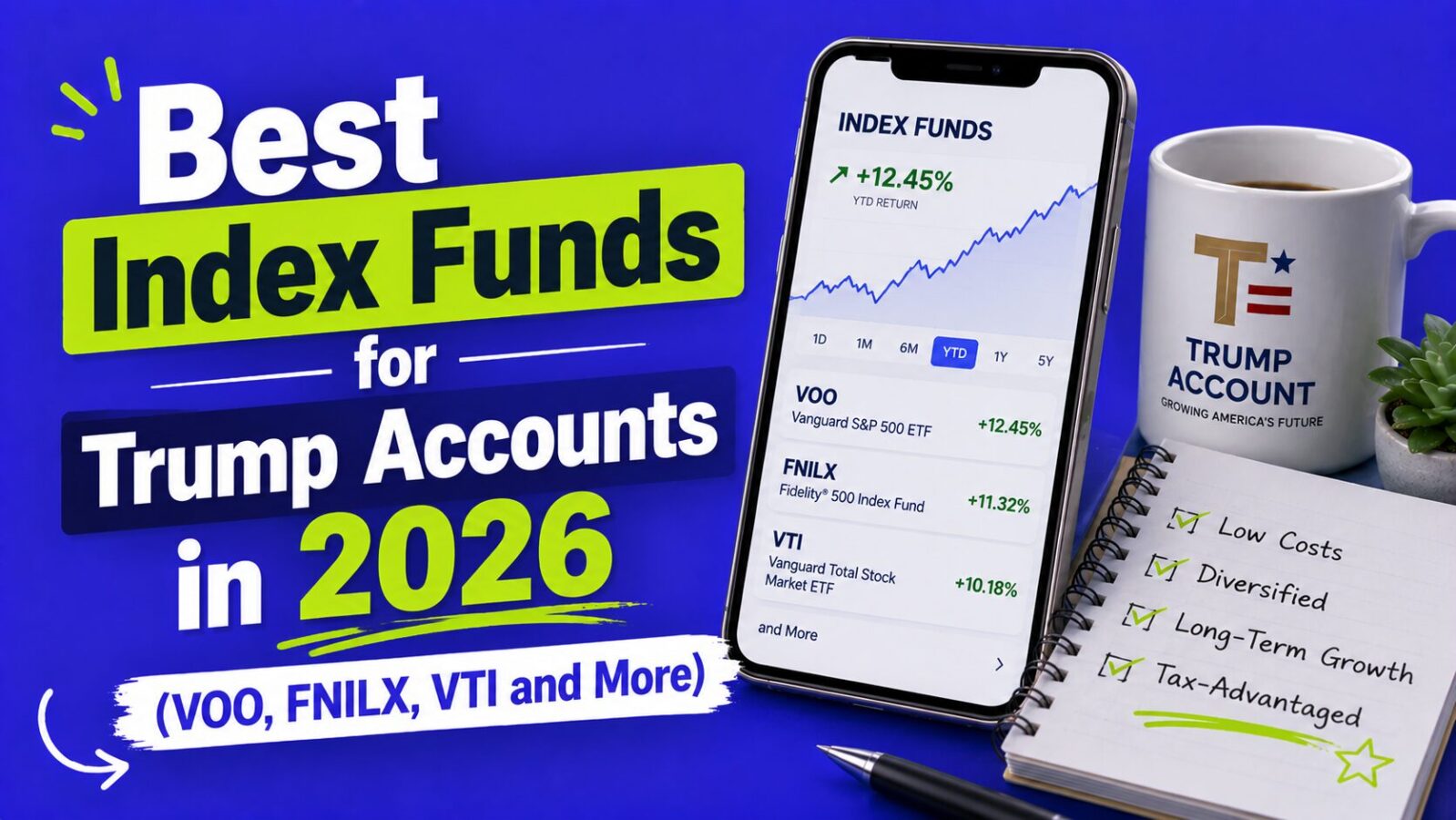
SPYM is the best Trump Account fund for most families right now because it is the current default, costs just 0.02%, and already provides broad S&P 500 exposure.
Treasury has also selected IVV, VTI, SPTM, and ITOT as additional Trump Account investments. However, Treasury’s investment-specific announcement says those choices will become available through future investment-election functionality. Until that functionality is available, contributions remain invested in SPYM.
Once the additional choices are available, I would consider VTI or ITOT if you specifically want exposure beyond the S&P 500 to smaller U.S. companies.
But this is not a decision where you need to chase the lowest possible fee.
The difference between a 0.02% fund and a 0.03% fund is just $1 per year for every $10,000 invested.
FinancePulse view: Keep SPYM unless you have a clear reason to prefer broader U.S. market exposure. When more choices become available, VTI and ITOT are the alternatives I would look at first.
Trump Account index funds compared
Treasury has selected five ETFs for the initial Trump Account investment lineup.
| Fund | Ticker | Exposure | Current expense ratio | FinancePulse take |
|---|---|---|---|---|
| State Street SPDR Portfolio S&P 500 ETF | SPYM | S&P 500 | 0.02% | Best current default |
| iShares Core S&P 500 ETF | IVV | S&P 500 | 0.03% | Similar exposure to SPYM |
| Vanguard Total Stock Market ETF | VTI | Total U.S. market | 0.03% | Best broader-market option |
| State Street SPDR Portfolio S&P 1500 ETF | SPTM | Large, mid, small U.S. stocks | 0.03% | Broad alternative |
| iShares Core S&P Total U.S. Stock Market ETF | ITOT | Total U.S. market | 0.03% | Strong alternative to VTI |
State Street currently lists SPYM at 0.02% and SPTM at 0.03%. Vanguard lists VTI at 0.03%, while BlackRock currently lists both IVV and ITOT at 0.03%.
Expense ratios can change, so verify the current fund information before making an investment election.
What is the default Trump Account investment?
The default Trump Account investment is SPYM, the State Street SPDR Portfolio S&P 500 ETF.
Treasury announced that all contributions would initially be invested in SPYM. It also said contributions would remain there until functionality allowing responsible parties to select among the additional investments becomes available.
SPYM tracks the S&P 500 and currently charges a 0.02% expense ratio. State Street describes it as a low-cost way to access the U.S. large-cap market.
At that expense ratio:
$10,000 invested = about $2 per year in fund expenses
assuming both the balance and expense ratio stayed unchanged for purposes of the example.
That is already extremely inexpensive.
Is SPYM a good Trump Account fund?
Yes. I would be comfortable leaving a Trump Account in SPYM.
Its strengths are straightforward:
- very low cost;
- exposure to approximately 500 major U.S. companies through the S&P 500;
- diversification across multiple sectors;
- no need to make an additional fund decision.
Its main limitation is that the S&P 500 focuses on large U.S. companies.
State Street says the S&P 500 represents roughly 80% of the U.S. equity market.
So SPYM does not provide the same small- and mid-cap exposure as a total-market fund.
That is the main reason I would consider VTI or ITOT when additional investment choices become available.
It is not because SPYM is a weak fund.
VTI: My pick for broader U.S. market exposure
If you eventually have the option and want broader diversification than the S&P 500, VTI is my first fund to compare with SPYM.
Vanguard Total Stock Market ETF tracks the CRSP US Total Market Index and includes large-, mid-, and small-cap U.S. stocks. Its current expense ratio is 0.03%.
The decision between SPYM and VTI is therefore mostly about coverage:
SPYM: large U.S. companies through the S&P 500.
VTI: large, mid-sized, and small U.S. companies.
I slightly prefer the total-market structure for someone who wants one fund covering a larger portion of the U.S. equity market.
But broader diversification does not guarantee higher returns.
There will be periods when the S&P 500 performs better and periods when smaller companies contribute more.
ITOT: A strong alternative to VTI
ITOT is another total-U.S.-market option.
BlackRock says the iShares Core S&P Total U.S. Stock Market ETF tracks an index of U.S. stocks across market capitalizations. Its current expense ratio is 0.03%.
Its role is very similar to VTI.
For the typical Trump Account investor, I would not spend much time predicting whether VTI or ITOT will outperform over the child’s growth period.
Both are designed to provide broad exposure across the U.S. stock market.
If both become available in your account, either can fill the total-market role.
SPTM: Between an S&P 500 fund and total market
SPTM tracks the S&P Composite 1500 Index, which combines:
- S&P 500 large-cap stocks;
- S&P MidCap 400 stocks;
- S&P SmallCap 600 stocks.
State Street says the index represents approximately 90% of the investable U.S. equity market. SPTM currently charges 0.03%.
That makes it broader than SPYM without trying to cover essentially the entire U.S. market.
SPTM is a perfectly reasonable option.
I simply do not see a strong reason for most families to favor it over VTI or ITOT if the goal is straightforward broad-market exposure.
IVV: Good fund, but little reason to switch from SPYM
IVV is the iShares Core S&P 500 ETF.
It tracks the same S&P 500 index as SPYM and currently charges 0.03%.
That means its investment exposure is very similar to SPYM.
If your Trump Account is already invested in SPYM at 0.02%, I do not see a compelling reason to switch to IVV solely because IVV is a familiar or larger ETF.
On $10,000:
SPYM at 0.02% = about $2 per year
IVV at 0.03% = about $3 per year
The $1 difference is not meaningful by itself, but neither is there an obvious investment advantage from replacing one S&P 500 tracker with another.
Which Trump Account fund should you choose?
My ranking is intentionally simple.
Best right now: SPYM
If your account is currently invested in SPYM, leave it alone unless you want different market exposure once additional choices become available.
It is cheap, diversified, and tracks the S&P 500.
Best for broader diversification: VTI
When investment elections become available, VTI would be my first alternative for someone who prefers one fund covering large, mid-sized, and small U.S. companies.
Best alternative to VTI: ITOT
ITOT provides a similar total-market approach at the same current 0.03% expense ratio.
Also good: SPTM
SPTM offers broader market coverage than the S&P 500 through the S&P 1500.
Least compelling switch: IVV
IVV is an excellent low-cost S&P 500 ETF.
But if you already have SPYM, switching between two S&P 500 funds does not materially change your diversification.
Are the other four funds available yet?
Treasury announced IVV, VTI, SPTM, and ITOT on July 1, 2026, saying parents and guardians would be able to allocate among them “in the coming months.”
Treasury also said it would announce when investment-election functionality became available.
The Trump Accounts app officially launched on July 4 with account access, contributions, dashboards, recurring contributions, and other account-management features. Treasury’s launch announcement did not separately say that the previously announced investment-election feature had gone live.
As of August 18, 2026, I would therefore check the current app before assuming you can switch funds.
If your account currently shows only SPYM, there is no reason to force a change elsewhere.
What investments are legally allowed in a Trump Account?
The five-fund Treasury lineup is different from the broader statutory definition of an eligible Trump Account investment.
During the growth period, Section 530A generally limits Trump Accounts to mutual funds or ETFs that:
- track a qualified index;
- do not use leverage;
- charge no more than 0.10% annually;
- meet other applicable requirements.
A qualified index can be the S&P 500 or another qualifying equity index composed primarily of U.S. companies.
Sector- and industry-specific indexes do not qualify.
The IRS has also created a safe harbor for determining when an index is considered composed primarily of U.S. companies.
Do not turn that safe harbor into a homemade fund-selection test.
The practical investment menu is the menu actually made available by the Trump Account trustee.
Can you invest in VOO, FXAIX, FNILX, or SWPPX?
Do not treat them as current Trump Account options just because they are inexpensive U.S. index funds.
Treasury’s announced lineup is:
- SPYM;
- IVV;
- VTI;
- SPTM;
- ITOT.
VOO, FXAIX, FNILX, and SWPPX are not on that initial Treasury list.
This distinction is important:
A fund appearing to satisfy some of the legal criteria does not automatically mean it is available inside your Trump Account.
Choose from the funds actually offered by the trustee rather than building your own eligibility list from expense ratios.
What about QQQ, ARKK, crypto, or individual stocks?
They are not part of Treasury’s current Trump Account fund lineup.
More importantly, the growth-period rules require qualifying index funds or ETFs meeting Section 530A’s requirements. The IRS says eligible investments must track a qualified equity index, avoid leverage, and remain below the statutory fee ceiling. Sector- and industry-specific indexes are excluded.
That means the growth-period account is not designed for:
- individual stocks;
- crypto;
- leveraged ETFs;
- actively managed funds such as ARKK;
- sector-specific funds;
- bond funds.
The restrictions deliberately keep the investment strategy narrow.
Does the 0.02% vs. 0.03% expense ratio matter?
Very little at normal Trump Account balances.
For every $10,000 invested:
0.02% = about $2 per year
0.03% = about $3 per year
Difference:
about $1
For $100,000:
0.02% = about $20
0.03% = about $30
Difference:
about $10
Fees matter, especially when comparing an expensive fund with a cheap one.
But all five Treasury-selected ETFs are already extremely low cost.
Do not choose an investment with different market exposure solely to save or spend one additional basis point.
Frequently asked questions
What is the best index fund for a Trump Account?
SPYM is the best choice for most families right now because it is the current default and charges only 0.02%.
When additional choices become available, VTI or ITOT may be preferable for someone who specifically wants broader U.S. market exposure.
What is the default Trump Account fund?
The default is SPYM, the State Street SPDR Portfolio S&P 500 ETF.
Treasury selected it as the launch investment for Trump Accounts.
What other Trump Account funds are available or planned?
Treasury selected IVV, VTI, SPTM, and ITOT as the additional investment options.
Its July 1 announcement said investment-selection functionality would be introduced in the coming months.
Is VTI better than SPYM for a Trump Account?
Neither is universally better.
SPYM tracks the S&P 500, while VTI holds large-, mid-, and small-cap U.S. stocks.
I prefer VTI if the goal is broader U.S. market exposure. I would keep SPYM if you are satisfied with an inexpensive S&P 500 strategy.
Can I invest a Trump Account in VOO?
VOO is not one of Treasury’s five announced Trump Account funds.
Do not assume it is available merely because it is a low-cost S&P 500 ETF.
Can I invest in Fidelity funds such as FXAIX or FNILX?
They are not part of Treasury’s initial five-fund investment lineup.
Availability should be based on what your Trump Account trustee actually offers, not whether a fund appears to satisfy part of the statutory criteria.
Are Trump Account investments guaranteed?
No.
These funds invest in stocks, so the account value can fall as well as rise.
Neither the $1,000 government contribution nor the Trump Account structure guarantees an investment return.
The bottom line
If your Trump Account is currently invested in SPYM, I would keep it there.
SPYM tracks the S&P 500, currently costs just 0.02% per year, and is Treasury’s official default investment.
When the additional investment-election functionality is available, the decision becomes:
Want to stay with the S&P 500? Keep SPYM.
Want broader U.S. market exposure? Compare VTI and ITOT.
SPTM is also a strong broad-market choice, while IVV largely duplicates the S&P 500 exposure you already receive from SPYM.
I would not spend much time optimizing a difference of 0.01 percentage point in annual fees.
And I would not build the portfolio around VOO, FNILX, FXAIX, SWPPX, QQQ, or another fund simply because someone online says it “should qualify.”
Use the investment menu Treasury actually provides. Then choose based on market exposure, not ticker popularity or a $1 annual fee difference.
For the account itself, see our guide to opening a Trump Account and our comparison of Trump Accounts vs. 529 plans.