By
By 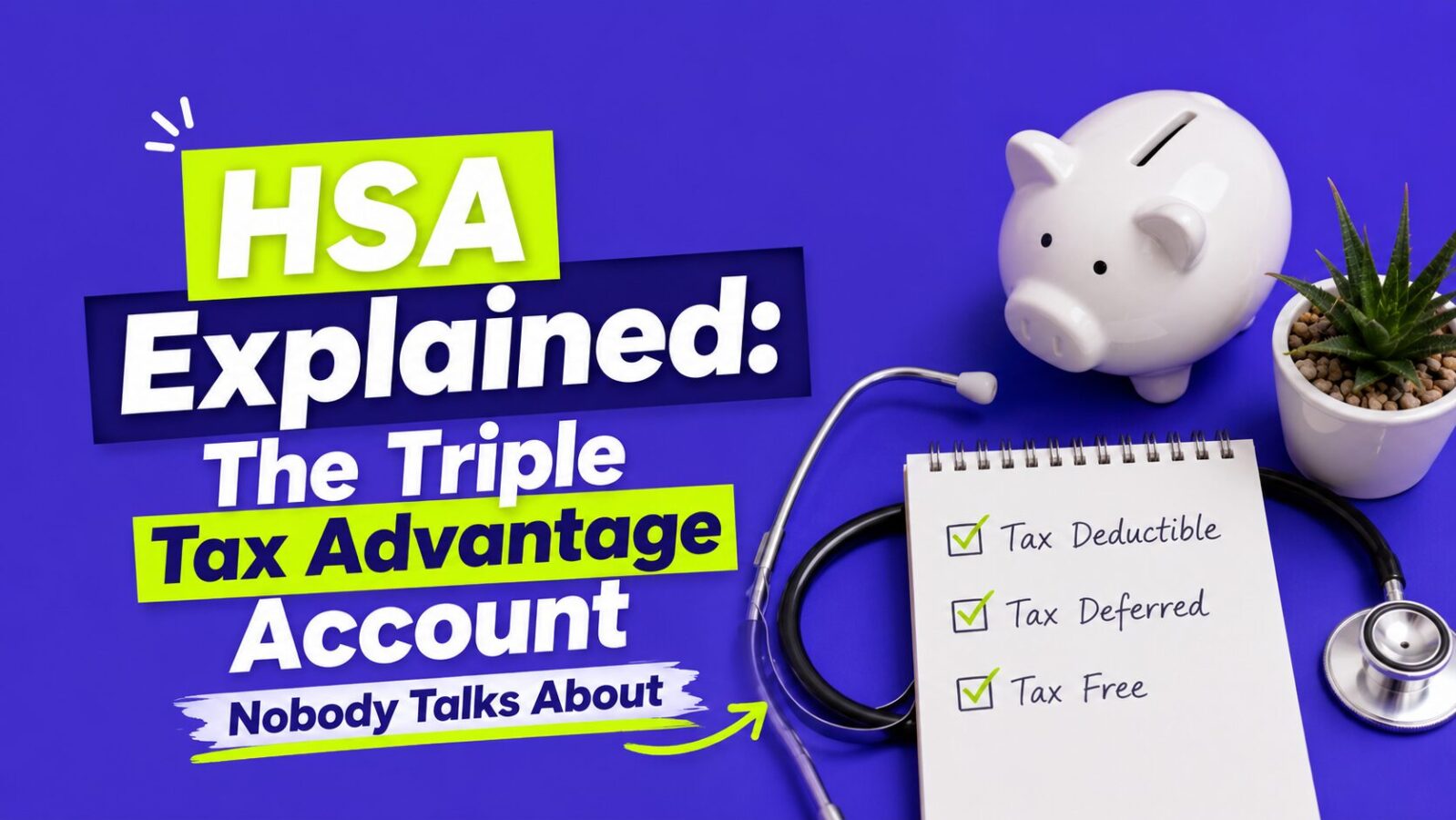
An HSA gives you a tax deduction going in, tax-free growth, and tax-free withdrawals for medical expenses. No other account does all three. Here is how to use it as a stealth retirement account that can fund hundreds of thousands of dollars in healthcare costs completely tax-free.
If someone told you there was an account that gives you a tax deduction when you contribute, lets your money grow tax-free, and allows tax-free withdrawals, you would assume it does not exist. Every other account makes you choose: a Traditional 401(k) gives you a deduction now but taxes you on withdrawals. A Roth IRA taxes you now but lets you withdraw tax-free. Neither does all three. The Health Savings Account does all three.
The HSA is the only triple-tax-advantaged account in the US tax code, and it is one of the most overlooked tools on the retirement account roadmap. Most people who have one treat it like a checking account for doctor visits instead of one of the most powerful investment vehicles available to them.
- The HSA is the only account in the US tax code with a triple tax advantage: tax-deductible contributions, tax-free growth, and tax-free withdrawals for medical expenses. A Traditional 401(k) gets the first benefit only. A Roth IRA gets the second and third. The HSA gets all three at once, for qualified medical expenses.
- The most powerful HSA strategy: pay current medical expenses out of pocket, save every receipt, and let the HSA grow invested in index funds for decades. The IRS sets no deadline for reimbursing yourself. A $500 medical bill from 2026, left invested for 20 years at 7%, grows to roughly $1,935 that you can withdraw tax-free later using the original receipt. The $1,435 in growth is never taxed.
- HSA contributions made through payroll also avoid FICA taxes (Social Security + Medicare = 7.65%) on top of income taxes. A $4,400 payroll contribution saves about $337 in FICA versus contributing from your bank account. No other tax-advantaged account avoids payroll taxes this way.
- After age 65, the HSA works like a Traditional IRA for non-medical withdrawals: ordinary income tax, no penalty. Medical withdrawals stay completely tax-free. Since healthcare is often the largest expense in retirement (Fidelity has estimated a 65-year-old couple may need well over $300,000), a tax-free healthcare fund is valuable.
- A common contribution order: 401(k) to the employer match, then pay off high-interest debt, then HSA to the max, then Roth IRA, then max the 401(k). Some advisors rank the HSA above the Roth IRA because of the triple tax advantage and the FICA exemption.
What is the triple tax advantage?
| Account | Tax deduction going in | Tax-free growth | Tax-free withdrawal |
|---|---|---|---|
| HSA | Yes | Yes | Yes (for medical expenses) |
| Traditional 401(k) | Yes | No (tax-deferred) | No (taxed as income) |
| Roth IRA | No | Yes | Yes |
| Traditional IRA | Yes (if eligible) | No (tax-deferred) | No (taxed as income) |
| Taxable brokerage | No | No (taxed annually) | No (capital gains tax) |
What are the 2026 HSA contribution limits?
| Coverage type | 2026 limit |
|---|---|
| Individual (self-only) coverage | $4,400/year |
| Family coverage | $8,750/year |
| Catch-up contribution (age 55+) | Additional $1,000 |
These 2026 figures come from the IRS (Rev. Proc. 2025-19). Employer contributions count toward the limit. With individual coverage and a $500 employer contribution, you can add up to $3,900 yourself to stay within the $4,400 cap. Contributions can be made until your tax filing deadline, including extensions.
Payroll deduction vs bank transfer: HSA contributions through payroll avoid the 7.65% FICA tax (Social Security + Medicare) on top of income taxes. A $4,400 payroll contribution saves about $337 in FICA versus contributing from your bank account. If your employer offers payroll HSA contributions, that method is usually the most tax-efficient.
Project your HSA retirement balance
HSA Growth Calculator
See your projected HSA balance and “stealth retirement account” value at age 65. Estimates only.
Who can open an HSA?
You must meet all of these requirements:
- Enrolled in a High-Deductible Health Plan (HDHP). For 2026: minimum deductible of $1,700 (individual) or $3,400 (family), and an out-of-pocket maximum no higher than $8,500 (individual) or $17,000 (family), per the IRS.
- Not enrolled in Medicare.
- Not claimed as a dependent on someone else’s tax return.
- No other non-HDHP health coverage (with exceptions for dental, vision, and specific-disease insurance).
If your employer offers an HDHP during open enrollment, choosing it unlocks HSA eligibility. Many employers also contribute to your HSA, which is free money, similar to a 401(k) match.
How does the stealth retirement account strategy work?
Most people use their HSA like a healthcare debit card: pay a medical expense, swipe the HSA card, balance stays near $0. That leaves the most powerful benefit on the table.
The optimal strategy:
- Contribute the maximum every year ($4,400 individual / $8,750 family in 2026).
- Invest the entire balance in index funds (most providers let you invest once the cash balance exceeds $1,000 to $2,000).
- Pay current medical expenses out of pocket using your regular checking account or a cash-back credit card.
- Save every medical receipt digitally: doctor visits, prescriptions, dental, vision, hospital bills. A folder labeled “HSA Receipts” with date, provider, and amount works well.
- Let the HSA investments compound for years or decades.
- Reimburse yourself later, with no deadline. The IRS does not require reimbursement in the same year as the expense. Pay a $500 medical bill in 2026, save the receipt, and withdraw $500 (or the grown amount) tax-free in 2036 or 2046.
- After age 65: withdraw for any purpose. Medical expenses remain 100% tax-free. Non-medical withdrawals are taxed as ordinary income, identical to a Traditional IRA, but with no penalty.
The receipt reimbursement math: a $500 medical expense paid out of pocket in 2026, left invested at 7% for 20 years, grows to roughly $1,935 inside your HSA. You withdraw $1,935 tax-free in 2046 using the original receipt. The $1,435 in growth was never taxed. No other account structure produces this outcome.
HDHP vs traditional plan: does the math work?
Quick HDHP Cost Comparison
HSA vs FSA: what is the difference?
| Feature | HSA | FSA |
|---|---|---|
| Requires HDHP | Yes | No (any health plan) |
| Your money or employer’s | Yours, portable, stays with you | Employer-owned (you may lose unused funds) |
| Use-it-or-lose-it rule | No, balance rolls over indefinitely | Yes, expires at year end (some plans allow a small carryover) |
| Can be invested | Yes, index funds and ETFs | No |
| Tax advantages | Triple: deduction + growth + withdrawal | Single: pre-tax contribution only |
| 2026 contribution limit | $4,400 individual / $8,750 family | About $3,400 |
| Best for | Long-term wealth building + medical funding | Predictable near-term medical expenses |
If you have access to an HSA, it is usually the stronger choice. The rollover and investment features make it a long-term wealth-building tool, while the FSA is a short-term tax break that must be used each year (some plans allow a carryover of up to about $680 for 2026). If your plan is not an HDHP and you cannot get an HSA, the FSA is still worth using for predictable annual medical expenses; just estimate carefully to avoid losing unused funds.
Which HSA providers are best for investing?
If your employer’s HSA provider has limited investment options or high fees, you can transfer your HSA balance to a better provider, generally once per year.
Fidelity HSA: $0 fees, access to Fidelity funds and ETFs, and no minimum cash balance required before investing. A strong overall HSA for investors. See our Fidelity review.
Lively + Schwab: Lively is a fee-free HSA administrator that integrates with Schwab for investments, giving you Schwab’s full lineup with no management fees. See our Schwab review.
A common approach: keep enough with your employer’s provider to capture any employer contributions, then transfer excess funds to a low-cost provider periodically. The key factors are $0 monthly fees and access to low-cost index funds (expense ratios under 0.10%).
Common HSA mistakes
Using the HSA debit card for every medical expense. Every dollar withdrawn is a dollar that cannot grow tax-free for decades. When you can, pay out of pocket, save the receipt, and withdraw later after the balance has grown.
Not investing the balance. Many HSA providers default to a cash savings account earning very little. Your HSA can hold index funds just like a Roth IRA. Many people invest everything above their cash threshold (typically $1,000 to $2,000) in a total stock market fund or target-date fund.
Not saving receipts. Without documentation, you cannot prove a withdrawal is for a qualified expense, which can make it taxable income plus a 20% penalty if you are under 65. Create a digital receipt folder and add to it after every medical expense you pay out of pocket.
Contributing when not eligible. If you switch from an HDHP to a traditional health plan mid-year, your HSA contribution limit is prorated. Contributing above the prorated amount triggers a 6% excess contribution penalty. Verify eligibility if your insurance changes during the year.
Ignoring employer contributions. Some employers contribute $500 to $1,500 a year to employee HSAs as part of the HDHP incentive. That is free money. Always check whether your employer contributes before choosing between plan types during open enrollment.
Frequently Asked Questions
Yes, dental and vision are fully qualified medical expenses: cleanings, fillings, crowns, root canals, orthodontics, eye exams, glasses, contacts, and LASIK. Cosmetic-only procedures are not qualified. Over-the-counter medications are eligible since the CARES Act of 2020, without a prescription. That makes the HSA useful even for routine healthcare spending.
Your existing HSA balance remains yours and keeps growing, and you can still use it for qualified medical expenses anytime, tax-free. You simply cannot make new contributions until you are enrolled in an HDHP again. Even a few years of HDHP coverage can build a balance that funds medical expenses for the rest of your life.
Yes. HSA funds can pay qualified medical expenses for your spouse and tax dependents, even if they are not on your HDHP. They do not need to share your health plan. A single HSA can effectively cover qualified healthcare costs for your whole household.
Before age 65, you pay ordinary income tax plus a 20% penalty, which is steeper than the 10% on an early IRA withdrawal. After age 65, the 20% penalty disappears and non-medical withdrawals are simply taxed as ordinary income, like a Traditional IRA, while medical withdrawals stay tax-free.
That is actually an ideal scenario for the strategy. If you are healthy, you likely qualify for a lower-premium HDHP, you have few expenses hitting the deductible, and your contributions go straight into investments that compound tax-free for decades. A healthy 30-year-old who maxes the HSA and leaves it invested until 65 could accumulate a large tax-advantaged balance.
Yes, they are separate accounts with separate limits. In 2026 you could contribute $24,500 to a 401(k), $4,400 to an HSA, and $7,500 to a Roth IRA, a combined $36,400 in tax-advantaged savings. A common priority order is: 401(k) to the match, HSA to the max, Roth IRA to the max, then max the 401(k).
No. HSAs have no RMDs at any age, unlike Traditional IRAs and 401(k)s, which require withdrawals starting at 73. Your HSA can compound indefinitely with no forced distributions, which makes it unusually flexible for long-term planning.
No IRS deadline exists. You can reimburse yourself for a medical expense from any prior year as long as you had the HSA at the time of the expense, it was a qualified expense, and you have documentation. This is the foundation of the stealth retirement strategy. Keep digital copies, since the IRS requires documentation in an audit.
The bottom line
The HSA is the most tax-efficient account in the US tax code: a deduction going in, tax-free growth, and tax-free withdrawals for medical expenses. If you have access to an HDHP through your employer, maxing your HSA belongs near the top of your financial priority list.
The strategy in one line: contribute the max, invest the balance in index funds, pay current medical expenses out of pocket, save every receipt, and let the account compound for decades. Use the growth calculator above to see what your HSA could be worth at 65.
- New to retirement accounts? Start with our hub, Retirement Accounts Explained.
- Looking at your full savings priority? Read our 401(k) maximization guide for how the HSA fits alongside the employer match and Roth IRA.
- Want to compare with a Roth IRA? Read our Traditional vs Roth IRA guide.
- Building toward early retirement? Read our Roth conversion ladder guide, where HSA reimbursements can serve as one bridge funding source before 59.5.
A quick note: this article is for educational purposes only and is not financial, investment, or tax advice. HSA limits, HDHP thresholds, and other figures come from the IRS and apply to 2026; verify current numbers at IRS.gov before you act. Everyone’s situation is different, so it is worth talking with a qualified financial or tax professional about yours.