 By
By 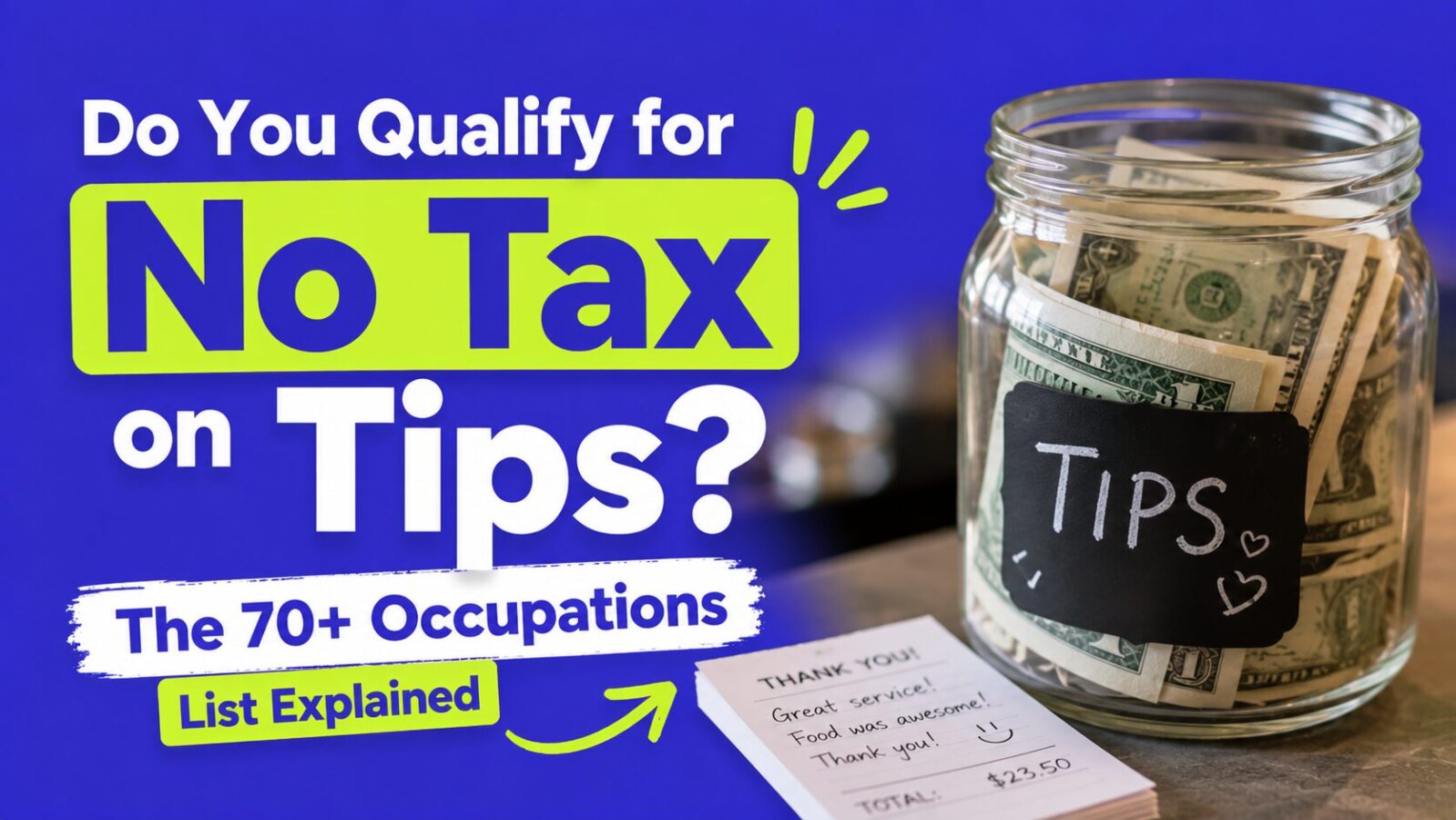
You may qualify for the federal no-tax-on-tips deduction in 2026 if you work in an occupation on the IRS’s official tipped-occupation list and receive tips that meet the federal definition of qualified tips.
The IRS final regulations include more than 70 occupations across eight categories, covering jobs from servers and bartenders to housekeepers, barbers, rideshare drivers, tutors, musicians, pet groomers, home-service workers, and tour guides.
For 2026, employers and other payers also have new reporting requirements. Qualified tips should generally be separately identified on forms such as the W-2, 1099-NEC, 1099-MISC, or 1099-K, along with a Treasury Tipped Occupation Code, or TTOC.
But being on the occupation list is only the first step.
The payment itself must also qualify as a tip, your income can reduce the deduction, married taxpayers must generally file jointly, and the person earning the tips must have a valid Social Security number.
Key takeaways
- The IRS final list contains more than 70 qualifying tipped occupations across eight categories.
- Your occupation must be on the IRS list, but that alone does not make every payment you receive a qualified tip.
- Qualified tips generally must be voluntary, customer-determined, paid in cash or a cash-equivalent form, and not negotiated.
- A mandatory service charge generally does not qualify when the customer cannot disregard or change it.
- The federal deduction is limited to $25,000 per tax return, not $25,000 per job or per spouse.
- The deduction begins phasing out when MAGI exceeds $150,000, or $300,000 for married couples filing jointly.
- Married taxpayers generally must file jointly to claim the deduction.
- The person who earned the qualified tips must have a valid Social Security number.
- Self-employed workers can qualify, but their deduction cannot exceed the net income from the business in which the tips were earned.
- This is a federal income-tax deduction, not an exemption from every tax that may apply to tip income.
What is the no-tax-on-tips deduction?
The One Big Beautiful Bill created a new federal deduction for certain qualified tips received during tax years 2025 through 2028.
The maximum deduction is:
Up to $25,000 per tax return
That means the deduction is not automatically equal to all the tips you earned.
Suppose you received $18,000 of qualified tips in 2026 and meet the other requirements.
Your potential deduction could be up to:
$18,000
If you received $32,000 of otherwise qualified tips, the normal maximum before other limitations would be:
$25,000
The deduction is available whether you take the standard deduction or itemize deductions.
You claim it through Schedule 1-A with your federal income tax return.
What counts as a qualified tip?
A payment does not become a qualified tip just because your employer, app, customer, or receipt calls it a tip.
Under the IRS final regulations, the tip generally must satisfy several conditions.
The customer must pay it voluntarily
The customer must have a real choice about whether to leave the payment.
A normal restaurant tip where the customer chooses to leave 20% can potentially qualify.
A required charge automatically added to the bill is different.
The customer determines the amount
The customer must determine how much to give.
The business cannot simply rename part of an agreed price as a “tip.”
The amount cannot be negotiated
A payment that was part of a negotiated price for services generally does not become a qualified tip just because it appears separately on an invoice.
It must be cash or a cash equivalent
“Cash tips” for this deduction are broader than literal paper currency.
The final regulations include qualifying amounts paid through methods such as:
- Cash
- Check
- Credit card
- Debit card
- Certain gift cards
- Electronic payment apps
- Other qualifying cash-equivalent payment methods
Noncash gifts are different.
For example, a customer giving you concert tickets or merchandise can still create taxable tip income under ordinary tax rules, but it is not necessarily a qualified cash tip for this deduction.
Do mandatory service charges qualify?
Generally no, if the customer cannot choose whether to pay them or change the amount.
For example, suppose a restaurant automatically adds an 18% service charge to every large-party check.
The customer has no option to remove or modify it.
Even if the restaurant later distributes that money to servers and bussers, the IRS says those distributed amounts are not qualified tips for the deduction.
There is an important nuance.
A charge may be treated differently if the customer has a genuine option to disregard or modify it.
So the label “service charge” alone does not answer the question. The customer’s ability to control the payment matters.
Do pooled tips qualify?
They can.
The IRS final regulations allow qualified tips received through qualifying tip-sharing arrangements, including tip pools.
For example, a customer voluntarily leaves a $20 tip.
The restaurant then distributes part of it to the server and part to another eligible worker through its tip pool.
The fact that the original tip was shared does not automatically make it nonqualified.
The key question is whether the original customer payment met the qualified-tip rules.
A mandatory service charge does not turn into a qualified tip simply because the employer later distributes it through the same payroll system.
Which occupations qualify for no tax on tips?
The IRS’s final list uses Treasury Tipped Occupation Codes, or TTOCs.
The occupations are divided into eight categories:
| TTOC category | Examples of qualifying occupations |
|---|---|
| 100s: Beverage and food service | Bartenders, wait staff, baristas, bussers, cooks, dishwashers, hosts, bakers |
| 200s: Entertainment and events | Casino dealers, musicians, singers, DJs, performers, digital content creators, ushers |
| 300s: Hospitality and guest services | Bellhops, concierges, hotel desk clerks, hotel housekeepers |
| 400s: Home services | Handymen, landscapers, electricians, plumbers, HVAC workers, house cleaners, locksmiths |
| 500s: Personal services | Personal care workers, event planners, photographers, pet groomers, tutors, babysitters, florists |
| 600s: Personal appearance and wellness | Estheticians, massage therapists, barbers, hairstylists, nail technicians, makeup artists, personal trainers, tattoo artists |
| 700s: Recreation and instruction | Golf caddies, self-enrichment teachers, tour guides, travel guides, sports instructors |
| 800s: Transportation and delivery | Valets, rideshare drivers, shuttle drivers, delivery workers, car wash attendants, charter bus drivers, movers, gas pump attendants |
These examples come from the IRS’s final occupation list.
The exact TTOC matters more than whatever informal job title your employer happens to use.
For example, the official Bartenders category includes illustrative titles such as mixologist and sommelier. The IRS list also explicitly includes app-based rideshare and delivery workers under its transportation categories.
If you are unsure whether your role fits, use the official IRS tipped-occupation list rather than guessing based on your job title.
Some qualifying jobs are easy to miss
The final list is much broader than restaurants and salons.
It also includes occupations such as:
- Digital content creators
- Hotel desk clerks
- Hotel housekeeping workers
- Home repair workers
- Electricians doing home services
- Plumbers doing home services
- Locksmiths
- Tow truck and roadside assistance workers
- Wedding and event photographers
- Wedding videographers
- Pet groomers and pet sitters
- Tutors
- Babysitters and nannies
- Visual artists
- Floral designers
- Personal trainers
- Tattoo artists and piercers
- Golf caddies
- Tour guides
- Sports instructors
- Rideshare drivers
- Delivery workers
- Home movers
- Gas pump attendants
That is why describing the deduction as simply “no tax on restaurant tips” misses a large part of the law.
What does your 2026 W-2 show?
The 2026 W-2 adds specific information to help taxpayers calculate the deduction.
For qualified tips, the IRS says your W-2 should generally report:
Box 12, code TP: qualified cash tips reported to your employer
Box 14b: the applicable Treasury Tipped Occupation Code or codes
Do not confuse those two boxes.
TP tells you the separately reported tip amount.
TTOC tells you the occupation associated with the tips.
A TTOC does not by itself prove that every dollar you received qualifies. The customer-payment requirements and the other tax rules still apply.
What if your W-2 information looks wrong?
Do not assume that a missing or incorrect code means you should simply give up the deduction.
First compare the form with:
- Your tip records
- Pay statements
- Employer records
- Your actual occupation and duties
- The IRS TTOC list
Employees are required to keep records of tips and generally report qualifying cash tips to employers when the reporting rules apply.
If your employer’s 2026 W-2 appears incorrect, contact payroll and ask them to review it.
If a correction is required, the employer can use the normal corrected W-2 process.
Do not invent a TTOC yourself or simply change the W-2 amount on your return without understanding why the information differs.
What about unreported employee tips?
Employees generally must report cash tips to their employer when they receive $20 or more in a calendar month from that employer.
Employees also need to report all taxable tip income on their federal income tax return.
If applicable tips were not reported to the employer, Form 4137 may be involved.
Importantly, IRS guidance says qualified tips used for the deduction can include amounts properly reported by the worker on Form 4137, not only amounts appearing in Box 12 code TP.
That is another reason the statement “no TP box means no deduction” is too broad.
Can Uber and Lyft drivers qualify?
Yes, potentially.
The IRS final list specifically includes:
TTOC 802: Taxi and rideshare drivers and chauffeurs
The examples include platform or app-based rideshare drivers.
So an Uber or Lyft driver can potentially qualify when passengers leave voluntary tips.
The driver still has to satisfy the other requirements.
For example, the ordinary fare charged for the ride is not a tip. A voluntary $5 amount the passenger adds afterward can potentially be.
For a complete self-employed filing walkthrough, see How to File Taxes as a Gig Worker / 1099 in 2027.
What about DoorDash and other delivery drivers?
They can also potentially qualify.
The IRS final list includes:
TTOC 804: Goods delivery people
Examples include food delivery, grocery delivery, package delivery, bicycle couriers, and app-based delivery workers.
Again, only the qualifying tip portion is relevant to this deduction.
The normal delivery payment, platform earnings, bonuses, incentives, and other compensation do not automatically become qualified tips.
Can self-employed workers claim the deduction?
Yes.
The no-tax-on-tips provision is available to both employees and qualifying self-employed individuals.
For 2026, information returns have new fields for qualified tips and TTOCs:
| Form | Qualified tips | TTOC |
|---|---|---|
| W-2 | Box 12, code TP | Box 14b |
| 1099-MISC | Box 13a | Box 13b |
| 1099-NEC | Box 1b | Box 1c |
| 1099-K | Box 1c | Box 1d |
Self-employed taxpayers also have an extra limitation:
The deduction cannot exceed the net income, before this deduction, from the trade or business in which the qualified tips were earned.
For example, if you received $15,000 in otherwise qualified tips but the relevant business produced only $10,000 of net income before the tip deduction, the self-employed limitation becomes important.
How does the $25,000 limit work?
The maximum deduction is $25,000 per return.
It is not:
- $25,000 per employer
- $25,000 per tipped occupation
- $25,000 per gig platform
- $25,000 for each spouse on a joint return
Suppose a married couple filing jointly has:
- Spouse A: $20,000 of qualified tips
- Spouse B: $15,000 of qualified tips
Their combined qualified tips are $35,000.
The normal deduction ceiling is still:
$25,000 per joint return
before applying any other limitations.
What are the income limits?
The deduction begins to phase out when modified adjusted gross income exceeds:
$150,000 for most filers
or
$300,000 for married couples filing jointly
This is a phaseout threshold, not an immediate cliff.
Crossing $150,000 by one dollar does not mean the entire deduction suddenly disappears.
If your income is above the threshold, use Schedule 1-A and the applicable filing instructions to calculate the reduced amount.
Married? You generally have to file jointly
If you are married, the IRS says you generally must file a joint federal return to claim the qualified tips deduction.
That means a married couple filing separately generally cannot use this deduction.
This is important enough to check before deciding your filing status solely based on another tax issue.
You also need a valid Social Security number
The taxpayer or spouse who earned the qualified tips must have a valid Social Security number to qualify under the federal rules.
This requirement is separate from the occupation and income tests.
Does no tax on tips mean you pay no tax at all?
No.
The name is misleading if taken literally.
This is a federal income-tax deduction for qualifying tip income.
It does not mean that qualified tips disappear from payroll or business income reporting.
Employees still have tip reporting responsibilities, and tips remain relevant to Social Security and Medicare taxes under the normal rules. Employers continue to withhold and report applicable payroll taxes on employee tip income.
Self-employed workers also should not simply remove tip receipts from Schedule C because they plan to claim the deduction.
The deduction is calculated separately on Schedule 1-A.
State income-tax treatment can also differ depending on whether your state conforms to the federal provision.
Quick eligibility checklist
Before claiming the deduction, check all of these:
- My occupation appears on the IRS tipped-occupation list.
- The amounts I am counting were voluntary customer tips.
- The customer determined the tip amount.
- The payment was not negotiated as part of the price.
- I am not treating an unavoidable mandatory service charge as a tip.
- The tips were paid in cash or another qualifying cash-equivalent form.
- My tip income was properly reported.
- I have reviewed the applicable TTOC on my W-2 or 1099.
- I have a valid Social Security number.
- If I am married, I will file jointly.
- I have applied the $25,000 per-return maximum.
- I have checked the MAGI phaseout if my income exceeds $150,000, or $300,000 jointly.
- If self-employed, I have checked the net-business-income limit.
If any of these are unclear, do not rely only on the phrase “no tax on tips.”
See How to Claim the No-Tax-on-Tips Deduction for the filing steps.
Frequently asked questions
Who qualifies for no tax on tips in 2026?
You may qualify if you receive qualified tips while working in an occupation on the IRS’s official tipped-occupation list and meet the other requirements, including reporting, income, filing-status, and SSN rules.
How many occupations qualify?
The IRS final regulations list more than 70 separate tipped occupations across eight TTOC categories.
Do servers and bartenders qualify?
Yes. Wait staff and bartenders are explicitly included on the IRS list. Other food-service occupations on the list include baristas, bussers, cooks, hosts, dishwashers, and bakers.
Do Uber and Lyft drivers qualify?
Rideshare drivers are explicitly included in TTOC 802. Voluntary passenger tips can potentially qualify when the other federal requirements are met.
Do DoorDash and delivery drivers qualify?
Potentially. Goods delivery workers, including app-based delivery people, are included on the final IRS list. Only qualifying tip income counts toward the deduction, not the entire delivery payment.
Do pooled restaurant tips qualify?
They can. Qualified tips can be received through tip-sharing arrangements. The original payment must still satisfy the qualified-tip requirements.
Does an automatic 20% gratuity qualify?
Generally not when the customer is required to pay it and cannot disregard or modify the amount. The IRS treats that type of mandatory service charge differently from a voluntary tip.
What is Box 12 code TP on my 2026 W-2?
Code TP separately reports qualified cash tips for purposes of the new deduction. The related Treasury Tipped Occupation Code is reported in Box 14b.
What if my W-2 does not show a TTOC?
Compare the form with your occupation and records and contact your employer if you believe the information is incorrect. Do not assume that a blank box automatically proves you are ineligible or invent a code yourself.
Is the deduction $25,000 per person?
No. The statutory ceiling is $25,000 per tax return. Married couples filing jointly do not receive a separate $25,000 ceiling for each spouse.
Do I still pay Social Security and Medicare tax on tips?
The new provision is an income-tax deduction. It does not generally eliminate the existing Social Security and Medicare tax rules for tip income.
Bottom line
Qualifying for the 2026 no-tax-on-tips deduction takes more than simply receiving tips.
Start with two questions:
Is your occupation on the IRS’s official tipped-occupation list?
and
Were the payments actually qualified tips under the federal definition?
The final IRS list now covers more than 70 occupations in eight categories, including food service, entertainment, hospitality, home services, personal services, appearance and wellness, recreation and instruction, and transportation and delivery.
For 2026, your W-2 or 1099 should also make the process easier by separately reporting qualified tips and the applicable TTOC. But those reporting fields do not replace the underlying eligibility rules.
The deduction is capped at $25,000 per return, begins phasing out above $150,000 of MAGI or $300,000 for joint filers, requires a valid SSN, and generally requires married taxpayers to file jointly. Self-employed workers face an additional net-business-income limitation.
And remember what “no tax on tips” actually means: it is a federal income-tax deduction, not a rule making every dollar of tip income tax-free for every purpose.
For the next step, see How to Claim the No-Tax-on-Tips Deduction or, if you are self-employed, How to File Taxes as a Gig Worker / 1099 in 2027.
This article is for general educational and informational purposes only and is not individualized tax, legal, or financial advice. Federal reporting forms, deduction instructions, occupation classifications, and state tax treatment can change. Check the current IRS tipped-occupation list and Schedule 1-A instructions before filing, or consult a qualified tax professional if your occupation, tip reporting, or self-employment situation is unclear.