 By
By 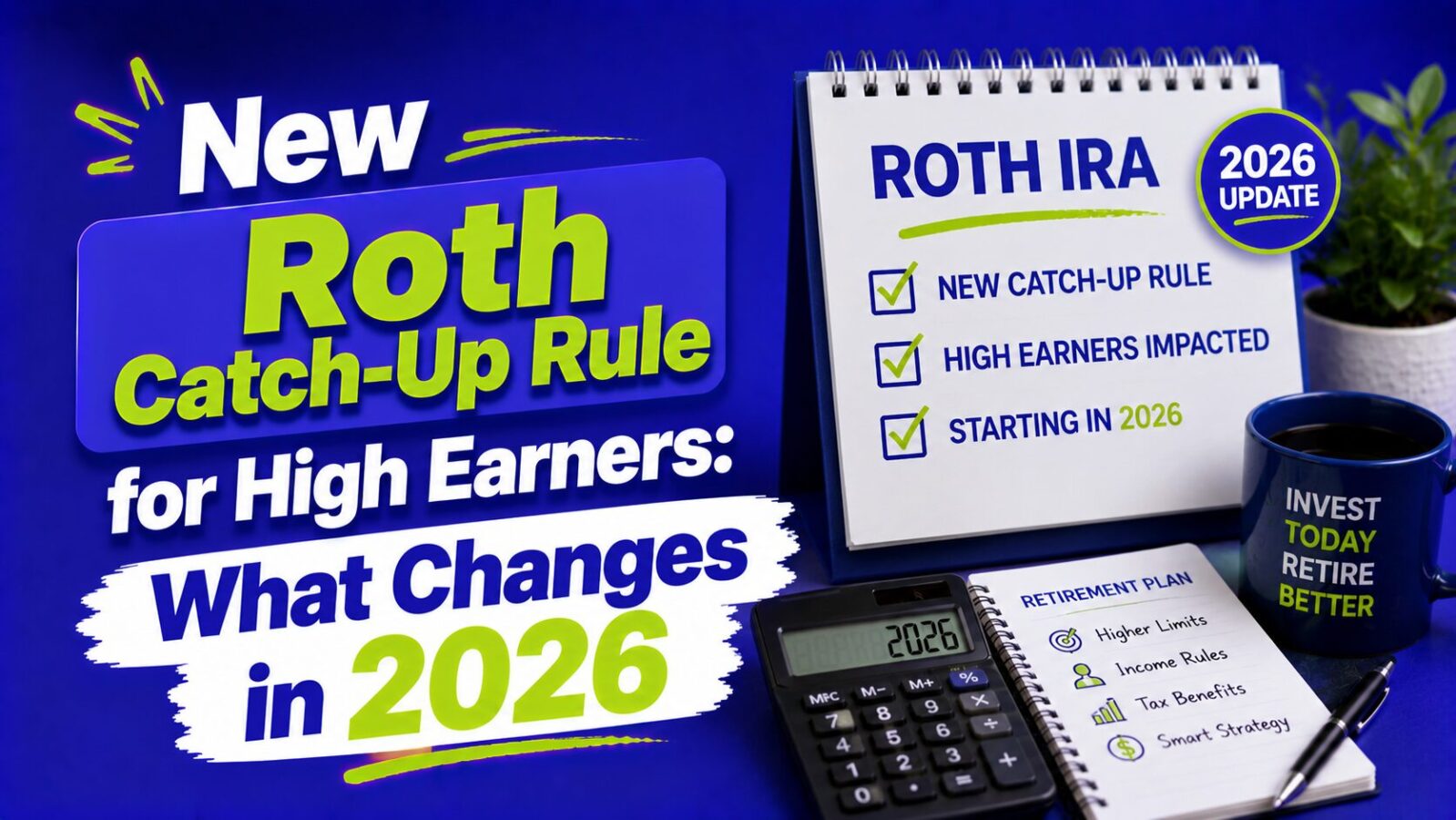
If you are age 50 or older and had more than $150,000 of Social Security wages from the employer sponsoring your plan in 2025, your age-based catch-up contributions generally must be made as Roth contributions in 2026.
The rule does not force your entire 401(k) contribution into Roth.
For 2026, you can still generally choose pre-tax or Roth treatment for your regular contributions up to the $24,500 elective-deferral limit, subject to what your plan allows. It is the additional age-50 catch-up amount that must be Roth if you cross the wage threshold.
The easiest way to check whether you are affected is to look at Box 3 of your 2025 Form W-2 from the employer sponsoring the plan.
Key takeaways
- The Roth catch-up rule takes effect in 2026.
- For 2026 contributions, the test generally looks at 2025 Social Security wages reported in W-2 Box 3.
- The rule applies when those wages were more than $150,000. Exactly $150,000 does not cross the threshold.
- The regular 2026 401(k) contribution limit is $24,500 and is not forced into Roth by this rule.
- The normal age-50 catch-up limit is $8,000 in 2026.
- If you turn 60, 61, 62 or 63 during 2026, the higher catch-up limit is $11,250.
- The rule can also affect age-based catch-up contributions to 403(b) and governmental 457(b) plans.
- IRA catch-up contributions are governed by separate rules and are not subject to this Roth catch-up mandate.
- If your employer plan does not offer the necessary Roth feature, affected workers may be unable to make age-based catch-up contributions under that plan.
For all of this year’s contribution limits, see our 2026 retirement contribution limits guide.
What is the 2026 Roth catch-up rule?
SECURE 2.0 changed the tax treatment of catch-up contributions for certain higher-paid workers.
Beginning in 2026, if you are subject to the rule, age-based catch-up contributions to an applicable employer retirement plan must be designated Roth contributions rather than pre-tax contributions.
That means you pay income tax on that money now.
In exchange, the money goes into the Roth side of your workplace retirement account. Investment earnings are not taxed annually, and qualified Roth distributions can be tax-free when the applicable requirements are met.
The IRS issued final regulations covering the rule in September 2025.
The statutory Roth catch-up requirement applies beginning in 2026. The final regulations generally become applicable for contributions in taxable years beginning after December 31, 2026, while plans implementing the requirement earlier can rely on a reasonable, good-faith interpretation of the law and related guidance.
For the official rule, see the IRS Roth catch-up guidance.
Who has to make Roth catch-up contributions in 2026?
For a typical 401(k) participant, two things generally need to be true.
1. You are eligible for age-based catch-up contributions
You generally need to be age 50 or older by the end of 2026.
If you are younger than 50, there is no age-50 catch-up contribution to which this rule would apply.
2. Your 2025 Social Security wages exceeded $150,000
The 2026 threshold is more than $150,000.
The IRS test generally uses wages subject to Social Security tax from the employer sponsoring the retirement plan.
For most employees, the easiest place to find that number is:
2025 Form W-2, Box 3: Social Security wages
So:
| 2025 Box 3 wages | Roth catch-up rule for 2026 |
|---|---|
| $140,000 | Generally not required |
| $150,000 | Generally not required |
| $150,001 | Generally required |
| $175,000 | Generally required |
The threshold is indexed for inflation, so do not assume $150,000 will remain the test in future years.
It is not based on your total household income
This is an important difference from many other tax rules.
The Roth catch-up test is generally not based on your AGI, MAGI, taxable income or household income.
It looks to prior-year Social Security wages from the employer sponsoring the plan, subject to the applicable employer rules.
That creates some outcomes that may initially seem strange.
For example, a married couple could have household income well above $300,000 while one spouse has only $120,000 of relevant prior-year Social Security wages from their employer. That spouse would not automatically be subject to the rule just because the household earns more than $300,000.
The reverse can also happen.
A single employee whose relevant Box 3 wages exceeded $150,000 could be subject to the Roth catch-up requirement regardless of deductions that later reduce taxable income.
What happens if I changed jobs?
Changing employers can affect the test, but this rule is more nuanced than simply saying a new job resets everything.
The general rule looks at prior-year FICA wages from the employer sponsoring the plan.
So if you start working for an unrelated new employer in 2026 and had no 2025 Social Security wages from that employer, you generally would not meet the wage test based solely on wages from your old employer.
However, the IRS final regulations allow plans to aggregate wages in certain situations involving related employers, controlled groups, common paymasters and some business transactions.
So I would not rely on a job change as a tax strategy.
If you moved between related companies or your employer went through an acquisition or restructuring, ask the plan administrator which 2025 wages it is using for the Roth catch-up test.
What if I am self-employed?
Pure self-employment income does not work the same way as W-2 Social Security wages.
The IRS final regulations make clear that someone who had no FICA wages from the employer sponsoring the plan in the prior year, such as a partner whose compensation consisted only of self-employment income, generally is not subject to the Roth catch-up requirement on the basis of that income alone.
But business structure matters.
For example, an owner who receives W-2 wages through a corporation can have a different result from a sole proprietor whose compensation is entirely self-employment income.
If you have a solo 401(k), S corporation, partnership or another owner-employee arrangement, check the rule for your specific structure rather than assuming “self-employed means exempt.”
How much can you contribute in 2026?
The regular employee elective-deferral limit for most 401(k), 403(b) and governmental 457(b) plans is $24,500 in 2026.
Age-based catch-up amounts sit on top of that.
| Age during 2026 | Regular limit | Catch-up | Potential total |
|---|---|---|---|
| Under 50 | $24,500 | $0 | $24,500 |
| 50 to 59 | $24,500 | $8,000 | $32,500 |
| 60 to 63 | $24,500 | $11,250 | $35,750 |
| 64 or older | $24,500 | $8,000 | $32,500 |
The higher amount for ages 60 through 63 is sometimes called the super catch-up.
The age test looks at the age you attain during the calendar year. So if you turn 60 at any point during 2026, you can potentially fall into the higher catch-up category for that year.
We cover that rule separately in our ages 60 to 63 super catch-up guide.
Does the $150,000 rule force my entire 401(k) into Roth?
No.
This is probably the most important practical point.
Suppose you are 55, had $175,000 of relevant 2025 Social Security wages and want to maximize your employee contributions in 2026.
Your potential contributions could look like this:
- Regular contribution: $24,500
- Age-50 catch-up: $8,000
- Total: $32,500
The new rule applies to the catch-up portion.
Your regular $24,500 is not automatically forced into Roth by SECURE 2.0. Depending on your plan, you may still choose to make regular contributions pre-tax, Roth or a combination.
The additional catch-up amount required under the new rule must satisfy the Roth requirement.
In practice, plan payroll systems may administer the classification automatically, so check how your employer handles elections rather than assuming you need to manually divide every paycheck into “regular” and “catch-up” dollars.
What does Roth catch-up cost you today?
The immediate downside is that you lose the current-year pre-tax treatment you previously could have received on the affected catch-up amount.
Suppose you are 55 and contribute the full $8,000 catch-up.
If the entire $8,000 would otherwise have reduced income taxed at a 24% marginal federal rate, the rough federal income tax difference could be:
$8,000 × 24% = $1,920
At a 32% marginal rate:
$8,000 × 32% = $2,560
For someone age 60 to 63 contributing the full $11,250 super catch-up, the illustrative federal tax difference at 24% would be:
$11,250 × 24% = $2,700
These are simplified illustrations, not guaranteed changes to your final tax bill. Your actual result depends on your full return, state taxes, payroll elections and other factors.
But they show why this rule matters most to workers who were using catch-up contributions specifically to reduce taxable income during peak earning years.
Is Roth catch-up actually bad?
Not necessarily.
You lose an upfront tax break, but you gain Roth tax treatment on that money.
A simplified comparison looks like this:
| Pre-tax catch-up | Roth catch-up | |
|---|---|---|
| Tax deduction now | Yes | No |
| Contributions taxed today | No | Yes |
| Investment growth taxed annually | No | No |
| Qualified retirement distributions | Generally taxable | Generally tax-free |
| Lifetime RMDs for original workplace Roth owner | No | No |
Whether Roth is better ultimately depends on factors such as your current marginal tax rate, future tax rate, retirement income and how long the money remains invested.
For a worker in a peak earning year who expects a much lower tax rate in retirement, losing the pre-tax option may be a real disadvantage.
For someone who expects significant taxable retirement income or values building a larger tax-free pool, Roth treatment may be useful.
But SECURE 2.0 removes that choice for the catch-up portion when the wage test applies.
Roth does not mean every withdrawal is automatically tax-free
Be careful with the shorthand “Roth withdrawals are tax-free.”
A qualified distribution from a designated Roth account can generally be received tax-free.
Qualification normally involves requirements including the applicable five-tax-year participation period and a qualifying event such as reaching age 59½.
That distinction matters because someone making their first workplace Roth contribution late in their career should not assume every immediate withdrawal will receive qualified-distribution treatment.
The broader Roth-versus-pre-tax decision is covered in our Traditional vs. Roth guide.
Does this rule apply to IRAs?
No.
The SECURE 2.0 Roth catch-up mandate discussed here applies to catch-up contributions under applicable employer retirement plans, not the age-50 catch-up contribution to a traditional or Roth IRA.
For 2026, the IRA contribution limit is:
- $7,500 regular contribution
- $1,100 age-50 catch-up
- $8,600 total for someone age 50 or older
Traditional IRA deductibility and Roth IRA eligibility have their own income rules, but the $150,000 workplace Roth catch-up test is not one of them.
Does the rule apply to 403(b) and 457(b) plans?
The Roth catch-up requirement is not limited to 401(k)s.
The core rule can also apply to age-based catch-up contributions under:
- 403(b) plans
- Governmental 457(b) plans
There are additional wrinkles for those plans.
For example, some long-serving 403(b) participants have access to a special 15-year-service catch-up. The IRS final regulations clarify that this special 403(b) catch-up is not itself the age-based Section 414(v) catch-up subject to the new Roth mandate.
Governmental 457(b) plans also have special catch-up rules near normal retirement age, so participants using those provisions should verify how their plan applies the Roth requirement rather than assuming every dollar labeled “catch-up” is treated identically.
What if my employer does not offer Roth contributions?
This is one of the most important things to check with HR.
If you are subject to the mandatory Roth catch-up rule but the plan does not have a Roth program that can accept the required contribution, the plan may prevent affected participants from making age-based catch-up contributions.
In other words, the law does not simply convert a pre-tax contribution into something the plan is incapable of holding.
Plans have had time to prepare for the 2026 requirement, and many employers already offer designated Roth accounts, but do not assume yours does.
Ask your plan administrator:
“If I am subject to the 2026 Roth catch-up requirement, how will the plan process my catch-up contributions?”
Do I need to change my 401(k) election?
Maybe.
The final regulations allow plans to use mechanisms such as a deemed Roth catch-up election, subject to applicable requirements. In practical terms, your plan may be designed to automatically treat contributions that need to be Roth as Roth contributions.
But employers and payroll systems can implement the rule differently.
Before you max out your account, check:
- Your 2025 W-2 Box 3.
- Whether it exceeds $150,000.
- Whether you will be age 50 or older by the end of 2026.
- Whether you are eligible for the $8,000 or $11,250 catch-up.
- Whether your plan offers Roth contributions.
- How the plan handles mandatory Roth catch-up elections.
Do not wait until the last paycheck of December to discover that your contribution election does not work the way you expected.
What should higher earners do now?
If the rule applies to you, there is no election that lets you simply make the required catch-up pre-tax instead.
So the practical planning moves are fairly straightforward.
Check Box 3, not your salary
Your salary, taxable income and W-2 Box 1 are not the cleanest test.
Start with Box 3 of your prior-year W-2 from the relevant employer.
Recalculate your withholding
If you previously made your catch-up pre-tax, switching those dollars to Roth can increase taxable wages compared with the strategy you used before.
That does not necessarily mean you need to make estimated tax payments, but it is worth checking your withholding if you normally max out catch-up contributions.
Keep regular contributions separate in your planning
Do not assume the rule eliminates all pre-tax 401(k) saving.
Your regular elective deferrals can still have different tax treatment depending on what your plan permits.
Check your tax diversification
You may already have a large traditional 401(k) balance.
Mandatory Roth catch-up contributions can create a second pool of retirement assets with different tax treatment.
That may be useful even if you would not have chosen Roth voluntarily.
See our guide on how to maximize your 401(k) for the broader contribution strategy.
FAQ
When does the Roth catch-up rule start?
The statutory Roth catch-up requirement applies beginning in 2026. IRS final regulations were issued in September 2025 and generally apply to contributions in taxable years beginning after December 31, 2026, with reasonable, good-faith implementation permitted before their general applicability date.
What income triggers mandatory Roth catch-up contributions in 2026?
For 2026, the threshold is more than $150,000 of prior-year Social Security wages from the employer sponsoring the plan, generally measured using 2025 W-2 Box 3.
What if my 2025 Box 3 is exactly $150,000?
The statutory test is whether wages exceeded $150,000 for the 2026 threshold. Exactly $150,000 does not exceed it.
Does the rule affect regular 401(k) contributions?
No. The mandatory Roth rule applies to affected catch-up contributions. It does not automatically force your regular contributions up to the $24,500 2026 elective-deferral limit into Roth.
How much is the 2026 401(k) catch-up contribution?
The normal age-50 catch-up limit is $8,000. If you turn age 60, 61, 62 or 63 during 2026, the higher catch-up limit is $11,250.
Does the Roth catch-up rule apply to IRAs?
No. Traditional and Roth IRAs have separate contribution and tax rules. The mandatory workplace Roth catch-up rule does not apply to the IRA age-50 catch-up.
What happens if I change employers?
Wages from an unrelated prior employer generally are not automatically combined with wages from your current employer for this test. But final IRS regulations permit wage aggregation in certain related-employer, controlled-group and common-paymaster situations, so verify the result with your plan if your employment situation is more complicated.
What if I have only self-employment income?
Pure self-employment income is not the same as Social Security wages reported in W-2 Box 3. Someone with no prior-year FICA wages from the employer sponsoring the plan generally is not subject to the rule based solely on self-employment income. Business owners with W-2 wages or more complex structures should verify their situation.
What if my plan does not offer Roth catch-up contributions?
An affected participant may be unable to make age-based catch-up contributions if the plan does not provide the Roth capability needed to satisfy the rule. Ask your plan administrator how the plan handles affected employees.
Bottom line
If you are age 50 or older in 2026, start by checking Box 3 of your 2025 W-2 from the employer sponsoring your retirement plan.
If that number is more than $150,000, your age-based 2026 catch-up contributions generally must be Roth.
For most 50-and-older workers, that means up to $8,000 of catch-up money receives Roth treatment. If you turn 60, 61, 62 or 63 during 2026, as much as $11,250 can fall into the higher catch-up limit.
Your regular contribution limit of $24,500 is a separate issue and is not automatically forced into Roth.
The practical downside is losing the immediate pre-tax benefit on the catch-up dollars. The potential upside is building more retirement money in a Roth account, where qualified future distributions can be tax-free.
So do not change your whole retirement strategy because of this rule. Check whether it applies, confirm how your employer plan implements it, and account for the higher current-year taxable income on only the portion that actually has to be Roth.
For more 2026 retirement planning:
- 2026 401(k) and IRA contribution limits
- Super catch-up contributions for ages 60 to 63
- Traditional vs. Roth: how to choose
- How to maximize your 401(k)
- Retirement accounts explained
This article is for educational and informational purposes only and is not individualized tax, legal or investment advice. Retirement-plan rules and contribution limits can change, and employer plans can differ in how they implement catch-up contributions. Verify your plan’s rules with your administrator and check current IRS guidance before making contribution decisions.