 By
By 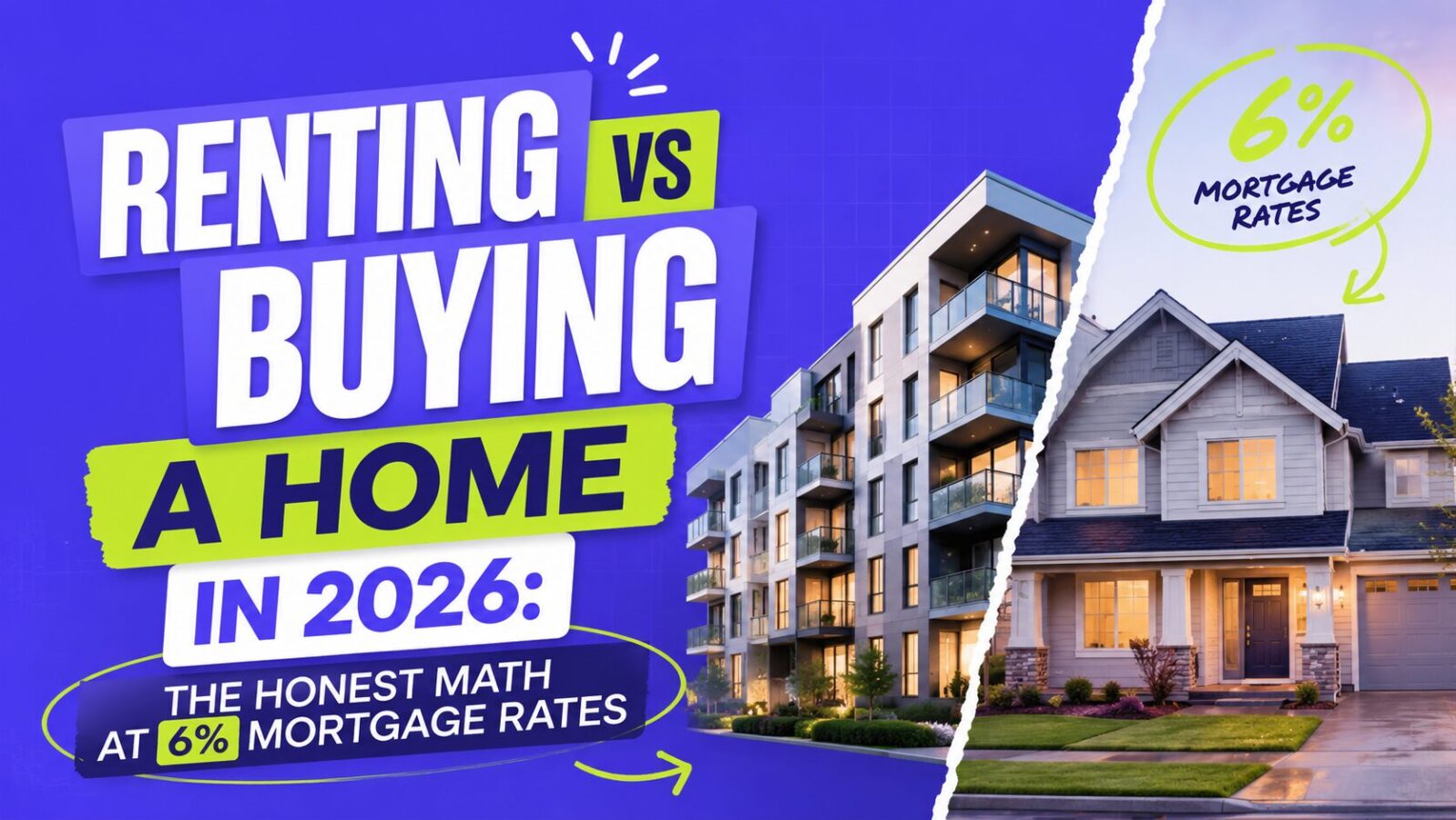
With mortgage rates around 6.4% and home prices still high in mid-2026, the rent versus buy calculation has shifted a lot since 2020 or 2021. In many major markets, renting is now cheaper month to month than buying the equivalent home. That does not make buying wrong, it just means the decision needs honest math instead of the old assumption that buying is always better. Here is how to think it through for your situation.
Key Takeaways
- Compare the full cost of owning, not just rent versus the mortgage payment.
- Higher rates have raised the bar: in many markets, renting wins on a monthly basis right now.
- Time matters most. Buying usually needs 5 to 8 years to break even on transaction costs.
- Use quick checks like the price-to-rent ratio and the 5% rule before running detailed numbers.
The Monthly Cost Comparison
The most common mistake is comparing rent to the mortgage payment alone. The full cost of ownership also includes property taxes, insurance, any HOA fees, maintenance, and the opportunity cost of your down payment. Here is an example for a $400,000 home with 10% down ($40,000), at a roughly 6.4% rate.
| Cost component | Renting ($2,000/month) | Buying ($400,000, 10% down) |
|---|---|---|
| Monthly housing payment | $2,000 | $2,267 (P&I at about 6.4%) |
| Property taxes (1.2% avg) | $0 | $400 |
| Insurance | $21 (renters) | $150 (homeowners) |
| PMI (under 20% down) | $0 | $118 |
| Maintenance (1% of value/yr) | $0 | $333 |
| Opportunity cost of $40K down at 4.5% | $0 | $150 |
| Total monthly cost | $2,021 | $3,418 |
In this example, owning costs about $1,397 more a month than renting. That gap has to be offset by home price appreciation, equity building, and the non-financial value of ownership before buying wins financially. Note these are illustrative figures, and your numbers depend on local taxes, insurance, and rates, which change.
The Break-Even Timeline
Buying has high upfront costs: closing costs of 2% to 5% ($8,000 to $20,000 on a $400,000 home), moving costs, and early payments that are mostly interest rather than equity. The break-even point is how long you must stay before buying beats renting financially. At current rates and prices, that is often 5 to 8 years. If you are confident you will stay 7 or more years, buying often wins long-term. If you might move within 3 to 4 years, renting is usually cheaper even after accounting for appreciation.
Rent vs Buy Calculator
When Buying Still Makes Sense in 2026
- You plan to stay 7 or more years. The longer you own, the more equity builds and the more appreciation compounds. A home you live in for a decade or more has historically been a reliable way to build wealth.
- Your market has a favorable rent-to-price ratio. Use the price-to-rent ratio: divide the home price by a year of rent for a comparable property. Below 15 generally favors buying, above 20 generally favors renting. Some Midwest and Southern cities still favor buying even at these rates.
- You value stability and customization. Renting offers flexibility but not permanence. You can be asked to leave, face rent increases, and cannot renovate. That permanence has real value, especially for families with school-age children.
- You would not actually invest the difference. The math often shows renting wins if you invest the monthly savings, but most renters do not. If a mortgage forces savings through equity that you would not build otherwise, the comparison shifts toward buying.
When Renting Makes More Sense
- Your timeline is under 5 years. The costs of buying and selling are too high to recoup quickly. Moving after 3 years in a slow-appreciation market can leave you worse off than renting.
- Your price-to-rent ratio is above 20 to 25. Major coastal cities like San Francisco, New York, Seattle, and Boston often sit at 25 to 40 or more, where renting and investing the difference typically wins even over long horizons.
- You are not financially ready. Buying without a 3 to 6 month emergency fund, an adequate down payment, and stable income creates fragility. A big repair, a job loss, or a health event can cascade fast. Renting until you are genuinely ready is often the right call.
The 5% Rule for a Quick Check
Economist Ben Felix’s 5% rule is a fast framework: multiply the home price by 5%, then divide by 12. If renting the equivalent home costs less than that monthly figure, renting is likely the better financial choice. If renting costs more, buying may be advantageous.
Example: a $400,000 home times 5% is $20,000 a year, or about $1,667 a month. If you can rent a comparable home for less than $1,667, renting tends to win. If a similar home rents for $2,500, buying starts to look better despite the higher upfront costs.
Before You Decide
Whichever way you lean, get the foundations right first. Compare loan types in our guide to types of mortgages in 2026, build your down payment with our guide on how to save for a down payment fast, and check whether you qualify for first-time homebuyer assistance.
FAQ
Is it cheaper to rent or buy in 2026?
In many major markets, renting is cheaper on a monthly basis right now because of higher rates and prices. Whether buying wins depends on how long you stay and your local price-to-rent ratio.
How long do I need to stay for buying to pay off?
Often 5 to 8 years at current rates and prices, to recoup transaction costs. Under 5 years, renting is usually the safer financial choice.
What is the 5% rule?
Multiply the home price by 5% and divide by 12. If comparable rent is below that monthly number, renting tends to win financially; if rent is higher, buying may be better.
What price-to-rent ratio favors buying?
Below 15 generally favors buying, and above 20 generally favors renting. Calculate it by dividing the home price by a year of rent for a similar property.
Bottom Line
At today’s rates, buying is no longer automatically better, so run the honest math instead of following old assumptions. Compare the full cost of owning, weigh how long you will stay, use the price-to-rent ratio and the 5% rule, and make sure you are financially ready. For many people moving within a few years or in high-cost markets, renting is the smarter financial move right now.
This article is for educational and informational purposes only and is not financial advice. The figures here are illustrative, and rates, taxes, prices, and rents vary by market and change over time. Run your own numbers and consider a qualified professional before deciding.