 By
By 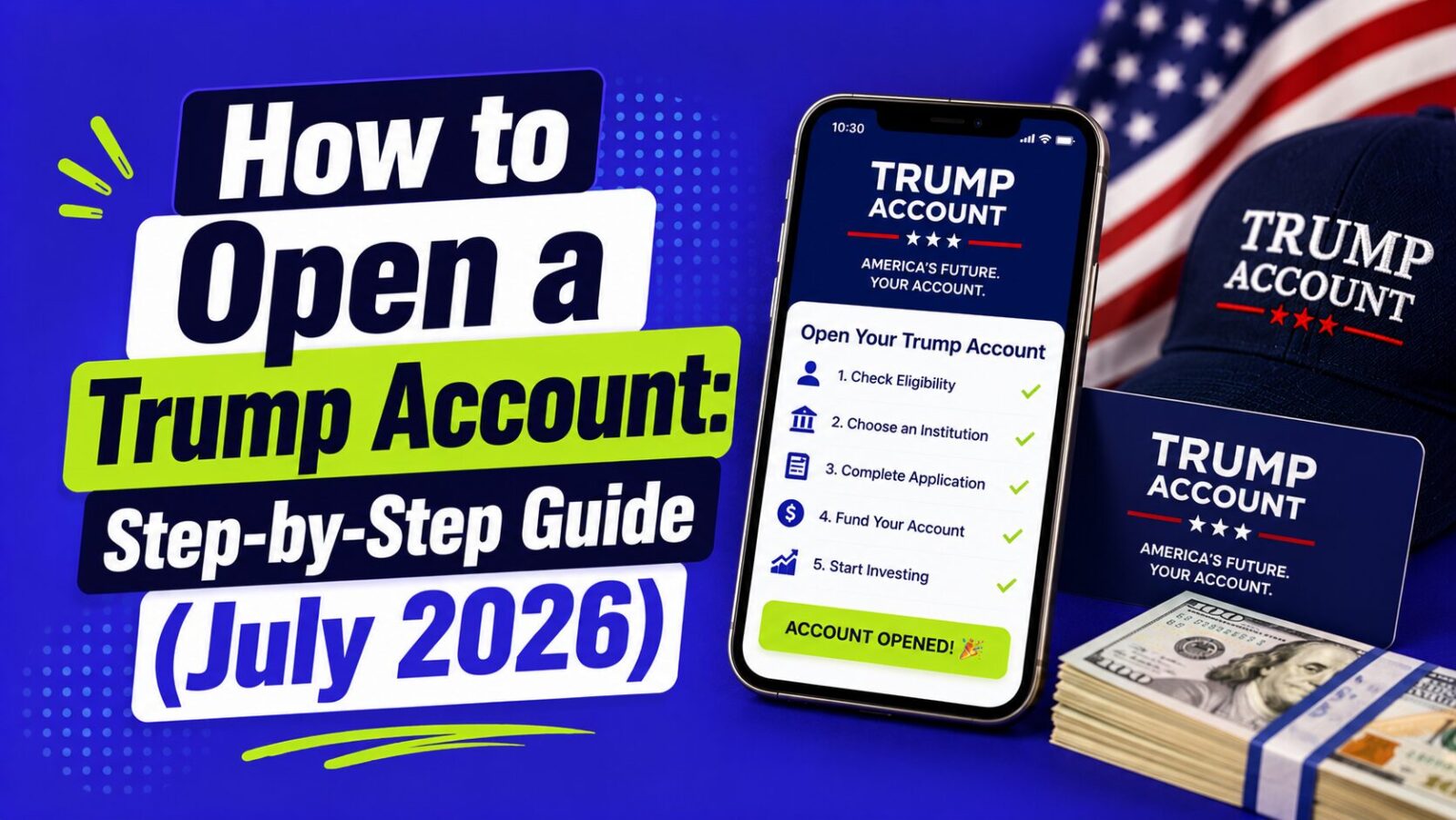
To open a Trump Account in 2026, submit IRS Form 4547 for an eligible child, complete the account activation process when Treasury contacts you, and then fund the account through the official Trump Accounts platform.
If the child also qualifies for the federal pilot program, Form 4547 is how you request the one-time $1,000 Treasury contribution. The $1,000 seed is limited to qualifying U.S. citizen children born from January 1, 2025 through December 31, 2028.
Trump Accounts officially became fundable on July 4, 2026, so families can now activate accounts and make contributions.
FinancePulse view: If your child qualifies for the $1,000 Treasury contribution, claiming it is the easy decision. Whether you should add thousands of dollars of your own money is a separate question that should be compared with options such as a 529 plan or, when the child has earned income, a custodial Roth IRA.
How to open a Trump Account in 2026
The current process is:
- Check whether the child is eligible for an account.
- Submit Form 4547 through the IRS.
- Request the $1,000 Treasury contribution if the child qualifies.
- Complete Treasury’s account activation process.
- Add contributions if you want to.
- Leave the money invested under the Trump Account rules during the growth period.
The IRS estimates that completing its online Trump Account election takes roughly 5 to 10 minutes, but that estimate covers the Form 4547 election rather than the entire account-opening and activation process.
Step 1: Check whether the child can have a Trump Account
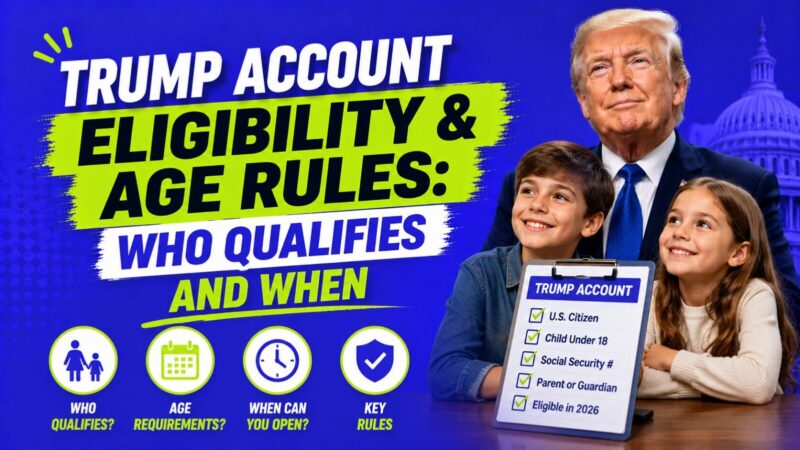
For an initial Trump Account election, current IRS instructions say the child generally must:
- Be under age 18 at the end of the year the election is made
- Have a valid Social Security number issued before the election
- Not already have had a Trump Account election filed on their behalf
For an election made in 2026, the child generally must have been born after December 31, 2008.
This is important because the technical IRS eligibility rules for opening the account are broader than the rules for receiving the federal $1,000 contribution.
Who qualifies for the $1,000 seed?
To receive the pilot contribution, the child must additionally:
- Be born after December 31, 2024 and before January 1, 2029
- Be a U.S. citizen
- Have a valid SSN
- Be anticipated to be the qualifying child of the person making the election for that year
- Not already have had a pilot contribution election processed
So do not use these two statements interchangeably:
“My child can have a Trump Account.”
and
“My child qualifies for the $1,000 Treasury seed.”
A child can meet the first set of rules without meeting the second.
Step 2: Submit Form 4547
IRS Form 4547, Trump Account Election(s), is used to elect to establish the initial account and, if applicable, request the $1,000 pilot contribution.
The easiest current method is through an IRS Individual Online Account.
The IRS added functionality in May 2026 that lets taxpayers:
- Submit Form 4547 electronically
- Check the status of a previous Form 4547 election
- See next steps after processing
You will need the child’s identifying information, including the SSN, and your own information as the authorized individual.
Do you need to file an amended tax return?
No.
The IRS explicitly says:
- Do not attach Form 4547 to Form 1040-X.
- Do not amend Form 1040, 1040-SR, or 1040-NR simply to attach Form 4547.
If you already filed your return without the election, you can submit Form 4547 separately instead.
This is one of the most important corrections to older pre-launch Trump Account guides.
Step 3: Request the $1,000 Treasury contribution
If the child meets the pilot-program requirements, complete the corresponding election on Form 4547.
Treasury makes the $1,000 contribution after the election is processed and the government confirms that the initial Trump Account has been opened.
You do not have to contribute $1,000 of your own money to receive it.
The federal seed also does not count against the normal annual $5,000 contribution limit.
That means an eligible account can potentially receive:
$1,000 Treasury seed + up to $5,000 of ordinary contributions
subject to the program’s contribution rules.
Step 4: Activate the account
Submitting Form 4547 is not the final step.
After the IRS processes the election, Treasury or its authorized agent provides instructions for completing account activation. The activation includes an authentication process.
Treasury launched the full Trump Accounts app nationwide on July 4, 2026. The app currently supports features including:
- Viewing balances
- Making contributions
- Linking bank accounts
- Setting recurring contributions
- Viewing investment performance
Who actually holds the account?
For the initial government-created accounts, Treasury designated BNY as its financial agent.
BNY partnered with Robinhood, which serves as the brokerage and initial trustee. Treasury retains oversight of the platform for these initial accounts.
So the current process should not be described as:
“Pick Fidelity, Vanguard, Schwab, or any other brokerage when you sign up.”
Those companies may participate in the broader ecosystem, and IRS rules allow qualifying trustees and trustee-to-trustee Trump Account rollovers. But the official initial-account platform launched through Treasury, BNY, and Robinhood.
Step 5: Understand where the money is invested
Trump Accounts have unusually strict investment rules during the growth period, which lasts until the end of the year before the child turns 18.
Eligible investments generally must:
- Be a mutual fund or ETF
- Track a broad index primarily made up of U.S. companies
- Avoid leverage
- Keep annual fund fees and expenses at or below 0.10%
- Meet other program requirements
What is the default fund?
Treasury selected SPYM, the State Street SPDR Portfolio S&P 500 ETF, as the default investment at launch.
Treasury also selected four additional ETFs for the Trump Account lineup:
| Fund | Exposure |
|---|---|
| IVV | S&P 500 |
| VTI | Total U.S. stock market |
| SPTM | S&P Composite 1500 |
| ITOT | Total U.S. stock market |
However, Treasury’s investment-lineup announcement said the ability to choose among those additional funds would become available in the coming months.
I found no later Treasury announcement confirming that this investment-election feature is already generally available as of August 18, 2026.
So the safest current wording is:
SPYM is the confirmed launch default. IVV, VTI, SPTM, and ITOT are confirmed additional lineup choices that Treasury plans to make selectable as the platform expands.
Do not assume that any ETF with a 0.10% or lower expense ratio can simply be selected inside the official platform today.
Step 6: Decide whether to contribute more
You do not have to add family money.
During the growth period, the general annual limit for ordinary contributions is currently $5,000 per child for 2026 and 2027, with inflation adjustments scheduled after 2027.
That combined limit applies to contributions such as:
- Parent contributions
- Grandparent contributions
- Contributions by the child
- Other individual contributions
- Qualifying employer contributions
The child does not need earned income for contributions during the growth period, unlike a normal IRA contribution.
What does not count toward the $5,000 cap?
The $5,000 limit does not apply to certain exempt contributions, including:
- The $1,000 pilot contribution
- Qualified general contributions from qualifying governments or nonprofits
- Qualified rollover contributions
That distinction matters because the account can potentially receive more than $5,000 in total deposits during a year when exempt contributions are also made.
How do employer contributions work?
An employer can contribute up to $2,500 per year under a qualifying Trump Account contribution program for an employee or an employee’s dependent.
When the tax requirements are met, the employer contribution can be excluded from the employee’s gross income.
But it normally counts toward the overall $5,000 contribution cap.
For example:
- Employer: $2,500
- Parents: $2,500
Total ordinary contributions:
$5,000
The parents cannot then make another $5,000 ordinary contribution for that same year.
Are family contributions tax-deductible?
No federal IRA deduction is allowed for ordinary individual contributions during the growth period.
The IRS specifically states that Section 219’s normal IRA deduction does not apply to Trump Account contributions during this period.
Family contributions generally create tax basis in the account.
By contrast, the $1,000 government pilot contribution and certain other exempt contribution types do not create basis.
That distinction matters later when distributions are taxed.
For someone simply deciding whether to contribute today, the important point is:
Putting $5,000 into a child’s Trump Account does not give the parent a standard traditional IRA deduction.
Can grandparents open or contribute to a Trump Account?
Grandparents can contribute.
Opening the initial account is more specific.
If the election is only to establish an account, IRS instructions use this priority:
- Legal guardian
- Parent
- Adult sibling
- Grandparent
A grandparent therefore is not automatically the person entitled to make the initial election when a higher-priority authorized individual is available.
Once the account exists, grandparents and other people can contribute, subject to the contribution limit.
Can you take the money out before age 18?
Generally, no.
During the growth period, distributions are restricted.
Current IRS guidance allows limited exceptions involving:
- A full trustee-to-trustee transfer to another Trump Account
- A qualifying rollover to the child’s ABLE account at age 17
- Correcting excess contributions
- Distribution after the beneficiary’s death
So this is not a flexible custodial savings account that parents can tap for summer camp, a car, high school expenses, or other ordinary needs.
That lack of liquidity should factor into how much of your own money you contribute.
What happens at age 18?
This point is often described incorrectly.
A Trump Account does not convert into a traditional IRA at 18.
It is already a type of traditional IRA from the beginning.
What ends is the special growth period.
Starting January 1 of the calendar year in which the child turns 18, most special Trump Account restrictions stop applying and the normal rules governing traditional IRAs generally take over.
That means withdrawals may become possible.
But it does not mean the child receives tax-free unrestricted cash.
Early distributions can be subject to:
- Ordinary IRA income-tax rules
- A potential 10% additional tax on early distributions
unless an IRA exception applies, such as certain qualified higher-education expenses or qualifying first-home purchases.
That makes the post-18 rules considerably more restrictive than a normal bank or custodial brokerage account.
Should you contribute the full $5,000?
Not automatically.
The $5,000 figure is a legal contribution limit, not a recommendation.
Before adding family money, ask what the money is supposed to accomplish.
A Trump Account has several distinctive characteristics:
| Feature | Trump Account |
|---|---|
| Government seed | $1,000 for eligible 2025–2028 births |
| Earned income required | No during growth period |
| Parent contribution deduction | No |
| Pre-18 withdrawals | Generally restricted |
| Investment choices | Restricted during growth period |
| After growth period | Traditional IRA rules generally apply |
If the goal is specifically college, a 529 deserves comparison.
If the child has earned income, a Roth IRA deserves comparison.
If flexibility is more important, other savings structures may make more sense.
FinancePulse view: The free $1,000 and your own next $5,000 should be treated as two separate decisions.
Frequently asked questions
How do I open a Trump Account?
Submit IRS Form 4547, wait for the election to be processed, and complete the activation process through the official Trump Accounts platform.
Can I open a Trump Account now?
Yes.
Trump Accounts officially launched for funding on July 4, 2026.
Does every child get $1,000?
No.
The Treasury seed applies only to qualifying U.S. citizen children born from January 1, 2025 through December 31, 2028 who meet the other pilot-program requirements.
Can an older child still have a Trump Account?
Potentially, yes.
For a 2026 election, the IRS generally allows an initial account for a child who is under 18 at year-end, has a valid SSN issued before the election, and has not already had an account election filed. The child may still be ineligible for the $1,000 seed.
Do I amend my tax return if I forgot Form 4547?
No.
The IRS explicitly tells taxpayers not to file Form 1040-X just to attach Form 4547.
How much can I contribute?
The general current annual limit for ordinary contributions during the growth period is $5,000, excluding certain contribution types such as the $1,000 federal pilot contribution.
Which fund is the Trump Account invested in?
SPYM is the confirmed default investment at launch.
Treasury has also selected IVV, VTI, SPTM, and ITOT as additional options, with investment-election functionality scheduled to expand after launch.
Does the child need a job?
No, not for contributions during the Trump Account growth period.
Current IRS rules allow contributions even when the child does not have compensation.
Can the child spend the account freely at 18?
No.
Traditional IRA rules generally apply after the growth period, including taxation and potentially the 10% additional early-distribution tax unless an exception applies.
The bottom line
Opening a Trump Account in 2026 is now straightforward: submit Form 4547, complete the official activation process, and then decide whether you want to contribute beyond any federal seed.
If your child qualifies for the $1,000 Treasury contribution, request it through Form 4547. The seed does not consume the normal $5,000 annual contribution limit.
If you already filed your tax return, do not amend it solely to add Form 4547. Submit the election separately through the IRS instead.
And do not assume you need to find a Fidelity, Vanguard, or Schwab Trump Account before getting started. The initial official accounts are administered through Treasury’s platform with BNY and Robinhood, and SPYM is the current launch-default investment.
For eligible children, I would claim the government contribution first.
Then decide whether your own money belongs in the Trump Account based on the goal, tax treatment, withdrawal restrictions, and alternatives, not simply because the account allows another $5,000.