 By
By 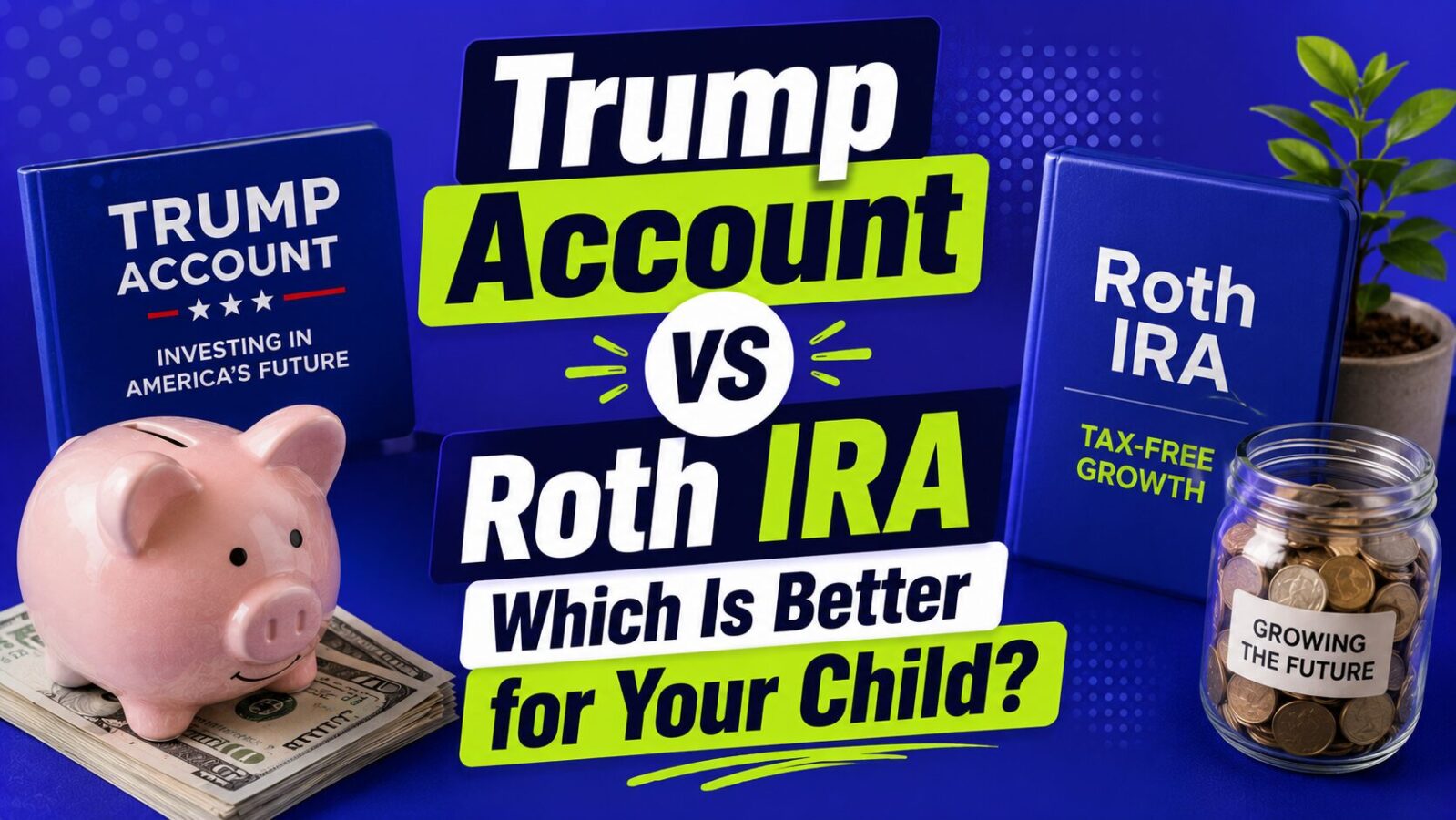
If the money is primarily for education, I would usually choose a 529 plan. If your child qualifies for the one-time $1,000 Trump Account contribution, claim that benefit separately.
That is the simplest way to think about this comparison.
A 529 is designed specifically for education and can provide federally tax-free investment earnings when withdrawals are used for qualified expenses. A Trump Account is a special type of traditional IRA for children. It can receive contributions before a child has earned income, but money is generally locked during childhood and later follows traditional IRA tax rules.
So I would not automatically tell every family to fund both.
Use the account that matches what the money is actually for.
Trump Account vs 529 at a glance
| Feature | Trump Account | 529 plan |
|---|---|---|
| Best suited for | Long-term IRA-style savings for a child | Education savings |
| 2026 ordinary contribution limit | $5,000 during growth period | No comparable $5,000 federal annual cap |
| Earned income required | No during growth period | No |
| Federal tax on qualified education earnings | Taxable amounts generally remain subject to IRA income-tax rules | Generally tax-free |
| $1,000 federal seed | Yes, for eligible children | No |
| Investment choices | Restricted during growth period | Plan-specific range of portfolios |
| Access during childhood | Generally prohibited | Account holder can take distributions |
| Control | Child is account owner under Trump Account rules | 529 account holder controls the funds |
| Unused funds | Traditional IRA rules generally apply after growth period | Several options, including beneficiary changes and limited Roth rollover |
The two accounts have very different purposes.
Why a 529 usually wins for college
The biggest advantage of a 529 is its tax treatment.
When a 529 distribution is used for qualifying education expenses, the beneficiary generally does not owe federal income tax on the investment earnings.
That is difficult for a Trump Account to match.
After the Trump Account growth period ends, most traditional IRA distribution rules generally apply. Amounts attributable to basis are not included in income, while earnings and other amounts without basis generally are taxable when distributed.
Higher-education expenses can qualify for an exception to the 10% additional tax on an early IRA distribution, but that exception does not automatically make otherwise taxable amounts income-tax-free.
So if you already expect the money to pay for education:
529 → potentially tax-free qualified education earnings
is generally more attractive than:
Trump Account → IRA taxation, with a possible education exception to the additional early-withdrawal tax.
That is why the 529 is my default choice for education savings.
529 plans cover more than four-year college
A 529 is also more flexible than the old description of “college tuition account” suggests.
Current federal rules allow qualifying 529 money to be used for expenses including:
- college and other qualifying postsecondary education;
- recognized postsecondary credential programs;
- certain room and board expenses;
- registered apprenticeship expenses;
- up to $10,000 of qualifying student-loan repayment per individual;
- up to $20,000 per beneficiary per year for qualifying elementary and secondary school expenses.
That does not mean every expense a child ever has will qualify.
But it does mean a 529 is no longer useful only for someone attending a traditional four-year university.
Where the Trump Account has a clear advantage
The most obvious Trump Account benefit is the one-time $1,000 federal pilot contribution.
An eligible child for that contribution generally must:
- be born from January 1, 2025 through December 31, 2028;
- be a U.S. citizen;
- have a valid Social Security number;
- meet the qualifying-child and election requirements;
- not already have had a pilot contribution election processed.
The election can currently be made through Form 4547 and the IRS’s online process.
The $1,000 government contribution does not count against the normal $5,000 Trump Account annual contribution limit.
If your child qualifies, I would generally claim it.
But that does not answer where your next $1,000 of family money should go.
Those are two separate decisions.
How much can you put into a Trump Account?
During the growth period, ordinary contributions and employer contributions are generally subject to a combined $5,000 annual limit.
The limit is scheduled for inflation adjustments after 2027.
Certain contributions sit outside that limit, including:
- the $1,000 pilot contribution;
- qualified general contributions;
- qualified rollover contributions.
Employers can contribute up to $2,500 per year through a qualifying employer program, but that amount counts toward the broader $5,000 annual cap rather than sitting on top of it.
So this would be wrong:
$5,000 from family + $2,500 employer + $1,000 federal seed
The family and employer contributions generally share the $5,000 limit.
The federal pilot contribution is separate.
Does a 529 have an annual contribution limit?
Not like a Trump Account.
529 plans do not have the same $5,000 federal annual contribution cap. Individual plans can have aggregate limits, and larger contributions can create gift-tax reporting considerations.
529 plans also have a special gift-tax election that can allow a large contribution to be treated as if it were spread over five years for gift-tax purposes.
For most families saving a few hundred dollars per month, those maximums are unlikely to be the main decision.
The practical point is:
A 529 offers far more contribution capacity if you are trying to build a substantial education fund.
Does a 529 give you a tax deduction?
Not federally.
529 contributions are not deductible on your federal income-tax return.
Some states offer deductions, credits, matching grants, or other benefits.
Those rules vary by state and sometimes depend on whether you use your home state’s plan.
So I would not write:
“A 529 gives you a state tax deduction.”
The accurate wording is:
Your state may offer a 529 tax benefit, so check your state’s rules before choosing a plan.
Trump Account investments are deliberately restricted
During the growth period, Trump Account funds generally must be invested in qualifying mutual funds or ETFs that track a broad index of primarily U.S. companies.
The investments must also meet other requirements, including:
- no leverage;
- annual fees and expenses no higher than 0.1%.
A broad U.S. index such as the S&P 500 is the type of index contemplated by the current rules.
529 plans usually provide a menu of preselected investment choices instead.
Those can include:
- equity portfolios;
- bond portfolios;
- static portfolios;
- age-based portfolios that typically become more conservative as the beneficiary approaches college age.
That difference makes sense.
A 529 may need to fund an expense on a relatively predictable date.
A Trump Account is built around a much longer IRA-style time horizon.
Trump Account money is not freely available at 18
This is one of the most important corrections to the original article.
During the growth period, Trump Account distributions are generally prohibited except in narrow circumstances such as certain rollovers, correction of excess contributions, an ABLE rollover in the permitted period, or the beneficiary’s death.
Starting January 1 of the calendar year in which the beneficiary turns 18, most traditional IRA rules generally apply.
That makes the money more accessible.
But it does not transform the account into a normal brokerage account.
If the beneficiary takes a taxable distribution before age 59½, the taxable portion may generally face:
ordinary income tax + a 10% additional early-distribution tax
unless an exception applies.
Higher education and certain first-home purchases are examples of potential exceptions to the additional tax.
So I would not say:
“Trump Accounts are flexible for any purpose after 18.”
A better description is:
After the growth period, the account becomes much more flexible, but it still operates largely under IRA tax rules.
What if the child never goes to college?
This does not automatically make a 529 a bad choice.
You have several potential options.
Keep the account
The money does not expire when the child turns 18.
It can remain invested for later qualified education.
Change the beneficiary
529 plans generally allow beneficiary changes, subject to the applicable rules. Investor.gov specifically notes beneficiary flexibility as something to compare when choosing plans.
Use it for another qualified education path
College is only one qualifying use.
Registered apprenticeships, certain credential programs, eligible K-12 expenses, and qualifying student-loan repayments can also fall within current 529 rules.
Roll some money into the beneficiary’s Roth IRA
Current federal rules allow certain long-held 529 balances to be rolled directly into a Roth IRA for the beneficiary.
Requirements include:
- direct trustee-to-trustee transfer;
- a 529 account that has been open for at least 15 years;
- the annual Roth IRA contribution limit;
- a $35,000 lifetime rollover limit;
- restrictions on contributions and earnings from the previous five years.
This does not solve every unused-529 problem.
But it gives families another exit route that did not exist historically.
Take a nonqualified withdrawal
You can also withdraw the money for a nonqualified purpose.
The contribution portion is not taxed again, but the earnings portion generally becomes taxable and can face an additional 10% federal tax unless an exception applies.
So unused 529 funds can create tax costs.
They are not simply “stranded.”
Who controls the account?
A 529 gives the account holder substantial control.
The IRS states that whoever purchases the 529 is the custodian and controls the funds until they are withdrawn.
The beneficiary does not automatically gain control simply because they turn 18.
Trump Accounts work differently.
IRS Form 4547 guidance says the child is the owner and account beneficiary of the Trump Account, although the special growth-period rules tightly restrict how the account can be invested and distributed.
This can matter if parental control is important to you.
Should every family open both?
No.
That recommendation is too broad.
Suppose parents:
- have little emergency savings;
- are behind on their own retirement;
- qualify for the $1,000 Trump Account seed;
- can afford only $150 per month for the child.
I would not automatically tell them to split the $150 between two child accounts.
A better decision order is:
First: protect the parents’ basic financial foundation.
Second: claim the $1,000 Trump Account contribution if the child qualifies.
Third: if education is the primary goal, direct ongoing child savings toward a 529.
Fourth: consider additional Trump Account contributions when long-term retirement-style savings for the child is also a real goal.
Parents do not need to maximize every available child account.
When I would choose a 529
I would make a 529 the primary account when:
You expect the money to pay for education.
You want the possibility of tax-free qualified education earnings.
You want age-based investment options that can reduce risk as college gets closer.
You value maintaining control over the account.
Your state offers a meaningful tax incentive for using a 529.
For a clear college goal, that combination is hard to beat.
When I would consider additional Trump Account contributions
A Trump Account becomes more interesting when:
The child does not have earned income but you want to start long-term retirement-style investing.
Trump Account contributions during the growth period do not require the beneficiary to have compensation.
The child qualifies for the $1,000 pilot contribution.
Claiming that benefit is the clearest reason to establish the account.
An employer offers Trump Account contributions.
A qualifying employer can contribute up to $2,500 under current rules, within the broader $5,000 annual cap.
You specifically want money locked into a long-term IRA structure rather than available for ordinary childhood expenses.
That restriction can be useful if it matches your goal.
What if you want money the child can use freely at 18?
Then neither account may be ideal.
A 529 receives its strongest tax treatment when money goes toward qualified uses.
A Trump Account remains largely subject to IRA tax rules after its growth period.
If your actual goal is:
“I want my child to have money for whatever they choose at 18 or 21,”
then compare taxable savings or custodial investment arrangements as well.
Those accounts bring different tax, ownership, and control tradeoffs, but they may better match a truly unrestricted goal.
Trump Account vs 529: my decision rule
The goal is college or other qualified education
529 first.
The tax treatment is better aligned with the goal.
The child qualifies for the $1,000 Trump Account contribution
Claim it.
Then make a separate decision about additional contributions.
You want long-term investing before the child earns income
Consider a Trump Account.
It does not require compensation during the growth period.
You have both education and retirement-style goals for the child
Using both can make sense.
But fund each account because you have a reason for it, not because both accounts exist.
Your own emergency savings or retirement is weak
I would generally strengthen the parents’ finances before aggressively funding either account with additional family money.
A child can borrow for education.
Parents cannot borrow for retirement.
Frequently asked questions
Is a Trump Account or 529 better for college?
A 529 is generally better for money specifically intended for education because qualified withdrawals can include federally tax-free investment earnings. A Trump Account education withdrawal can potentially avoid the 10% additional IRA tax, but taxable amounts can still be subject to ordinary income tax.
Can a child have both a Trump Account and a 529?
Yes. The accounts operate under separate rules, so there is no requirement to choose only one.
Who qualifies for the $1,000 Trump Account contribution?
The pilot generally applies to eligible U.S.-citizen children with valid Social Security numbers born from January 1, 2025 through December 31, 2028, with the required election and qualifying-child conditions satisfied.
What is the Trump Account contribution limit in 2026?
Ordinary and qualifying employer contributions during the growth period are generally subject to a combined $5,000 annual limit. The $1,000 federal pilot contribution and certain other exempt contributions do not count against it.
Can an employer contribute to a Trump Account?
Yes. A qualifying employer program can contribute up to $2,500 annually to an employee’s or dependent’s Trump Account. That contribution generally counts toward the $5,000 annual Trump Account cap.
What happens to a 529 if my child does not go to college?
You may be able to keep the account for later education, change the beneficiary, use the funds for other qualified educational purposes, roll a limited amount into the beneficiary’s Roth IRA if all requirements are met, or take a nonqualified withdrawal and accept the applicable taxes and potential penalty.
Can unused 529 money be rolled into a Roth IRA?
Potentially. Qualifying rollovers are currently subject to requirements including a $35,000 lifetime maximum, annual Roth IRA limits, a 15-year 529 holding period, and restrictions involving contributions made during the preceding five years.
The bottom line
For education savings, I would usually choose a 529 plan over making additional family contributions to a Trump Account.
The reason is straightforward:
A 529 is designed to turn qualified education spending into federally tax-free investment earnings.
The Trump Account has a different advantage.
If your child qualifies, claim the $1,000 government contribution. The account can also provide additional IRA-style savings during childhood without requiring the beneficiary to have compensation.
So my preferred order is:
Claim the Trump Account seed if eligible → use a 529 for money genuinely intended for education → add more to the Trump Account only when long-term retirement-style saving for the child is also a goal.
Using both can be perfectly reasonable.
It just should not be the default recommendation for every family.
Choose the account based on what you expect the money to do.