By
By 
The average federal student loan borrower owes about $39,547. Here is every repayment strategy compared in 2026, from the new income-driven options to aggressive payoff and forgiveness programs.
Key Takeaways
- The average federal student loan borrower owes around $39,547.
- Federal loans come with income-driven repayment, deferment, and forgiveness options that private loans do not, so handle them differently.
- For aggressive payoff, target the highest-rate loan first (avalanche) while keeping minimums on the rest.
- Refinancing can cut your rate but converts federal loans to private and forfeits federal protections.
The average federal student loan borrower owes about $39,547, according to Education Data Initiative figures for 2026. Total outstanding student loan debt is roughly $1.87 trillion across about 43 million borrowers.
Student loans are not like credit card debt (where the answer is almost always “pay it off as fast as possible”). Student loans have lower interest rates, potential tax deductions, income-driven repayment options, and forgiveness programs. The optimal strategy depends on your loan type, interest rate, income, career, and financial goals.
Know Your Loans First
Before choosing a strategy, understand what you owe.
Federal loans (Direct Subsidized, Direct Unsubsidized, PLUS loans) have fixed interest rates set by Congress, access to income-driven repayment plans, forgiveness programs, deferment, and forbearance, and are managed through StudentAid.gov.
Private loans (from banks, credit unions, online lenders) have variable or fixed rates based on your credit, no income-driven plans, no forgiveness, limited hardship options, and are treated like regular consumer debt.
Log in to StudentAid.gov for federal loans and your private lender’s website for private loans. Know each loan’s balance, interest rate, and servicer.
Which Repayment Strategy Fits Your Situation?
Your best plan depends on loan type (federal vs private), interest rate, income, career path, and financial goals. Here are the main options compared.
Standard Repayment (10 years)
Fixed monthly payments over 10 years. The default plan and the fastest way to pay off federal loans without extra payments. Monthly payment on $39,500 at 6.4%: roughly $446/month. Total interest paid: roughly $14,000. Best for borrowers who can comfortably afford the payment and want to minimize total interest.
Tiered Standard Plan (new for 2026, fixed-term)
Available July 1, 2026, the Tiered Standard Plan sets a fixed payoff term by your total balance: 10 years under $25,000, 15 years for $25,000 to $49,999, 20 years for $50,000 to $99,999, and 25 years for $100,000 or more. It is not income-driven, so there is no income recertification and no forgiveness, and it does not count toward PSLF. If you do nothing when SAVE ends, this is one of the two plans you can be auto-enrolled into. Full breakdown in the Tiered Standard Plan explained.
Income-Driven Repayment in 2026: SAVE Is Gone, RAP Is Here
Important 2026 update: a federal court vacated the SAVE plan on March 10, 2026, and it is no longer available. Borrowers who were in SAVE are being moved off it and have 90 days from July 1, 2026 to choose a new plan. Do not count on SAVE.
For the full picture of every change taking effect July 1, 2026, see our hub on student loan changes in 2026, and compare the two income-driven options in RAP vs IBR.
The income-driven options that actually exist now:
- RAP (Repayment Assistance Plan): the new plan created by the 2025 reconciliation law, launched July 1, 2026. Payments are 1% to 10% of your adjusted gross income (not discretionary income), minus $50 per dependent, with a $10 minimum. Unpaid interest is waived and the balance is forgiven after 30 years. For anyone borrowing on or after July 1, 2026, RAP is the only income-driven option. See how RAP payments are calculated.
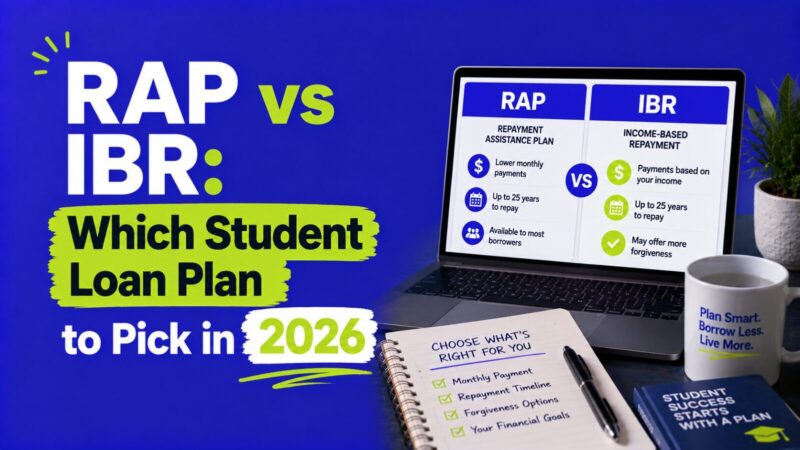
- IBR (Income-Based Repayment): still open. 10% to 15% of discretionary income, forgiveness after 20 to 25 years, and your payment never exceeds the 10-year Standard amount. This is the main IDR plan for existing borrowers.
- PAYE and ICR: still available to current enrollees but closed to new borrowers after July 1, 2028.
Example (IBR): a single borrower earning $50,000 with undergraduate loans has discretionary income of about $26,500 (AGI minus 150% of the poverty guideline), so a 10% IBR payment is roughly $220/month, well below the standard payment. Use the Federal Student Aid Loan Simulator to compare plans with your actual loan details.
Public Service Loan Forgiveness (PSLF)
If you work full-time for a qualifying employer (government, nonprofit, 501(c)(3)) and make 120 qualifying payments (10 years) under an IDR plan, the remaining balance is forgiven tax-free.
For 2026, note that only income-driven plans like RAP and IBR count toward PSLF (the Tiered Standard Plan does not), and a new employer-eligibility rule takes effect July 1, 2026. Details in PSLF in 2026.
Requirements: work full-time (30+ hours/week) for a qualifying employer, have Direct Loans (consolidate older FFEL loans), be on an income-driven repayment plan, make 120 qualifying monthly payments (they do not need to be consecutive), and submit the PSLF Employment Certification Form annually.
The math: a teacher earning $55,000 with $80,000 in student loans on an IBR plan pays roughly $260/month. After 10 years of qualifying payments (about $31,000 total), the remaining balance (potentially $60,000+) is forgiven tax-free. Best for anyone working in government, education, healthcare nonprofits, or other qualifying public service roles.
Aggressive Payoff Strategies
The avalanche method (mathematically optimal): list all student loans by interest rate, highest to lowest. Make minimum payments on all except the highest-rate loan. Throw every extra dollar at the highest-rate loan until it is gone, then move to the next. This minimizes total interest paid.
The snowball method (psychologically motivating): list all loans by balance, smallest to largest. Pay minimums on everything except the smallest loan. Pay off the smallest first for a quick win. The momentum keeps you motivated.
Making extra payments: any extra payment beyond your minimum goes directly to principal. Making even $100/month extra on a $39,500 loan at 6.4% saves roughly $4,000 in interest and pays off the loan about 3 years early. Find extra money by automating savings from raises, redirecting side hustle income, applying tax refunds to principal, or cutting one spending category.
See how extra payments accelerate your payoff:
Loan Payoff Calculator
Refinancing
Refinancing replaces one or more existing loans with a new private loan at a lower interest rate. It makes sense when your credit score has improved to 720+, current market rates are lower than your loan rates, or you have private loans at high rates.
When NOT to refinance: you have federal loans and might need income-driven repayment or forgiveness, you work in public service (refinancing disqualifies you from PSLF), or you might need deferment or forbearance in the future. Refinancing federal loans into private loans permanently eliminates access to income-driven plans, forgiveness, deferment, and forbearance. Only refinance federal loans if you have stable, high income and no chance of needing federal protections. Full detail in how to refinance student loans.
Student Loans vs. Investing
Pay loans first if the interest rate is above 6 to 7%, the debt causes significant stress, you have no emergency fund, or you have private loans with no forgiveness option.
Invest first if the interest rate is below 5%, you have an employer 401(k) match (always get the full match first), you are pursuing PSLF (paying extra on loans you expect forgiven wastes money), or you want to max your Roth IRA for tax-free growth.
The balanced approach: get the full employer match, build a 3-month emergency fund, then split extra money between loan payments and Roth IRA contributions.
Frequently Asked Questions
What happened to the SAVE plan in 2026?
A federal court vacated the SAVE plan on March 10, 2026, so it is no longer an option. Borrowers who were enrolled have 90 days from July 1, 2026 to switch. The replacements are IBR for existing borrowers and the new Repayment Assistance Plan (RAP), which launched July 1, 2026 and bases payments on 1% to 10% of your AGI. A third option, the fixed-term Tiered Standard Plan, is also available. See our 2026 student loan changes hub for how they compare.
Should I pay off student loans or save for a house?
Both, if possible. Get the 401(k) match and build an emergency fund while making loan payments. Once those are handled, split extra money between loan payoff and a house down payment. If your loan rate is under 5%, prioritizing the house fund is reasonable.
Is student loan interest tax-deductible?
Yes, up to $2,500/year in student loan interest is deductible (above the line, meaning you do not need to itemize). The deduction phases out at higher incomes. Verify current thresholds at IRS.gov.
Can student loans be discharged in bankruptcy?
Historically very difficult, but recent Department of Justice guidance has made it somewhat easier. You must prove “undue hardship” through an adversary proceeding. Consult a bankruptcy attorney if this applies to your situation.
I graduated years ago and still owe. What should I do?
Check if you qualify for PSLF or IDR forgiveness. Review your servicer and repayment plan at StudentAid.gov. Consider refinancing if your credit has improved and you have private loans at high rates.
The Bottom Line
Student loan repayment is not one-size-fits-all. Your optimal strategy depends on loan type, interest rate, income, career path, and financial goals. If you work in public service, pursue PSLF. If you have high-rate private loans, refinance if your credit qualifies. If you can afford aggressive payments, use the avalanche method. If payments are unaffordable, apply for an income-driven plan immediately. Whatever your strategy, do not let student loans prevent you from building the rest of your financial life.
Related from Finance Pulse
- Student loan changes in 2026: the complete guide
- RAP vs IBR: which plan to pick in 2026
- Student loans vs credit card debt: which to pay first
- How to refinance student loans
- Debt avalanche vs snowball
Disclosure: Some links on this page are affiliate links. We may earn a commission at no cost to you if you open an account through them. Our editorial content is not influenced by compensation. See our full disclosure.