 By
By 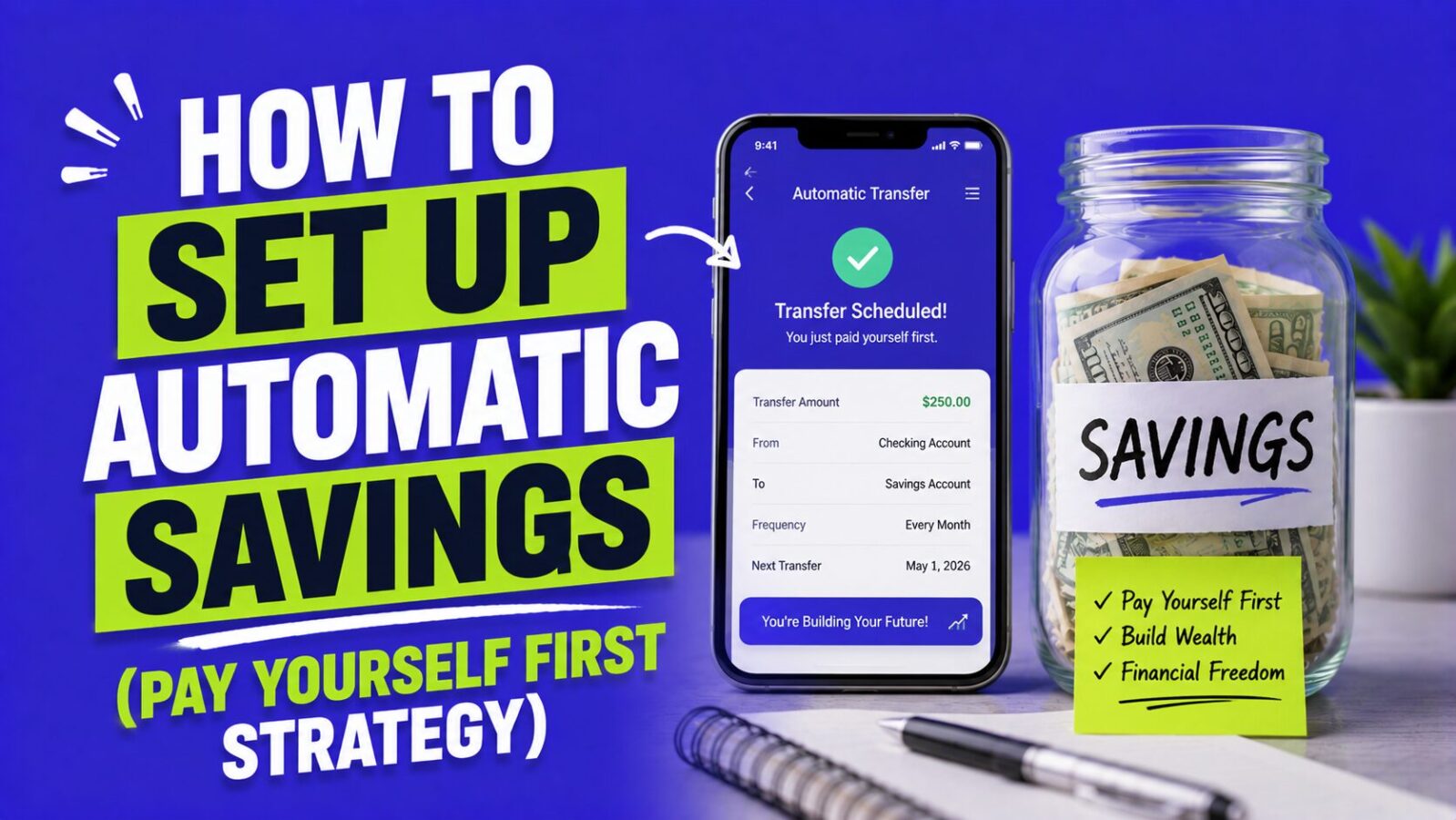
The pay yourself first strategy means deciding how much you want to save and moving that money automatically when you get paid, before it gets absorbed by discretionary spending.
It does not mean ignoring rent, groceries, minimum debt payments or other essential bills. A good pay yourself first system leaves enough money in checking for required expenses while making saving happen automatically.
For most people, the best way to start is simple: pick one savings goal, automate an amount you can actually afford each payday, and increase it later if your budget has room.
What does pay yourself first mean?
A traditional approach to saving looks like this:
Income → bills and spending → save whatever is left
Pay yourself first changes the order:
Income → planned savings → bills and spending from the remaining budget
The important part is that the saving decision happens before discretionary spending, not that savings should come before financial obligations you are required to pay.
Automation makes this easier.
The Consumer Financial Protection Bureau says recurring bank transfers and split direct deposit are two ways consumers can automatically put money into savings. It also warns that you should monitor your checking balance so an automatic transfer does not trigger an overdraft.
That is why I think the useful part of pay yourself first is not the slogan. It is turning saving from a monthly decision into a recurring transaction.
How to pay yourself first in 5 steps
You can build the system without creating a complicated budget.
- Choose what you are saving for.
- Decide how much your cash flow can support.
- Choose the right account for the goal.
- Automate the money around payday.
- Review the amount when your finances change.
Start with one goal if you are new to automatic saving. You can add more later.
Step 1: Choose one savings goal
Saving is easier to manage when you know what the money is supposed to do.
Common goals include:
- Emergency savings
- Retirement
- A home down payment
- A car or major purchase
- Travel
- Annual or irregular expenses
- Long-term investing
Your goal matters because not all savings should go into the same type of account.
Money you may need suddenly has a different job from money intended for retirement decades from now.
If you are starting with an emergency fund, use the emergency fund calculator to estimate a target based on your own expenses rather than choosing an arbitrary dollar amount.
Step 2: Decide how much to pay yourself first
There is no required savings percentage.
The 50/30/20 rule uses 20% of after-tax income for savings and extra debt payments, which can be a useful starting framework. But 20% is not a requirement and may not fit your budget.
Someone with $4,000 in monthly take-home pay could theoretically allocate $800 under that framework. But if doing so leaves too little money for housing, food, insurance or minimum debt payments, $800 is not a sustainable automatic transfer.
Start with what your cash flow can actually handle.
A useful test is:
Could I leave this money in savings without repeatedly transferring it back to checking?
If the answer is no, lower the amount.
For example, someone paid twice a month might start by automatically saving $100 from each paycheck. That is $200 per month without assuming the person should be saving 10%, 15% or 20%.
You can increase it later.
If you want a broader framework for dividing your income, see the 50/30/20 budget rule guide.
Step 3: Choose where the money should go
The right account depends mainly on when you expect to need the money.
| Goal | Account to consider | Main reason |
|---|---|---|
| Emergency fund | Savings account | Accessible without stock market risk |
| Short-term goal | Savings account or other appropriate cash account | Money stays relatively accessible |
| Workplace retirement | 401(k), 403(b) or similar plan | Contributions can come directly from payroll |
| Individual retirement | Traditional or Roth IRA if eligible | Potential tax advantages |
| Long-term non-retirement goal | Taxable brokerage account | Investing flexibility, but market risk applies |
Emergency and short-term savings
For money you may need soon, prioritize accessibility and stability.
Investor.gov notes that investments should be matched to your time horizon and that riskier investments can be inappropriate for short-term goals because you may have to sell when the investment is down.
That is why I would not put an emergency fund into stocks just because automatic investing is available.
A savings account can also work for other near-term goals such as a car repair fund, upcoming travel or an annual insurance bill.
You do not have to keep savings at a different bank from checking. Some people like the extra friction of separating the accounts, while others value instant access and simplicity. Choose whichever setup helps you save without making emergency money unnecessarily difficult to reach.
Workplace retirement accounts
A workplace retirement plan can be one of the easiest places to automate long-term saving because contributions are taken directly from your paycheck.
If your employer offers matching contributions, check the actual plan terms.
Employer matching formulas vary, and some employer contributions may be subject to vesting. The Department of Labor notes that employees are always vested in their own 401(k) contributions, while employer contributions may follow a vesting schedule depending on the plan.
So do not rely on a generic rule such as “your employer gives you a guaranteed 100% return.”
Find out:
- How the match works
- How much you need to contribute to receive the available match
- Whether employer contributions vest immediately
- What happens if you leave the job
IRAs
You can also automate contributions to a traditional or Roth IRA if you are eligible.
Contribution limits and income rules can change from year to year. For example, the IRS increased the general IRA contribution limit to $7,500 for 2026, with different rules applying to catch-up contributions and Roth eligibility.
If you automate IRA contributions, check the current IRS rules rather than relying on an old monthly contribution target.
Step 4: Automate your savings around payday
There are two simple ways to automate cash savings and a third for workplace retirement contributions.
Split your direct deposit
If your employer allows it, you may be able to divide your paycheck between checking and savings.
For example:
$150 → savings
Remaining paycheck → checking
The CFPB specifically identifies split direct deposit as a way to automate saving, although the option depends on whether your employer supports deposits into multiple accounts.
I like this setup because the savings money never needs to become part of your normal spending balance.
Schedule a recurring bank transfer
If you cannot split your paycheck, create an automatic transfer from checking to savings.
Schedule it around when income actually arrives.
For example, if you are normally paid every other Friday, you could schedule a recurring savings transfer for payday or shortly afterward.
Before activating it, check the timing of your major bills.
CFPB guidance specifically cautions consumers to keep enough money in checking when automatic savings transfers occur to avoid potential overdraft fees.
Automate workplace retirement contributions
If you participate in a workplace retirement plan, choose a contribution amount or percentage through your plan.
Investor.gov recommends regular retirement contributions and notes that automated contributions can help keep saving consistent as you get paid.
What if your income is irregular?
Pay yourself first can still work if you freelance, work on commission or have variable income.
A fixed $500 monthly transfer may not make sense if one month you earn $6,000 and the next you earn $2,500.
Instead, consider creating a rule tied to income.
For example:
Whenever income arrives, save 5% of the payment.
That percentage is only an example. Your actual number should reflect your expenses, income volatility and other financial obligations.
People with irregular income may also benefit from keeping more cash available in checking because the timing between income and bills is less predictable.
The goal is still automation where possible, but the system should adapt to your income rather than pretending every month looks the same.
Should you save automatically if you have debt?
Usually, the answer is not simply “save first” or “pay debt first.”
Start by making required payments and keeping enough cash available for essential expenses.
If you have no emergency savings at all, building at least some cash reserve can reduce the chance that the next unexpected expense immediately becomes new debt. CFPB guidance notes that even a relatively small emergency reserve can provide some financial security when unexpected expenses occur.
High-interest debt deserves serious attention too.
Investor.gov advises prioritizing high-interest debt such as credit card debt because eliminating the interest cost can be more beneficial and less risky than trying to earn an investment return while carrying expensive debt.
A reasonable order for many people is:
- Cover essential expenses and minimum payments.
- Keep some emergency cash available.
- Understand any employer retirement match available to you.
- Focus additional cash on high-interest debt and emergency savings.
- Increase long-term investing as your financial position improves.
That is a framework, not a universal formula.
Your interest rates, income stability, employer benefits and existing savings can change the right order.
How much money should stay in checking?
Enough to prevent normal monthly variation from creating a problem.
Your checking balance may need to cover:
- Rent or mortgage
- Utilities
- Groceries
- Transportation
- Insurance
- Minimum debt payments
- Automatic subscriptions
- Bills that have not cleared yet
There is no rule that everyone needs exactly one week or one month of expenses sitting in checking.
Look at your own transaction history.
If your balance frequently gets close to zero after your automatic savings transfer, reduce the transfer or adjust its timing.
An automatic savings system should make your finances easier to manage, not create overdrafts.
Three pay yourself first mistakes to avoid
Saving too aggressively
Saving more is not automatically better if it causes you to borrow money again before the next paycheck.
Start with an amount you can maintain.
Investing money you may need soon
A brokerage account is not a substitute for emergency cash.
All investments involve risk, and the SEC advises investors to consider their time horizon before choosing how much risk to take.
Never reviewing the setup
Automation should reduce financial decisions, not eliminate them forever.
Review your savings amount when something meaningful changes, such as:
- A raise
- A new job
- A major expense
- A paid-off debt
- A new financial goal
- A significant income drop
If you receive a raise and your expenses have not risen by the same amount, that can be a good opportunity to increase the automatic transfer before the extra income becomes part of your normal spending.
A simple pay yourself first example
Suppose you take home $4,000 per month and are paid twice a month.
After reviewing your bills and spending, you decide that saving $300 per month is comfortable.
You set up:
$150 from first paycheck → savings
$150 from second paycheck → savings
The rest remains available for required expenses and normal spending.
After six months, your checking balance is consistently healthy and you receive a raise.
Instead of deciding that you now “should” save 20%, you increase the transfer to $175 per paycheck.
You are now saving $350 per month.
The lesson is not that $300 or $350 is the correct amount.
The correct starting amount is the one your budget can support consistently.
Frequently asked questions
What is the pay yourself first strategy?
Pay yourself first means setting aside a planned amount for savings or investing when income arrives, before using the remaining money for discretionary spending. Automatic transfers or payroll contributions can make the system easier to maintain.
What percentage should I pay myself first?
There is no required percentage.
Twenty percent of after-tax income is one common budgeting benchmark, but you can start lower if that is what your budget supports. A sustainable amount is better than an aggressive target you repeatedly have to reverse.
What is the easiest way to automate savings?
If your employer supports it, split direct deposit is one of the simplest options. Otherwise, set up a recurring transfer from checking to savings around payday.
Should I pay myself first before paying bills?
Not if doing so leaves you unable to pay required expenses.
“Pay yourself first” is best understood as making saving a planned priority before discretionary spending, while still keeping enough money available for essential bills and minimum debt payments.
Should I pay off debt or save first?
If you have no emergency savings, keeping some cash available can help absorb unexpected expenses. High-interest debt, especially credit card debt, should also be a priority because of its interest cost. The best balance depends on your existing savings, debt rates and financial stability.
Does pay yourself first work with irregular income?
Yes.
Instead of automating the same dollar amount every month, you can base savings on a percentage of income as payments arrive. Keep the percentage low enough that weaker income months do not leave you short on essential expenses.
The bottom line
The pay yourself first strategy is useful because it changes saving from something you hope to do into something your financial system is designed to do.
You do not need to start at 20%. You do not need multiple savings accounts. And you do not need to predict decades of investment returns to make the strategy worthwhile.
Start with one goal.
Choose an amount you can leave saved without struggling to pay your bills.
Automate it around payday.
Then increase it when your finances genuinely have more room.
The best automatic savings amount is not the biggest number you can transfer today. It is the amount you can keep transferring month after month without undoing it.