By
By 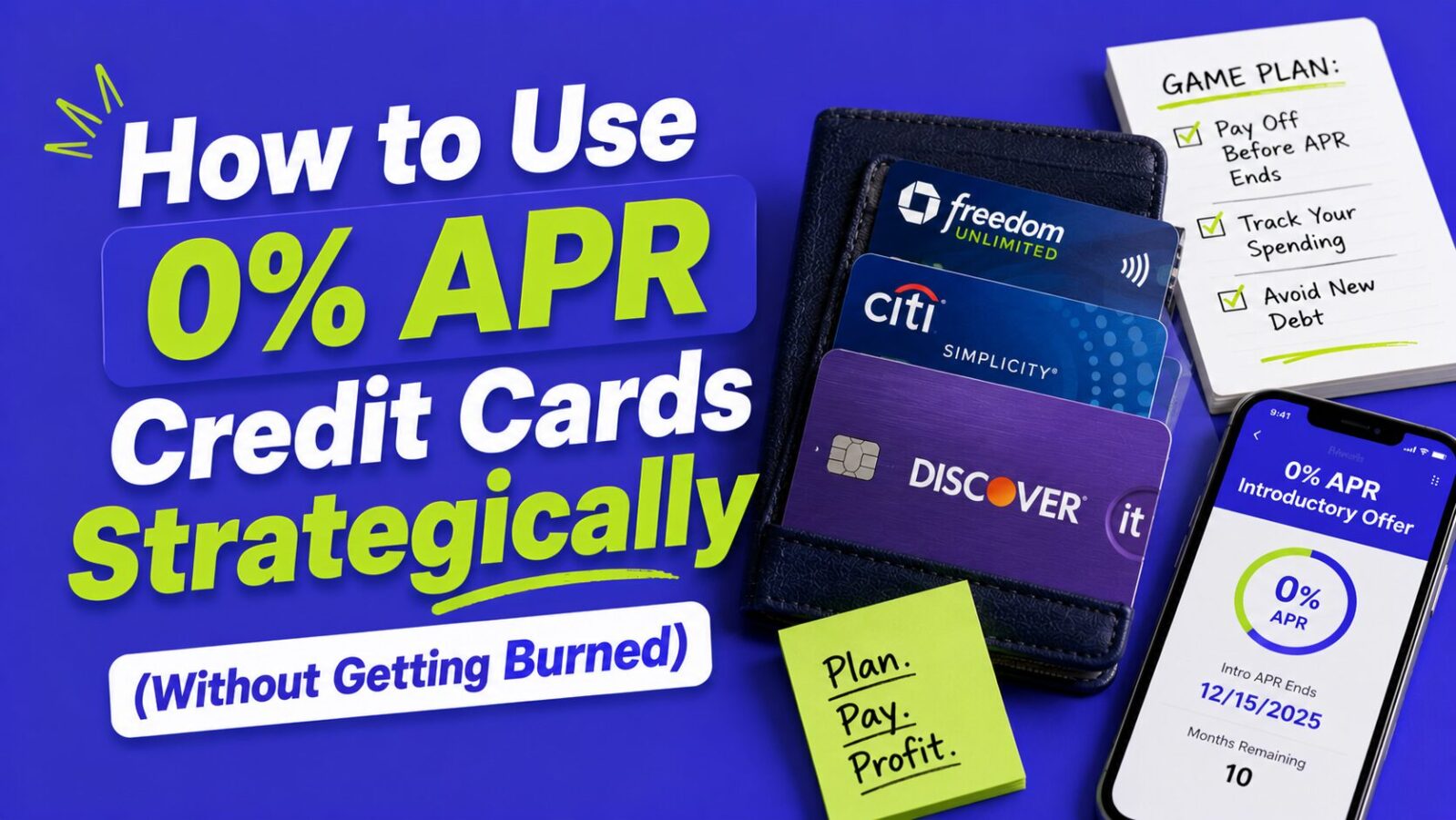
A 0% APR credit card is an interest-free loan for 12 to 21 months. Used with discipline and a plan, it saves hundreds in interest. Used carelessly, it is a debt trap with a timer. Here is how to be on the right side.
A 0% APR credit card gives you an interest-free loan for 12 to 21 months. No bank in the world offers $5,000 to $15,000 at 0% interest. But credit card companies do it regularly as a promotional offer to win your business. Used strategically, 0% APR cards save hundreds or thousands in interest on large purchases and accelerate debt payoff. Used carelessly, they create a larger problem when the promo period ends.
- The promo period starts from the date the account is opened, not the date of the first purchase or transfer. A 15-month offer that takes you 2 months to start using gives you only 13 effective months. Apply and transfer immediately.
- Calculate your required monthly payment before you apply: total balance divided by number of promo months. Set up autopay for that exact amount on day one. This is the single most important step — most people who get burned skip this.
- “0% APR” and “no interest if paid in full” are fundamentally different. True 0% APR means only the remaining balance accrues interest when the promo ends. Deferred interest (“no interest if paid in full”) means if you do not pay the entire balance by the deadline, you owe all interest retroactively from day one — a $3,000 purchase at 27% APR deferred 12 months triggers $810 in retroactive interest if not paid in full.
- One missed payment typically voids the 0% rate immediately — your entire remaining balance can jump to penalty APR (up to 29.99%). Set up autopay for at least the minimum payment the moment you open the account. Non-negotiable safety net.
- Do not use a 0% APR purchase card for new charges while trying to pay off a balance transfer. Payment allocation rules mean your payments reduce the 0% balance first while new purchases may accrue interest at the regular rate immediately.
See how much you would save with a 0% APR card
0% APR Interest Savings Calculator
Compare the cost of keeping your balance at current APR vs transferring to a 0% card.
How 0% APR offers work
0% APR on purchases: New charges earn no interest for the promotional period (12 to 21 months). After the promo ends, the standard APR (typically 18 to 28%) applies to any remaining balance. You still earn full rewards on purchases during the 0% period.
0% APR on balance transfers: Transfer existing credit card debt to the new card and pay no interest on the transferred amount for the promotional period. A balance transfer fee of 3 to 5% typically applies upfront.
Some cards offer both: 0% on purchases AND balance transfers. These are the most versatile for people who need to transfer debt and make new purchases during the same period.
Critical timing fact: The promo period starts from the date the account is opened, not the first purchase or transfer date. A 15-month offer that takes you 2 months to initiate leaves you only 13 months of 0% APR. Transfer immediately after approval.
True 0% APR vs deferred interest: the critical difference
True 0% APR: If you do not pay off the full balance before the promo ends, only the remaining balance starts accruing interest going forward at the regular APR. You keep all interest savings from payments already made.
Deferred interest (“no interest if paid in full”): If you do not pay off the ENTIRE balance by the deadline, you owe ALL interest that would have accrued from day one retroactively. On $3,000 at 27% APR deferred 12 months, missing the deadline triggers roughly $810 in retroactive interest. Common with store cards and retail financing.
How to tell the difference: “0% intro APR for 15 months” = true 0%. “No interest if paid in full within 12 months” = deferred interest. Never use deferred interest offers unless you are 100% certain you will pay in full.
3 strategies for using 0% APR cards
Strategy 1: Large planned purchases
You need a new appliance ($2,000), furniture set ($3,000), or home improvement project ($5,000). Instead of draining your emergency fund or savings, put it on a 0% APR card and pay it off in equal monthly installments before the promo expires.
Example: $3,000 purchase on a 15-month 0% APR card. Monthly payment: $3,000 / 15 = $200/month. Total interest paid: $0. Compare to: $3,000 on a regular 24% APR card with $200/month payments = $430 in interest over 17 months. Savings: $430.
The rule: Only use this strategy if you have the discipline to make the calculated monthly payment and pay off the full balance before the promo expires. Set up autopay for the calculated amount on day one.
Strategy 2: Accelerating debt payoff
If you have existing credit card debt at 20 to 28% APR, a balance transfer to a 0% APR card stops interest from accruing. Every dollar of your payment goes to principal instead of interest.
Example: $8,000 balance at 24% APR. Without balance transfer: $300/month payments, 33 months total, $1,775 in interest. With 18-month balance transfer (3% fee = $240): $300/month payments, 28 months total, $0 in interest. Net savings: $1,535 (after fee). See your specific numbers in the calculator above.
Strategy 3: Cash flow management during transitions
Major life events (moving, job change, unexpected expenses) sometimes create temporary cash flow gaps. A 0% APR card provides a short-term interest-free buffer for planned, manageable expenses.
This only works if the expenses are planned, the total is within your ability to repay within the promo window, and you have a firm monthly payment plan. Using 0% as a crutch for unplanned overspending is how this strategy becomes a trap.
The 5 traps to avoid
Trap 1: Not calculating the payoff before applying. Divide your total balance (including transfer fee) by the number of promo months. This is your required monthly payment. If you cannot afford it, the balance transfer will fail to solve your problem — you will still have a large balance when the rate reverts to 22%+ APR.
Trap 2: Deferred interest (retail cards). As described above — if you do not pay the FULL balance by the deadline, all retroactive interest triggers. Never use “no interest if paid in full” offers unless you are certain you will pay every dollar.
Trap 3: Spending more because the rate feels free. 0% APR does not mean free money. It means delayed payment. If you would not buy a $3,000 TV with cash today, do not buy it with a 0% card. The interest-free period changes the cost of borrowing, not the cost of the item.
Trap 4: Missing one payment. Even with 0% APR, a late or missed payment typically triggers the penalty APR (up to 29.99%) and can void the promotional rate on your entire remaining balance. Set up autopay for at least the minimum payment on day one — this is a non-negotiable safety net.
Trap 5: Opening too many 0% cards. Each application adds a hard inquiry to your credit report (5 to 10 point temporary score drop). Opening multiple 0% cards in a short period can lower your score and raise red flags. Space applications 6+ months apart.
Interest saved at different balances
| Balance | Regular APR | Interest saved (12 months) | Interest saved (15 months) | Interest saved (18 months) |
|---|---|---|---|---|
| $3,000 | 24% | ~$415 | ~$530 | ~$650 |
| $5,000 | 24% | ~$690 | ~$875 | ~$1,085 |
| $8,000 | 24% | ~$1,105 | ~$1,400 | ~$1,735 |
| $10,000 | 24% | ~$1,380 | ~$1,750 | ~$2,170 |
After subtracting a 3% balance transfer fee, savings are still substantial. On $8,000 over 18 months: $1,735 saved minus $240 fee = $1,495 net savings.
Loan Payoff Calculator
Frequently Asked Questions
Does a 0% APR card affect my credit score?
Opening a new card causes a temporary 5 to 10 point dip from the hard inquiry and a slight reduction in average account age. However, the increased total credit limit lowers your utilization ratio, which typically offsets these effects. For most applicants, the net credit score impact is neutral or slightly positive within 3 to 6 months. Long-term, paying down the balance significantly improves your credit utilization — a 30% factor in your FICO score. The benefit of reduced debt far outweighs the small temporary score impact from the application.
What happens to rewards during the 0% period?
You still earn rewards on all purchases during the 0% promotional period. The 0% APR only affects interest charges — it does not reduce or eliminate rewards earning. Many excellent balance transfer cards also earn solid cash back: Wells Fargo Active Cash (2% on everything, $200 bonus) offers 0% for 12 months on purchases and balance transfers while earning 2% cash back. The combination of interest-free borrowing and rewards earning is genuinely excellent for responsible users.
Can I balance transfer from one card to another at the same bank?
Usually no. Most banks do not allow balance transfers between their own cards. You cannot transfer a Chase balance to another Chase card, or a Citi balance to another Citi card. The transfer must go to a card from a different issuer. When you initiate a transfer, the new card issuer attempts to pay off the account you specify — if both accounts are from the same bank, the transfer is typically declined. This is why issuers sometimes advertise “transfer balances from other banks” in the fine print.
Should I keep the card after the 0% promo ends?
If the card has no annual fee, keep it open. Closing the card reduces your total available credit and can lower your credit score by increasing utilization. Use it for a small recurring purchase (a streaming subscription, for example) and set up autopay to keep the account active and continue building account age. If the card has an annual fee that you cannot justify with ongoing rewards or benefits, downgrade to a no-fee version of the same card if available, or close it after ensuring the impact on your score will be minimal (generally, having multiple other cards open helps cushion the effect).
Can I get another 0% APR card after the first promo ends?
Yes — there is no lifetime limit on 0% APR offers across different cards. However, issuers have their own rules: Chase’s 5/24 rule means no approval if you opened 5+ cards in the past 24 months regardless of credit score; Amex limits welcome bonuses to once per card per lifetime; Citi restricts bonuses on the same card to once per 24 months. If you have a remaining balance when your first 0% period ends, transferring to another 0% card (sometimes called “balance transfer surfing”) can work but comes with a new 3 to 5% transfer fee each time. Treat each 0% period as your one real opportunity to eliminate the debt, not just delay it.
What is the best 0% APR card for purchases in 2026?
Cards offering 0% APR on purchases with the longest promo periods and no annual fee: Wells Fargo Reflect (up to 21 months on purchases and qualifying balance transfers — one of the longest available), Citi Simplicity (no late fees, no penalty APR, 0% on balance transfers), Chase Freedom Unlimited (15 months 0% on purchases, 1.5% cash back, $200 sign-up bonus). For purchases specifically where you also want rewards earning during the 0% period, Chase Freedom Unlimited or Wells Fargo Active Cash (12 months 0%, 2% cash back, $200 bonus) are excellent because you earn rewards while paying zero interest. Always verify current terms directly with the issuer before applying.
What is the best strategy for a large purchase I cannot pay off in full right now?
Step 1: Apply for a 0% APR purchase card immediately — before making the purchase. Step 2: Put the purchase on the new card. Step 3: Calculate the purchase amount divided by the promo months. Step 4: Set up autopay for that exact monthly amount. Step 5: Do not use the card for any other purchases. This gives you interest-free financing with a clear payoff date. Compare the transfer fee (if applicable) to the interest you would pay on a regular card — for any purchase over $1,000 that will take more than 3 months to pay off, a 0% card almost always wins financially.
The bottom line
0% APR credit cards are one of the most powerful financial tools available when used with discipline. They turn expensive debt into free borrowing, make large purchases manageable, and provide cash flow flexibility during life transitions.
The strategy is simple: know your promo end date, calculate the monthly payoff amount, set up autopay on day one, and do not charge new purchases to the card. Do this and you borrow thousands interest-free. Skip any of these steps and you are stuck with a large balance at 22%+ APR when the clock runs out.
Used responsibly: an interest-free loan from the bank. Used carelessly: a debt trap with a timer. The difference is a 5-minute autopay setup and the discipline not to borrow more than you can repay within the promo window.
Related reading:
- Carrying credit card debt and want the full strategy? Read our balance transfer complete guide — every step from application to payoff with a savings calculator.
- Deciding between a 0% balance transfer card and a personal loan? Read our personal loan vs credit card guide — when each option wins for your specific balance and timeline.
- Want to understand how credit card interest works? Read our APR guide — daily compounding explained and the one rule to never pay interest again.