By
By 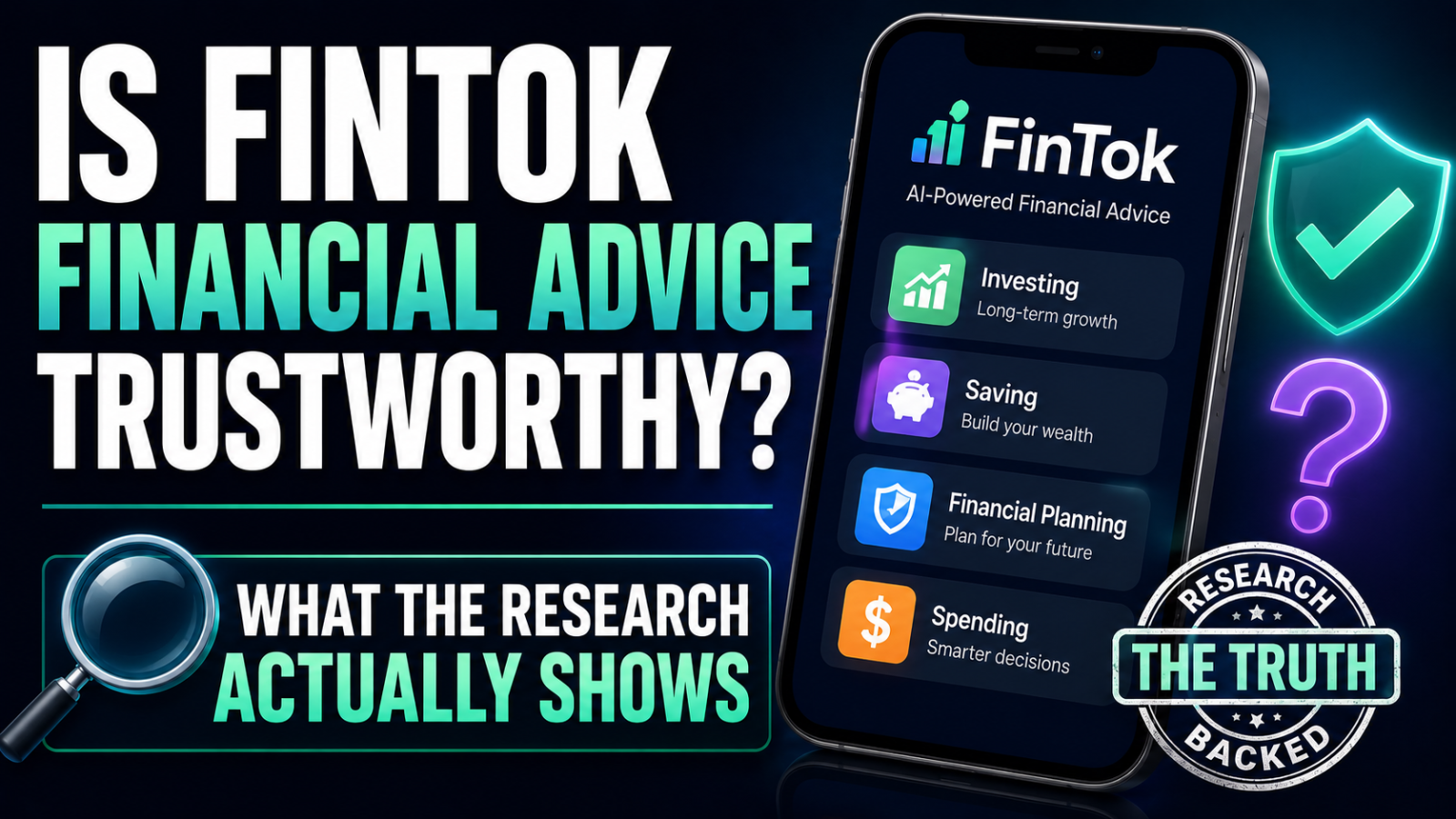
A 2024 survey found that 77% of Gen Zers and 61% of millennials actively seek financial advice on social media, with nearly half of Gen Z favoring TikTok specifically. That same year, a study by DayTrading.com analyzing viral FinTok content found that 70% of videos were misleading. Both of those statistics are true simultaneously, which tells you something important about what FinTok actually is and is not.
What FinTok Is
FinTok is the informal name for the financial content community on TikTok, encompassing creators who make videos under hashtags like #FinTok, #MoneyTok, #StockTok, #WealthTok, and related tags. As of 2025, #MoneyTok had accumulated over 3.2 million posts and #FinTok over 155,000. The average FinTok user watched approximately 416 hours of finance-related video content in 2025, according to a Chime-commissioned survey, which is roughly equivalent to watching a 30-minute finance video every day for the entire year.
The content spans an enormous range. On one end are credentialed financial professionals, CFPs, CPAs, former investment bankers, and licensed advisors who use short-form video to explain concepts clearly and reach audiences who would never open a financial planning textbook. On the other end are individuals with no credentials, large followings, and strong incentives to produce engaging content that may or may not be accurate.
The TikTok algorithm does not distinguish between these. Content that generates engagement, including outrage, excitement, and aspiration, surfaces to more people regardless of accuracy.
The Research Numbers
Several independent analyses of FinTok content quality have produced consistent and concerning findings.
DayTrading.com’s Finance TikTok Report Card, which reviewed viral finance and investing videos in September 2025 using a four-part framework scoring accuracy, risk disclosure, oversimplification, and educational value, found that 70% of videos received a C or lower and were classified as misleading. Risk disclosure was the weakest category: 30% of videos scored an F on risk disclosure, and only 10% earned an A.
A separate BrokerChooser analysis of 100 of the most popular trading-related TikTok videos found that 93% contained potentially misleading or harmful content. A study cited by SoFi from Social Capital Markets found that 71% of social media financial advice broadly misleads Gen Z and millennials. A Paxful analysis found that 1 in 7 videos from TikTok finance influencers is misleading, and 14% encourage specific financial decisions without any disclaimer.
These studies use different methodologies and examine different content subsets, so the specific percentages should not be treated as precise measurements of the overall platform. But the directional consistency across multiple independent analyses is meaningful: a significant proportion of FinTok content, particularly investment-related content, fails basic standards of accuracy and disclosure.
The most alarming statistic may be the behavioral one. A 2025 survey found that nearly 64% of FinTok users aged 25 to 45 reported making financial decisions they later regretted after following online advice. That number represents real financial damage, not just a theoretical risk.
What FinTok Does Poorly: Investment and Trading Content
The research consistently shows that investment advice is where FinTok fails most severely. The reasons are structural.
Survivorship bias is invisible in short-form video. A creator who made 400% on a meme stock in three months will make 40 videos about it. The 99% of people who tried the same strategy and lost money are not making content. The algorithm surfaces the wins; the losses stay private. This creates a systematically distorted picture of what investment strategies produce in practice.
Fifteen to thirty seconds cannot contain meaningful investment analysis. A video cannot responsibly explain the risk-adjusted return characteristics of a leveraged ETF, the tax implications of day trading, or the historical evidence base for any investment claim in the time it takes to eat a bite of food. The format is architecturally incapable of conveying the complexity that sound investment decisions require. Creators who try to simplify into a usable format strip out exactly the caveats and context that make advice safe to follow.
No regulatory accountability applies to most creators. Registered investment advisors are subject to fiduciary standards, mandatory disclosures, and regulatory oversight. An individual with a TikTok account and 2 million followers is subject to none of those requirements. Nothing stops someone from telling their audience that a specific stock will go up next month, collecting affiliate income from a brokerage referral link in the bio, and never facing any consequence when the call is wrong.
Paid promotions are pervasive and often opaque. Some FinTok creators receive payment to promote specific financial products, brokerage platforms, or investment apps. Disclosure requirements exist but enforcement is inconsistent. Research from the FTC has repeatedly found that social media influencers fail to adequately disclose sponsored content at rates that would be actionable if they were traditional media figures. The financial advice and the paid promotion are often stylistically indistinguishable.
Urgency and FOMO are content mechanics, not financial analysis. “This stock is about to explode,” “You need to buy this before Monday,” and “The window is closing on this opportunity” are engagement triggers, not investment theses. The algorithm rewards urgency because urgency drives clicks. The financial consequences of acting on artificially manufactured urgency fall entirely on the viewer.
Investment Fee Impact Calculator
What FinTok Does Well: Concepts, Norms, and Vocabulary
The same research that documents FinTok’s failures also documents its genuine positive impact on financial awareness, and the distinction between where it helps and where it hurts is worth understanding precisely.
Financial concept education is largely reliable. A video explaining what compound interest is, how a Roth IRA works, what the difference between gross and net income is, or how credit utilization affects a credit score is not giving you personalized advice. It is explaining a concept. At the concept level, much FinTok content is accurate and genuinely useful for people who did not grow up with financial literacy education. The Chime survey found that 65% of FinTok users felt more financially secure and 68% reported their home financial situation improved. That is not noise; real financial learning is happening for a meaningful portion of the audience.
Normalization of financial conversations is a genuine benefit. The loud budgeting trend, salary transparency discussions, debt payoff content, and honest conversations about financial stress all emerged or were amplified by FinTok. For a generation that received almost no formal financial education in school, the social permission to talk openly about money, ask basic questions without embarrassment, and see peers navigating the same challenges has real value.
Introductory vocabulary reduces the barrier to learning. Someone who watched FinTok videos explaining index funds, expense ratios, and the difference between a 401(k) and an IRA is better positioned to read deeper sources, ask better questions of an advisor, and make more informed decisions than someone with no baseline vocabulary. FinTok as a first contact with financial concepts can be a legitimate on-ramp, as long as it stays an on-ramp and not a final destination for decision-making.
A Framework for Evaluating Any FinTok Content
Rather than categorically trusting or dismissing FinTok, the more useful approach is applying a consistent evaluation standard to what you watch.
What are the creator’s credentials, and do they match the claim? A CFP explaining Roth conversion strategies is different from a 23-year-old with no stated qualifications claiming to have found the best stock for 2026. The credential is not sufficient on its own, credentialed people say wrong things too, but its absence for complex or specific advice claims is a clear signal to apply more skepticism.
Is there a risk disclosure? Any legitimate financial content about investments, strategies, or specific products should include some form of risk disclosure. “Past performance does not guarantee future results,” “this is not financial advice,” or “consult a professional” are baseline disclosures that responsible creators include. Their absence, especially on investment-specific content, is a red flag. In the DayTrading.com analysis, only 10% of videos scored an A on risk disclosure. That means 90% fell short of the standard that any regulated financial communication is required to meet.
Is the advice personalized, or presented as universal? Sound financial advice depends on individual circumstances: income, tax situation, existing assets, debt load, risk tolerance, and time horizon. Content that presents a specific action, “you should buy X,” “everyone should do Y before the end of the year,” without any acknowledgment that circumstances vary is either oversimplified or engineered to sound more actionable than it actually is. Legitimate educators explain principles and let you apply them to your situation. Problematic creators tell you what to do.
What is the creator’s incentive? Check the bio for affiliate links, course promotions, or sponsorship disclosures. There is nothing inherently wrong with a creator who earns income through referral links, but the financial products they are most likely to recommend are the ones that pay the highest affiliate fees, which is not the same as the ones that are best for you. When a specific product is recommended, search for whether the creator has a financial relationship with it.
Does the claim hold up in five minutes of verification? Before acting on any specific financial claim from FinTok, spend five minutes checking it against a source with institutional credibility: the IRS website for tax claims, SEC.gov for securities regulations, the Consumer Financial Protection Bureau for credit and banking questions, or an established financial news outlet. A legitimate claim survives a quick verification. Claims that cannot be verified elsewhere, or that contradict established sources, should not drive financial decisions.
The Deeper Issue: Format and Fiduciary Gap
The structural problem with FinTok as a financial advice medium is not primarily that creators are dishonest, though some are. It is that the format, the algorithm, and the economics all select for content that simplifies, excites, and recommends, rather than content that discloses risk, acknowledges complexity, and tells you that the right answer depends on your situation.
A registered financial advisor who gave the same quality of advice that fills a typical FinTok feed would lose their license. The platform creates no equivalent accountability. The research showing that 64% of users aged 25 to 45 regret financial decisions made based on online advice is the outcome of that gap at scale.
The useful response is not to ignore FinTok. The useful response is to understand what it is structurally capable of providing accurately, which is financial vocabulary and conceptual education, and what it is structurally incapable of providing reliably, which is personalized, risk-appropriate, fiduciary-standard investment and financial advice. Use it accordingly.
The Bottom Line
FinTok is a legitimate educational starting point for financial concepts, and a risky source for investment decisions and specific financial recommendations. The research is consistent on both counts. The same platform that helped millions of young people learn what a Roth IRA is also produced a body of investment content that independent analysts found to be misleading in the majority of videos examined.
The variable that matters most is not whether you use FinTok. It is whether you treat what you watch there as education that requires verification and professional guidance before action, or as advice that can be acted on directly. The first approach captures the platform’s real value. The second approach is how the 64% who regretted their decisions got there.
Chime/Talker Research FinTok survey (2,000 Americans, 2024). Intuit Credit Karma financial advice survey (Fall 2024). DayTrading.com Finance TikTok Report Card (September 2025 viral content analysis). BrokerChooser analysis of 100 trading TikTok videos. Social Capital Markets study on social media financial advice accuracy. Paxful analysis of TikTok finance influencer content. American Bazaar FinTok data (April 2026), citing 416-hour average and 64% regret statistic. This article is for informational purposes only.