 By
By 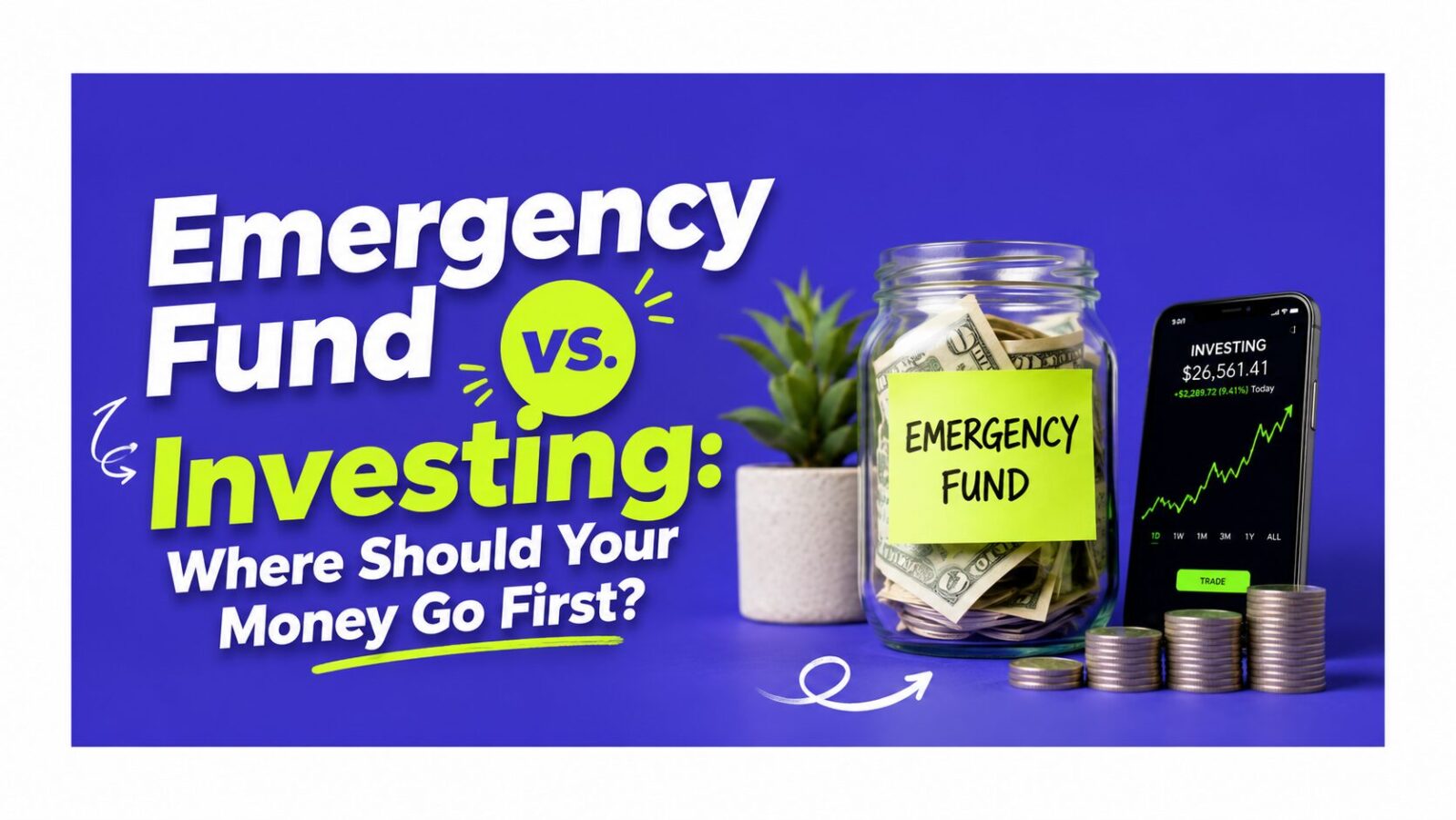
If you have little or no accessible savings, build some emergency cash before investing aggressively.
But that does not mean you need to finish a three- or six-month emergency fund before you invest anything. For many people, the better approach is to build a starter cash cushion first, consider an available employer match, deal with expensive debt, and then gradually shift more money toward long-term investing as their short-term finances become stronger.
The CFPB says the amount you need in emergency savings depends on your situation and that even a small amount can provide some financial security.
So the emergency fund vs. investing decision is not really about choosing one forever. It is about deciding where your next available dollar is most useful right now.
Emergency fund vs. investing at a glance
| Your situation | What to prioritize |
|---|---|
| Almost no accessible savings | Build a starter cash cushion |
| Employer offers a useful 401(k) match | Consider saving and investing together |
| Expensive revolving debt | Keep some cash, then emphasize debt payoff |
| Stable income with usable emergency savings | Increase long-term investing |
| Irregular income or higher job risk | Build a larger cash reserve |
| Strong cash reserve and manageable debt | Put more surplus toward long-term investing |
This is a framework, not a fixed financial order. Your income stability, debt, household responsibilities, employer benefits, and access to cash can change the answer.
Why emergency savings usually comes first
Emergency savings and investments have different jobs.
An emergency fund is cash reserved for unexpected expenses or financial shocks such as a car repair, medical bill, urgent home repair, or loss of income. That is also how the CFPB defines the purpose of emergency savings.
Investments are generally better suited to goals with a longer time horizon because their value can rise and fall.
Investor.gov explains that time horizon matters when deciding how much investment risk is appropriate. Investors with shorter time horizons generally have less ability to wait for a portfolio to recover after a market decline.
That distinction is why putting every spare dollar into investments when you have virtually no cash can make your finances fragile.
An unexpected expense could force you to:
- borrow on a credit card;
- take out a loan;
- withdraw retirement savings;
- sell investments when markets are down.
The CFPB specifically notes that without savings, even a relatively small financial shock can lead people to rely on credit or pull money from other savings.
Your emergency fund helps prevent a short-term problem from interfering with a long-term investment plan.
How much should you save before investing?
There is no universal amount you must save before you start investing.
You will often hear rules such as $1,000, one month of expenses, or three to six months of expenses. Those can be useful reference points, but they should not be treated as requirements that fit every household.
The CFPB does not prescribe one universal emergency fund amount. Instead, it recommends considering your own situation and the kinds of unexpected expenses you have faced before.
A better starting question is:
What realistic financial surprise could put me into debt right now?
That might be:
- an insurance deductible;
- a car repair;
- an unexpected medical bill;
- an urgent home repair;
- a temporary interruption in income.
Your first savings target can be enough to make one of those events manageable without immediately borrowing.
Once you have that basic protection, you can continue building the reserve while deciding whether some new money should also go toward investing.
How large should your full emergency fund be?
Think about financial risk rather than automatically choosing a fixed number of months.
You may want more accessible cash if:
- you are the only earner in your household;
- your income changes significantly from month to month;
- replacing your job could take a long time;
- you support children or other dependents;
- your essential expenses are high;
- you have few other liquid resources.
A smaller reserve may be easier to justify when your income is highly stable, your household has multiple dependable income sources, and your required expenses are relatively flexible.
If you use a months-of-expenses target, base it primarily on essential expenses, not automatically on your full salary or normal lifestyle spending.
The important point is that the reserve should reflect what your household would actually need during a disruption.
What about your employer 401(k) match?
An employer match is one reason the answer is not always “finish the emergency fund first, then invest.”
Suppose your employer contributes money to your 401(k) when you contribute. Giving up that benefit for a long period can have a real opportunity cost.
At the same time, having almost no cash creates an immediate financial risk.
That makes a blended approach reasonable for some workers:
build a starter emergency fund while contributing enough to capture some or all of the employer match your budget can support.
Then continue strengthening the emergency reserve before substantially increasing long-term contributions.
Do not assume every employer match works the same way. The Department of Labor says a plan’s Summary Plan Description should explain important provisions including contributions and vesting.
Also check whether the employer contribution is immediately vested. Your own 401(k) contributions are always fully vested, but employer contributions can be subject to a vesting schedule depending on the plan.
The employer match deserves consideration, but it should not make you ignore your need for accessible cash.
What if you have high-interest debt?
Then you are deciding between three uses for your money:
emergency savings, debt payoff, and investing.
Expensive revolving debt can deserve a high priority because paying it down reduces a known borrowing cost. Investment returns, by contrast, are uncertain.
But sending every spare dollar to debt while keeping nothing available for emergencies can create another problem. The next unexpected bill may simply go back onto the credit card.
A practical sequence can be:
starter emergency cash → expensive debt → stronger savings and long-term investing
while considering an employer match alongside those priorities.
There is no useful universal rule that says an APR of exactly 7%, 8%, or another specific number automatically determines what everyone should do.
Instead, compare:
- the actual cost of the debt;
- how much accessible cash you have;
- any employer match available;
- the stability of your income;
- how easily you could handle another unexpected expense.
The more expensive the debt and the less valuable the competing investment opportunity, the stronger the case for directing additional money toward repayment.
Can you invest while building an emergency fund?
Yes.
You do not need to completely finish one goal before starting the other.
Once you have enough accessible cash to handle smaller disruptions, it can be reasonable to divide additional money between emergency savings and long-term investing.
How you divide it should reflect your actual risk rather than an arbitrary percentage.
For example, someone with unstable income and very little cash may continue sending most available money toward savings. Someone with stable employment, manageable expenses, and a meaningful cash reserve may be comfortable directing more toward investing.
The principle is more important than the percentage:
As your short-term financial position becomes stronger, you have more flexibility to commit money to long-term goals.
Where should you keep your emergency fund?
Emergency savings should prioritize:
safety, accessibility, and separation from everyday spending.
For many households, a dedicated savings account can do that job well.
A high-yield savings account can also be appropriate when it offers convenient access, manageable fees, and appropriate deposit insurance.
The CFPB recommends keeping emergency money somewhere safe and accessible and lists a bank or credit union account as one possible option.
If you use a bank, confirm that the bank is FDIC-insured and that the product is an insured deposit account. FDIC insurance covers eligible deposit products such as savings accounts at FDIC-insured banks, but it does not cover investments such as stocks, bonds, or mutual funds.
At a federally insured credit union, qualifying share savings and other eligible deposit accounts can be covered by NCUA share insurance. Not every state-chartered credit union has federal insurance, so check the institution rather than assuming.
Do not choose an emergency account based only on whichever bank advertises the highest APY today. Interest rates change.
For emergency money, access, insurance, fees, and account restrictions matter at least as much as squeezing out a slightly higher yield.
Should you invest your emergency fund?
Generally, not the core amount you may need on short notice.
The problem is not that stocks are bad investments. It is that emergency money has an unpredictable time horizon.
Imagine the market falls just before you lose your job or face a large medical bill. If the emergency fund is invested, you may have to sell after prices have dropped instead of waiting for a recovery.
That conflicts with the purpose of the money.
Investor.gov emphasizes that investments should match the investor’s time horizon and ability to tolerate risk. Money that may be needed soon generally has less time to recover from investment losses.
Your emergency fund does not need to outperform the stock market.
It needs to be available when you need it.
If you eventually build more cash than you reasonably need for emergencies and near-term expenses, you can evaluate that excess separately for long-term investing.
How to decide where your next dollar should go
If you are still unsure, use these four questions in order.
1. Could an ordinary unexpected expense force me to borrow?
If yes, build more accessible cash.
2. Am I leaving a meaningful employer match unused?
If yes, check the plan terms and consider whether you can contribute while continuing to build savings.
3. Is expensive debt consuming a meaningful part of my cash flow?
If yes, once you have some emergency liquidity, paying down that debt may deserve more of your available money.
4. How vulnerable is my income?
If losing income for a period would be difficult to absorb, continue building the cash reserve.
If your income is stable and your short-term finances are already resilient, increasing long-term investing becomes easier to justify.
That framework is more useful than forcing every household through the same dollar target or number of months.
Frequently asked questions
Should I build an emergency fund or invest first?
If you have little or no accessible savings, build some emergency cash first. Once you have a starter cushion, you can consider investing at the same time, especially when an employer match is available.
Do I need three to six months of expenses before investing?
No. Three to six months is a common rule of thumb, not a universal requirement. The CFPB says the emergency savings amount you need depends on your individual situation.
Should I get my 401(k) match before building an emergency fund?
Not automatically. A useful employer match is valuable, but so is having enough accessible cash to prevent an ordinary expense from turning into debt. For some workers, building emergency savings and contributing enough to receive an employer match at the same time can be a reasonable compromise.
Can I save and invest at the same time?
Yes. You do not need to completely finish an emergency fund before investing. Once you have some short-term liquidity, dividing additional money between both goals can make sense.
Should an emergency fund be in stocks?
Generally, no for money you may need with little notice. Stocks can lose value over short periods, while emergency savings should emphasize accessibility and stability.
The bottom line
If you have almost no accessible savings, build some emergency cash before investing aggressively.
But do not turn that into a rule that says you cannot invest until you have reached an arbitrary three- or six-month target.
Start with enough accessible cash to keep a realistic financial surprise from immediately becoming debt. Then consider your employer match, expensive debt, income stability, household responsibilities, and how much disruption you could absorb without borrowing.
As your short-term finances become stronger, direct more of your available money toward long-term investing.
The emergency fund and your investment portfolio have different jobs.
Your emergency fund protects your ability to stay invested when life does not go according to plan.