 By
By 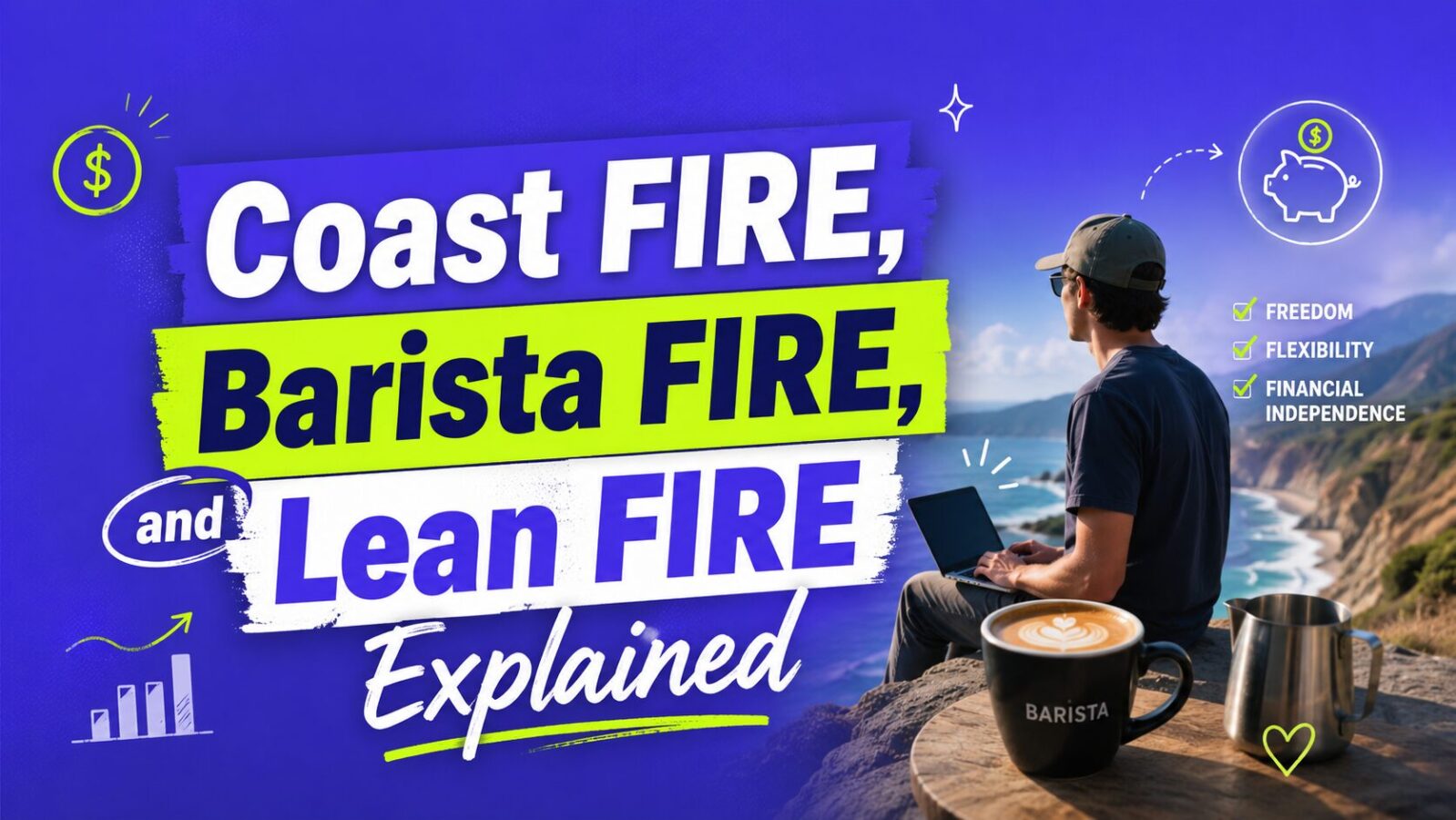
Coast FIRE, Barista FIRE, Lean FIRE, and Fat FIRE are all variations on the same idea, reaching financial independence, but they differ in how much you save, whether you keep working, and how much you plan to spend. Coast FIRE means you’ve saved enough that compound growth alone will get you to retirement, Barista FIRE means working a lighter job for income while your savings grow, and Lean versus Fat FIRE describe how frugally or comfortably you plan to live once you get there.
KEY TAKEAWAYS
- Coast FIRE: you’ve saved enough that, left untouched, compound growth alone reaches your full retirement number by a normal retirement age. You still work to cover current expenses.
- Barista FIRE: you’ve saved a partial nest egg and work a lower-stress or part-time job, often specifically for its health insurance, to cover the rest.
- Lean FIRE: retiring on a deliberately minimal budget, often defined loosely as needing $25,000-$40,000 a year or less.
- Fat FIRE: retiring with enough to sustain a more comfortable, higher-spending lifestyle, often $100,000+ a year.
- All FIRE variants share the same underlying tool: the 4% safe withdrawal rate guides how big a nest egg you actually need.
What Is Coast FIRE?
Coast FIRE is the point where your current retirement savings, if you stopped contributing entirely today, would still grow through compound investment returns alone to hit your full retirement number by a traditional retirement age like 65. Once you hit Coast FIRE, you no longer need to save aggressively, you just need to earn enough to cover your current living expenses, since your existing investments are “coasting” toward the finish line on their own.
This appeals to people who want to reduce work stress, switch to a lower-paying but more fulfilling career, or simply stop the aggressive saving grind, without fully retiring yet.
What Is Barista FIRE?
Barista FIRE describes leaving a demanding career for a lighter, often part-time job, named for the classic example of working part-time at a coffee shop specifically for benefits like health insurance, while your savings continue generating some income or growth. Unlike full retirement, you’re still earning some income to bridge the gap between your savings and your full expenses. This is a popular middle ground for people who want more freedom and flexibility well before their nest egg alone could support them entirely.
What Is Lean FIRE?
Lean FIRE means retiring on a deliberately minimal, frugal budget, commonly discussed as living on roughly $25,000 to $40,000 a year or less. It requires a smaller total nest egg than other FIRE variants, since the 4% rule math scales directly with how much you plan to spend, but it also means less cushion for unexpected costs like healthcare, home repairs, or economic downturns.
What Is Fat FIRE?
Fat FIRE is the opposite end of the spectrum, retiring with enough saved to maintain a more comfortable or even upscale lifestyle, often defined as $100,000 or more in annual spending. It requires a substantially larger nest egg, but offers more flexibility for travel, dining out, and other discretionary spending without the tight budgeting that Lean FIRE requires.
How Much Do You Actually Need for Each?
| FIRE type | Typical annual spending | Nest egg needed (25x spending) |
|---|---|---|
| Lean FIRE | $25,000-$40,000 | $625,000-$1,000,000 |
| Standard FIRE | $40,000-$100,000 | $1,000,000-$2,500,000 |
| Fat FIRE | $100,000+ | $2,500,000+ |
These figures use the common “25x annual spending” shorthand version of the 4% rule, a starting framework, not a guarantee, since actual safe withdrawal rates depend on market returns, how long your retirement lasts, and your specific spending flexibility. See our full 4% rule guide for the details and caveats.
Which FIRE Type Fits You?
None of these are mutually exclusive or permanent labels, many people move through several stages, starting with a Coast FIRE mindset in their 30s, transitioning to Barista FIRE in their 40s, and eventually reaching a Lean or Fat FIRE number depending on how their spending and income evolve. The right starting point depends on your current savings rate, how much flexibility you want in your career, and how comfortable you are with a leaner versus more cushioned retirement budget.
For a broader overview of the movement itself, see our FIRE movement explained guide, and for benchmarking your current progress by age, see how much you need to retire by age.
FAQ
What’s the difference between Coast FIRE and Barista FIRE?
Coast FIRE means your existing savings will grow on their own to a full retirement number, you just work to cover current bills. Barista FIRE means you’ve saved a partial amount and still work part-time, often for benefits, to cover the rest.
How much money do you need for Lean FIRE?
Using the common 25x annual spending guideline, roughly $625,000 to $1,000,000 for spending of $25,000 to $40,000 a year, though this varies with your actual withdrawal strategy and location.
Is Fat FIRE realistic for most people?
It requires a substantially larger nest egg than other FIRE variants and typically takes a high income, aggressive saving rate, or a longer timeline to reach.
Do I have to pick one FIRE type and stick with it?
No. Many people move between these stages over time as their savings, income, and goals change.
Bottom Line
Coast, Barista, Lean, and Fat FIRE are all variations on the same core idea, financial independence, that differ mainly in how much you spend and whether you keep working part-time. Pick the framework that matches your current savings and lifestyle goals, and remember none of these labels are permanent commitments.
A quick note: FIRE is a planning framework, not personal financial advice, and safe withdrawal assumptions carry real uncertainty over decades-long retirements. A fee-only financial planner can help stress-test your specific numbers before you make a major work or lifestyle change based on them.