By
By 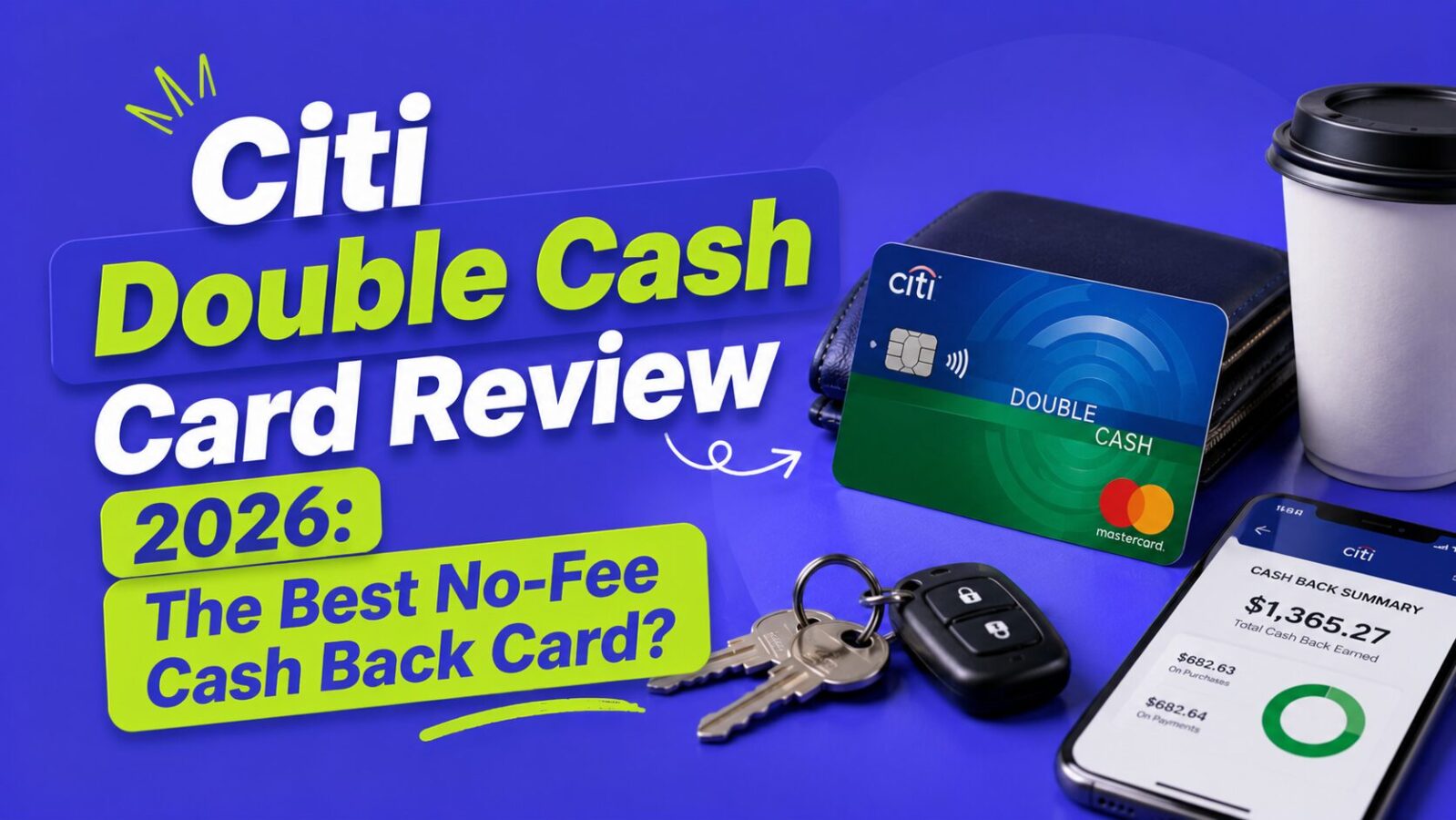
If someone asked me to recommend exactly one credit card for a person who wants simplicity, solid rewards, and zero annual fees, the Citi Double Cash would be at the top of the list. It has earned that reputation for good reason: a flat 2% back on every purchase, no category tracking, no quarterly activation, no games.
But the credit card landscape has gotten more competitive since the Double Cash first launched. Cards like the Wells Fargo Active Cash and PayPal Cashback Mastercard now offer the same 2% rate with their own perks. So is the Citi Double Cash still worth it in 2026? Here is the complete breakdown.
- The Citi Double Cash earns 2% cash back on every purchase with no caps, no rotating categories, and no annual fee — 1% when you buy and 1% when you pay your bill.
- Rewards are earned as Citi ThankYou Points, not plain cash back. If you also hold a Citi Premier card ($95/year), those points become transferable to airlines and hotels and can be worth 1.5 to 2+ cents each.
- The card has a 3% foreign transaction fee — do not use it outside the US. Any spending abroad costs you more in fees than you earn in rewards.
- No sign-up bonus. The Wells Fargo Active Cash offers the same 2% rate plus a $200 welcome bonus and cell phone protection. For most first-time applicants, the Active Cash gives more upfront value.
- The 18-month 0% intro APR on balance transfers makes this a solid debt payoff tool, even if you never plan to use it for everyday spending.
Card Overview
| Annual fee | $0 |
| Rewards rate | 2% on every purchase (1% when you buy + 1% when you pay your bill) |
| Intro APR | 0% on balance transfers for 18 months (then variable APR applies) |
| Regular APR | 18.24% to 28.24% variable |
| Foreign transaction fee | 3% |
| Sign-up bonus | None (as of early 2026) |
| Credit needed | Good to Excellent (670+) |
The core value proposition has not changed since the card launched: you earn 2% cash back on literally every dollar you spend, with no caps, no categories to track, and no annual fee eating into your returns.
How the 2% earning structure works
The 2% is split into two pieces:
- 1% when you make a purchase — this posts when the transaction settles
- 1% when you pay for that purchase — this posts when you make at least your minimum payment
This means you only get the full 2% if you actually pay your bill. If you carry a balance and only make minimum payments, you still earn the second 1% — but the interest charges will far exceed any rewards. At 24% APR, you pay $240 in annual interest on a $1,000 carried balance while earning maybe $20 in rewards. That math does not work.
The practical takeaway: Pay your full statement balance every month. The split earning structure is essentially Citi’s built-in incentive for responsible credit card use, and this card is only worth using if you are a pay-in-full cardholder.
ThankYou Points: more than just cash back
This is the part most people miss about the Citi Double Cash. Your rewards do not have to be redeemed as cash back — they earn Citi ThankYou Points, which opens up interesting possibilities.
Cash back redemption: Each ThankYou Point is worth 1 cent when redeemed as a statement credit, direct deposit, or check. Earn 5,000 points, get $50. Straightforward.
Transfer partners (with a catch): If you also hold a Citi Premier or Citi Prestige card, you can pool ThankYou Points and transfer to airline and hotel partners at 1:1. When transferred, points can be worth 1.5 to 2+ cents each — effectively turning your 2% card into a 3 to 4% card on every purchase. But this only works with the Citi Premier ($95/year) as a second card.
| Partner | Type | Ratio |
|---|---|---|
| Turkish Airlines Miles&Smiles | Airline | 1:1 |
| Singapore Airlines KrisFlyer | Airline | 1:1 |
| Virgin Atlantic Flying Club | Airline | 1:1 |
| JetBlue TrueBlue | Airline | 1:1 |
| Air France/KLM Flying Blue | Airline | 1:1 |
| Avianca LifeMiles | Airline | 1:1 |
| Accor Hotels | Hotel | 1:1 |
| Wyndham Rewards | Hotel | 1:1 |
Without a premium Citi card, you can still redeem points for travel through the ThankYou portal, gift cards, or at Amazon checkout — but value per point typically stays at or below 1 cent.
Intro APR offer
The Citi Double Cash offers 0% intro APR on balance transfers for 18 months, with a 3% transfer fee (minimum $5) on transfers completed within the first four months. This makes it a solid option if you are carrying high-interest debt on another card. Just be aware the 0% intro rate applies only to balance transfers, not new purchases. After the intro period ends, the variable APR is 18.24% to 28.24% depending on your credit profile.
What the card does not offer
- No sign-up bonus. Most competing cards offer $150 to $200 in bonus cash back after meeting a spending threshold.
- No purchase protections. Citi removed extended warranty, purchase protection, and return protection from the Double Cash several years ago.
- No travel protections. No trip cancellation, baggage delay, or rental car insurance.
- 3% foreign transaction fee. This card is not for international travel — see the dedicated section below.
- No bonus categories. The 2% everywhere is great, but you leave money on the table at grocery stores, restaurants, and gas stations compared to category-specific cards.
See how much you would earn
Cash Back Earnings Calculator
Enter your monthly spending to compare annual earnings across cards. Sign-up bonuses shown separately for year-1 context.
Citi Double Cash vs other flat-rate cards
| Feature | Citi Double Cash | Wells Fargo Active Cash | PayPal Cashback Mastercard |
|---|---|---|---|
| Rewards rate | 2% (1% buy + 1% pay) | 2% flat | 3% PayPal/Venmo, 2% elsewhere |
| Annual fee | $0 | $0 | $0 |
| Sign-up bonus | None | $200 (after $500 in 3 months) | None |
| Intro APR | 0% on BT for 18 months | 0% on purchases and BT for 15 months | None |
| Cell phone protection | No | Yes (up to $600) | No |
| Foreign transaction fee | 3% | 3% | None |
| Transfer partners | Yes (with Citi Premier) | No | No |
Wells Fargo Active Cash is the strongest competitor — same 2% rate, plus a $200 sign-up bonus, cell phone protection (up to $600 per claim when you pay your monthly bill with the card), and 0% intro APR on both purchases and balance transfers for 15 months. For most new applicants with no Citi ecosystem loyalty, the Active Cash gives more out of the box.
PayPal Cashback Mastercard earns 3% on PayPal and Venmo purchases and 2% everywhere else. If significant spending goes through PayPal or Venmo, this card can outperform both competitors — and it has no foreign transaction fees. The downsides: no sign-up bonus, no intro APR, and rewards are locked into the PayPal ecosystem.
Does Citi Double Cash have foreign transaction fees?
Yes — the Citi Double Cash charges a 3% foreign transaction fee on all purchases made outside the United States. This applies to any transaction processed in a foreign currency or by a non-US bank, including online purchases from international merchants.
On a $1,000 international purchase, you pay $30 in foreign transaction fees while earning $20 in 2% cash back — a net loss of $10 on that transaction. The more you spend internationally, the worse this math gets.
If you travel internationally: Leave the Double Cash at home. Use a card with no foreign transaction fees instead. Good options with no FTF:
- Capital One VentureOne — no annual fee, no FTF, 1.25x miles on everything
- Chase Sapphire Preferred — no FTF, 2x on travel, strong transfer partners
- Capital One Venture X — no FTF, 2x on everything, Priority Pass lounge access
- PayPal Cashback Mastercard — no annual fee, no FTF, 2% flat
The 3% foreign transaction fee is the single biggest limitation of the Citi Double Cash. For domestic-only spenders it is irrelevant. For anyone who travels internationally even once a year, it is a dealbreaker for those trips.
Pros and cons
| Pros | Cons |
|---|---|
| True 2% on everything — no caps, no limits | No sign-up bonus (leaves $150 to $200 on the table vs competitors) |
| No annual fee — 2% return is never reduced | Split earning structure requires you to pay your bill to get the full 2% |
| ThankYou Points ecosystem — unlocks transfer partners | No purchase protections (removed several years ago) |
| Solid 18-month 0% balance transfer offer | 3% foreign transaction fee — unusable abroad |
| Simplest card to use — one rate, no thinking | Transfer partners require a second Citi card ($95/year Citi Premier) |
| Great catch-all card paired with category cards | 2% ceiling — category cards earn 3 to 6% on groceries, dining, gas |
Who is the Citi Double Cash best for?
Minimalists who want one card. If you refuse to carry multiple credit cards and want the best return on a single card, 2% on everything is hard to beat. You will not maximize rewards like a multi-card strategy, but you will still outperform the average American’s 1% return by double.
The “everything else” card in a multi-card wallet. This is where the Double Cash shines brightest. Use category cards for dining (3 to 5%), groceries (3 to 6%), and travel (3 to 5x points), then pull out the Double Cash for every other purchase. Rent, utilities, insurance, subscriptions, random online purchases — the Double Cash ensures nothing earns below 2%.
Citi ecosystem investors. If you already have or plan to get a Citi Premier, the Double Cash becomes one of the best earning cards available. Every dollar earns transferable points potentially worth 1.5 to 2+ cents each — turning your “2% card” into something much more valuable.
Balance transfer candidates. The 18-month 0% intro APR on balance transfers makes this card a useful debt payoff tool even if you never plan to use it for everyday spending long-term.
Who should skip it: International travelers (3% FTF is a dealbreaker), sign-up bonus hunters (no bonus means leaving $150 to $200 on the table), and big spenders in specific categories where a dedicated category card earning 3 to 6% will outperform the flat 2% by hundreds of dollars per year.
How to maximize the Citi Double Cash
Step 1: Make it your default card. Set it as your default payment method for all subscriptions, online stores, and recurring bills. Any purchase that does not fall into a bonus category on another card goes on the Double Cash.
Step 2: Always pay in full. This earns you the full 2% and avoids interest charges that would wipe out rewards. Set up autopay for the full statement balance.
Step 3: Consider the Citi Premier pairing. If your annual spending above $20,000 on the Double Cash, the ThankYou Points you earn could be worth significantly more through transfer partners. The Citi Premier’s $95 annual fee can pay for itself through its own bonus categories (3x on dining, groceries, gas, flights, hotels) plus the ability to transfer your Double Cash points at premium value.
Step 4: Stack with category cards. Build a two or three card system where the Double Cash handles non-bonus spending while dedicated cards cover dining, groceries, and travel. Use the calculator above to see exactly how much more a two-card combo earns for your spending profile.
Is the Citi Double Cash still worth it in 2026?
Yes — but with a caveat. The card is no longer the undisputed king of no-annual-fee cash back. The Wells Fargo Active Cash matches its 2% rate while adding a sign-up bonus, cell phone protection, and a purchase-inclusive intro APR. For most new applicants with no Citi ecosystem loyalty, the Active Cash is arguably the better first choice.
But the Citi Double Cash has a unique advantage: ThankYou Points. No other no-annual-fee card gives you access to a transferable points ecosystem. For anyone building a Citi card portfolio or already holding a Citi Premier, the Double Cash is the best flat-rate earning card available, period.
The card also remains one of the best no-annual-fee options for people who want simplicity — no rotating categories to activate, no spending caps to track, no annual fee to justify. Just 2% back on everything, every time.
Frequently Asked Questions
Does the Citi Double Cash have foreign transaction fees?
Yes — the Citi Double Cash charges a 3% foreign transaction fee on purchases made outside the United States or processed in a foreign currency. On a $500 international purchase, you pay $15 in fees while earning $10 in 2% rewards — a net loss of $5. For any international travel or shopping from foreign merchants, use a card with no foreign transaction fees. The Double Cash is a domestic-only card.
How does the 1% + 1% earning structure work?
The Citi Double Cash splits its 2% into two parts: you earn 1% when a purchase posts to your account, and another 1% when you pay for that purchase (as long as you make at least the minimum payment). In practice, if you pay your full statement balance every month — which you should — you automatically receive the full 2% on every purchase within 1 to 2 billing cycles. The structure is Citi’s way of incentivizing cardholders to pay their bills. If you only make minimum payments, you still earn the second 1%, but interest charges will vastly outweigh any rewards benefit.
Is there a sign-up bonus on the Citi Double Cash?
No — the Citi Double Cash does not currently offer a sign-up welcome bonus. This is its most notable competitive disadvantage against the Wells Fargo Active Cash, which offers $200 back after spending $500 in the first 3 months (effectively a free $200 for spending you would make anyway). If you are opening a new card primarily for the welcome offer, the Double Cash is the wrong choice. That said, the Double Cash’s long-term earning rate of 2% flat and access to the ThankYou Points ecosystem may outperform a one-time $200 bonus for cardholders who hold the card for years.
Can I transfer Citi Double Cash points to airlines?
Only if you also hold a Citi Premier ($95/year) or Citi Prestige card. With one of those premium cards in your wallet, you can pool all your ThankYou Points and transfer them 1:1 to airline and hotel partners including Turkish Airlines, Singapore Airlines, Virgin Atlantic, JetBlue, Air France/KLM, and others. Transferred points can be worth 1.5 to 2+ cents each — turning the Double Cash’s effective 2% rate into 3 to 4% on every purchase. Without a premium Citi card, your Double Cash points are redeemable only at 1 cent per point or less through the ThankYou portal, gift cards, or Amazon checkout.
How does the Citi Double Cash compare to the Wells Fargo Active Cash?
Both cards earn 2% flat on everything with no annual fee. The Wells Fargo Active Cash adds a $200 sign-up bonus (after $500 spend in 3 months), cell phone protection up to $600 per claim, and a 0% intro APR on both purchases and balance transfers for 15 months. The Citi Double Cash counters with an 18-month 0% balance transfer window (vs 15 for the Active Cash) and access to the Citi ThankYou Points transfer ecosystem. For most first-time applicants with no Citi card history, the Active Cash delivers more immediate value. For Citi ecosystem builders or dedicated pay-in-full cardholders focused on long-term rewards optimization, the Double Cash is the better foundation.
Is the Citi Double Cash good for a first credit card?
It is decent but not the best first card. The Citi Double Cash requires good to excellent credit (670+), which means it may not be accessible for someone with thin or no credit history. If you are building credit from scratch, start with a secured credit card or a beginner card like the Discover it Cash Back (no credit score required, Cashback Match year 1). Once you have 12 to 18 months of credit history and a 670+ score, the Citi Double Cash becomes an excellent upgrade — its simplicity and flat 2% rate are particularly well-suited for people who do not want to track categories.
What credit score do I need for the Citi Double Cash?
Citi recommends good to excellent credit for the Double Cash, which generally means a FICO score of 670 or higher. In practice, most approved applicants have scores of 700+, and the best credit limits typically go to applicants with 720+. If your score is below 670, focus on building your credit score first. Approval is not guaranteed even above 670 — Citi also considers income, existing debt load, and credit history length.
How do I redeem ThankYou Points from the Citi Double Cash?
Log into your Citi account and navigate to the ThankYou rewards portal. Redemption options include: statement credit (1 cent per point), direct deposit to a bank account (1 cent per point), check (1 cent per point), travel through the ThankYou portal (typically 1 cent per point), gift cards (1 cent per point at select merchants), and Amazon or PayPal checkout (often less than 1 cent per point — avoid these). The only way to get more than 1 cent per point is by transferring to airline or hotel partners — and that requires also holding a Citi Premier or Prestige card. Minimum redemption is typically 500 points ($5 cash back).
Bottom line
The Citi Double Cash is a reliable, no-drama cash back card that earns a legitimate 2% on all spending with zero annual fee. It is not flashy, and it will not win you a free flight to Tokyo on its own. But as a foundation card in any wallet — or as a gateway into the Citi ThankYou Points ecosystem — it remains one of the best credit cards available in 2026.
The 3% foreign transaction fee is the clearest limitation: this is a domestic card, full stop. And the lack of a sign-up bonus means first-time cardholders leave $150 to $200 on the table that the Wells Fargo Active Cash would hand them immediately.
But for long-term cardholders who pay in full every month, want one card that earns well on everything, and may eventually pair it with a Citi Premier for transfer partner access — the Double Cash earns its place in any well-built wallet.
Related reading:
- Want a sign-up bonus too? Read our comparison of the best no-annual-fee cards — the Wells Fargo Active Cash and Discover it Cash Back both offer strong welcome bonuses the Double Cash lacks.
- Carrying a balance right now? The Double Cash’s 18-month 0% balance transfer offer is one of the better deals available. Read our balance transfer guide to see if it beats the other options.
- Want to maximize the ThankYou Points angle? The Citi Premier is the key to unlocking transfer partners. Compare it alongside the best travel cards to decide if the $95 fee is worth it for your travel frequency.