 By
By 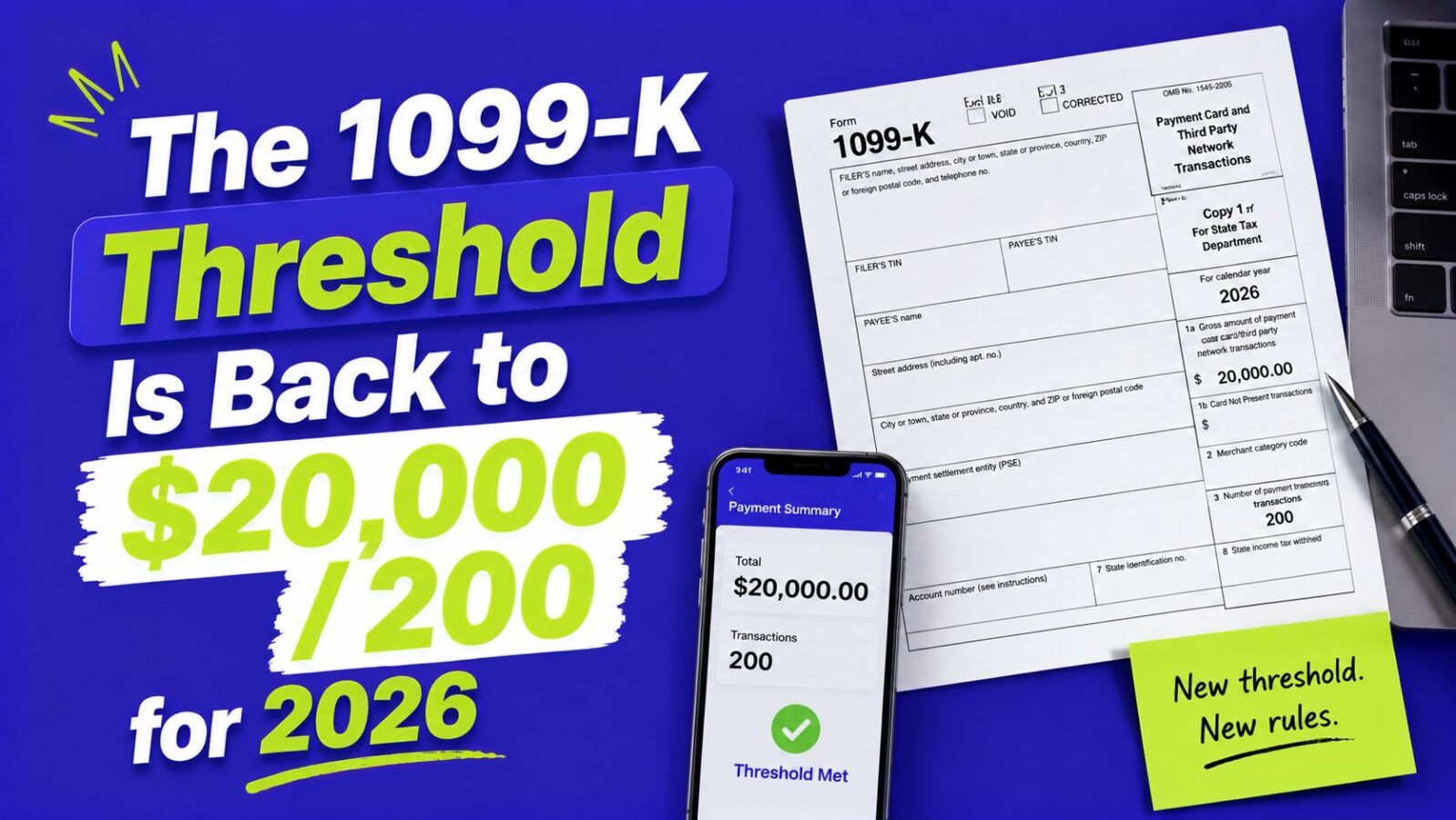
The 1099-K reporting threshold is back to $20,000 and more than 200 transactions for 2026. The One Big Beautiful Bill Act repealed the much lower $600 threshold that was being phased in, so payment apps like PayPal, Venmo, Etsy, and eBay only have to send you a Form 1099-K if your business payments top both $20,000 in gross sales and 200 transactions in a year. One thing did not change: you still owe tax on all your income, with or without a form. Here is what the new threshold means for side hustlers and sellers. Because tax rules are nuanced, confirm your specifics with a tax professional.
Key Takeaways
- For 2026, a payment app sends a Form 1099-K only if you exceed both $20,000 in gross payments and 200 transactions.
- The OBBBA repealed the $600 threshold from the American Rescue Plan, restoring the old $20,000 / 200 rule retroactively.
- The form threshold does not change your taxes: all business and side hustle income is taxable whether or not you get a 1099-K.
- Personal payments like gifts, splitting a dinner, or reimbursing a friend are never reportable on a 1099-K.
- The separate 1099-NEC threshold for freelance pay rose from $600 to $2,000 for 2026.
FILING AS A GIG WORKER OR FREELANCER IN 2027?
The 2027 filing season is the first time these deductions appear on a real return. For step-by-step claim instructions, see: How to File Your 2026 Taxes (2027 Season): Complete Guide to Claiming the New OBBBA Deductions.
What is a Form 1099-K?
A Form 1099-K is an information return that payment platforms send to you and the IRS reporting the gross amount of your business payment transactions for the year. It comes from “third-party settlement organizations,” which include apps and marketplaces like PayPal, Venmo, Cash App for Business, Etsy, eBay, StubHub, Uber, and Airbnb, when you receive payments for goods or services.
The form reports your gross sales, before fees, refunds, or costs. It is not a tax bill and not a measure of your profit. It simply tells the IRS that money flowed to you through that platform.
What is the 1099-K threshold for 2026?
For 2026, a platform must send you a 1099-K only if your payments for goods or services exceed both $20,000 in gross total and 200 separate transactions in the year. You have to cross both lines, so $25,000 across 150 transactions does not trigger a form, and neither does 300 transactions totaling $8,000.
This restores the threshold that was in place before 2022. The One Big Beautiful Bill Act (OBBBA) repealed the $600 threshold that the American Rescue Plan had created, which the IRS had been easing in gradually (it had announced $5,000 for 2024 and $2,500 for 2025 as transition steps). Those lower thresholds are gone, and the $20,000 / 200 rule applies.
| Tax year | 1099-K threshold that applies |
|---|---|
| 2025 and 2026 | More than $20,000 and more than 200 transactions |
| Previously planned (now repealed) | $2,500 (2025), then $600 (2026), no transaction minimum |
Does this mean less tax for side hustlers?
No. This is the most important point: the reporting threshold changes who gets a form, not who owes tax. All income from selling goods or providing services is taxable, whether or not a platform sends you a 1099-K. If you earn $5,000 reselling sneakers and never get a form, that $5,000 is still taxable self-employment income.
The higher threshold mainly reduces paperwork and the confusion of getting a form for casual activity. It does not lower your tax bill. Keep your own records of income and expenses regardless of what forms arrive. Our guides on side hustle taxes and freelancer taxes cover how to track and report it.
What about personal payments between friends?
Personal payments are never reportable on a 1099-K. Splitting rent or a dinner bill, sending a gift, or paying back a friend are not business transactions, so they should not appear on the form. The issue arises when these get mixed in with business payments on the same account.
To avoid a form that overstates your business income, mark personal transfers as “friends and family” or personal when the app gives the option, and keep business sales on a separate account or a business profile where possible. If you do receive a 1099-K that includes personal amounts, you can report and back them out on your return, but it is cleaner to keep them separate from the start.
How is a 1099-K different from a 1099-NEC?
They cover different income and have different thresholds. A 1099-K comes from a payment platform and reports gross payments processed through it. A 1099-NEC comes from a client or business that paid you directly for freelance or contract work. Under the OBBBA, the 1099-NEC threshold rose from $600 to $2,000 for 2026, so a single client now has to send a 1099-NEC only if they paid you more than $2,000 in the year.
You can receive both for the same work in some cases. As always, the income is taxable regardless of which form, if any, you receive.
What if you sold personal items at a loss?
Selling your own used items for less than you paid is generally not taxable, because you have a loss, not a gain. But if those sales run through a platform and cross the threshold, you could still receive a 1099-K reporting the gross amount. In that case you report the form and show that the items were personal-use property sold at a loss, so there is no taxable gain. Keep records of what you originally paid. Selling collectibles or items for more than you paid is a different story and can create a taxable gain.
Do states have their own 1099-K rules?
Some do. A handful of states set their own, lower 1099-K thresholds that apply regardless of the federal number, so you may receive a state 1099-K even if you are under the federal $20,000 / 200 limit. Check your state’s department of revenue if you sell through platforms, and remember that a state form, like a federal one, does not change whether the income is taxable.
FAQ
What is the 1099-K threshold for 2026?
More than $20,000 in gross payments and more than 200 transactions through a single platform. You must exceed both for the platform to send a form.
Do I owe tax if I do not get a 1099-K?
Yes. All income from goods or services is taxable whether or not you receive a form. The threshold only decides who gets paperwork, not who owes tax.
Will Venmo or PayPal report money my friends send me?
No, not if it is correctly marked as a personal payment. Gifts, reimbursements, and splitting bills are not business transactions and should not appear on a 1099-K. Use the personal or friends-and-family option for those.
Did the freelance 1099 threshold change too?
Yes, but separately. The 1099-NEC threshold for direct freelance or contract pay rose from $600 to $2,000 for 2026.
I got a 1099-K for selling old personal stuff. What do I do?
Report the form and show the items were personal property sold at a loss, which is not taxable. Keep records of your original cost. A tax professional or tax software can walk you through reporting it correctly.
Bottom line: For 2026 the 1099-K threshold is back to $20,000 and 200 transactions, so most casual sellers will not get a form. But the rule that matters has not changed: you owe tax on all your income whether a form shows up or not, so track your sales and expenses and keep personal payments separate.
How to Claim This on Your 2026 Return
Now that you know the rules, here is how to actually claim it when you file. The step-by-step guides below cover which boxes to check on your W-2, where the deduction appears on Form 1040, and how the major tax software platforms handle it:
- How to File Taxes as a Gig Worker / 1099 in 2027 (New 1099-K Rules)
- How to File Your 2026 Taxes (2027 Season): Complete Guide to Claiming the New OBBBA Deductions
- Best Tax Software for 2027 for Gig Workers
This article is for educational and informational purposes only and is not tax advice. Reporting thresholds and rules change, and state rules vary. We want you to feel clear, not anxious, so confirm how this applies to you with a qualified tax professional, or at irs.gov, before you file.