 By
By 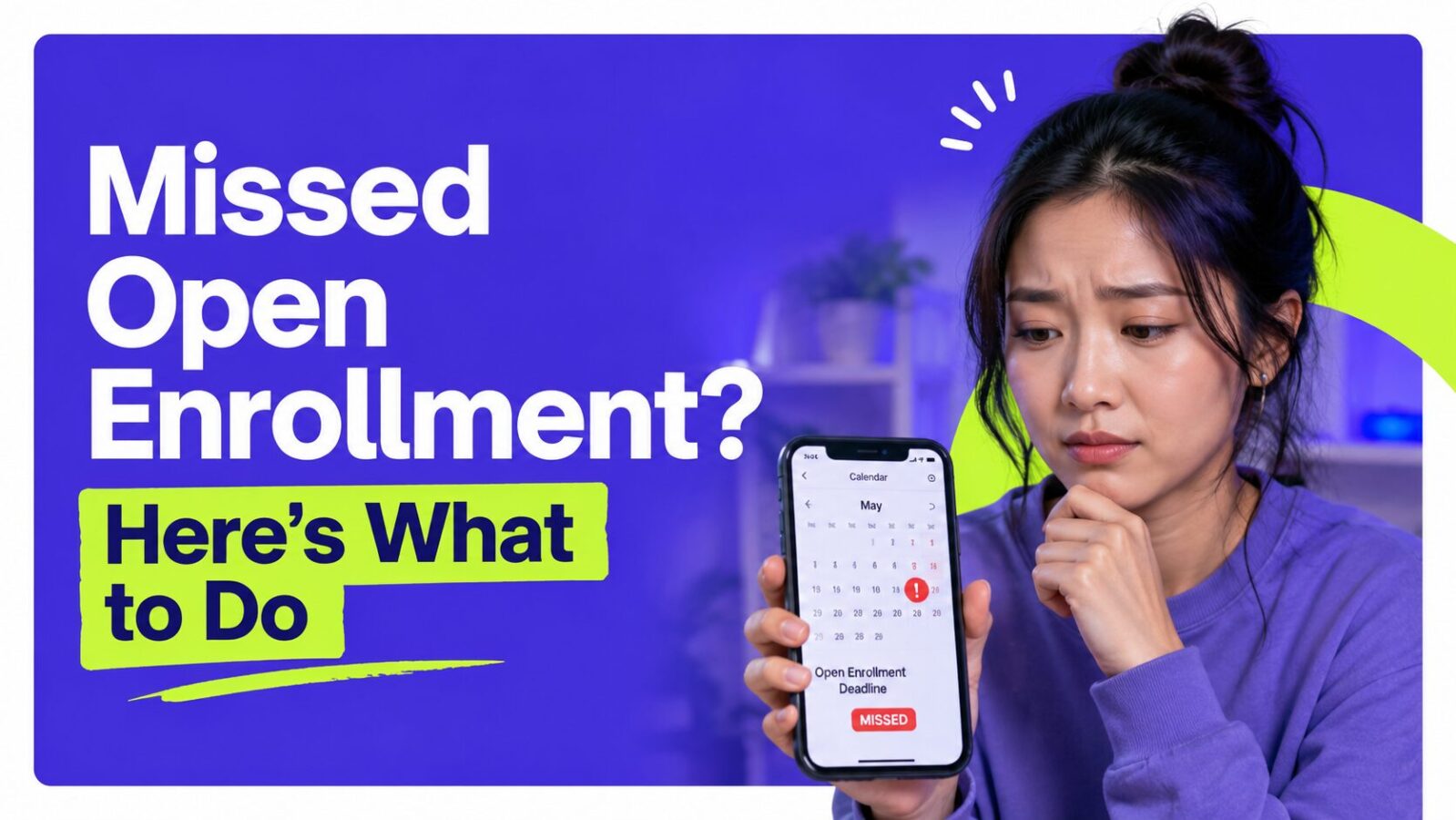
If you miss ACA Marketplace open enrollment, you generally have to wait until the next enrollment period unless you qualify for a Special Enrollment Period, or SEP.
The most common ways to qualify are losing other health coverage, getting married, having or adopting a child, or moving to a new coverage area. But the often-repeated rule that “every qualifying life event gives you exactly 60 days” is too simple. The timing and coverage start date depend on what happened, and losing Medicaid or CHIP can give you a longer window.
If none of the SEP rules apply, check Medicaid or CHIP immediately. Both accept applications year-round.
Key takeaways
- Missing Marketplace open enrollment usually means waiting until the next enrollment period unless you qualify for a Special Enrollment Period.
- Most SEP windows are around 60 days, but the exact timing depends on the event.
- If you lose qualifying health coverage, you can generally enroll up to 60 days before or 60 days after the loss.
- If you lose Medicaid or CHIP, HealthCare.gov currently allows up to 90 days after the coverage ends to select a Marketplace plan.
- Having a baby, adopting a child, or placing a child for foster care can produce coverage effective from the date of the event, even if you enroll afterward.
- You may need documents proving your SEP eligibility. For 2027, CMS is expanding pre-enrollment SEP verification on the federal Marketplace.
- Medicaid and CHIP enrollment is available all year, not just during ACA open enrollment.
What is a Special Enrollment Period?
A Special Enrollment Period is a period outside annual Marketplace open enrollment when a qualifying change in your circumstances allows you to enroll in or change ACA Marketplace coverage.
HealthCare.gov groups the common events into areas such as:
- changes in household,
- changes in residence,
- loss of health coverage, and
- certain other qualifying circumstances.
The important word is qualifying.
Simply forgetting the open enrollment deadline does not create a SEP. Neither does voluntarily dropping coverage in many situations just because you would rather buy a Marketplace plan.
You need an event or circumstance recognized under the Marketplace rules.
Which life events can qualify you for a SEP?
Here are the main situations to check.
| Situation | Can it trigger a SEP? | Important detail |
|---|---|---|
| Lose job-based health insurance | Usually yes | Losing coverage can qualify even if you quit or were fired |
| Turn 26 and lose a parent’s coverage | Usually yes | Coverage loss creates the SEP |
| COBRA reaches its end | Usually yes | Voluntarily dropping COBRA early usually does not |
| Lose Medicaid or CHIP | Yes, if eligibility rules are met | HealthCare.gov allows up to 90 days after coverage loss |
| Lose eligible student health coverage | May qualify | Check your Marketplace eligibility result |
| Get married | Usually yes | Generally enroll within 60 days after marriage |
| Have a baby | Usually yes | Coverage can start on the date of birth |
| Adopt or foster a child | Usually yes | Special effective-date rules apply |
| Divorce or legal separation | Only in certain cases | The event generally needs to cause a loss of coverage |
| Move to a new coverage area | May qualify | A move alone is not always enough |
| Move to the U.S. from abroad | May qualify | Different prior-coverage rules can apply |
| Leave incarceration | May qualify | Listed by HealthCare.gov as a qualifying circumstance |
| Become a U.S. citizen | May qualify | Marketplace eligibility rules still apply |
| Certain disasters or exceptional circumstances | May qualify | The Marketplace may provide a specific SEP |
HealthCare.gov also lists more specialized circumstances, so if your situation does not fit neatly into one of these categories, complete the Marketplace eligibility application rather than assuming you do not qualify.
Losing job-based insurance
Losing employer health coverage is one of the clearest SEP triggers.
HealthCare.gov says you can qualify after leaving a job whether you quit or are fired, as long as you lose the job-based health coverage. A reduction in hours that causes you to lose eligibility can also create a coverage-loss situation.
You can generally use the loss-of-coverage SEP before the employer plan ends, which can help prevent a gap.
If the coverage has already ended, select a Marketplace plan within 60 days after the loss. HealthCare.gov says coverage generally begins the first day of the month after plan selection in this situation.
Do not wait until day 59 if you already know your coverage is ending.
What if you have COBRA?
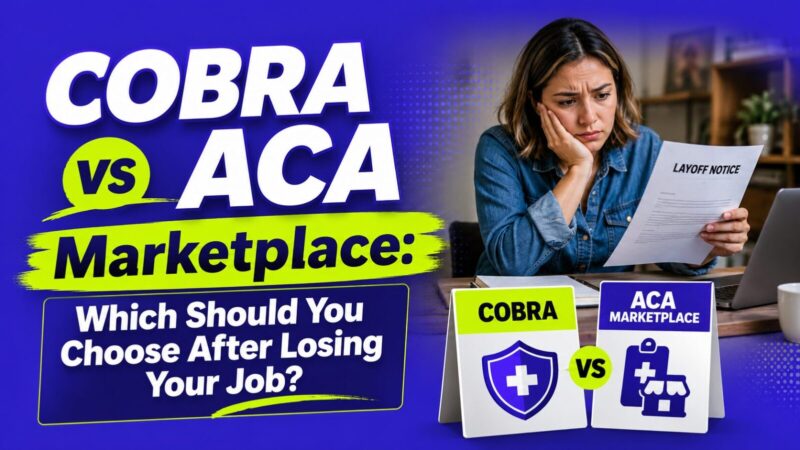
Losing employer coverage may leave you with both a Marketplace SEP and the option to continue the employer plan temporarily through COBRA.
Compare them before choosing.
COBRA can let you keep the same employer coverage, but you may have to pay the full premium yourself. Marketplace coverage may qualify for premium tax credits depending on your projected household income and other eligibility rules.
There is also an important trap.
If your COBRA coverage reaches the end of its permitted period or becomes unavailable for another qualifying reason, that loss can trigger a Marketplace SEP.
But voluntarily canceling COBRA early or simply stopping premium payments generally does not create a new SEP by itself.
So do not enroll in COBRA assuming you can drop it whenever you want and immediately switch to a Marketplace plan.
What happens when you turn 26?
If turning 26 causes you to lose qualifying coverage under a parent’s health plan, that loss can create a SEP.
HealthCare.gov specifically includes losing dependent coverage because you reach the plan’s maximum dependent age as a qualifying coverage-loss situation.
Use the SEP before your old coverage ends when possible so you can line up the new policy without an uninsured gap.
Does getting married qualify?
Getting married can qualify you for a Special Enrollment Period.
HealthCare.gov says you may qualify when the marriage occurred in the previous 60 days. If you select a plan by the end of the month, coverage can generally begin on the first day of the following month.
Do not assume every household change works the same way.
For example, divorce or legal separation by itself is not enough. It generally needs to result in the loss of health coverage to create the applicable SEP.
What happens after having or adopting a child?
Birth and adoption have more favorable effective-date rules than many other SEPs.
If you have a baby, adopt a child, or place a child for foster care, HealthCare.gov says coverage can generally start on the date of the event, even when you complete enrollment up to 60 days afterward.
That is different from a typical SEP where coverage starts prospectively.
Still, enroll as soon as possible. Retroactive coverage can mean premiums are owed back to the coverage effective date.
Does moving qualify for a SEP?
Sometimes, but moving is not automatically a qualifying life event.
Potential qualifying moves include moving to a new ZIP code or county, moving to the U.S. from another country or U.S. territory, or certain moves involving students, seasonal workers, or transitional housing. A temporary move for vacation or medical treatment does not qualify.
For many domestic moves, there is another rule that gets missed: you generally need to have had qualifying health coverage for at least one day during the 60 days before the move. Exceptions apply in certain circumstances, including some people moving from outside the U.S. or a U.S. territory.
The Marketplace may ask for proof of both your new residence and previous coverage.
So “I changed ZIP codes” is not enough information by itself to know whether you qualify.
What if you lose Medicaid or CHIP?
Losing Medicaid or CHIP can trigger a Marketplace SEP if you are no longer eligible.
And this is one case where the standard “60-day rule” is wrong.
HealthCare.gov currently says that if Medicaid or CHIP coverage has already ended, you can have 90 days after the coverage end date to select a Marketplace plan.
If your income has changed, complete a new application rather than guessing whether you now belong in Medicaid or the Marketplace.
You may also reapply directly for Medicaid or CHIP at any time to find out whether you still qualify.
Does an income change by itself create a SEP?
Do not assume it does.
The broad year-round SEP that had allowed people with projected household income at or below 150% of the federal poverty level to enroll monthly was eliminated beginning with plan year 2026, and CMS has finalized its removal beyond 2026 as well.
Income can still matter in connection with specific circumstances. For example, HealthCare.gov lists situations where losing Medicaid because income rises, or certain changes involving existing individual coverage and eligibility for Marketplace savings, may qualify.
But “my income changed” should not be treated as a universal SEP.
Update or submit a Marketplace application and let the eligibility determination tell you whether your particular situation qualifies.
How long does a Special Enrollment Period last?
The safest answer is: it depends on the event.
For many common SEPs, you usually have about 60 days around the qualifying event.
But there are important exceptions:
Loss of qualifying coverage: generally up to 60 days before or 60 days after the loss.
Loss of Medicaid or CHIP: up to 90 days after coverage ends under current HealthCare.gov guidance.
Birth, adoption, or foster placement: you generally have 60 days after the event, with coverage potentially effective from the event date.
The practical rule is simple: do not calculate your deadline from memory. Check the Marketplace as soon as the event happens.
Will you need proof of your qualifying event?
Possibly.
HealthCare.gov says your Marketplace Eligibility Notice will tell you whether supporting documents are required. If documentation is required after you select a plan, HealthCare.gov generally gives you 30 days to submit it.
For example, documentation might need to show:
- when previous insurance ended,
- your move and previous address,
- marriage,
- birth or adoption, or
- another event supporting the SEP.
Do not assume everyone automatically has to upload the same paperwork.
For the federal Marketplace, verification is becoming more important. CMS finalized expanded pre-enrollment SEP verification for 2027 and requires the federal platform to verify at least 75% of new SEP enrollments.
That makes it smart to keep coverage termination letters and other supporting records instead of throwing them away.
What if you missed open enrollment and have no SEP?
Your choices become narrower, but check these before deciding you must simply remain uninsured.
Check Medicaid and CHIP
You can apply for Medicaid and CHIP at any time of year. If you qualify, you can enroll without waiting for Marketplace open enrollment.
Medicaid rules vary by state.
As of April 2026, CMS identifies 41 expansion jurisdictions, including Washington, D.C., and 10 non-expansion states.
In an expansion state, many adults can qualify based on income alone up to effectively about 138% of the federal poverty level, although some state rules differ.
For 2026, the federal poverty guideline for one person in the 48 contiguous states and D.C. is $15,960, putting 138% at roughly $22,025. Alaska and Hawaii use higher figures.
Do not rely on the old $20,800 figure for a single adult. It is no longer the right 2026 approximation.
Look at CHIP for children
CHIP also accepts applications year-round.
HealthCare.gov says that if a child qualifies, coverage can begin without waiting for annual Marketplace open enrollment. Eligibility limits vary by state.
Children may qualify for CHIP even when their parents do not qualify for Medicaid.
Check whether COBRA is available
If you recently lost employer coverage, COBRA may still be available even if you missed the window you wanted for a Marketplace plan.
Compare the premium, provider network, deductible, current medical treatment, and how long you need coverage before choosing.
Be very careful with short-term insurance
Short-term, limited-duration insurance may be available in some states, but it is not a substitute for ACA-compliant coverage.
These policies are generally exempt from many ACA individual-market protections, including major rules involving pre-existing conditions.
The regulatory situation is also unusually fluid. A 2024 federal rule imposed tighter duration limits, but in August 2025 the Departments announced that they would not prioritize enforcement of parts of that definition while considering future rulemaking, and state law can impose its own requirements.
So do not buy a short-term policy simply because the premium is lower. Read exclusions, benefit caps, pre-existing-condition rules, prescription coverage, and your state’s current requirements first.
When is the next ACA open enrollment?
If you use HealthCare.gov, the next Open Enrollment Period for 2027 coverage runs from November 1 through December 15, 2026.
CMS finalized the shorter HealthCare.gov window beginning with plan year 2027. All coverage selected during that federal Open Enrollment Period begins January 1, 2027.
That means you should not plan around the old January 15 HealthCare.gov deadline for 2027.
State-based Exchanges may use different dates within federal timing limits, so check your state’s Marketplace if it does not use HealthCare.gov.
For the full schedule, see our ACA Marketplace 2027 enrollment guide.
Frequently asked questions
What happens if I miss ACA open enrollment?
You generally have to wait until the next Open Enrollment Period unless you qualify for a Special Enrollment Period. Medicaid and CHIP are exceptions because you can apply for them year-round.
Does every qualifying life event give you 60 days?
No. Sixty days is common, but timing depends on the SEP. Losing qualifying coverage can provide a window before and after the loss, while losing Medicaid or CHIP currently gives you up to 90 days after coverage ends through HealthCare.gov.
Does losing your job qualify for a Special Enrollment Period?
Losing job-based health coverage can qualify. The important event is the loss of qualifying insurance, not simply the job itself. HealthCare.gov says this can apply whether you quit or are fired.
Does voluntarily canceling insurance trigger a SEP?
Usually not when you simply choose to drop qualifying coverage. For example, voluntarily ending COBRA or stopping COBRA premium payments generally does not create a coverage-loss SEP.
Does moving qualify?
It can, but not every move qualifies. The move generally needs to change your primary residence, and many domestic moving SEPs require prior qualifying health coverage. Moving for vacation or medical treatment does not qualify.
Can I enroll in Medicaid after missing open enrollment?
Yes. Medicaid and CHIP accept applications year-round. Eligibility depends on your state, income, household, and other factors.
Do I always need documents for a SEP?
Not necessarily. Your Marketplace Eligibility Notice tells you whether documents are required. If they are requested after plan selection, HealthCare.gov generally gives you 30 days to submit them.
Bottom line
Missing ACA open enrollment does not automatically mean you must remain uninsured for the rest of the year, but simply missing the deadline does not create a second chance to enroll.
Check first for a qualifying coverage loss, marriage, birth or adoption, qualifying move, loss of Medicaid or CHIP, or another recognized Special Enrollment Period.
Then pay close attention to the deadline. Most SEP windows are around 60 days, but the rules are not identical. Medicaid and CHIP loss can provide a 90-day post-coverage window, and birth or adoption can have special effective-date rules.
If you do not qualify for a SEP, check Medicaid, CHIP, COBRA, and any other coverage available to you before considering limited non-ACA coverage.
And if you need the next regular HealthCare.gov enrollment window, mark November 1 through December 15, 2026 for 2027 coverage.
For the broader enrollment timeline, see the Open Enrollment 2026 Complete Guide.
This article is for general educational purposes and is not individualized insurance, financial, tax, or legal advice. Marketplace and Medicaid rules can change and state rules vary. Confirm your SEP eligibility, deadlines, documentation requirements, and coverage effective date through HealthCare.gov or your state Marketplace before enrolling.