By
By 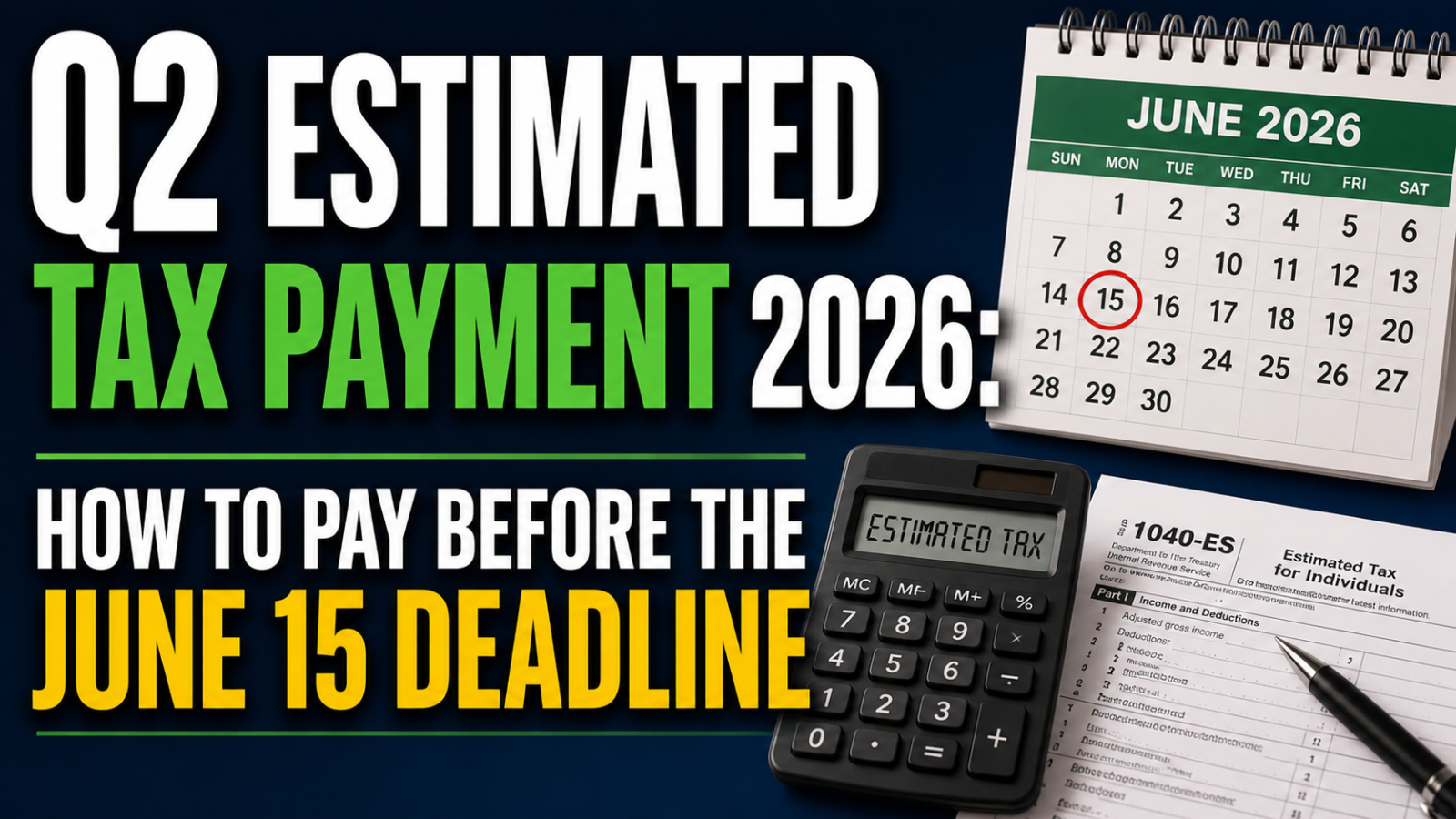
The second quarter estimated tax payment deadline is June 15, 2026. If you are self-employed, a freelancer, a gig worker, an investor with capital gains, or anyone whose income is not fully covered by employer withholding, you likely need to make a payment by that date. Missing it does not trigger an immediate penalty notice, but it results in an underpayment penalty calculated on the amount you owed from April 15 to June 15.
Here is exactly what you need to know and how to pay.
Who Needs to Pay Estimated Taxes
You need to make estimated tax payments if both of these are true:
- You expect to owe at least $1,000 in federal income tax for 2026 after subtracting withholding and credits
- Your withholding and credits will cover less than 90% of your 2026 tax liability, or less than 100% of your 2025 tax liability (whichever is smaller)
This applies to:
- Self-employed individuals and sole proprietors
- Freelancers and independent contractors (1099 workers)
- Gig economy workers (Uber, DoorDash, Etsy sellers, etc.)
- Investors with significant capital gains, dividends, or interest income
- Rental property owners with net income
- Retirees with pension, Social Security, or investment income not covered by withholding
- People who received a large tax bill last April and want to avoid another one
If you have a regular W-2 job and your employer withholds enough taxes from each paycheck, you generally do not need to make estimated payments. But if you have side income on top of your W-2 job, that side income may not have taxes withheld, which can push you into estimated payment territory.
The 2026 Estimated Tax Payment Schedule
| Payment Period | Due Date | Status |
|---|---|---|
| January 1 to March 31 | April 15, 2026 | Past due |
| April 1 to May 31 | June 15, 2026 | Due in 18 days |
| June 1 to August 31 | September 15, 2026 | Upcoming |
| September 1 to December 31 | January 15, 2027 | Upcoming |
Note that the Q2 period covers only two months (April and May) while the Q3 period covers three months and Q4 covers four. This uneven schedule catches many first-time estimated tax payers off guard.
How Much to Pay
There are two safe harbor methods that protect you from underpayment penalties:
Method 1: Pay 100% of last year’s tax liability — If your 2025 adjusted gross income was $150,000 or less, pay at least 100% of your total 2025 federal tax bill across the four quarterly payments. If your 2025 AGI was above $150,000, pay 110% of your 2025 liability.
Method 2: Pay 90% of this year’s estimated liability — Estimate what you will owe for all of 2026 and pay 90% of that amount across the four quarters.
Method 1 is simpler because you already know your 2025 tax bill from your return. Divide your total 2025 federal tax (the number from line 24 of your Form 1040) by four, and pay that amount each quarter. If your income is significantly higher in 2026 than 2025, you may still owe a balance in April 2027, but you will avoid underpayment penalties.
How to Calculate Your Q2 Payment Specifically
If you are using the safe harbor method based on last year’s taxes, the calculation is straightforward:
- Find your 2025 total tax (Form 1040, line 24)
- Subtract any amount you already paid for Q1 (April 15)
- The Q2 payment is approximately one quarter of your total 2025 tax liability, minus Q1
Example: Your 2025 total tax was $12,000. Safe harbor requires paying $12,000 across four quarters, or $3,000 per quarter. If you paid $3,000 in Q1, your Q2 payment is another $3,000.
If this is your first year paying estimated taxes and you did not make a Q1 payment, you can catch up by paying more in Q2, Q3, and Q4 to still meet the annual safe harbor threshold.
How to Actually Pay
The IRS offers several payment methods. The easiest is the IRS Direct Pay system:
- Go to irs.gov/payments/direct-pay
- Select “Estimated Tax” as the reason for payment
- Select “1040-ES” as the tax form
- Enter “2026” as the tax year
- Enter your bank account information and payment amount
- Submit before June 15 at midnight Eastern Time
No account creation is required. Direct Pay is free and the payment is confirmed instantly. Save the confirmation number.
Alternative payment methods:
- IRS2Go mobile app — same Direct Pay functionality from your phone
- EFTPS (Electronic Federal Tax Payment System) — requires advance enrollment but preferred by people making frequent business tax payments
- Debit or credit card — available through third-party processors but charges a fee (1.82% to 1.98% for credit cards, flat fee for debit). Not recommended unless you are earning enough rewards to offset the fee.
- Check — make payable to “United States Treasury,” write your SSN and “2026 Form 1040-ES” on the memo line, mail to the address on IRS Form 1040-ES for your state. Must be postmarked by June 15.
What Happens If You Miss the June 15 Deadline
Missing an estimated tax deadline does not trigger a separate IRS notice or late payment fee like missing an annual filing deadline does. Instead, you incur an underpayment penalty calculated at the federal short-term interest rate plus 3 percentage points, applied to the amount you should have paid from April 15 through June 15. At current rates, this works out to approximately 7% to 8% annualized on the underpaid amount for those two months.
On a $3,000 underpayment for two months, that is roughly $35 to $40 in penalty. Not catastrophic, but avoidable with a payment before June 15.
The penalty is calculated on IRS Form 2210 when you file your annual return. You can also request a waiver if the underpayment was due to unusual circumstances.
One More Thing: The OBBBA No-Tax-on-Tips and Overtime Deductions
If you received qualifying tip income or FLSA overtime in 2026, the One Big Beautiful Bill Act created new deductions for both. If you updated your W-4 to reflect these deductions earlier in the year, your withholding may already account for them. If you did not, you can factor the expected deductions into your estimated tax calculation when determining how much to pay this quarter.
Quick Summary
- Deadline: June 15, 2026
- Who pays: self-employed, freelancers, investors, anyone with unwithheld income
- How much: 25% of your 2025 total tax bill (safe harbor method)
- How to pay: IRS Direct Pay at irs.gov/payments/direct-pay — free, instant, no account needed
- Penalty for missing: ~7-8% annualized on the underpaid amount, calculated for two months
Sources: IRS Publication 505 (Tax Withholding and Estimated Tax); IRS Form 1040-ES instructions 2026; Charles Schwab personal finance calendar 2026. This article is for informational purposes only and does not constitute tax advice. Consult a qualified tax professional for guidance specific to your situation.