By
By 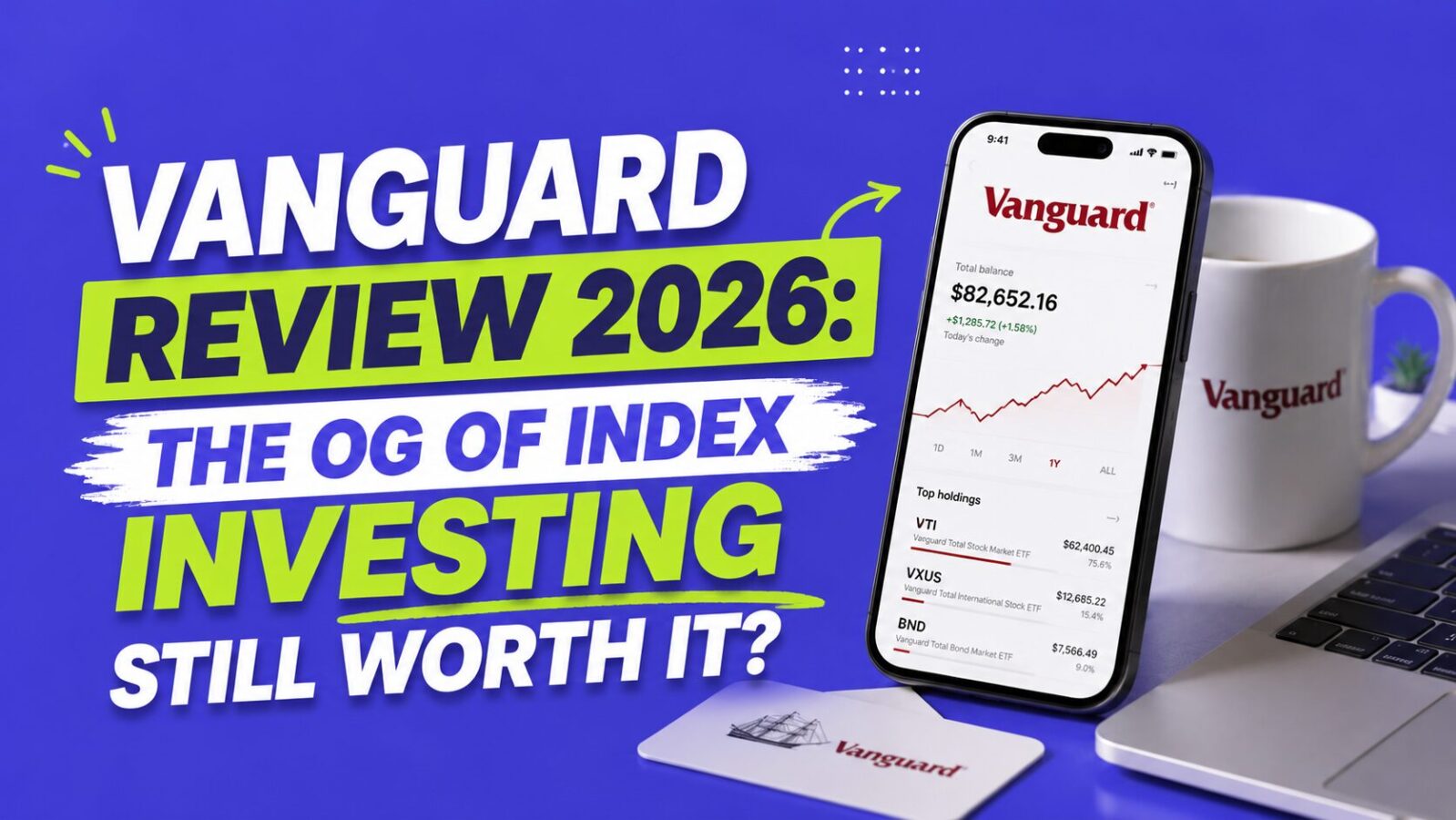
Disclosure: Some links on this page are affiliate links. We may earn a commission at no cost to you if you open an account through them. Our editorial ratings are not influenced by compensation. See our full disclosure.
- World-class index funds (VTI, VOO, BND)
- Client-owned structure, no conflicts of interest
- Consistently declining expense ratios
- 529 plans and full account range
- Solid robo-advisor and human advisor options
- $3,000 mutual fund minimum
- Customer service below Fidelity/Schwab
- No checking or banking features
- App still lags behind competitors
- Limited fractional share support
- Vanguard invented the index fund in 1976 and is owned by its fund shareholders, the only major brokerage with this structure.
- VTI (0.03%), VOO (0.03%), VXUS (0.07%), and BND (0.03%) are the gold standard index ETFs that every other fund company benchmarks against.
- Fidelity now offers cheaper funds (FZROX at 0.00%) and better technology. Vanguard’s edge is its ownership structure, fund track record, and philosophical alignment.
- For the simplest long-term portfolio: buy VTI + VXUS + BND in a Roth IRA at Vanguard and rebalance once a year. Nothing else needed.
- If you need responsive customer service, a checking account, or frequent trading tools, Fidelity or Schwab serve you better.
Vanguard is not just a brokerage. It is a philosophy. Founded by Jack Bogle in 1975, Vanguard introduced the first index fund available to individual investors and spent the next half-century proving that low-cost, passive investing beats most active managers over time. Today Vanguard manages over $9 trillion in global assets, making it one of the largest investment companies on the planet.
But having a great history does not automatically make Vanguard the best choice for your money in 2026. The competition has caught up on fees, and in technology and customer service, Vanguard still lags behind. Here is who should use Vanguard today, and who is better off elsewhere.
The Vanguard Story: Why It Matters
John C. “Jack” Bogle believed most investors were being ripped off by high-fee mutual funds that failed to beat the market. In 1976, he launched the First Index Investment Trust (now the Vanguard 500 Index Fund), which simply tracked the S&P 500. Wall Street mocked it as “Bogle’s Folly.”
They stopped laughing. That fund, now VFIAX, holds over $900 billion in assets. The concept Bogle pioneered, low-cost indexing, has become the dominant investment strategy worldwide.
What makes Vanguard truly unique is its ownership structure. Vanguard is owned by its funds, and the funds are owned by their shareholders. That means you, the investor, are effectively the owner. There are no outside shareholders demanding profits, no pressure to push expensive products. This structure is why Vanguard has consistently lowered expense ratios over time, when the company saves money, it passes those savings back to investors.
Account Types
- Individual and joint taxable brokerage accounts
- Traditional IRA and Roth IRA
- Rollover IRA (for old 401(k) plans)
- SEP IRA and SIMPLE IRA (for self-employed)
- Custodial accounts (UGMA/UTMA)
- 529 college savings plans (state-dependent)
- Trust accounts
- Vanguard Digital Advisor (robo-advisor, $3,000 min)
- Vanguard Personal Advisor Services (human + digital, $50,000 min)
Fees and Commissions
| Trade Type | Cost |
|---|---|
| US stocks and ETFs | $0 |
| Vanguard mutual funds | $0 |
| Non-Vanguard mutual funds | $0 for most NTF funds; $20 for transaction-fee funds |
| Options | $0 + $1 per contract |
| Account maintenance | $0 (legacy $20/year fee eliminated) |
| Account transfer out (ACAT) | $0 |
Vanguard’s Flagship Funds
This is the real reason people choose Vanguard. The fund lineup is legendary.
| Fund | Type | Tracks | Expense Ratio | Minimum |
|---|---|---|---|---|
| VTI | ETF | Total US Stock Market | 0.03% | $0 |
| VTSAX | Mutual Fund (Admiral) | Total US Stock Market | 0.04% | $3,000 |
| VOO | ETF | S&P 500 | 0.03% | $0 |
| VFIAX | Mutual Fund (Admiral) | S&P 500 | 0.04% | $3,000 |
| VXUS | ETF | Total International Stock | 0.07% | $0 |
| BND | ETF | Total US Bond Market | 0.03% | $0 |
| VT | ETF | Total World Stock | 0.07% | $0 |
A three-fund portfolio using VTI + VXUS + BND gives you the entire global stock and bond market for a blended expense ratio around 0.04%. See our 3-fund portfolio guide for the complete setup.
The fee difference between Vanguard’s 0.03 to 0.04% funds and the industry average matters enormously over decades. See exactly how much:
Vanguard Fee Savings Calculator
How much do you save by choosing Vanguard’s 0.04% index funds vs the US fund industry average of 0.42%? (Assumes 10% gross annual return.)
Admiral Shares vs ETFs: Which Should You Choose?
Vanguard mutual funds now primarily offer Admiral Shares for index funds, with a $3,000 minimum. For most popular funds, the old higher-cost Investor Shares are gone.
ETF versions (VTI, VOO, VXUS, BND) have no minimum beyond the price of one share, slightly lower expense ratios in some cases, and are available at any brokerage. Fractional ETF purchasing is available through Vanguard for recurring automatic investments.
Mutual fund versions (VTSAX, VFIAX, etc.) can be set up with exact dollar amounts for automatic investing and are simpler for beginners who want to contribute $500 per month without worrying about partial shares.
For most investors under $3,000, start with VTI and VOO (no minimum). Once you reach $3,000, VTSAX is a small but real improvement over VTI (0.04% vs 0.03%, a $1/year difference on $10,000, so mostly irrelevant). Pick based on which is easier to automate for your situation.
Vanguard Digital Advisor and Personal Advisor Services
Vanguard Digital Advisor charges approximately 0.20% all-in (advisory fee + underlying fund costs) with a $3,000 minimum. It provides automated portfolio management using Vanguard ETFs, automatic rebalancing, and goal planning tools. At 0.20% total, it is among the cheapest full-service robo-advisors, cheaper than Betterment (0.28 to 0.40% all-in) and Wealthfront (0.31 to 0.38%).
Vanguard Personal Advisor Services charges 0.30% annually with a $50,000 minimum. This adds access to human financial advisors via video or phone. Comparable human-assisted services elsewhere typically charge 0.50 to 1.00%. For investors who want occasional human guidance without paying traditional advisor rates, Personal Advisor Services offers strong value.
Mobile App and Website
Let us be honest: the Vanguard app was not good for a long time. The redesigned app (rolled out through 2024 and 2025) is cleaner, faster, and more intuitive. You can now view balances with clear charts, place trades, set up automatic investments, and manage accounts. Is it as polished as Fidelity’s or Schwab’s? Not quite. But it has gone from a genuine weakness to “good enough” for buy-and-hold investors who check in quarterly rather than daily.
Customer Service
This remains Vanguard’s weakest area. Common complaints include long phone wait times (sometimes 30 to 60 minutes during peak periods), no physical branches, limited live chat, and slow email response times. Vanguard has been investing in improvements, but if responsive customer service is a priority, Fidelity and Schwab are meaningfully better.
That said, if you are a buy-and-hold index fund investor who rarely needs to call anyone, this may not matter much. Vanguard is built for investors who want to set up a portfolio once and let it run for years with minimal adjustments.
Vanguard vs Fidelity vs Schwab
| Feature | Vanguard | Fidelity | Schwab |
|---|---|---|---|
| Stock/ETF commissions | $0 | $0 | $0 |
| Cheapest US total market fund | VTI (0.03%) | FZROX (0.00%) | SWTSX (0.03%) |
| Mutual fund minimum | $3,000 | $0 | $0 |
| Fractional shares | Limited (auto-invest) | Yes (any stock/ETF) | Yes (S&P 500 stocks) |
| Robo-advisor | Digital Advisor (0.20%, $3K) | Fidelity Go (free under $25K) | Intelligent Portfolios (free, $5K) |
| Checking account | No | Yes | Yes (best-in-class) |
| Physical branches | 0 | 200+ | 300+ |
| Customer service | Below average | Excellent | Excellent |
| Ownership structure | Client-owned (unique) | Private | Publicly traded |
Vanguard vs Fidelity: Fidelity leads on cost (FZROX at 0.00%), technology, customer service, fractional shares, and $0 minimums everywhere. Vanguard’s edge is its client-owned structure, fund legacy, and philosophical alignment. For most new investors, Fidelity is the more practical choice. If you are already at Vanguard and happy, there is little reason to switch.
Vanguard vs Schwab: Schwab wins on banking features, customer service, and the thinkorswim trading platform. Vanguard wins on fund history and ownership structure. If you want checking, ATM rebates, and a full-service experience, Schwab is better. If you want the simplest possible three-fund portfolio and nothing else, Vanguard does that perfectly.
Is Vanguard Right for You?
Is Vanguard Right for Me?
Two quick questions for a personalized recommendation.
Step 1: What best describes your investing style?
Strengths and Weaknesses
- Legendary index funds with decades of track records
- Client-owned structure, no outside shareholders
- Consistently declining expense ratios
- Strong robo and human advisor options
- ETF versions have no minimum investment
- 529 plans and full account type range
- $3,000 mutual fund minimum (ETFs: $0)
- Customer service below Fidelity/Schwab
- No checking or banking features
- No physical branches
- App improving but still lags competitors
- Options: $1/contract vs $0.65 elsewhere
Who Vanguard Is Best For
Dedicated index fund investors. If your strategy is “buy VTI and chill” or “build a three-fund portfolio and forget it for 30 years,” Vanguard is the spiritual home of that approach. Everything about the platform is designed for patient, long-term investors.
People who care about corporate structure. Vanguard’s client-owned model is unique in the industry. If you want your brokerage’s incentives fully aligned with yours, Vanguard is the only major option that can claim this permanently.
Investors with $3,000+ to start. If you can meet the Admiral Shares minimum, you get access to some of the best mutual funds ever created. If not, start with the ETF versions (VTI, VOO, VXUS, BND) which have no minimums.
Who should look elsewhere: Beginners with less than $1,000 (Fidelity is more practical), people who want banking + investing together (Schwab or Fidelity), active traders (Schwab’s thinkorswim), and anyone who values responsive customer service (Fidelity or Schwab).
How to Open a Vanguard Account
- Go to vanguard.com and click “Open an Account”
- Choose your account type (brokerage, IRA, etc.)
- Provide personal information (name, SSN, address, employment)
- Link a bank account for transfers
- Fund your account and start investing
Vanguard accounts are protected by SIPC for up to $500,000 in securities and $250,000 in cash.
Frequently Asked Questions
Is Vanguard safe?
Yes. Vanguard is one of the largest and most established investment companies in the world, managing over $9 trillion in assets. Investment accounts are protected by SIPC up to $500,000 (including $250,000 in cash). Vanguard has been operating since 1975 with no major fraud or insolvency events in its history. The client-owned structure adds an additional layer of stability, there are no outside shareholders to whom Vanguard owes profits.
Should I choose VTI or VTSAX?
They track the same index (CRSP US Total Market) and have nearly identical performance. VTI (ETF, 0.03%) has no minimum but trades throughout the day. VTSAX (Admiral Shares mutual fund, 0.04%) requires $3,000 but executes at the exact closing price and is easier to set up in exact dollar amounts for automatic investing. For most investors the choice is irrelevant, pick whichever fits how you invest. At Vanguard’s own platform, VTSAX is slightly simpler for automated monthly investing.
Can I buy fractional shares at Vanguard?
Partially. Vanguard supports fractional share purchasing for automatic investment plans (recurring buys), so your $500 monthly contribution is fully invested even if it does not equal a whole number of shares. However, Vanguard does not currently support fractional share purchasing for one-time manual trades in ETFs, unlike Fidelity which allows fractional purchases of any stock or ETF at any time. For pure auto-investing, Vanguard handles it. For manual one-time purchases, you need a whole number of shares.
Is Vanguard better than Fidelity?
It depends on what you value. Fidelity wins on technology (better app, better website), customer service (faster, more accessible), cost (FZROX at 0.00% beats VTI at 0.03%), and fractional shares. Vanguard wins on its client-owned structure (no profit motive to push expensive products), fund legacy and track record, and philosophical alignment with passive investing. For pure practical value in 2026, Fidelity has pulled ahead. But Vanguard’s ownership structure is a genuine differentiator that matters to some investors.
What is the minimum investment at Vanguard?
For ETFs (VTI, VOO, VXUS, BND): $0 minimum, but you need enough to buy at least one share. At roughly $250 to $290 per share for VTI, fractional shares via automatic investing let you start with any amount. For Admiral Shares mutual funds (VTSAX, VFIAX, etc.): $3,000 minimum. For Vanguard Digital Advisor (robo): $3,000. For Personal Advisor Services: $50,000.
How does Vanguard compare to a robo-advisor like Betterment?
At Vanguard with ETFs, you pay 0.03 to 0.07% and manage your own rebalancing (once a year). At Betterment, you pay 0.25% (plus fund fees) and get automatic rebalancing, tax-loss harvesting, and goal tracking. The difference: roughly 0.22% per year in additional cost. On $100,000, that is $220 per year for automation. Whether that is worth it depends on your willingness to spend 30 minutes annually on rebalancing. For self-directed investors comfortable with a 3-fund portfolio, Vanguard DIY wins on cost.
Does Vanguard offer tax-loss harvesting?
Yes, through Vanguard Digital Advisor (their robo-advisor). For self-directed investors managing their own ETF portfolio, you would need to do tax-loss harvesting manually, selling ETFs at a loss and buying a similar fund to maintain your allocation. Vanguard’s ETF lineup makes this possible (sell VTI, buy ITOT temporarily) but it is not automated for DIY accounts. If you want automated tax-loss harvesting, Wealthfront or Betterment are better choices for taxable accounts.
Can I roll over my 401(k) to a Vanguard IRA?
Yes, and this is one of Vanguard’s strongest use cases. Rolling over an old 401(k) to a Vanguard IRA gives you access to the full ETF lineup (VTI, VXUS, BND) at 0.03 to 0.07%, far cheaper than most 401(k) plan options. The rollover process typically takes 1 to 2 weeks. Choose a Traditional IRA for a pre-tax rollover (maintaining tax deferral) or a Roth IRA if you want to convert (you will owe tax on the converted amount). Vanguard’s website walks through the process step by step.
Final Thoughts
Vanguard is not the flashiest brokerage. It does not have the best app, the most responsive customer service, or the cheapest funds anymore. But it is the company that started the index fund revolution, and it remains one of the best places to invest for anyone who believes in low-cost, diversified, long-term investing.
The client-owned structure is genuinely special. The fund lineup is world-class. And the philosophy, buy great index funds, keep costs low, stay the course, has made more ordinary people wealthy than any trading strategy ever will.
If that resonates with you, Vanguard is still an excellent choice in 2026. Just make sure you are comfortable with the trade-offs on technology and customer service, because those are real. The fee savings calculator above shows exactly why the fee discipline Vanguard built its reputation on still matters.
Compare your options:
- Thinking about Fidelity instead? Read our Fidelity review for the full comparison.
- Want to build a 3-fund portfolio at Vanguard? Read our 3-fund portfolio guide, the exact setup with VTI + VXUS + BND.
- Want Vanguard funds with automation? Read our robo-advisor comparison, Vanguard Digital Advisor is one of the cheapest options available.
- New to retirement accounts? Start with our hub, Retirement Accounts Explained.
- Opening a Roth IRA? See where to open a Roth IRA in 2026, our Fidelity vs Schwab vs Vanguard comparison.
- Considering Schwab? Read our Schwab review.
A quick note: this review is for educational purposes only and is not investment advice. Fees, features, and promotions can change, so verify current details on the provider’s official site before opening an account. Our ratings reflect our own research and are not affected by compensation.