 By
By 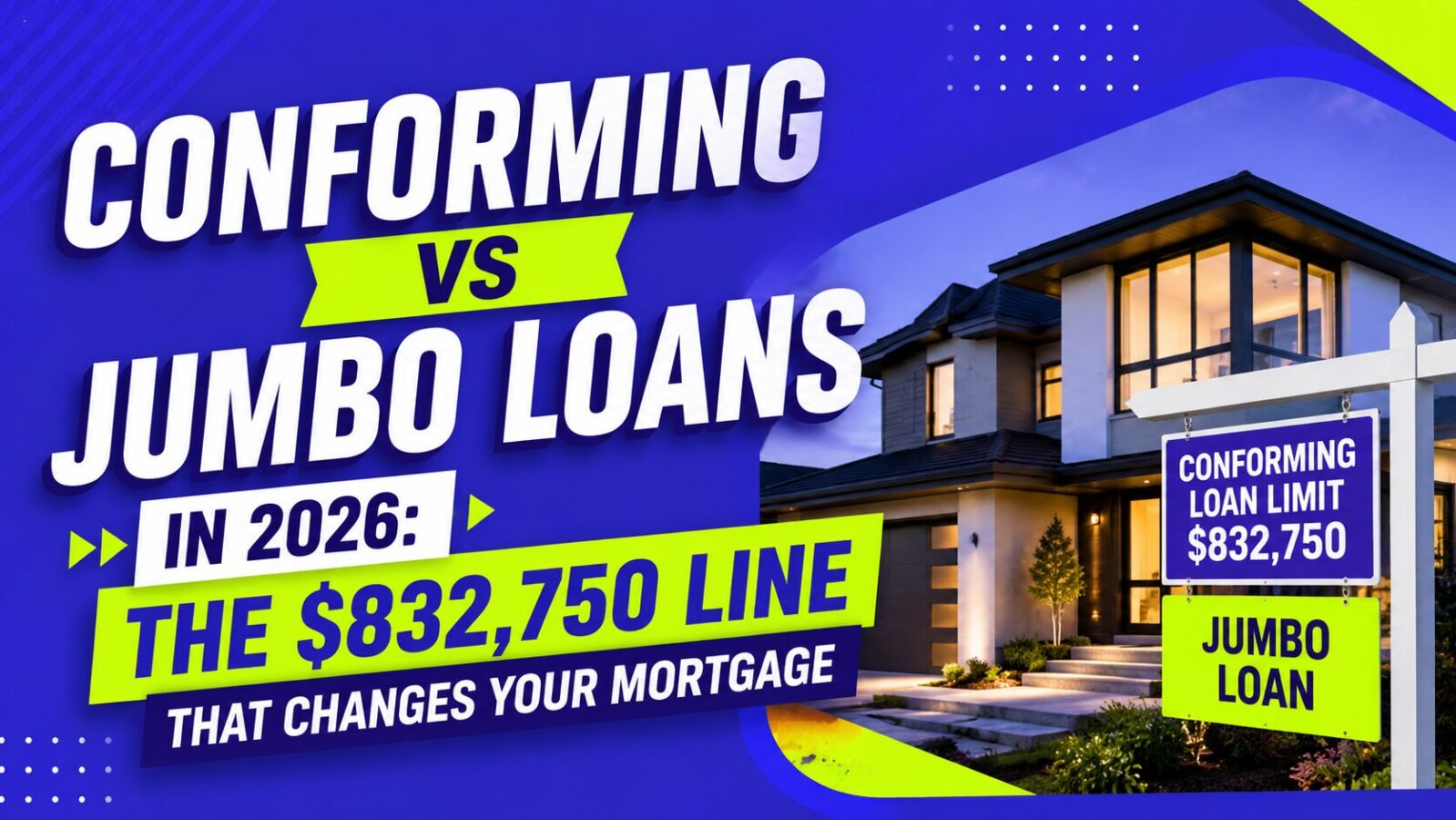
The conforming loan limit is the dollar threshold that separates conventional mortgages, backed by Fannie Mae and Freddie Mac, from jumbo loans, which lenders must hold or sell privately. In 2026, that line sits at $832,750 for a single-unit property in most U.S. markets (FHFA). Borrow up to that amount and you play by conforming rules: 3-5% down, PMI available, rates set by the secondary market. Borrow above it and everything changes: stricter credit, larger reserves, higher down payments, and rates that may be above or below conforming depending on the lender. Here is what the line means and when jumping over it makes sense.
KEY TAKEAWAYS
- The 2026 conforming loan limit is $832,750 for single-unit homes in most markets (FHFA). Loans above this are jumbo loans.
- High-cost area limits go up to $1,249,125 in counties where home prices are significantly above the national median (Alaska, Hawaii, and designated high-cost metros).
- Jumbo loans require stronger credit (typically 700-720+), more cash reserves (6-12 months of payments), and usually 10-20% down, no 3% down options.
- Jumbo rates are not always higher than conforming, in 2026 they have been competitive with or even slightly below conventional 30-year rates at some lenders, depending on loan size and credit profile.
- One strategy: put down enough to land at or just below the conforming limit to stay in conventional territory with more favorable underwriting.
Part of our Complete First-Time Buyer’s Guide for 2026.
What Is the Conforming Loan Limit and Why Does It Exist?
Fannie Mae and Freddie Mac are government-sponsored enterprises that buy mortgages from lenders and package them into mortgage-backed securities, which is how most mortgage lending gets funded. Congress sets limits on which loans they can buy, and the FHFA (Federal Housing Finance Agency) adjusts those limits annually based on home price changes.
When you get a conforming loan, the lender can sell it to Fannie or Freddie after closing, freeing up their capital to make more loans. That secondary market demand keeps conforming rates competitive and underwriting standardized. Jumbo loans above the limit cannot be sold to Fannie or Freddie, so lenders must hold them on their books or find other buyers, which means higher standards and potentially different pricing.
What Are the 2026 Conforming Loan Limits?
| Property type | Standard markets | High-cost areas |
|---|---|---|
| 1-unit (single-family) | $832,750 | $1,249,125 |
| 2-unit (duplex) | $1,066,275 | $1,599,450 |
| 3-unit (triplex) | $1,288,650 | $1,932,975 |
| 4-unit (fourplex) | $1,601,450 | $2,402,175 |
High-cost limits apply to specific counties where the median home price significantly exceeds the national baseline. The highest limits apply in areas like San Francisco, New York metro, Los Angeles, Honolulu, and parts of Colorado, Washington, and Virginia. Check your specific county limit at fhfa.gov.
How Are Conforming and Jumbo Loans Different?
| Feature | Conforming loan | Jumbo loan |
|---|---|---|
| Loan limit (2026) | Up to $832,750 (standard) | Above $832,750 |
| Min. credit score | 620 | 700-720 typically (higher at some lenders) |
| Min. down payment | 3% (HomeReady/Home Possible), 5% standard | 10-20% (most lenders require 20%) |
| Cash reserves required | 2-6 months PITIA | 6-18 months PITIA (often 12+ for large loans) |
| DTI limit | Up to 45-50% with compensating factors | Typically 43-45% maximum |
| PMI availability | Yes, standard with <20% down | Rarely, most require 20% down |
| Rate vs conforming (2026) | Baseline (~6.5% 30-yr) | Varies: competitive with or slightly above/below conforming |
| Backed by Fannie/Freddie | Yes | No, held by lender or sold privately |
Are Jumbo Rates Higher Than Conforming Rates?
Not necessarily, and this surprises many buyers. Historically, jumbo rates ran 0.25-0.5% above conforming because lenders held more risk. But in recent years, including 2025-2026, jumbo rates have often been competitive with or slightly below conforming rates for well-qualified borrowers.
Why? Wealthy borrowers who take jumbo loans tend to default less often, and private-label MBS buyers and portfolio lenders compete aggressively for high-quality jumbo loans. A borrower with 780 credit, 20% down, 12 months reserves, and a $1M loan may actually get a lower rate than a first-time buyer with 640 credit, 5% down, and a $400,000 conforming loan.
The practical implication: do not assume a home above $832,750 automatically means a worse rate. Get quotes from multiple jumbo lenders and compare against conforming options side by side.
What Are the Reserve Requirements for Jumbo Loans?
Cash reserves are funds that remain in your accounts after closing, not including the down payment or closing costs. Conforming loans typically require 2-6 months of PITIA (principal, interest, taxes, insurance, and association dues) in verified reserves. Jumbo lenders typically want 6-18 months, and for loans above $1.5M-2M, 12-24 months is common.
This is the requirement that most buyers underestimate. On a $1.2M home with a $960,000 loan at 6.25%, PITIA might run $7,000-8,000/month. Twelve months of reserves means $84,000-96,000 sitting in verified accounts after you close, in addition to your 20% down payment ($240,000) and closing costs. Total liquid assets needed: roughly $350,000-400,000 before making an offer.
Strategies for Borrowers Near the Conforming Limit
Put down more to land below the limit. If you are buying a $900,000 home and have the cash, putting down $70,000+ keeps your loan at $830,000, just under the $832,750 limit, and keeps you in conforming territory with more lender options and potentially better terms. Run the math against what a jumbo loan at your credit tier would cost.
Use a piggyback loan. A first mortgage at the conforming limit ($832,750) plus a smaller second mortgage or HELOC can fund a purchase above $832,750 while keeping the primary loan conforming. This requires qualifying for two loans simultaneously, but can work for buyers who want to preserve conforming rates on the majority of the financing.
Shop more lenders for jumbo. Conforming rates are relatively standardized because Fannie/Freddie set the pricing framework. Jumbo rates vary more by lender because each lender sets their own pricing. Getting 3-5 quotes on a jumbo loan often surfaces more spread than conforming shopping does, worth the extra effort.
When Does a Jumbo Loan Make Sense?
Jumbo loans are the only option when you need to borrow above the local conforming limit and cannot (or choose not to) make a down payment large enough to bring the loan below it. In high-cost markets, greater Los Angeles, New York, San Francisco, Boston, Seattle, a significant share of first-time purchases require jumbo financing simply because median home prices are above $1M.
For jumbo buyers, the preparation checklist is longer: get your credit to 720+ (ideally 740+), accumulate 20% down plus 12 months of reserves, document all income sources thoroughly (especially if self-employed), and start the lender search 60-90 days before you plan to make an offer.
Frequently Asked Questions
What is the conforming loan limit in 2026?
$832,750 for a single-unit property in most U.S. markets, per the FHFA. High-cost areas (specific counties where median home prices are well above average) have higher limits up to $1,249,125. Check your county’s exact limit at fhfa.gov.
What makes a loan “jumbo”?
Any loan amount above the conforming limit for your county. In most areas that means above $832,750 in 2026. Jumbo loans cannot be sold to Fannie Mae or Freddie Mac and must be held by the lender or sold through private channels, leading to stricter underwriting.
What credit score do I need for a jumbo loan?
Most jumbo lenders require 700-720 as a minimum, with better rates starting at 740-760. A 620 credit score that qualifies for a conforming loan typically will not qualify for a jumbo loan at competitive rates. See our full guide on credit scores for mortgages.
Do jumbo loans require 20% down?
Most jumbo lenders do require 20% down, though some offer 10-15% down with stronger compensating factors (high credit score, large reserves, low DTI). The 3-5% down options available for conforming loans do not typically exist for jumbo.
Are jumbo mortgage rates higher than regular mortgage rates?
Not always. In 2025-2026, jumbo rates have been competitive with conforming rates for well-qualified borrowers, and sometimes slightly lower. This varies by lender, loan size, and your credit profile. Always get quotes for both scenarios if you are near the conforming limit.
Does the conforming loan limit change every year?
Yes, the FHFA adjusts conforming limits annually based on the FHFA House Price Index. Limits have risen significantly over the past several years as home prices climbed. The 2026 limit of $832,750 is up from $766,550 in 2024.
Bottom Line
The 2026 conforming loan limit of $832,750 is the most important number in mortgage shopping for buyers in mid- to high-price markets. Stay below it and you get standardized, widely available financing with lower qualification bars. Cross it and you enter jumbo territory, higher reserves, stronger credit requirements, and typically 20% down, though sometimes at competitive or even lower rates for the best-qualified borrowers. Know the limit for your county, and if you are close, model both scenarios before choosing your loan amount.
Last updated: July 11, 2026. Conforming loan limits per FHFA 2026. High-cost area limits as published by FHFA for 2026. Rates approximate per Freddie Mac PMMS. Jumbo requirements vary significantly by lender. This article is for educational purposes only and does not constitute financial or mortgage advice.