By
By 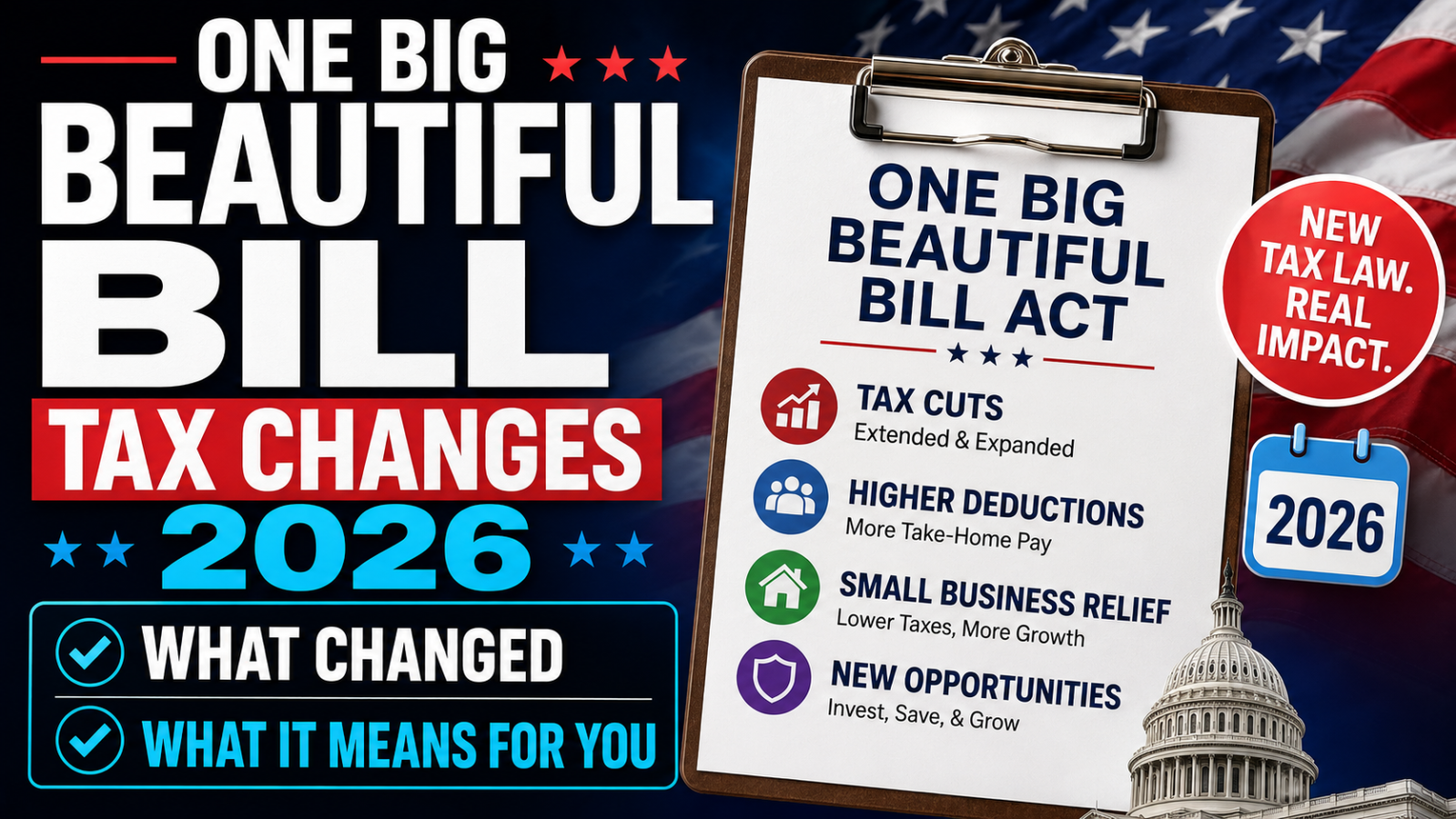
The One Big Beautiful Bill Act, signed July 4, 2025, made the most significant changes to the U.S. tax code since 2017. It permanently extended the Tax Cuts and Jobs Act provisions that were set to expire after 2025 and added several new temporary deductions for 2025 through 2028. The Tax Foundation estimates the changes reduced individual income taxes by approximately $129 billion in 2025, averaging a $611 tax cut per household. Here is every change that directly affects your personal tax situation in 2026.
1. Tax Brackets Are Now Permanent
The seven tax brackets created by the 2017 Tax Cuts and Jobs Act were originally scheduled to expire after December 31, 2025, which would have reverted rates to pre-2017 levels and raised taxes on most households. The OBBBA made these brackets permanent.
The 2026 tax brackets for single filers after the OBBBA and inflation adjustment:
| Rate | Taxable Income (Single) | Taxable Income (Married Filing Jointly) |
|---|---|---|
| 10% | Up to $11,925 | Up to $23,850 |
| 12% | $11,926 – $48,475 | $23,851 – $96,950 |
| 22% | $48,476 – $103,350 | $96,951 – $206,700 |
| 24% | $103,351 – $197,300 | $206,701 – $394,600 |
| 32% | $197,301 – $250,525 | $394,601 – $501,050 |
| 35% | $250,526 – $640,600 | $501,051 – $768,700 |
| 37% | Over $640,600 | Over $768,700 |
Without the OBBBA, the top bracket would have dropped back to seven rates ranging up to 39.6% starting with the 2026 tax year. The permanence of these rates eliminates a major source of tax uncertainty for households and businesses that had been planning around the potential reversion.
2. Standard Deduction Increased
The standard deduction for tax year 2026 increased from 2025 levels due to the OBBBA’s permanent extension of the higher TCJA base combined with the IRS’s annual inflation adjustment:
- Single / Married Filing Separately: $16,100 (up from $15,750 in 2025)
- Married Filing Jointly: $32,200
- Head of Household: $24,150 (up from $23,625 in 2025)
For most Americans who do not itemize deductions, this is the most directly impactful change. The higher standard deduction means more income is shielded from tax before the brackets even apply. A single filer earning $55,000 in 2026 pays tax on $55,000 minus $16,100, or $38,900 in taxable income.
3. No Tax on Tips: Deduction Up to $25,000 (2025–2028)
The OBBBA introduced a new above-the-line deduction for workers in tipped occupations. This is one of the most discussed provisions and also one of the most misunderstood.
What it is: A deduction of up to $25,000 per return for “qualified tip income,” available for tax years 2025 through 2028. The deduction applies whether you itemize or take the standard deduction.
Who qualifies: Workers in occupations that customarily and regularly received tips as of December 31, 2024. The IRS issued final regulations in April 2026 listing qualifying occupations, which include food and beverage service workers, hotel housekeeping, hair stylists, valets, taxi and rideshare drivers, and other service industry workers. The tip must be voluntary and not subject to negotiation. Mandatory service charges do not qualify.
Income phase-out: The deduction begins to phase out at a Modified Adjusted Gross Income (MAGI) of $150,000 for single filers and $300,000 for married filing jointly, with a $100 reduction per $1,000 over the threshold.
Important limitation: This deduction reduces federal income taxes only. Social Security and Medicare taxes (FICA) still apply to tip income. The deduction is retroactive to January 1, 2025.
Starting with the 2026 tax year, employers are required to separately report qualified tips on Form W-2. Workers who earned tips in 2025 will need to self-report the qualifying amount on their 2025 return using Form 4137 or the information provided by their employer.
4. No Tax on Overtime: Deduction Up to $12,500 (2025–2028)
Alongside the tips deduction, the OBBBA created a deduction for overtime compensation paid under the Fair Labor Standards Act.
What qualifies: Only the premium portion of overtime pay, meaning the additional half in “time-and-a-half.” If your regular hourly rate is $20 and you earn $30 per hour for overtime, only the extra $10 per hour qualifies. State-law overtime, daily overtime rules, and contractual overtime above the FLSA minimum do not qualify.
Deduction cap: $12,500 per person per year, or $25,000 for married filing jointly. The same income phase-out applies as the tips deduction: begins at MAGI $150,000 (single) or $300,000 (joint).
Practical action now: If you regularly earn FLSA overtime, you can update your Form W-4 by entering your estimated qualifying overtime on Line 4b to reduce withholding immediately throughout 2026, so you receive the tax benefit in each paycheck rather than as a refund at filing. Employers must report qualifying overtime in a new Box 12 on the W-2 starting with 2026 tax year reporting.
Hourly to Salary Calculator
5. Child Tax Credit Increased to $2,200
The Child Tax Credit increased from $2,000 to $2,200 per qualifying child under 17 for tax year 2026. The OBBBA also made the credit automatically inflation-indexed going forward, so it will continue to increase in future years without requiring new legislation.
The income thresholds at which the credit begins to phase out are also higher than they were under the pre-OBBBA framework, meaning more middle-income families now receive the full credit amount before it starts to phase out.
6. Additional $6,000 Senior Deduction (2025–2028)
Taxpayers aged 65 and older can claim an additional $6,000 deduction on top of the standard deduction for tax years 2025 through 2028. This is separate from the existing extra standard deduction amount for seniors already built into the standard deduction tables.
The deduction phases out starting at MAGI of $75,000 for single filers and $150,000 for married filing jointly. It requires a Social Security number valid for work and is not available to taxpayers using the Married Filing Separately status.
For a single 65-year-old with $70,000 in income, the combination of the standard deduction ($16,100) plus the senior deduction ($6,000) shelters $22,100 from federal income tax before any other deductions apply.
7. SALT Deduction Cap Raised to $40,000
The cap on the State and Local Tax (SALT) itemized deduction, which limits the amount of state income taxes and property taxes deductible on a federal return, increased from $10,000 to $40,000 for 2025, indexed annually through 2029.
This is a significant change for taxpayers in high-tax states. A homeowner in California or New York paying $25,000 in state income taxes and $10,000 in property taxes was previously limited to deducting $10,000 total. Under the OBBBA, they can now deduct up to $35,000 of those combined taxes (still below the $40,000 cap in this example), meaningfully reducing federal taxable income.
High-income taxpayers face a phase-out of the expanded SALT cap, which gradually reverts back toward the previous $10,000 limit for the highest earners. If you are in the 37% bracket, review your specific situation with a tax professional to understand exactly how much SALT benefit you retain.
For taxpayers who previously did not itemize because their total deductions were close to the standard deduction amount, the expanded SALT cap may now make itemizing worthwhile, especially when combined with mortgage interest and charitable contributions.
8. New Deduction for Auto Loan Interest
The OBBBA introduced a new deduction of up to $10,000 for interest paid on loans used to purchase new vehicles assembled in the United States. The deduction is available for tax years 2025 through 2028, applies above the line (whether you itemize or not), and is subject to income limits that phase it out at higher income levels.
The vehicle must be new (not used) and assembled in the U.S. to qualify. Verify the vehicle’s assembly location using its VIN through the National Highway Traffic Safety Administration’s database before claiming the deduction.
9. 1099-NEC Threshold Raised to $2,000
For gig workers, freelancers, and self-employed individuals, the reporting threshold for Form 1099-NEC increased from $600 to $2,000 starting in 2026. This means platforms and clients are not required to issue a 1099-NEC unless they paid you $2,000 or more during the year.
This reduces administrative friction and the volume of forms issued. However, income remains fully taxable regardless of whether a 1099 is issued. If you earn $1,500 from a client, you still owe self-employment tax and income tax on it; you just may not receive a form documenting it. The obligation to track and report is on the worker, not the payer, at amounts below the threshold.
10. Trump Accounts Launched (Section 530A)
The OBBBA created a new type of tax-advantaged account for children, officially called Trump Accounts (also known as 530A or MAGA accounts). These accounts allow up to $5,000 per year in contributions, with a $1,000 federal seed deposit for children born between 2025 and 2028. Accounts open for contributions on July 4, 2026.
For a full explanation of how Trump Accounts work, see our dedicated guide.
What Did NOT Get a Tax Cut
Not every OBBBA provision was a tax reduction. Several changes either maintained existing limitations or introduced new ones.
Mortgage interest: Interest on home equity loans remains non-deductible under the OBBBA, continuing the TCJA rule. Only interest on loans used to buy, build, or substantially improve your primary or second home qualifies.
Charitable deductions for top earners: The OBBBA introduced a new 0.5% of income floor on the charitable deduction, and taxpayers in the 37% bracket now face a limit on the total tax benefit they can receive from itemized deductions. These provisions reduce the after-tax value of charitable giving for the highest-income households.
SALT for high earners: The expanded $40,000 SALT cap phases out for high earners, reverting toward the previous $10,000 cap. Households in the top bracket in high-tax states should not assume the full $40,000 benefit applies without checking the phase-out calculation.
Energy vehicle credits: The OBBBA terminated the alternative fuel vehicle refueling property credit for property placed in service after June 30, 2026. Several clean energy credits from the Inflation Reduction Act were reduced or eliminated.
What This Means for Your 2026 Budget
The most immediate practical steps for most households in 2026:
If you earn tips: Track your qualifying tip income carefully throughout 2026. Your employer should report it in a new W-2 box starting this year. Confirm with your payroll department that your tips are being tracked for the deduction. Consider adjusting withholding on your W-4 to reflect the expected deduction rather than waiting for a refund.
If you earn FLSA overtime regularly: Update your W-4 Line 4b with an estimate of your qualifying overtime premium for the year. This reduces withholding now rather than overpaying through the year and waiting for a refund.
If you itemize and live in a high-tax state: Recalculate whether the expanded $40,000 SALT cap, combined with your mortgage interest and charitable deductions, now makes itemizing more valuable than the $16,100 standard deduction. For many middle-income homeowners in California, New York, New Jersey, or Illinois, itemizing is now worthwhile for the first time since 2017.
If you are 65 or older: Claim the additional $6,000 senior deduction on your 2025 and 2026 returns. It is above the line, requires no additional documentation beyond confirming your age and Social Security number, and reduces your taxable income directly.
If you have children: The increased Child Tax Credit of $2,200 per qualifying child applies automatically. No action needed beyond claiming the credit on your return as usual.
One Big Beautiful Bill Act (P.L. 119-21, signed July 4, 2025). IRS tax inflation adjustments for tax year 2026 including OBBBA amendments (IRS Rev. Proc. 2025-32). IRS final regulations T.D. 10044 on qualifying tip occupations (April 2026). Tax Foundation estimates on average household tax impact. TurboTax OBBBA tax changes guide (updated March 2026). H&R Block OBBBA tax changes summary. All figures for tax year 2026 unless otherwise noted. This article is for informational purposes only and does not constitute tax advice. Tax situations vary; consult a qualified tax professional for personalized guidance.