Who Is SoFi Invest For?
Best for: Beginners opening their first investment account who want a clean app, zero fees, and the option to combine investing with SoFi banking in one place
Skip if: You need mutual funds, individual bonds, tax-loss harvesting in a taxable account, or advanced research tools for active trading
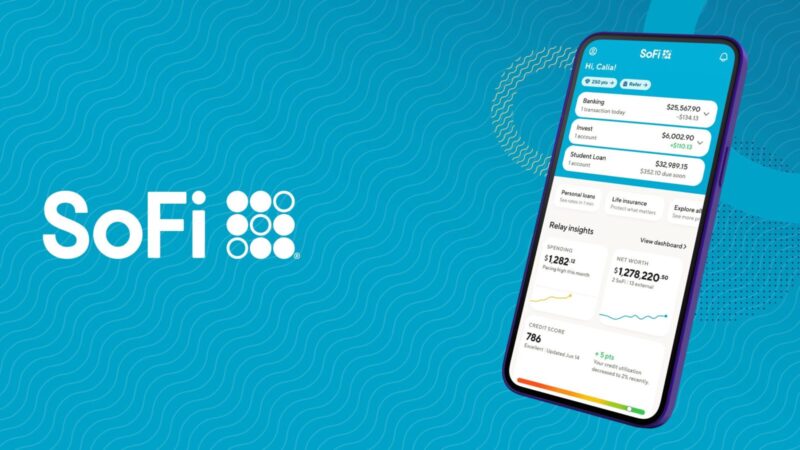
SoFi Invest is three products in one app: self-directed trading, a free robo-advisor, and crypto. All with zero commissions and a free certified financial planner for SoFi members. For beginners putting their first $1,000 to $50,000 to work, it is the cleanest platform available. SoFi started as a student loan refinancing company in 2011 and has grown into a full financial ecosystem. SoFi Invest is the brokerage arm, launched in 2018, and has become one of the most popular platforms for first-time investors.
Key Takeaways
- The free robo-advisor is the standout feature. SoFi’s automated investing charges $0 management fee. Betterment and Wealthfront both charge 0.25%/year. On a $30,000 portfolio, that is $75/year SoFi saves you. The trade-off: no tax-loss harvesting. For IRAs, where TLH generates no benefit, the $0 fee is a clear win over paying 0.25% elsewhere.
- 1% IRA match, no subscription required. SoFi adds 1% on top of your IRA contributions, automatically, at no cost. On a $7,500 contribution (2026 limit under 50), SoFi adds $75 in free match. Robinhood Gold offers 3% but requires a $5/month subscription. At contributions above $4,000/year, Robinhood Gold’s net match edges ahead.
- Free CFP access is underrated. SoFi members can schedule 1-on-1 sessions with a Certified Financial Planner at no cost. For a beginner deciding between Roth and Traditional IRA, or figuring out how to invest a windfall, one CFP session is worth hundreds of dollars of guidance available nowhere else at $0.
- No mutual funds or bonds. SoFi supports U.S. stocks, ETFs, options, and crypto. Not mutual funds, individual bonds, or international stocks. VTI is functionally identical to VTSAX as an ETF, so most index investors are unaffected. But if you want VTSAX specifically, a target-date fund, or individual bonds, use Fidelity or Vanguard.
- Banking integration is a real advantage. SoFi banking, investing, and lending all live under one login. Paycheck arrives in SoFi checking, sweeps to 4.50% APY savings, auto-invests into your IRA — zero manual steps, zero transfer delays between SoFi accounts.
What SoFi Invest Offers
SoFi Invest is three products under one login:
Active Investing: A self-directed brokerage where you buy stocks, ETFs, and crypto at $0 commission. Fractional shares from $5. This is what most beginners use for index fund investing.
Automated Investing (Robo-Advisor): You answer a risk questionnaire, SoFi builds and manages a diversified ETF portfolio automatically, rebalancing as needed. $0 management fee: the only major robo-advisor with a zero fee.
Crypto Trading: Buy and sell 30+ cryptocurrencies within the same app, no separate account needed, available 24/7. SoFi earns via a 1.25% spread built into the price rather than a visible commission. For casual crypto purchases this is fine; for high-volume trading, a dedicated exchange (Kraken, Coinbase Advanced) offers lower spreads.
SoFi Invest Fees
Free Robo-Advisor vs Betterment and Wealthfront: The Fee Math
The decision rule is straightforward: for IRA accounts, SoFi’s $0 fee wins clearly because tax-loss harvesting is irrelevant inside a tax-advantaged account. For large taxable accounts (especially $100,000+), Betterment and Wealthfront’s TLH can generate 0.5 to 1.5% in after-tax return improvements annually, which more than offsets their 0.25% fee. For taxable accounts under $50,000, the TLH benefit is smaller and SoFi’s zero fee competes more closely.
Account Types Available
What You Can and Cannot Trade at SoFi
The SoFi Ecosystem Advantage
SoFi is more than a brokerage. For people who use SoFi across products, the integration creates genuine convenience that no competitor replicates at zero cost across all products. SoFi Checking and Savings offers 4.50% APY on savings with direct deposit. Internal transfers between SoFi bank and SoFi Invest are instant, without the 1 to 3 business day ACH wait for external transfers. The 1% IRA match applies automatically. And free CFP access means professional financial planning guidance is available to every SoFi member at no charge. For a complete beginner who wants their checking, savings, IRA, and investments all in one place at $0, SoFi is the best integrated option available.
Frequently Asked Questions
Does SoFi Invest have an IRA match?
Yes. SoFi offers a 1% match on IRA contributions, deposited into your SoFi IRA on top of your contribution and not counting toward the annual contribution limit. On the 2026 maximum of $7,500 (under 50), SoFi adds $75 in free match. No subscription required. Robinhood Gold offers a 3% IRA match ($225 on $7,500) but requires a $5/month ($60/year) subscription. At annual contributions above $4,000, Robinhood Gold’s net match exceeds SoFi’s. Below $4,000/year in IRA contributions, SoFi’s free 1% is comparable or better.
Is SoFi’s free robo-advisor as good as Betterment?
For IRA accounts, SoFi’s $0 robo is better than Betterment (0.25%/year) because tax-loss harvesting (Betterment’s main advantage) generates no benefit inside a tax-advantaged account. You get the same automated ETF portfolio for free. For taxable accounts, Betterment wins despite the fee: TLH can generate 0.5 to 1.5% in annual after-tax return improvements, which exceeds the 0.25% advisory cost for most investors in higher tax brackets. Wealthfront adds direct indexing for taxable accounts over $100,000, which creates even more TLH value. SoFi’s robo wins on cost for IRA investors; Betterment and Wealthfront win on after-tax value for large taxable accounts.
Can I transfer an existing IRA or 401(k) to SoFi Invest?
Yes. SoFi accepts incoming ACATS transfers from other brokerages for both taxable and IRA accounts, typically completed in 5 to 10 business days. SoFi charges no transfer-in fee. Outgoing transfers cost $75. For 401(k) rollovers, SoFi accepts direct rollovers into a Rollover IRA account and applies the 1% IRA match to eligible rollover amounts. Important: assets not available at SoFi (mutual funds, bonds) must be sold before transferring, which may create taxable events in non-IRA accounts. Confirm your holdings are compatible before initiating.
Is SoFi Invest safe and SIPC insured?
Yes. SoFi Securities LLC is a FINRA-registered broker-dealer and SIPC member. Securities are protected up to $500,000 per account ($250,000 for cash) in the event of SoFi’s insolvency. Your investments are held in your name at a custodian, separate from SoFi’s own assets. The SoFi bank (savings and checking) is FDIC insured up to $250,000 per depositor. Crypto assets are not covered by SIPC or FDIC, which is true at every platform, not just SoFi.
How does SoFi Invest compare to Fidelity for a first brokerage?
Both are strong at $0 fees. SoFi wins on simpler onboarding, a cleaner beginner interface, free robo-advisor at $0 (Fidelity Go charges 0.35% above $25K), and banking integration. Fidelity wins on ZERO funds (0.00% expense ratio vs 0.03% for VTI), mutual fund access, superior research tools (20+ providers), 24/7 customer service, and physical branches. For a pure beginner buying 2 to 3 ETFs: SoFi is more approachable. For a long-term investor who wants institutional breadth and room to grow: Fidelity is the better permanent home. Many investors start at SoFi and open Fidelity accounts as needs expand.
Bottom Line: Is SoFi Invest Worth It in 2026?
Our Verdict
SoFi Invest: 4.5 / 5 | Best Brokerage for Beginners Who Want Everything in One Place
SoFi Invest is the best brokerage for someone opening their first investment account. Zero commissions, zero minimum, fractional shares from $5, the only major free robo-advisor, a 1% IRA match, and the cleanest beginner app in the category. It has real limits for advanced needs: no mutual funds or bonds, basic research tools, and no tax-loss harvesting. But most people buying 2 to 3 index ETFs consistently over decades will not hit those limits. For your first $1,000 to $50,000, SoFi does everything right.
Features, rates, and fee information are accurate as of June 2026 and subject to change. SoFi Invest brokerage accounts are SIPC insured; crypto assets are not SIPC or FDIC insured. Investment values fluctuate. This is not financial advice. Thanks for reading Finance Pulse.