By
By 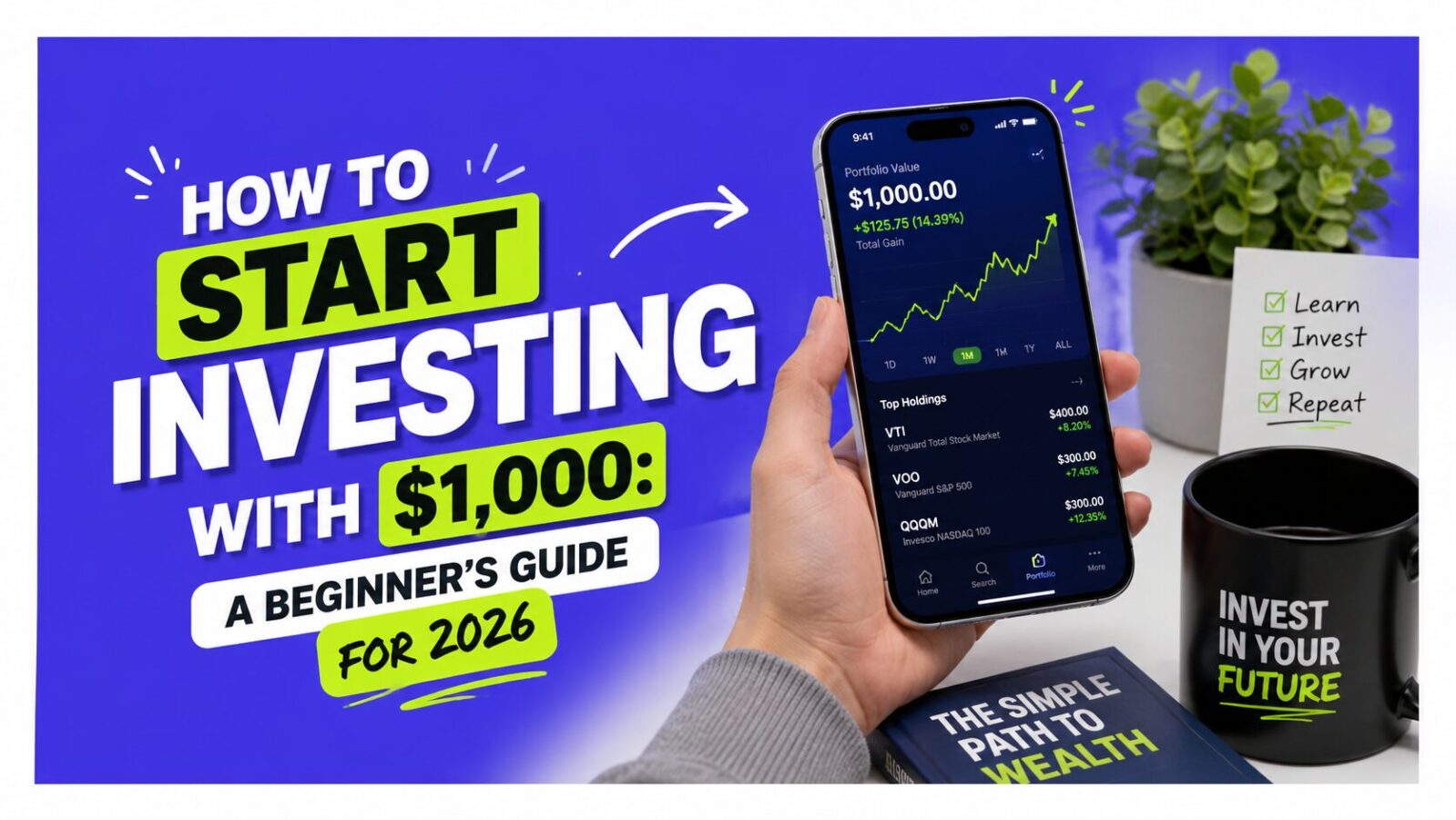
You do not need tens of thousands to start investing. Here is a step-by-step plan to turn your first $1,000 into the foundation of lifelong wealth — without jargon or gimmicks.
You have saved your first $1,000 and you are ready to put it to work. Good. The hardest part of investing is not picking stocks or timing the market. It is starting. According to the 2025 FINRA Foundation survey, 62% of Americans under 35 say “not knowing where to begin” is their biggest barrier to investing.
This guide cuts through the noise. By the end, you will know exactly what to do with your first $1,000 — in what order, and why.
- Before investing a single dollar: build a 3-month emergency fund in a HYSA (4 to 5% APY), and pay off any debt above 7% interest. Investing while carrying 22% APR credit card debt is a losing trade mathematically.
- The right account order: 401(k) match first (free 100% return) → Roth IRA next (tax-free growth for decades) → taxable brokerage last. Most beginners skip this and leave free money behind.
- Do not buy individual stocks with your first $1,000. Three index ETFs — VTI, VXUS, BND — give you exposure to thousands of companies at 0.03 to 0.07% expense ratio.
- Starting with $1,000 today plus $200/month at 7% annual return grows to over $240,000 in 30 years. The earlier you start, the more compounding does the heavy lifting.
- Set up automatic monthly contributions and check your account quarterly. Dollar-cost averaging and ignoring short-term noise beats 90% of people who try to time the market.
Why $1,000 is enough to start
A generation ago, you needed $5,000 to open a brokerage account and paid commissions on every trade. That world is gone. Today: zero minimums at SoFi, Robinhood, Fidelity, and Schwab; zero commissions on most stock and ETF trades; and fractional shares let you buy $10 of Amazon instead of a full share.
More importantly, starting with $1,000 now is vastly better than waiting until you have “more” — because of compounding. See it for yourself:
Compound Interest Calculator
Try setting monthly contribution to $0 and see what happens — the curve is modest without contributions. Then add $100 or $200/month and watch the difference over 30 years. That gap is why automating contributions matters more than the starting amount.
Where should my $1,000 go first?
The answer depends on your situation. Work through this decision tool to find out exactly what to do with your money:
Where Should My $1,000 Go?
Answer 4 quick questions for a personalized action plan.
Question 1 of 4
Do you have at least 3 months of expenses saved in a savings account?
Step 1: Build your emergency fund first
Before any investing, keep 3 months of expenses in a high-yield savings account. If you do not have this, investing that $1,000 could backfire. If your car breaks down and you have no cushion, you will be forced to sell investments at the worst possible moment — probably during a market dip.
High-yield savings right now pays 4 to 5% APY. That is real money for almost zero risk. Skip this step and you are building on sand.
Step 2: Pay off any debt above 7% interest
Paying off a credit card at 22% APR is a guaranteed 22% return. No stock can promise that. Investing while carrying high-interest debt is mathematically a losing trade.
| Debt type | Typical rate | What to do |
|---|---|---|
| Credit cards / BNPL | 20 to 28% | Pay off immediately before investing |
| Car loan | 6 to 10% | Judgment call — lean toward paying down |
| Student loans | 4 to 7% | Pay minimums, invest the rest |
| Mortgage | 6 to 7% | Pay minimums, invest the rest |
Step 3: Open the right type of account
This is where most beginners make an expensive mistake. For US readers under 50, the priority order is:
- 401(k) employer match. If your job offers a 3% match on a 3% contribution, contribute at least that much. It is free money — a 100% instant return. Nothing you do next will beat this.
- Roth IRA. After the match, contribute here first ($7,000/year limit in 2026). Roth money grows completely tax-free for decades. If you are in your 20s or 30s, this is almost certainly the single best account available to you.
- Taxable brokerage account. Use for money beyond the Roth limit, or money you want to keep accessible.
Step 4: Pick your first broker
For beginners investing their first $1,000, look for: $0 minimum, $0 commissions, fractional share support, and a clean mobile app.
Best for beginner investors who want a simple, commission-free brokerage with no account minimum.
Read our brokerage reviews to compare Fidelity, Schwab, and others head-to-head.
Step 5: Do not buy individual stocks yet
With $1,000 and no training, picking winning stocks is a negative-expected-value activity. Studies consistently show 80 to 90% of individual stock pickers underperform the market over 10+ years. Even professional fund managers mostly underperform.
Instead, start with index ETFs. A sensible 3-fund beginner portfolio:
| ETF | What it holds | Allocation | Expense ratio |
|---|---|---|---|
| VTI | Total US Stock Market (~3,700 companies) | 60% | 0.03% |
| VXUS | International Stocks (~8,500 companies) | 30% | 0.07% |
| BND | US Bonds (stability buffer) | 10% | 0.03% |
You will pay about $0.50 per year on $1,000 in fees. That is it. Adjust the stock/bond split based on age — a common rule: 110 minus your age equals your stock percentage.
Step 6: Automate monthly contributions
The single behavior that separates wealthy retirees from everyone else: they invest automatically, every payday, regardless of market conditions. Set up auto-invest for $100, $200 — whatever you can sustain — into the same 3 ETFs every month.
This is dollar-cost averaging. You buy more shares when the market is cheap, fewer when it is expensive. Over 30 years, it outperforms 90% of people who try to time the market. Use the calculator at the top of this page to see the difference between a one-time $1,000 investment vs adding $200/month consistently.
Common beginner mistakes to avoid
- Chasing meme stocks. GameStop, penny stocks, crypto moonshots. You are not going to beat millions of faster, better-funded traders with more information.
- Panic-selling during dips. The 2020 COVID crash lost 34% in a month. Anyone who sold missed the recovery. Anyone who bought got 100%+ gain in 12 months.
- Switching strategies every 3 months. Pick a boring plan and stick with it for years. Consistency beats cleverness.
- Checking the account daily. Check quarterly. Market noise hurts returns by triggering emotional decisions.
- Forgetting to rebalance annually. Once a year, adjust back to your target allocation.
Frequently Asked Questions
How much of my $1,000 should actually go into investments?
After emergency fund and high-interest debt are handled, 100% of that $1,000 can go into a diversified ETF portfolio — assuming you are in your 20s or 30s with 30+ years until retirement. Do not keep cash back “just in case” inside the brokerage; cash in a brokerage earns almost nothing and defeats the purpose. Your emergency fund is your just-in-case money. The investment account is for investing.
Is investing riskier than keeping money in savings?
Over 1 to 2 years: yes, stocks can drop 30 to 40% in the short term. Over 20+ years: historically, keeping money in low-yield savings is the riskier choice because inflation (averaging 3%/year) quietly erodes its purchasing power. $1,000 in a savings account at 2% loses real value vs inflation. $1,000 invested in a total market ETF at a historical 7% real return grows substantially. The risk framework flips depending on your time horizon — short-term needs stay in savings, long-term wealth goes into investments.
Roth IRA or Traditional IRA — which should I open?
For most readers in their 20s and 30s in the 12 to 22% tax bracket: Roth IRA. Pay tax now on contributions, and every dollar of growth comes out completely tax-free in retirement. If you are currently in a 32%+ tax bracket and expect your retirement income to be significantly lower, a Traditional IRA (deduct now, pay tax later) can win — but this is less common for younger earners. When in doubt, Roth. The tax-free compounding over 30 to 40 years is exceptionally powerful, and you can always withdraw your Roth contributions (not earnings) penalty-free in an emergency.
Can I withdraw money from a Roth IRA if I need it?
Yes — this is one of the most underappreciated features of the Roth IRA. You can withdraw your original contributions (the money you put in, not the earnings) at any time, for any reason, with no taxes and no penalties. This makes the Roth IRA serve double duty as a long-term investment account and a secondary emergency backup for genuine crises. The earnings (growth) are different — withdrawing those before age 59.5 typically triggers taxes and a 10% penalty. But your contributions are always accessible. This flexibility is one reason Roth is recommended as the first investment account for beginners.
What return should I realistically expect?
7% per year real (after inflation) is a reasonable long-term assumption for a stock-heavy portfolio like the VTI/VXUS/BND mix. This is slightly below the S&P 500’s long-term historical average of about 10% nominal (7% after inflation). Bond-heavy portfolios sit around 3 to 4% real. Some years your portfolio will be up 25%, others down 15%. The annual average is what matters for long-term planning, not the year-to-year noise. The calculator at the top of this article uses 7% as the default — adjust it down to 5% or 6% if you want a more conservative projection.
What is the difference between a Roth IRA and a regular brokerage account?
The key difference is tax treatment. A Roth IRA is a tax-advantaged retirement account — you contribute after-tax money, and all growth and withdrawals in retirement are completely tax-free. A regular (taxable) brokerage account has no special tax treatment — you pay capital gains tax when you sell investments at a profit, and dividends are taxed in the year they are received. For a beginner, always prioritize the Roth IRA up to the $7,000 annual limit before opening a taxable brokerage account. The tax-free growth over decades is worth more than the flexibility of a taxable account in almost every scenario.
Should I invest in individual stocks or ETFs with my first $1,000?
ETFs — no question. Individual stock picking with $1,000 means zero diversification (you might own 3 to 5 companies) and exposes you to company-specific risk that can permanently wipe out capital. Studies consistently show that 80 to 90% of individual stock pickers underperform the market over 10+ years, and even professional fund managers mostly fail to beat index funds over time. VTI alone gives you exposure to over 3,700 US companies for 0.03% per year in fees. Once you have $10,000 to $20,000 invested and a solid understanding of financial statements, you can consider adding individual stock positions as a small percentage of a diversified portfolio.
What if the market crashes right after I invest my $1,000?
This is the question that stops most beginners from starting. Here is the honest answer: it might. Markets crash periodically. The S&P 500 has dropped 20%+ multiple times in the past 30 years. But every single one of those crashes was eventually recovered — and surpassed. The 2020 COVID crash dropped 34% in one month, then gained 100%+ in the following 12 months. Anyone who held through it doubled their money. The only investors who locked in permanent losses were the ones who panic-sold at the bottom. With a 20 to 30-year time horizon, a crash in year 1 is actually an opportunity — your monthly auto-contributions buy more shares at lower prices. Time in the market consistently beats timing the market.
The bottom line
Starting with $1,000 is not a small thing. It is the start of everything. Use the decision tool above to find out exactly where your money should go first. Then: open the right account, buy 3 index ETFs, automate monthly contributions, and do not check the account more than once a quarter.
Do that for 30 years and the math all but guarantees you will be in the top 5% of Americans by retirement wealth. Simple, boring, effective.
Open your first brokerage account
Next steps:
- Want to understand index funds better? Read our best index funds guide — which specific funds to pick and why.
- Not sure whether to open a Roth IRA or Traditional? Read our Roth vs Traditional IRA comparison for a complete breakdown.
- Still carrying credit card debt? Read our debt payoff guide — clear the debt first, then start this plan.