 By
By 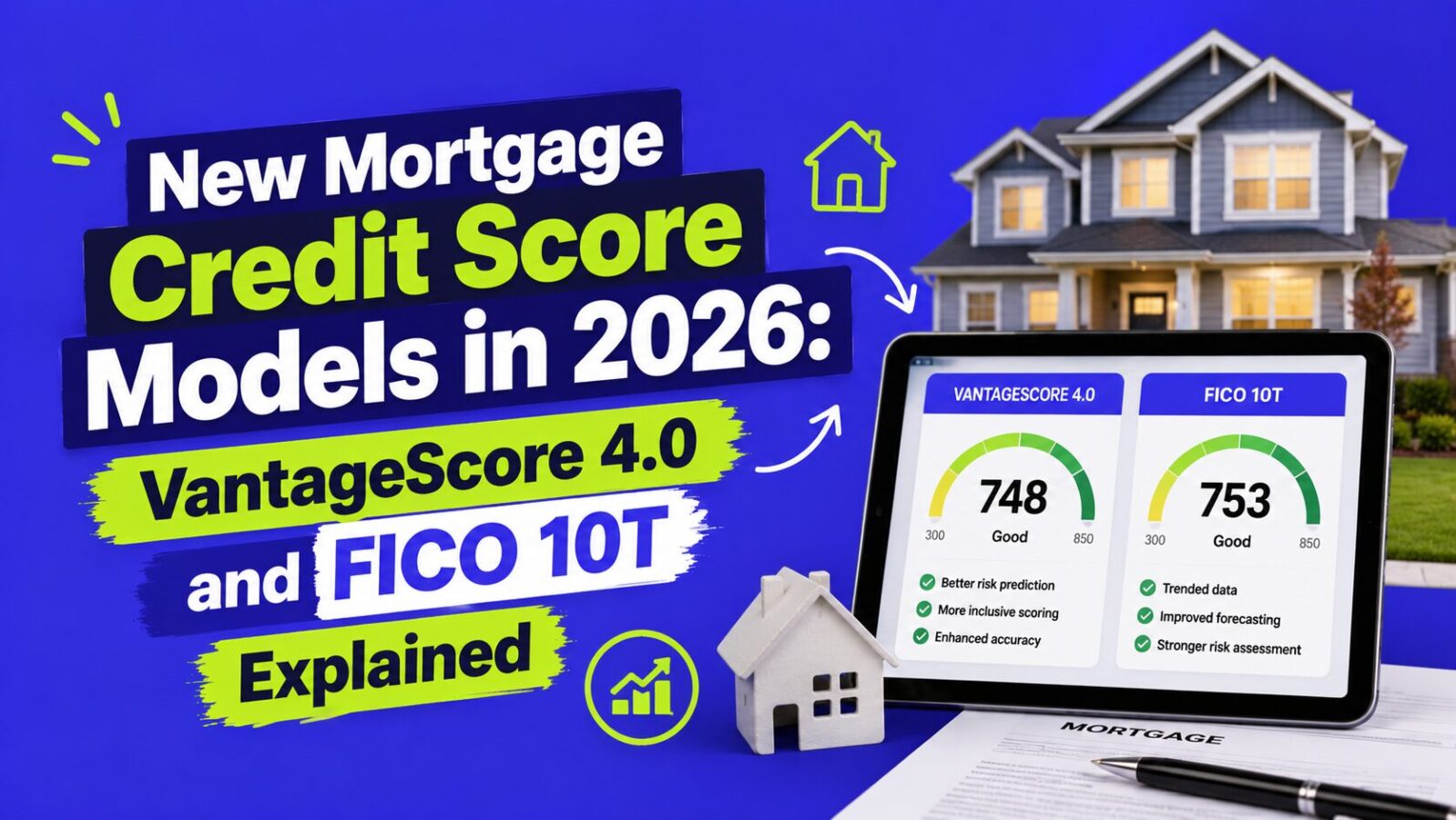
Mortgage credit scoring is changing in 2026, but Classic FICO has not disappeared.
As of August 18, 2026, a limited group of approved Fannie Mae and Freddie Mac lenders can use VantageScore 4.0 instead of Classic FICO on eligible loans. FICO Score 10T is also an approved mortgage model, but Fannie Mae and Freddie Mac are not yet accepting FICO 10T-scored loans for delivery.
FHA has separately announced plans to allow VantageScore 4.0 and FICO 10T, but HUD has not yet completed implementation. Its current guidance tells FHA lenders to continue following existing credit-report policy until new instructions and effective dates are issued.
FinancePulse view: This is a meaningful change, especially because newer models can use trended credit data and reported rent information. But do not assume a newer score will automatically be higher or that your lender already uses it. For a 2026 homebuyer, the first question is still: Which credit score model will this lender actually use for my loan?
What changed with mortgage credit scores in 2026?
The new models were not first approved in 2026.
FHFA approved VantageScore 4.0 and FICO Score 10T in October 2022 for eventual use by Fannie Mae and Freddie Mac. The difficult part since then has been implementation across lenders, credit bureaus, underwriting systems, and the mortgage market.
The major operational change came on April 22, 2026.
FHFA moved Fannie Mae and Freddie Mac into an interim phase in which approved lenders can choose between:
- Classic FICO
- VantageScore 4.0
for loans delivered to the Enterprises.
Fannie Mae describes the current VantageScore 4.0 program as a limited lender rollout. Lenders that are not participating must continue using Classic FICO until they receive approval or broader availability begins.
Where the three models stand now
| Credit score model | Fannie Mae/Freddie Mac status in August 2026 |
|---|---|
| Classic FICO | Still accepted and widely used |
| VantageScore 4.0 | Available now to approved lenders in limited rollout |
| FICO Score 10T | Approved, but not yet available for GSE loan delivery |
Freddie Mac explicitly says mortgages delivered with FICO 10T are currently not eligible, although it plans to accept them later.
So saying that all three models are already interchangeable for conventional mortgages would be inaccurate.
What about FHA loans?
FHA is on a separate implementation track.
HUD announced on April 22, 2026 that FHA intends to permit VantageScore 4.0 and FICO 10T alongside Classic FICO for FHA-insured mortgage underwriting.
But HUD followed that announcement with more detailed guidance on May 21.
FHA said:
- Implementation dates would be announced later
- Additional guidance would follow
- FHA would continue requiring existing credit-report procedures in the meantime
- Mortgagees should continue following current Handbook 4000.1 policy until implementation occurs
So if you apply for an FHA mortgage today, do not assume you can ask the lender to simply substitute VantageScore 4.0 or FICO 10T for the score it currently uses.
Why are VantageScore 4.0 and FICO 10T different?
One of the biggest changes is the use of trended credit data.
Older mortgage scoring models primarily evaluate information contained in your credit report at a particular point in time.
Newer models can also analyze how parts of your credit history have changed over a longer period.
Fannie Mae notes that trended data is a key component of both VantageScore 4.0 and FICO 10T.
For example, imagine two borrowers who both report $3,000 of revolving debt today.
One borrower has reduced balances substantially over the previous year.
The other has gradually accumulated debt until reaching the same $3,000.
A scoring model using historical balance information has more context than a model looking only at today’s reported balance.
That does not mean the borrower paying balances down is guaranteed a higher score. The formulas consider many factors, and their precise weighting is proprietary.
The better takeaway is:
Newer models can see more of the trajectory behind the current credit report.
Does VantageScore 4.0 use rent payments?
Yes, when rental information is actually reported to the nationwide credit bureaus.
FHFA specifically says the newer models can take into account additional information including rent payment history.
VantageScore also says its models use rent and utility information when it appears in data from Equifax, Experian, or TransUnion.
The important phrase is when reported.
Paying your landlord on time every month does not necessarily mean those payments appear on your standard credit reports.
CFPB says positive rental payments can help build credit and suggests first asking your landlord whether they participate in a rent-reporting program. It also advises consumers to consider any fees associated with third-party reporting services.
Should you sign up for rent reporting before applying for a mortgage?
Maybe, but I would not automatically pay for it.
Start by checking whether your landlord already reports positive payments.
If you are considering a separate rent-reporting service, find out:
- Which credit bureaus receive the data
- Whether positive payments are reported
- Whether late payments are also reported
- Whether previous rental history can be added
- How much the service costs
Do not buy a rent-reporting subscription because a company promises that your mortgage score will increase by a specific number of points.
There is no universal point increase.
And reporting rent shortly before a mortgage application does not guarantee that the particular score model used by your lender will produce a better result.
Does FICO 10T use rent too?
It can when rental information is available in the credit bureau file.
FICO says Score 10T incorporates trended credit data and can use rental payment information when that information is present.
But FICO 10T should not be described as identical to VantageScore 4.0.
One particularly important difference involves consumers with very limited credit histories.
Do the new scores help people with thin credit files?
VantageScore 4.0 has greater potential here than FICO 10T.
Traditional FICO scoring generally requires the credit file to contain:
- At least one account opened for six months or more
- At least one account reported within the previous six months
- No indication that the consumer is deceased
FICO has said FICO 10T preserves its traditional minimum scoring criteria.
VantageScore 4.0 was designed to score a broader group of consumers, including some people whom conventional models cannot score because their credit histories are limited or dormant. VantageScore says the model can score millions more consumers than conventional approaches.
Because that claim comes from VantageScore itself, I would not translate it into:
“Millions of people will now qualify for mortgages.”
Having a score and qualifying for a mortgage are very different things.
A lender still evaluates the rest of the application.
Will the new score automatically be higher?
No.
This may be the most important thing for borrowers to understand.
There is no rule that says:
VantageScore 4.0 > Classic FICO
or:
FICO 10T > Classic FICO
The models calculate risk differently, so the same borrower can receive different scores.
FICO reported that among mortgages evaluated by lenders participating in its early-adopter program, 51% had a higher FICO 10T score than Classic FICO, while the median score was unchanged.
That is useful precisely because it shows the result is not one-directional.
Some borrowers may benefit.
Others may see little change.
Some may receive a lower score.
So I would not try to “optimize for VantageScore” or “optimize for FICO 10T” based on internet hacks.
Build a credit file that looks healthy under any reasonable scoring model.
Can you check your mortgage VantageScore 4.0 on Credit Karma?
No.
Credit Karma currently shows VantageScore 3.0 scores based on Equifax and TransUnion data. It does not display the VantageScore 4.0 score being introduced into the Fannie Mae and Freddie Mac mortgage process.
That means seeing a 720 on Credit Karma does not mean:
“My mortgage VantageScore 4.0 is 720.”
Credit Karma can still be useful for monitoring your general credit profile and underlying reports.
Just do not treat the score shown there as the exact score a mortgage lender will use.
The same principle applies to many free FICO scores from banks and card issuers. There are multiple FICO versions, and the model shown to a consumer may not be the mortgage model used by a particular lender.
Your credit score still does not determine mortgage approval by itself
A score matters, but underwriting does not stop there.
CFPB says mortgage lenders also consider factors such as:
- Your credit report
- Existing debt
- Income
- Savings
- Other assets
Loan type, property eligibility, down payment, reserves, and underwriting rules can also affect the outcome.
That is why a new scoring model is not a loophole around the rest of mortgage underwriting.
Someone who becomes scoreable under VantageScore 4.0 does not automatically become mortgage-ready.
What should you do before applying for a mortgage?
1. Check the actual credit reports
Do this before worrying about which scoring algorithm the lender will use.
CFPB recommends reviewing your reports before major credit applications because inaccurate information can reduce your scores and potentially affect borrowing terms.
Review all three major reports for:
- Accounts you do not recognize
- Incorrect late payments
- Wrong balances
- Duplicate accounts
- Other inaccurate information
2. Keep paying every account on time
This advice survives every scoring-model change.
A new algorithm does not make missed payments harmless.
Focus on building a clean credit history rather than trying to reverse-engineer proprietary score formulas.
3. Reduce revolving debt when you can
Lower credit card balances can strengthen your overall credit profile.
With newer trended models, the history behind those balances can also provide additional context because the models incorporate information about credit behavior over time.
But do not expect a guaranteed point increase after six or twelve months.
4. Consider rent reporting if the economics make sense
If you have years of strong rental payments that are not being reported, adding positive rent history may be useful.
Ask the landlord first.
Only then consider a paid reporting service, and confirm where the information will actually appear. CFPB specifically notes that positive rent can help build credit but advises considering service fees.
5. Avoid unnecessary new credit near the mortgage process
There is no magic rule saying you must avoid every new account for exactly six months.
But applying for additional cards or loans shortly before or during a mortgage application can add inquiries and new debt.
CFPB recommends avoiding unnecessary new credit when preparing for a mortgage.
6. Ask the lender which model it will use
In 2026, this is a legitimate question.
For a conventional mortgage, ask:
“Are you currently participating in the VantageScore 4.0 Fannie Mae or Freddie Mac rollout, or are you still using Classic FICO?”
For FICO 10T, remember that some lenders already use it for non-GSE mortgages, but Fannie Mae and Freddie Mac are not yet accepting FICO 10T loan deliveries.
For FHA, current HUD implementation guidance still matters.
Frequently asked questions
Is VantageScore 4.0 used for mortgages now?
Yes, on a limited basis.
Approved lenders participating in the current Fannie Mae and Freddie Mac rollout can use VantageScore 4.0 instead of Classic FICO for eligible loan deliveries. Lenders outside the rollout continue using Classic FICO.
Is FICO 10T being used for conventional mortgages?
Some lenders use FICO 10T for non-GSE mortgage lending, but Fannie Mae and Freddie Mac do not yet accept FICO 10T-scored mortgages for delivery.
It is approved for future GSE use.
Does FHA accept VantageScore 4.0 or FICO 10T?
HUD has announced that FHA intends to allow both models, but implementation is not yet complete. FHA lenders were instructed to continue following existing policy until new effective dates and guidance are issued.
Will VantageScore 4.0 help renters?
It can if positive rent history is reported and the information improves the borrower’s overall risk profile.
VantageScore 4.0 can consider reported rental payment history. That does not guarantee a higher score or mortgage approval.
Does Credit Karma show VantageScore 4.0?
No.
Credit Karma currently provides VantageScore 3.0 scores from Equifax and TransUnion.
Is FICO 10T better than Classic FICO for borrowers?
Not automatically.
Different borrowers can receive higher, lower, or similar scores under different models. FICO’s own early-adopter data found higher FICO 10T scores for 51% of evaluated mortgages while the median score remained unchanged.
Should I pay for rent reporting before buying a house?
Consider it if you have a strong rental history that is not already reported, but first confirm the cost and which credit bureaus receive the information.
CFPB recommends asking your landlord about existing rent reporting before paying for another service.
The bottom line
Mortgage credit scoring is changing, but the change is happening in stages.
Right now:
Classic FICO → still widely used
VantageScore 4.0 → available through a limited Fannie Mae/Freddie Mac lender rollout
FICO 10T → approved but not yet eligible for Fannie Mae/Freddie Mac loan delivery
FHA → has announced both new models, but implementation guidance is still pending
The newer models matter because they can use trended credit data and reported rental history, and VantageScore 4.0 can score some consumers who may not meet conventional FICO scoring criteria.
But that does not mean renters automatically get better scores, borrowers with falling balances automatically receive mortgage approvals, or everyone should pay to report rent.
For someone planning to buy a home, the practical strategy is much less dramatic:
Check your reports → fix errors → pay on time → reduce revolving debt → avoid unnecessary new credit → ask the lender which scoring model it actually uses
The mortgage industry may be changing the algorithm.
You still want a credit file that looks strong no matter which approved model reads it.